
NHTSA ID Number: 11006912
Manufacturer Communication Number: 2024.26.100_082024.pdf
TSB/Document Date: 2024-09-04
Summary
Tesla does not provide physical owner's manual copies. Instead, all available owner’s manual content is integrated into the vehicle software, and only the content relevant for a given vehicle, based on vehicle configuration and software version installed, is displayed on its touchscreen. This file contains all available owner’s manual content for the vehicle converted to PDF format, and given the distribution method and NHTSA’s submission format requirements, it is the best available representative copy of owner’s manual content. However, a customer who accesses the owner’s manual via their vehicle’s touchscreen would only see the parts of this PDF file that are relevant to their vehicle.
Some repair shops and insurance companies might suggest using non-original equipment or salvaged parts to save money.
However, these parts do not meet Tesla's high standards for quality, fit and corrosion resistance. In addition, non-original
equipment and salvaged parts (and any damage or failures they might cause) are not covered by the warranty.
Using RFID Transponders
When attaching an RFID transponder (used by many automated toll systems) inside Cybertruck, place the transponder . This
ensures best results and minimizes any obstruction to your driving view. Refer to the RFID manufacturer's instructions for
specific placement.
NOTE: You can also attach a weather-proof transponder to the front license plate or behind the nose cone (for details on how
to remove the nose cone, see #unique_417 on page ).
Owner's Manual
136
Owners Manual
Do It Yourself Maintenance
Learn how to perform simple Do It Yourself procedures, such as replacing the wiper blade and HEPA filter. Go to https://
www.tesla.com/support/do-it-yourself-guides for instructions, animations, and videos of these procedures.
NOTE: Due to market region or vehicle configuration specifics, some parts and procedures may not be available for your
vehicle. When navigating to https://www.tesla.com/support/do-it-yourself-guides, select your vehicle, region, and/or
language to see an updated list of parts and accessories available for your region.
CAUTION: Perform each procedure in a dry and well-lit area. For your safety, only perform a procedure if you feel
comfortable doing so, and always follow provided instructions.
Specifications
137
Owner's Manual
Owners Manual
Vehicle Loading
Tire and Loading Information Label
• The maximum number of occupant seating positions.
• The maximum vehicle capacity weight.
• The size of the original tires.
• The cold inflation pressures for the original front and rear tires. These pressures are recommended to optimize ride and
handling characteristics.
Label Format:
Never change this label, even if you use different tires in the future.
NOTE: If Cybertruck is loaded to its full capacity, double check all tires to ensure they are inflated to their recommended
pressure levels.
Vehicle Certification Label
The Vehicle Certification label provides:
• GVWR - Gross Vehicle Weight Rating. The maximum allowable total mass of Cybertruck. This is calculated as the weight of
Cybertruck equipped with the heaviest factory selectable options, all passengers, fluids, and cargo.
• GAWR FRT and GAWR RR - Gross Axle Weight Rating for the front and rear axles. The GAWR is the maximum distributed
weight that each axle can support.
CAUTION: To prevent damage, never load Cybertruck so that it is heavier than GVWR or exceeds the individual GAWR
weights.
Owner's Manual
138
Owners Manual
Calculating Load Limits
1. Locate the statement “The combined weight of occupants and cargo should never exceed XXX lbs or XXX kg” on the “Tire
and Loading Information” label.
2. Determine the combined weight of all occupants that will ride in the vehicle.
3. Subtract the combined weight of the occupants from XXX lbs or XXX kg (see Step 1).
4. The resulting figure equals the available cargo load capacity. For example, if the “XXX” amount equals 1400 lbs (635 kg)
and there will be five 150 lb (68 kg) passengers in the vehicle, the amount of available cargo capacity is 650 lbs (1400 ‑ 750
(5 x 150) = 650 lbs) or 295 kg (635 ‑ 340 (5 x 68) = 295 kg).
5. Determine the combined cargo weight being loaded on the vehicle. That weight must not exceed the available cargo load
capacity calculated in Step 4.
WARNING: Trunks are the preferred places to carry objects. In a collision, or during hard braking and sharp turns, loose
items in the cabin could injure occupants.
Example Load Limit Calculations
How much cargo Cybertruck can carry depends on the number and weight of passengers. The following calculated load limit
examples assume passengers weigh 150 lbs (68 kg). If passengers weigh more or less, available cargo weight decreases or
increases respectively.
Driver and one passenger
Description
Total
Vehicle capacity weight
954 lbs (433 kg)
Subtract occupant weight (2 x 150 lbs/68 kg)
300 lbs (136 kg)
Available cargo weight
654 lbs (297 kg)
Driver and four passengers
Description
Total
Vehicle capacity weight
954 lbs (433 kg)
Subtract occupant weight (5 x 150 lbs/68 kg)
750 lbs (340 kg)
Available cargo weight
204 lbs (93 kg)
When carrying cargo, distribute the weight as evenly as possible between the front and rear trunks. For maximum load limits
specific to the trunks, see Front Trunk Load Limit on page 12 and Rear Trunk Load Limits on page 11.
Subsystems
Transmission
Battery - Low Voltage
139
Owner's Manual
Owners Manual
Battery - High Voltage
Wheels and Tires
Wheel Specifications (Factory)
Lug Nut Torque
129 lb. ft (175 Nm)
Lug Nut Socket Size
21 mm
NOTE: For instructions on how to jack/lift Cybertruck, see Jacking and Lifting on page 133.
Tire Specifications (Factory)
Owner's Manual
140
Owners Manual
Understanding Tire Markings
Laws require tire manufacturers to place standardized information on the sidewall of all tires. This information identifies and
describes the fundamental characteristics of the tire. It also provides the tire identification number (TIN) for certification of
safety standards, and in case of a recall.
NOTE: You can identify a Tesla-approved tire by the "T-mark" specification on the tire's sidewall (for example, T0, T1,
T2).Tesla-approved tires are designed to work with your vehicle and optimize performance, safety, reliability, and durability.
For more information about Tesla-approved replacement tires, refer to the .
1. Tire category: P indicates that the tire is for passenger vehicles.
2. Tire width: This 3-digit number is the width (in millimeters) of the tire from sidewall edge to sidewall edge.
3. Aspect ratio: This 2-digit number is the sidewall height as a percentage of the tread width. So, if the tread width is 205 mm,
and the aspect ratio is 50, the sidewall height is 102 mm.
4. Tire construction: R indicates that the tire is of Radial ply construction.
5. Wheel diameter: This 2-digit number is the diameter of the wheel rim in inches.
6. Load index: This 2 or 3-digit number is the weight each tire can support. This number is not always shown.
7. Speed rating: When stated, indicates the maximum speed (in mph) at which the tire can be used for extended periods.
Q=99 mph (160 km/h), R=106 mph (170 km/h), S=112 mph (180 km/h), T=118 mph (190 km/h), U=124 mph (200 km/h),
H=130 mph (210 km/h), V=149 mph (240 km/h), W=168 mph (270 km/h), Y=186 mph (300 km/h), (Y)=vehicle's top speed
(exceeds the "Y" rating).
8. Tire composition and materials: The number of plies in both the tread area and the sidewall area indicates how many layers
of rubber coated material make up the structure of the tire. Information is also provided on the type of materials used.
9. Maximum tire load: The maximum load which can be carried by the tire.
10. Maximum permissible inflation pressure: This pressure should not be used for normal driving.
11. U.S. DOT Tire Identification Number (TIN): Begins with the letters DOT and indicates that the tire meets all federal
standards. The next 2 digits/letters represent the plant code where it was manufactured, and the last 4 digits represent the
week and year of manufacture. For example, the number 1712 is used to represent the 17th week of 2012. The other
numbers are marketing codes used at the manufacturer’s discretion. This information can be used to contact consumers if
a tire defect requires a recall.
12. Treadwear grade: This number indicates the tire’s wear rate. The higher the treadwear number is, the longer it should take
for the tread to wear down. A tire rated at 400, for example, lasts twice as long as a tire rated at 200.
13. Traction grade: Indicates a tire’s ability to stop on wet roads. A higher graded tire should allow you to stop your vehicle in a
shorter distance than a tire with a lower grade. Traction is graded from highest to lowest as AA, A, B, and C.
14. Temperature grade: The tire’s resistance to heat is grade A, B, or C, with A indicating the greatest resistance. This grading
is provided for a correctly inflated tire, which is being used within its speed and loading limits.
141
Owner's Manual
Owners Manual
Uniform Tire Quality Grading
The following information relates to the tire grading system developed by the National Highway Traffic Safety Administration
(NHTSA), which grades tires by tread wear, traction and temperature performance. Tires that have deep tread, and winter
tires, are exempt from these marking requirements.
Where applicable, quality grades are found on the tire’s sidewall between the tread shoulder and maximum section width. For
example:
• TREADWEAR 180
• TRACTION AA
• TEMPERATURE A
The quality grades are described next.
NOTE: In addition to the marking requirements, passenger car tires must conform to Federal Safety Requirements.
Treadwear
The treadwear grade is a comparative rating based on the wear rate of the tire when tested under controlled conditions on a
specified government test course.
For example, a tire graded 150 wears one and a half times better on a government test course than a tire graded 100. The
relative performance of tires depends on the actual conditions of their use, however, and can depart significantly from the
norm due to variations in driving habits, service practices, road characteristics, and climate.
Traction
The traction grades, from highest to lowest, are: AA, A, B, and C. These grades represent a tire’s ability to stop on wet
pavement as measured under controlled conditions on test surfaces of asphalt and concrete. A tire marked C might have poor
traction performance.
WARNING: Defective tires are dangerous. Do not drive if a tire is damaged, excessively worn, or is inflated to an
incorrect pressure. The safety of the vehicle and occupants can be adversely affected. Check tires regularly for wear
and to ensure there are no cuts, bulges or exposure of the ply/cord structure.
WARNING: The traction grade assigned to the tire is based on straight-ahead braking tests, and does not include:
acceleration, cornering, hydroplaning or peak traction characteristics.
Temperature
The temperature grades are A (the highest), B, and C, representing the tire’s resistance to the generation of heat and its ability
to dissipate heat when tested under controlled conditions on a specified indoor laboratory test wheel. Sustained high
temperature can cause the tire to degenerate and reduce tire life, and excessive temperature can lead to sudden tire failure.
The grade C corresponds to the minimum level of performance that all passenger car tires must meet under the Federal Motor
Safety Standard No. 109. Grades B and A represent levels of performance on the laboratory test wheel that exceed the
minimum requirements.
WARNING: A tire’s temperature grade is established for a tire that is properly inflated and not overloaded. Excessive
speed, under-inflation, or excessive loading, either separately or in combination, can cause heat buildup and possible
tire failure.
Tire and Loading Glossaries
General Wheel and Tire Terms
Accessory Weight
The combined weight (in excess of those items replaced) of items available as factory installed
equipment.
Bead
The inner edge of a tire that is shaped to fit to the rim and form an air tight seal. The bead is
constructed of steel wires which are wrapped, or reinforced, by the ply cords.
Owner's Manual
142
Owners Manual
Cold Tire Pressure
The air pressure in a tire that has been standing in excess of three hours, or driven for less than
one mile.
Curb Weight
The weight of a standard vehicle, including any optional equipment fitted, and with the correct
fluid levels.
Gross Vehicle Weight
The maximum permissible weight of a vehicle with driver, passengers, load, luggage, and
equipment.
kPa (kilo pascal)
A metric unit used to measure pressure. One kilo pascal equals approximately 0.145 psi.
Maximum Inflation
Pressure
The maximum pressure to which the tire should be inflated. This pressure is given on the tire side
wall in psi (lbf/in2).
CAUTION: This pressure marked on the tire is the maximum allowed by the tire
manufacturer. It is not the pressure Tesla recommends using for Cybertruck.
Maximum Loaded
Vehicle Weight
The sum of curb weight, accessory weight, vehicle capacity weight, and production options
weight.
Production Options
Weight
The combined weight of options installed which weigh in excess of 3 lb (1.4 kg) more than the
standard items that they replaced, and are not already considered in curb or accessory weights.
PSI (lbf/in2)
Pounds per square inch (the unit used to measure tire pressure).
Recommended Tire
Inflation Pressure
Tire inflation pressure, established by Tesla, which is based on the type of tires that are mounted
on the vehicle at the factory. This information can be found on the Tire and Loading Information
label located on the door pillar.
Rim
The metal support for a tire, or tire and tube, upon which the tire beads are seated.
Vehicle Capacity Weight The number of seats multiplied by 150 lbs (68 kg) plus the rated amount of load/luggage.
Load Carrying Definitions
Normal occupant weight
68 kilograms (150 lbs) times the number of occupants specified in the second column of the
tables for calculating load limits (see the Vehicle Loading topic of this Owner's Manual).
Occupant distribution
Distribution of occupants in a vehicle.
Passenger car tire
(P or Hard Metric) A tire intended for use on passenger cars, multipurpose passenger
vehicles, and trucks.
Light truck tire
(LT) A tire for use where additional load carrying capability is needed.
Rim diameter
Nominal diameter of the bead seat.
Rim size designation
Rim diameter and width.
Rim type designation
The manufacturing industry's designation for a rim by style or code.
Rim width
Nominal distance between the rim's flanges.
Vehicle maximum load on the Load on an individual tire that is determined by distributing to each axle its share of the
tire
maximum loaded vehicle weight and dividing by two.
Vehicle normal load on the
tire
Load on an individual tire that is determined by distributing to each axle its share of the curb
weight, accessory weight, and normal occupant weight and dividing by two.
Pneumatic Radial Tire Definitions
Bead separation
A breakdown of the bond between components in the bead.
Bias ply tire
A pneumatic tire in which the ply cords that extend to the beads are laid at alternate angles
substantially less than 90 degrees to the center line of the tread.
Carcass
The tire structure, except tread and sidewall rubber which, that when inflated, bears the load.
Chunking
The breaking away of pieces of the tread or sidewall.
143
Owner's Manual
Owners Manual
Cord
The strands forming the plies in the tire.
Cord separation
The parting of cords from adjacent rubber compounds.
Cracking
Any parting within the tread, sidewall, or inner liner of the tire extending to cord material.
Extra load tire
A tire designed to operate at higher loads and higher inflation pressure than the corresponding
standard tire.
Groove
The space between two adjacent tread ribs.
Inner liner
The layer(s) forming the inside surface of a tubeless tire that contains the inflating medium within the
tire.
Inner liner separation The parting of the inner liner from cord material in the carcass.
Load rating
The maximum load that a tire is rated to carry for a given inflation pressure.
Maximum load rating
The load rating for a tire at the maximum permissible inflation pressure for that tire.
Measuring rim
The rim on which a tire is fitted for physical dimension requirements.
Open splice
Any parting at any junction of tread, sidewall, or inner liner that extends to the cord material.
Outer diameter
The overall diameter of an inflated new tire.
Overall width
The linear distance between the exteriors of the sidewalls of an inflated tire, including elevations due
to labeling, decorations, or protective bands or ribs.
Ply
A layer of rubber-coated parallel cords.
Ply separation
A parting of rubber compound between adjacent plies.
Pneumatic tire
A mechanical device made of rubber, chemicals, fabric and steel or other materials, that, when
mounted on an automotive wheel, provides the traction and contains the gas or fluid that sustains the
load.
Radial ply tire
A pneumatic tire in which the ply cords that extend to the beads are laid at substantially 90 degrees
to the center line of the tread.
Reinforced tire
A tire designed to operate at higher loads and at higher inflation pressures than the corresponding
standard tire.
Section width
The linear distance between the exteriors of the sidewalls of an inflated tire, excluding elevations due
to labeling, decoration, or protective bands.
Sidewall
The portion of a tire between the tread and bead.
Sidewall separation
The parting of the rubber compound from the cord material in the sidewall.
Snow tire
A tire that attains a traction index equal to or greater than 110, compared to the ASTM E1136-93 (reapproved 2003, incorporated by reference, see §571.5) Standard Reference Test Tire when using the
snow traction test as described in ASTM F1805-00 (incorporated by reference, see §571.5), and that
is marked with an Alpine Symbol specified in S5.5(i) on at least one sidewall.
Test rim
The rim on which a tire is fitted for testing, and may be any rim listed as appropriate for use with that
tire.
Tread
The portion of a tire that comes into contact with the road.
Tread rib
A tread section running around the circumference of a tire.
Tread separation
The pulling away of the tread from the tire carcass.
Tread wear
indicators (TWI)
The projections within the principal grooves designed to give a visual indication of the degrees of
wear of the tread.
Wheel-holding
fixture
The fixture used to hold the wheel and tire assembly securely during testing.
Owner's Manual
144
Owners Manual
Instructions for Transporters
In Case of Emergency
Contacting Tesla Roadside Assistance
Tesla Roadside Assistance is available to you 24 hours a day, 365 days a year, for the duration of your warranty period. Tesla
Roadside Assistance is also available to speak with roadside service professionals to answer any questions and explain the
proper procedure for transporting your vehicle.
When contacting Tesla Roadside Assistance, please provide:
• The Vehicle Identification Number (VIN). The VIN is displayed when you touch Controls > Software. The VIN can also been
seen by looking through the driver's side of the windshield.
• Your exact location.
• The nature of the problem.
If available in your region, you can also expedite your request, by choosing the Roadside Assistance option in the Tesla mobile
app.
NOTE: For a detailed description of Tesla's Roadside Assistance policy, go to the support page on the Tesla web site for your
region.
Regional Phone Number(s)
Canada: 1-877-79TESLA (1-877-798-3752)
Mexico: 800-228-8145
United States: 1-877-79TESLA (1-877-798-3752)
NOTE: The phone number is also available by touching Controls > Service.
145
Owner's Manual
Owners Manual
Running Out of Range
CAUTION: It is your responsibility to monitor the state of the high voltage Battery and the remaining range of your
vehicle. Do not assume that there is any range available when the range displayed on the touchscreen is at 0 miles (0
km) (or 0%). Damage to the low voltage battery due to running out of range is not covered by the warranty.
NOTE: In the unlikely event your vehicle runs out of range while driving, pull over when safe to do so and contact Tesla
Roadside Assistance on page 145 or your preferred tow provider.
If Cybertruck runs out of range, the low voltage system is no longer supported – and when the low voltage battery runs out of
power, the vehicle cannot charge. Therefore, the low voltage system must be supported by an external power supply to allow
you to charge the High Voltage (HV) Battery. Once the vehicle begins charging, the external power supply is no longer
required.
In the case of running out of range away from a charger, the tow provider should transport Cybertruck to the nearest charging
station and unload the vehicle within the charging cable's reach. Once the vehicle is positioned next to a charger, follow these
instructions:
NOTE: If the vehicle is being transported to a charger, make sure the tow provider does not leave until confirming that the
vehicle's high voltage Battery is successfully charging.
1. Jump start the low voltage system (see Jump Starting on page 473). The low voltage battery must be jump started to
support the high voltage Battery.
2. Wait a few minutes. Once the touchscreen powers on, plug the charge cable into Cybertruck to begin charging the high
voltage Battery.
3. When Cybertruck begins to charge, disconnect the external power supply from the low voltage jump posts.
WARNING: Shut off the external power supply before removing either cable. Removing the cables while the external
power source is active may cause arcing.
NOTE: If Cybertruck is still not able to shift into Drive after charging the high voltage Battery, the low voltage battery may
need additional time to recover. Reconnect the charge cable, wait several minutes, disconnect the charge cable, and then
try again.
Before transporting to a non-Tesla charger, ensure your vehicle is equipped with an adapter that accommodates the specific
type of charging station you will be using. Even at a non-Tesla charger, you will need to jump start the low voltage system
before you can begin charging.
CAUTION: Always ensure Cybertruck has enough range for your drive, or for being stored for an extended period. Do
not rely on the range estimates displayed on the touchscreen or mobile app as range can decrease faster than projected
due to ambient temperature, driving habits, wind, vehicle settings (such as Sentry Mode), etc.
NOTE: Towing your vehicle as a result of running out of range is not covered by the warranty.
Opening the Hood with No Power
Owner's Manual
146
Owners Manual
Jump Starting
The following instructions assume you are using an external low voltage power supply (such as a portable jump starter). If
jump starting Cybertruck using another vehicle, refer to the vehicle manufacturer's instructions.
CAUTION: Cybertruck cannot be used to jump start another vehicle. Doing so can result in damage.
CAUTION: Avoid short circuits when jump starting Cybertruck. Connecting cables to the wrong jump post, touching
leads together, etc., can damage Cybertruck.
Troubleshooting
Consumer Information
147
Owner's Manual
Owners Manual
About this Owner Information
Document Applicability
For the latest and greatest information that is customized to your vehicle, view the Owner’s Manual on your vehicle’s
touchscreen by touching Controls > Service > Owner's Manual. The information is specific to your vehicle depending on the
features you purchased, vehicle configuration, market region and software version. In contrast, owner information that is
provided by Tesla elsewhere is updated as necessary and may not contain information unique to your vehicle.
Information about new features is displayed on the touchscreen after a software update, and can be viewed at any time by
touching Controls > Software > Release Notes. If the content in the Owner's Manual on how to use your vehicle conflicts with
information in the Release Notes, the Release Notes take precedence.
Illustrations
The illustrations provided in this document are for demonstration purposes only. Depending on vehicle options, software
version and market region, the information displayed on the touchscreen in your vehicle may appear slightly different.
Feature Availability
Some features are available only on some vehicle configurations and/or only in specific market regions. Options or features
mentioned in the Owner's Manual does not guarantee they are available on your specific vehicle. See Feature Availability
Statement on page 150 for more information.


- Advanced VCI Box, Industry-leading J2534 Pass-Thru...
- High-Speed OEM-Level Diagnostics & Programming: Unlock true...
- Coverage for 17 Car Brands & Ultra Reliability: Works...
- User-Friendly RLink Platform & Expert Support: TOPDON’s...
- 6.6 ft USB-C Cable & Portable Storage Case: The RLink J...
Last update on 2026-06-23 / Affiliate links / Images from Amazon Product Advertising API
If the PDF is very large, it may not load in the preview below.
Some older TSBs had multiple PDFs — visit the NHTSA Website to view all PDFs.
If the TSB PDF does not show, download or view it on the NHTSA Website.
Click on the (+) Plus Sign
Then Click on Associated Document(s)
Search NHTSA Database for Recalls
Search NHTSA Database for Vehicle Investigations
View Latest Vehicle Investigations
Search NHTSA Database for Vehicle Complaints
View Latest Vehicle Complaints
TSB/Document ID: 2024.26.100_082024.pdf
Replacement Service Bulletin Number:
MFR Communication Date: 2024-08-31
MFR Internal Campaign ID/Software Version: 2024.26.100
Communication Type: Over The Air
NHTSA Components: UNKNOWN OR OTHER
MFR Component System:
MFR Component Subsystem:
Previous TSB | Next TSB |
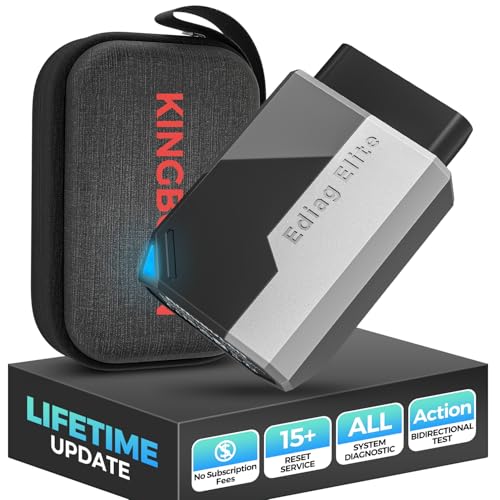
- Obd2 Bluetooth Scanner Lifetime Update: Ediag Elite offers revolutionary Advantage Lifetime Updates with unlimited access to the superior 15 reset service, bidirectional testing and full system diagnostics.The Ediag Elite is an excellent Bluetooth obd2 scanner diagnostic tool ideal for diy's and private car owners
- Bidirectional Control for Quickly Locating Problems: The Bidirectional Scan tool allows you to send commands directly from your smartphone to your vehicle for active testing. This feature helps to quickly narrow down problems such as air conditioning clutches, windows, doors, sunroofs, etc., reducing diagnostic time for mechanics and helping Diy users locate faults more easily. In addition, Ediag Elite provides fault analysis and repair guidance to help you solve problems efficiently.
- 15 Maintenance Resets: The current version introduces 15 popular special features: Oil Reset, Headlight Matching, Bleeding Reset, TPMS Reset, BMS Reset, Gear Box Relearn, Throttle Learning, Injector Coding, SAS Reset and more special functions in system diagnose menu. These functions make it easy for owners to carry out the necessary maintenance and servicing, ensuring that your vehicle stays in top condition, prolonging its service life and preventing common problems and breakdowns. Note: The Special function vary by model& year, Reach us check compatibility.
- Wide Compatibility CANFD & FCA
 Autoauth: Compatible with GM, Ford, Toyota, Chrysler, Honda, Mazda, Nissan, Mitsubishi, Hyundai, KIA with standard OBD2 port from 1996 to newer. More car brands and features will be released gradually. Newest Ediag Elite scanner supports CANFD Protocol and FCA cars. Note: Coverage may vary on different vehicle by model& year ,Please contact us to confirm compatibility before purchase.
 - Perfect for Monitoring The Health of Your Vehicle: Ediag Elite is designed to make vehicle maintenance simple and efficient. With intelligent AutoVIN quick recognition, it is easy to connect to your car without the need for manual input. Real-time data is visualized in a variety of formats, including graphs, numeric, meter displays and clear 4-in-1 data charts, allowing you to effortlessly monitor real-time data. Data logging/reporting is available for playback and further analysis.
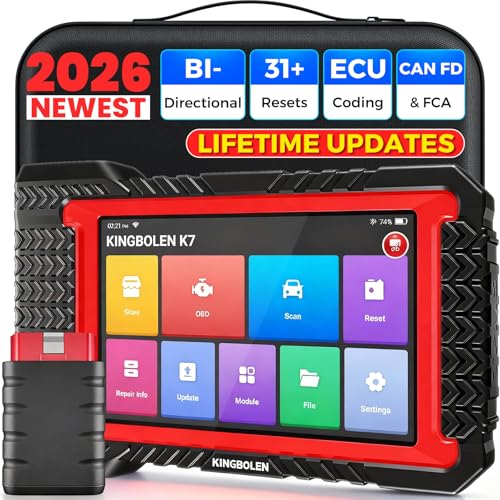
- No Annual Fees & 2026 Upgraded CAN FD: Why pay $199/year or more for updates? The 2026 newest Kingbolen K7 obd2 scanner features have been upgraded to Lifetime Updates without subscription fees, saving you significant costs in the long run. K7 scan tool also adds the CAN FD protocol for the latest GM models (2019+), enabling faster data transfer, reducing the risk of undetected errors
- 2026 Newest Top-tier Car Scanner: Kingbolen K7 diagnostic scan tool is equipped with most capabilities for daily repair/maintenance: Wireless diagnosis via Bluetooth, Bidirectional Test, ECU Online/Offline Code, 31+ Resets, PMI for Ford, Lincoln, Mazda, Global version for 100+ brand vehicles and 17 languages, no area limit, FCA AutoAuth
- OE-Level Full Systems Scan Tool: K7 professional diagnostic scanner with Auto Vin can do one-click to scan ECUs on most of vehicles, like pcm, ecm, eps, bcm, tpms, sas, a/c system... to read/clear code, view live data, freeze frame, read ecu info. 4-in-1 data stream graphics can make data viewing more intuitive. Detailed diagnostic reports will help you easily master the car situation as it can be shared by bluetooth or email! Adding workshop information can help your customers to know more
- Bidirectional Test/Active Test & ECU Code: Stop guessing and start fixing. Bidirectional scan tool Kingbolen K7 can perform real active test that can send commands to the vehicle's ECU to drive the actuators to work, like window, rear mirrors, sunroof, door, solenoids, wipers, headlamp, etc, helping you quickly find out bad parts and pinpoint faulty issues. K7 bidirectional scanner will be a good choice to save money and time on car repairs when performing complex maintenance and repair
- 31 Reset Functions: Avoid expensive dealership visits for simple services. Experience tells us that just a small repair service may cost a lot of money. Kingbolen K7 is a professional diagnostic scanner with 31 common maintenance services like Oil /SAS/EPB/TPMS Reset, Battery Matching, ABS Bleeding, Injector Code, etc. It effectively handles most of the car reset and relearning jobs, perfect for experienced DIYers and mechanics. Note: Functions in the menu vary across vehicles. Kindly check the compatibility before purchase
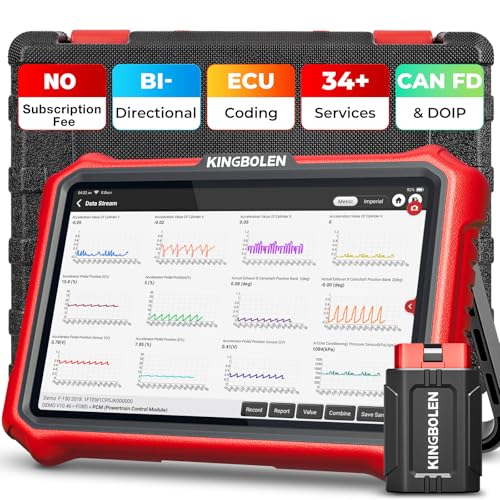
- 【Lifetime Database & Software Updates— No Subscription Fee, No Feature Lock, Save you $399/Y】KINGBOLEN K8 Pro's software can already be permanently upgraded and used for while software of other same price product still needs annual fee of almost $400. K8 pro scanner has packed all capabilities auto technicians would ever need for repair & maintenance services: Added CAN-FD & DOIP protocol, Bluetooth Wireless Diagnosis, Bidirectional Test, ECU Online/Offline Code & Guided Functions for VW, for Audi...34+ Restes, Autoauth for FCA SGW, Larger 4GB+64GB memory, 12600mAh battery, 8'' touch screen with 1280 * 800 Resolution. A Kickstand can allow the tablet to sit at a comfortable angle
- 【Newly Added CAN FD & DOIP Protocol】As Upgrade Version of Kingbolen K8, K8 Pro obd2 scanner supports CANFD and DOIP protocol, which will save you 200+ bucks as no need extra buy for special adapter. CANFD protocol suits for the latest GM(2019-), reducing the risk of undetected errors. The DoIP protocol (comes with DoIp cable) fits for 2017+ BMW(F&G chassis), for Jaguar & Land Rover after 2017, for Volvo after 2018. Plus, K8 Pro's Memory from 2G+32G expanded to 4G+64G, update period extended from 2 years to permanent
- 【34+ Hot Special Functions & V.A.G Guide】KINGBOLEN K8 pro bluetooth obd2 scanner covers almost all common services including Oil Reset, EPB, SAS, BMS Reset, ABS bleed, Throttle Reset, Suspension, Injector Code, Power Balance, Transmission Adaptation, Fuel Trim Learn, HVAC Control Module Calibrate, Language Change, A/F Settings, Stop/Start Reset, Crankshaft Sensor Relearn, TPMS, PMI function and etc. Imagine how much money and time you spend on car maintenance every year? K8 pro car scanner will be a good helper and saver for your car. V.A.G Guided function provides step-by-step guide to work for Volkswagen/Audi/Skoda. Note: Please send us model/year/vin to check compatibility before order
- 【Powerful Bidirectional Test/Active Test & ECU Code】As a bidirectional scan tool, KINGBOLEN K8 pro allows you to request information from a vehicle's ECU or send commands to the vehicle's modules to perform specific tests and functions, such as EVAP Tests, Turn on/off radiator fan, Window/Mirror/Door Lock Test, Pump and Value Tests, Sound horn Test, et. Without using the vehicle control system and dismantling car’s parts, it can quickly and accurately pinpoint the fault causes, simple operation saves time and money
- 【Wireless OE-Level All Systems Diagnostics】Equipped with Bluetooth VCI, you can do car diagnostics out of the car (up to 33F/10M) without being confined to a small space inside the car. Provides the convenience of Auto VIN, K8 pro allowing for easy access and diagnosis of all available modules on a wide range of vehicles, like PCM, ECM, BCM, TPMS, SAS, Fuel System, etc, to perform read/clear codes, view live data, freeze frame, perform active tests, and read ECU info... 12-In-1 Data Stream Graphics make data viewing more intuitive.Diagnostic reports can be shared via QR Code, Bluetooth or email.Built-in Browser and Fault Code Library allows you directly query the fault code when diagnosing
Last update on 2026-06-23 / Affiliate links / Images from Amazon Product Advertising API
This product presentation was made with AAWP plugin.