
NHTSA ID Number: 10176055
Manufacturer Communication Number: Circular93D2REV3
TSB/Document Date: 2020-06-04
Summary
It is possible that the high-voltage battery housing bonded seam was made in a non-optimal position. If this condition is present, moisture can enter the high-voltage battery housing. The driver may be alerted to this condition by the illumination of a high-voltage system warning indicator on the instrument cluster display. Updated claiming and work instructions in the event the coolant expansion tank is damaged.
Brake lines remain in clip .
Move electrical wiring harness clear.
The repair information in this document is intended for use only by skilled technicians who have the proper tools, equipment and training to correctly and safely maintain your vehicle. These
procedures are not intended to be attempted by “do-it-yourselfers,” and you should not assume this document applies to your vehicle, or that your vehicle has the condition described. To
determine whether this information applies, contact an authorized Audi dealer. 2020 Audi of America, Inc. and Audi Canada. All Rights Reserved.
May 2020
93D2 Page 23 of 96
Prepare high-voltage battery for removal (cont.):
Free up fuel lines .
o
Unlock securing tabs and remove
fuel line clips from high-voltage
battery.
o
Remove fuel lines from clips .
Ignore item .
Prepare scissor lift table:
Equip the -VAS6131B- with -VAS6131/10- and
-VAS6131/13- as follows:
Table
Coordinates
Supports from -VAS6131/10- and
-VAS6131/13-
B5
/10-1
/10-2
/10-5
/10-9
F6
/10-1
/10-2
/10-5
/13-2
B12
/10-1
/10-2
/10-5
/10-9
F11
/10-1
/10-2
/10-5
/13-2
Secure the mounting elements to the scissor
lift table by hand.
Position the scissor lift table horizontally and
verify it is level using the bubble gauge.
The repair information in this document is intended for use only by skilled technicians who have the proper tools, equipment and training to correctly and safely maintain your vehicle. These
procedures are not intended to be attempted by “do-it-yourselfers,” and you should not assume this document applies to your vehicle, or that your vehicle has the condition described. To
determine whether this information applies, contact an authorized Audi dealer. 2020 Audi of America, Inc. and Audi Canada. All Rights Reserved.
May 2020
93D2 Page 24 of 96
Position the scissor lift table sideways under the vehicle (at a right angle to direction of travel).
Make sure the threaded spindles are completely screwed in.
Move the -VAS6131B- far enough upward until the mounting elements are positioned just under the highvoltage battery.
Rotate all of the mounting element spindles upward until all the mounting pins come in contact with the
mounting points.
Tighten the mounting element base plates to scissor lift table to 20 Nm.
The repair information in this document is intended for use only by skilled technicians who have the proper tools, equipment and training to correctly and safely maintain your vehicle. These
procedures are not intended to be attempted by “do-it-yourselfers,” and you should not assume this document applies to your vehicle, or that your vehicle has the condition described. To
determine whether this information applies, contact an authorized Audi dealer. 2020 Audi of America, Inc. and Audi Canada. All Rights Reserved.
May 2020
93D2 Page 25 of 96
Remove high-voltage battery from the vehicle:
Remove the bolts .
The bolts have a fastener so that they
cannot fall out.
CAUTION
There Is a Risk of Damaging Lines and Hoses
by Lowering the High-Voltage Battery.
Make sure all connections between the
high-voltage battery and the body have
been disconnected.
Carefully guide the high-voltage battery out
of the body when lowering.
Lower the high-voltage battery using the
scissor lift table.
TIP
The high-voltage battery can be removed from the
-VAS6131B- with the -VAS6100- without having to
change the position of the scissor lift table.
Move the scissor lift table with high-voltage
battery to the cordoned off work area.
TIP
Mark the position of the scissor lift table wheels with
tape or chalk to make installation of the battery
easier.
Proceed to Section C.
The repair information in this document is intended for use only by skilled technicians who have the proper tools, equipment and training to correctly and safely maintain your vehicle. These
procedures are not intended to be attempted by “do-it-yourselfers,” and you should not assume this document applies to your vehicle, or that your vehicle has the condition described. To
determine whether this information applies, contact an authorized Audi dealer. 2020 Audi of America, Inc. and Audi Canada. All Rights Reserved.
May 2020
93D2 Page 26 of 96
Section C – High-voltage Battery Inspection Overview and Documentation
DANGER
High-voltage can cause fatal injury.
Danger of severe or fatal injuries from electric shock.
Wear clothing approved for working with electric arcs.
Wear an insulated helmet with a protective mask.
Wear protective gloves.
Wear safety shoes.
The high-voltage system must be de-energized by a suitably qualified person.
NOTE
The high-voltage battery inspection must be done before AND after the high-voltage battery module group
is removed from the battery housing.
Removal of the battery housing (top section) and battery module group is outlined in Section D.
Examples of evidence of moisture, corrosion and green
discoloration in the high-voltage battery:
The repair information in this document is intended for use only by skilled technicians who have the proper tools, equipment and training to correctly and safely maintain your vehicle. These
procedures are not intended to be attempted by “do-it-yourselfers,” and you should not assume this document applies to your vehicle, or that your vehicle has the condition described. To
determine whether this information applies, contact an authorized Audi dealer. 2020 Audi of America, Inc. and Audi Canada. All Rights Reserved.
May 2020
93D2 Page 27 of 96
The repair information in this document is intended for use only by skilled technicians who have the proper tools, equipment and training to correctly and safely maintain your vehicle. These
procedures are not intended to be attempted by “do-it-yourselfers,” and you should not assume this document applies to your vehicle, or that your vehicle has the condition described. To
determine whether this information applies, contact an authorized Audi dealer. 2020 Audi of America, Inc. and Audi Canada. All Rights Reserved.
May 2020
93D2 Page 28 of 96
The repair information in this document is intended for use only by skilled technicians who have the proper tools, equipment and training to correctly and safely maintain your vehicle. These
procedures are not intended to be attempted by “do-it-yourselfers,” and you should not assume this document applies to your vehicle, or that your vehicle has the condition described. To
determine whether this information applies, contact an authorized Audi dealer. 2020 Audi of America, Inc. and Audi Canada. All Rights Reserved.
May 2020
93D2 Page 29 of 96
Examples of oxidation that may be considered normal:
NOTE
Read the following carefully. Some of these examples may be considered normal oxidation. However, if a
combination of these scenarios is present, the high-voltage battery may require replacement.
Contact Audi Technical Assistance if there are any questions regarding the amount of corrosion/oxidation.
If this level of corrosion (fig. 1) is found only on
the top, the high-voltage battery does not
require replacement.
If this level of corrosion (fig. 1) is found only on
the bottom, the high-voltage battery does not
require replacement.
If this level of corrosion (fig. 1) is found on
both the top AND bottom, follow the
Documentation Requirements and contact
Audi Technical Assistance.
If this level of corrosion (fig. 2) is found only on
the top OR bottom, the high-voltage battery
does not require replacement.
If this level of corrosion (fig. 2) is found on both
the top AND bottom, the high voltage battery
does not require replacement.
If the top of the module has the level of
corrosion shown in (fig. 1) AND the bottom of
the module has the level of corrosion shown in
(fig. 2), the high-voltage battery does not
require replacement.
The repair information in this document is intended for use only by skilled technicians who have the proper tools, equipment and training to correctly and safely maintain your vehicle. These
procedures are not intended to be attempted by “do-it-yourselfers,” and you should not assume this document applies to your vehicle, or that your vehicle has the condition described. To
determine whether this information applies, contact an authorized Audi dealer. 2020 Audi of America, Inc. and Audi Canada. All Rights Reserved.
May 2020
93D2 Page 30 of 96
Documentation Requirements
NOTE
If there are no signs of water, moisture or corrosion, photos must still be uploaded to “doc-it” for documentation
purposed. If the technician does not have access to “doc-it”, they must supply the photos to their warranty
administrator to upload.
High-voltage battery leak test results:
Document results on repair order.
Take clear photos of all six sides of the battery module group and the bottom
section of the lower battery housing and upload photos to “doc-it”.
NO:
Take a clear photo of the low voltage connection inside the battery housing
(bottom section) and upload photo to “doc-it”.
Take a clear photo of the entire battery housing (lower section) and upload
photo to “doc-it”.
High-voltage battery housing requires replacement (outlined in Section D).
Are there signs of
water, moisture or
corrosion inside the
battery?
Audi Technical Assistance WEB contact must be created.
Take clear photos of the component and a close up photo of the corrosion and
attach to the TAC case.
YES:
Take clear photos of all six sides of the high-voltage battery module group and
the battery housing and attach to the TAC case.
If moisture can only be felt, e.g. black mat in the bottom section of the battery
housing is wet/moist, state: “moisture can only be felt, picture not capturing
condition” in TAC case.
Document leak test results in TAC case.
Document insulation test results in TAC case.
The repair information in this document is intended for use only by skilled technicians who have the proper tools, equipment and training to correctly and safely maintain your vehicle. These
procedures are not intended to be attempted by “do-it-yourselfers,” and you should not assume this document applies to your vehicle, or that your vehicle has the condition described. To
determine whether this information applies, contact an authorized Audi dealer. 2020 Audi of America, Inc. and Audi Canada. All Rights Reserved.
May 2020
93D2 Page 31 of 96
Photograph Requirements
NOTE
The follow are examples of how the required photographs should appear.
Photos for EVERY case:
Top and bottom
of battery
module group.
All four sides of
the battery
module group.
Battery housing
(lower section).
Low voltage
connector.
Additional photos if corrosion or moisture is found:
Wide shot of the
component.
Close up of the
condition
(moisture or
corrosion).
The repair information in this document is intended for use only by skilled technicians who have the proper tools, equipment and training to correctly and safely maintain your vehicle. These
procedures are not intended to be attempted by “do-it-yourselfers,” and you should not assume this document applies to your vehicle, or that your vehicle has the condition described. To
determine whether this information applies, contact an authorized Audi dealer. 2020 Audi of America, Inc. and Audi Canada. All Rights Reserved.
May 2020
93D2 Page 32 of 96
Section D – Opening High-voltage Battery Housing
DANGER
High-voltage can cause fatal injury.
Danger of severe or fatal injuries from electric shock.
Wear clothing approved for working with electric arcs (PPE).
Wear an insulated helmet with a protective mask.
Wear protective gloves.
Wear safety shoes.
The high-voltage system must be de-energized by a suitably qualified person.
WARNING
The work must be performed by a high-voltage expert (HVE) who has received additional training.
CAUTION
Risk to health due to toxic dust and liquids.
Never perform work on high-voltage batteries in which a short circuit has occurred.
The high-voltage battery can become extremely hot. This can cause injuries. Take care not to burn your
hands. Wear protective gloves.
CAUTION
Separating battery housing:
Work must be performed by high-voltage expert (HVE).
A second qualified person is required for all work on a high-voltage battery that has been opened.
The second person must not actively work on the high-voltage battery, he/she is present as a safeguard in
the event of an accident.
This section is made up of five sub-sections:
1. Performing High-voltage Battery Leak
Test
2. Removing
High-voltage
Module Group.
3. Preparing New Battery Housing.
4. Reinstalling Battery Module Group
into Battery Housing.
5. Sealing Battery Housing
The repair information in this document is intended for use only by skilled technicians who have the proper tools, equipment and training to correctly and safely maintain your vehicle. These
procedures are not intended to be attempted by “do-it-yourselfers,” and you should not assume this document applies to your vehicle, or that your vehicle has the condition described. To
determine whether this information applies, contact an authorized Audi dealer. 2020 Audi of America, Inc. and Audi Canada. All Rights Reserved.
May 2020
93D2 Page 33 of 96
Moving high-voltage battery off the scissor lift
supports:
Move the high-voltage battery off the scissor
lift supports onto a work bench equipped with
wheels or onto the scissor lift platform.
The high-voltage battery must be placed onto
insulating mat -VAS6762/44-.
Install -T10542/1- and -T10542/4- on the highvoltage battery as shown, align the shackle to
the center of the battery and tighten the
original bolts to 40 Nm.
Secure one -T40155- to both of the left
-T10542/4- and one -T40155- to both right
-T10542/4- as shown.
Bind both -T40155- together over the highvoltage
battery
using
shackle
-VAS691009-.
If corrosion is found (as outlined in Section B) on
the high-voltage battery at any time during
removal:
Refer to the “Documentation Requirements”
above in Section C.
Proceed to Section E.
The repair information in this document is intended for use only by skilled technicians who have the proper tools, equipment and training to correctly and safely maintain your vehicle. These
procedures are not intended to be attempted by “do-it-yourselfers,” and you should not assume this document applies to your vehicle, or that your vehicle has the condition described. To
determine whether this information applies, contact an authorized Audi dealer. 2020 Audi of America, Inc. and Audi Canada. All Rights Reserved.
May 2020
93D2 Page 34 of 96
Subsection 1 – Performing High-voltage Battery Leak Test
Perform HV battery leak test:
Perform tests in the following order:
1. Perform self-test
-VAS6911/3A-1-.
on
Leak
Tester
a. See Appendix C.
2. Perform
high-voltage
battery
acclimatization (pressure equalization)
test.
a. See Appendix D.
3. Perform high-voltage battery pressure
test.
a. See Appendix E.
If the pressure test fails, record the results of
the pressure test.
Subsection 2 – Removing High-voltage Battery Module Group
The work must be performed within the
cordoned off area.
The work requires a second technician AND
BOTH technicians MUST be wearing their
Personal Protective Equipment.
The second technician must not actively work
on the high-voltage battery. They are present
as a safeguard in the event of an accident.
The fasteners must be removed with tools
from the High Voltage Tool Set -VAS6762- and
-VAS691003-.
Remove high-voltage battery housing bolts:
Remove bolts on battery
housing (top section) .
The repair information in this document is intended for use only by skilled technicians who have the proper tools, equipment and training to correctly and safely maintain your vehicle. These
procedures are not intended to be attempted by “do-it-yourselfers,” and you should not assume this document applies to your vehicle, or that your vehicle has the condition described. To
determine whether this information applies, contact an authorized Audi dealer. 2020 Audi of America, Inc. and Audi Canada. All Rights Reserved.
May 2020
93D2 Page 35 of 96
CAUTION
When cutting between bolts and , it
is possible that the cutting tool can go in to
far and make contact with the SX6 ground
wire .

- High density negative paste, improves performance and...
- Enhanced life alloy or Silver Calcium stamped alloy...
- Calcium lead positive grid, maximizes conductivity and...
- Robust envelope separator with puncture resistant back...
- Vent cap design that resists acid leakage


- High density negative paste, improves performance and...
- Enhanced life alloy or Silver Calcium stamped alloy...
- Calcium Lead positive grid, maximizes conductivity and...
- Robust Envelope Separator with puncture-resistant back...
- Vent cap design that resists acid leakage
Last update on 2026-06-29 / Affiliate links / Images from Amazon Product Advertising API
If the PDF is very large, it may not load in the preview below.
Some older TSBs had multiple PDFs — visit the NHTSA Website to view all PDFs.
If the TSB PDF does not show, download or view it on the NHTSA Website.
Click on the (+) Plus Sign
Then Click on Associated Document(s)
Search NHTSA Database for Recalls
Search NHTSA Database for Vehicle Investigations
View Latest Vehicle Investigations
Search NHTSA Database for Vehicle Complaints
View Latest Vehicle Complaints
TSB/Document ID: Circular93D2REV3
Replacement Service Bulletin Number:
MFR Communication Date: 2020-05-20
MFR Internal Campaign ID/Software Version:
Communication Type: Service Bulletin/Repair Instructions
NHTSA Components: ELECTRICAL SYSTEM
MFR Component System:
MFR Component Subsystem:
Previous TSB | Next TSB |

- Stay Updated with Lifetime Access: This obd2 scanner includes lifetime free software updates for all app service functions. With a single payment, enjoy full access to diagnostics, reset tools, and maintenance features — zero subscription fees. A budget-friendly choice for weekend mechanics, home car owners, and DIYers, supporting vehicles from 1996 onward. Come to us with your VIN to check compatibility.
- Full Bidirectional Control/Active Tests & Stable Wireless Connectivity: This car code reader features full bidirectional control, allowing you to send commands to the vehicle's ECU for active tests on components such as fuel pumps, injectors, A/C clutches, windows, sunroofs, and more. This car scanner diagnostic tool helps DIYers quickly diagnose and test vehicle parts, cutting down troubleshooting and repair time. With BT 4.0 wireless connectivity, you can enjoy cable-free diagnostics up to 33 feet. Stand in your garage and test windows, wipers, or even engine components—all without needing to move around your car.
- Portable Car Scanner with 26 Special Functions: Scheduled vehicle maintenance with the A30M car diagnostic scanner can keep your vehicle in peak condition and save you big on dealership trips. The XTOOL A30M obd2 scanner diagnostic tool features essential reset and relearn functions, such as Oil Reset, EPB Reset (Electronic Parking Brake Release), SAS, ABS Brake Bleeding, Throttle Body Relearn, Injector Coding, Crank Sensor Relearn, Headlight Adjustment, and Tire Size Reset. Note: Service functions may vary by vehicle model – check compatibility beforehand!
- Wide Compatibility CAN FD & FCA
 Autoauth: This obd2 scanner diagnostic tool is compatible with over 85+ car brands from the U.S., Europe, and Asia, providing extensive coverage through a BT connection with your smartphone or iPad. Now upgraded to support the latest protocols, it includes FCA AutoAuth access for Chrysler, Jeep, Dodge, and Fiat (2018+), and supports CAN FD for GM (2020+) models, giving you greater access to newer vehicles and systems. Note: The FCA AutoAuth account is not included with the device. Users must register and pay separately through the official FCA AutoAuth website to access diagnostic functions for vehicles that require it.
 - Up to 8 Live Data Streams Graphing – Real-Time Graphing for Deeper Insight: This car scanner supports up to 8 live data streams simultaneously with intuitive, real-time graphing. Gain comprehensive insights into your vehicle’s performance, making it easier to spot issues, detect trends, and make informed diagnostic decisions with confidence.
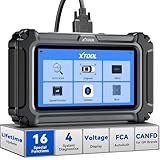
- Comprehensive OBD2 Scanner with 16 Resets: The XTOOL D5S car code reader and vehicle reset tool provides an advanced diagnostic solution with 16 commonly needed reset functions, including Electronic Parking Brake Reset (EPB Reset), SAS, BMS Reset (Battery Test), Throttle Body Relearn, TPMS Reset, ABS Bleeding, Injector Coding, Gearbox Match, Suspension Adjustment, Headlight, Window Initialization, Crank Sensor Relearn and more. Equipped with CAN FD Protocol and FAC AutoAuth, the D5S obd2 scanner diagnostic tool ensures compatibility with a broad range of modern vehicles, allowing users to address common maintenance needs quickly. NOTE: Please Check the Compatibility before ordering.
- 4 Main System Car Scanner & Full OBD2 Diagnostics: The XTOOL D5S car code reader is ideal for home mechanics, DIYers, and professionals, providing access to Transmission/Engine/ABS/SRS systems to read DTCs, Live data can be displayed in text or up to 4 PID data graphs, along with full OBD2 diagnostics to check the engine light on, other obd2 issues and routine maintenance. This car diagnostic scanner ensures you can keep your vehicles in top condition, avoiding costly repairs or unexpected breakdowns. NOTE: Some vehicles display three systems after connection because the transmission and engine of some vehicles are integrated into one.
- Check Engine Code Reader & Real-Time Engine Monitoring: Whether you're a car owner, a DIYer, or run a repair shop, the XTOOL D5S obd2 scanner diagnostic tool makes engine diagnostics fast and frustration-free, reading and explaining trouble codes in seconds—no confusion. Check live data like fuel trim, 02 sensor voltage, RPM, and coolant temp to pinpoint mis~fires, rough idle, or sensor issues. After repairs, simply use the D5S check engine code reader and reset tool to turn off the check engine light and confirm the problem’s fixed—saving time, money, and unnecessary shop visits. - Note: If the check engine light comes back on, it indicates the original problem still exists.
- Portable Car Scanner for ABS and SRS: XTOOL D5S gives you peace of mind when ABS or airbag warning lights come on. It reads and clears ABS codes to help you fix brake sensor, traction control, or wheel speed issues, and supports ABS bleeding after repairs like caliper or master cylinder replacement. For airbag systems, it scans and clears SRS codes related to airbags, seatbelt tensioners, and crash sensors. Whether you're doing repairs at home or running a small shop, the D5S is a cost-effective solution for safety diagnostics. Note: If a fault code returns after clearing, it usually means the issue hasn’t been fully resolved. Please check the compatibility before ordering.
- Transmission Warning Light ON? Here’s the Transmission Diagnostic and Reset Tool You Need: The XTOOL D5S is more than just a basic car scanner—it’s an easy-to-use transmission diagnostic tool. From rough shifts to slipping gears, the D5S lets you read and clear transmission trouble codes, monitor real-time TCM data, and perform transmission resets after fluid changes or repairs. Whether you’re a hands-on car owner or a pro running a busy shop, this OBD2 scanner with transmission functions helps you catch problems early—saving you time, money, and future headaches.. Note: Clearing fault codes is equivalent to a reset on some vehicles, but not all. For help, contact XTOOL Tech Support.
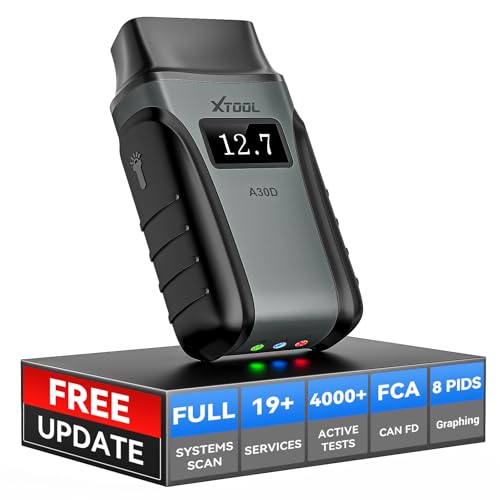
- Save $500+/Year with Pro-Level Diagnostics -No Subscriptions: The Portable XTOOL Anyscan A30D OBD2 scanner diagnostic tool includes free lifetime software updates for all app service functions, without extra cost. With a single payment, enjoy full access to diagnostics, relearn scan tools, and maintenance features. A cost-effective, smart choice for car owners and DIY enthusiasts, compatible with vehicles from 1996 onward. Please provide the car VIN and the special functions you need in advance so that we can confirm compatibility
- Bi-Directional Control for Faster Troubleshooting: Unlike a basic code reader, the A30D bi directional scan tool sends commands directly to your vehicle’s ECU to actively test components like fuel pump, valves, wipers, windows, doors, sunroof, and headlamps right from your smartphone. See component responses in real time without disassembly—perfect for brake jobs, electrical issues, and hard-to-find problems. This bidirectional obd2 scanner helps pinpoint faults faster, reduce guesswork, and avoid replacing good parts. An efficient, easy-to-use car scanner diagnostic tool built for DIYers, home garage users, and small-shop technicians who want real two-way scanner, not just codes
- 19 Reset Functions for Routine Maintenance: The A30D car diagnostic scanner provides 19 relearn functions without extra charges, including EPB Reset for parking brake replacement, TPMS Reset after tire changes, ABS Auto Bleeding, Oil Reset, SAS Reset, BMS Reset, Throttle Relearn, Injector C0ding, Gear Learning, Crank/Crankshaft/Cam/Ckp Sensor Relearn Tool, Transmission Match, Seat Calibration, Airbag Repair and more. This XTOOL A30D automotive scanner diagnostic tool supports preventive care, helping extend vehicle life and reduce costly shop visits. Functions vary by vehicle make and year—plz confirm compatibility before purchase
- Stable BT Connection & All-System & 8 Pids Live Data: The A30D wireless OBD2 scanner delivers a fast and stable wireless connection up to 33 feet, letting you move freely around the vehicle without tangled cables. Pair with with Android 9.0+ and iOS 10.0+ devices to turn your phone into a mobile auto scanner—perfect for home garages, driveways, or on-the-spot repairs. This full system scanner for cars provides real-time access to all major modules, including Engine, Gearbox, ABS, SRS, AC and more. with clear graphs, meters, and up to 8 PIDs displayed at once. This car code reader makes system monitoring visual, simple, easy to understand, and offering data logging for playback and deeper
- Wide Compatibility with CAN-FD & FCA Support: The A30D car computer diagnostic reader works with most 1996 and newer vehicles with a standard OBD2 port, including for Ford, for GM, for Toyota, for Honda, for Nissan,for Hyundai etc, with ongoing updates covering more car models and functions later. It also supports newer communication protocols like CAN-FD and FCA AutoAuth (Personal AutoAuth account and active subscription required, not included with the device!for Chrysler, for Dodge, for Jeep, for Fiat models). It is a future-ready automotive scanner diagnostic tool for households with multiple vehicles or part-time techs. Coverage vary by cars, plz check the compatibility first
Last update on 2026-06-23 / Affiliate links / Images from Amazon Product Advertising API
This product presentation was made with AAWP plugin.