NHTSA ID Number: 10054690
Manufacturer Communication Number: SU-1315
TSB/Document Date: 2014-02-18
Summary
BLUE BIRD (CUMMINS ): UPDATED INFORMATION BEING PROVIDED REGARDING THE FLEETGUARD FLEETCOOL EX COOLANT TO BE USED IN BLUE BIRD BUSES WITH CUMMINS ENGINE AND DECALS ON OR NEAR DEAERATION TANK FILLER TO STATE THE TYPE OF COOLANT FACTORY HAD INSTALLED. MODEL VISION, ALL AMERICAN. NO YEARS LISTED. *PE
measurements. Test strips, although less accurate than a refractometer, will also
provide an indication of freeze protection and additive levels. See Section 6 Coolant Testing for further information and test strip part numbers.
Test the coolant every 240,000 km [150,000 mi], 4000 hours or once per year,
whichever occurs first, to determine if it must be replaced. See Section 6 - Coolant
Testing for further information and test strip part numbers.
Replace the coolant only if the replacement limits are exceeded.
SCA Levels
Test the SCA level a minimum of twice a year.
If the SCA concentration level is between 0.3 and 1.3 units/liter [1.2 and 5.0 units
per gal], either install a chemical filter containing the appropriate dosage of SCA or
add the equivalent liquid SCA dosage and install a chemical free filter. For large
cooling systems, it can be necessary to replenish SCA with both a chemical filter
and liquid SCA.
If the SCA concentration level is less than 0.3 units/liter [1.2 units per gal], add 0.15
liters [5 ounces] of Fleetguard® DCA4 or Fleetcool liquid per 3.8 liters [1 gal] of
cooling system capacity and install a chemical filter.
If the SCA concentration level is greater than 1.3 units/liter [5.0 units per gal], install
a chemical free filter. Do not install a chemical coolant filter or add liquid
Extender/SCA. Test the SCA level at each successive oil change. When SCA units
drop below 1.3 units per liter [5.0 units per gal], resume installing chemical filters or
using the equivalent liquid SCA dosage and installing chemical free filters.
Consult Cummins® Filtration Technical Assistance for detailed Fleetguard® product
information and assistance at 800-223-4583 or www.Cumminsfiltration.com.
Section 3 - Extended Service Interval
This section covers the requirements for coolant products that provide extended service
maintenance intervals.
Extended service interval coolant is defined as a coolant capable of a minimum general
routine service interval of 240,000 km [150,000 mi], 4000 hours, or 1 year, whichever
occurs first. It must be noted that organic acid technology (OAT) coolants are generally
capable of extended service intervals ranging from 500,000 km to 1,000,000 km [300,000
mi to 600,000 mi] or 6000 hours to 7000 hours. Follow maintenance guidelines
recommended by the coolant manufacturer.
Successful usage of extended service interval products will be possible only if a
systematic approach to coolant maintenance is followed by the user. This means using the
extended service interval system of coolant products for all coolant maintenance at the
fleet shop as well as on the road. Use of the proper coolant is vital for successful extended
service interval maintenance. If control of top-off can not be accomplished, do not
consider extended service and use the standard service interval as described in Section 2.
Coolant must meet the requirements stated in this section.
It is preferred and recommended for all Cummins® engines to top off only with fully
formulated coolants which meet Cummins Engineering Standard 14603. See Attachment 2
for more information on Cummins Engineering Standard 14603. However, MidRange
products, including any Cummins® engine displacing less than 10 liters [610 C.I.D.], may
top off with fully formulated coolants meeting a minimum requirement of ASTM D6210.
Cummins Inc. recommends Fleetguard® Antifreeze Coolants including ES Compleat
containing DCA4 Plus, Fleetcool EX containing DCA2 Plus, and ES Compleat organic acid
technology (OAT), which meet the requirements of Cummins Engineering Standard 14603.
Cummins® Engines That are Using Chevron® Texaco™
or Shell™ Rotella™ Extended Life Coolant (TELC) Plus
Silicates
OAT coolants, such as Chevron® Texaco™, Shell™ Rotella™ or their private label
counterparts, which do not meet the elastomer compatibility section of Cummins
Engineering Standard (CES) 14603, are acceptable for extended service interval use in
Heavy-Duty and High Horsepower engines if the initial coolant fill requirements were met
by the vehicles' original equipment manufacturer (OEM), (including the addition of
silicates). See Cummins AEB 90.47 which can be accessed on
http://www.gce.cummins.com. All midrange engines are TELC compatible without the
addition of silicates.
Heavy-Duty and High Horsepower engines requiring overhauls or repairs involving the
replacement of the following components that are using OAT coolants not meeting CES
14603, must discard the original coolant and replace with new.
Rocker lever housing
Oil cooler housing
Cylinder head gasket
Thermostat housing gasket
Oil cooler cover gasket
V cavity gasket
If the replacement coolant is Chevron® Texaco™, Shell™ Rotella™ or their private label
counterparts, which do not meet the elastomer compatibility section of CES 14603, the
coolant must be treated by adding 0.24 liter [8 oz] of liquid silicate fluid for every 45 liters
[12 gal] of total coolant system volume. It is critical to not over treat the coolant with
silicate fluid. If over-treatment is suspected, drain the cooling system and discard the filter.
Clean the cooling system immediately. Symptoms of silicate over-treatment can be
thickened coolant in the lower radiator tank, water pump seal leakage soon after silicate
addition, reduced heater output and/or elevated engine temperatures. Use Fleetguard®
Restore™ Cooling System Cleaner at the rate of 3.8 liters [1 gal] per 38 to 45 liters [10 to
12 gal] of water. Do not use Restore with normal engine coolant.
To obtain order forms or ask questions relative to ordering the silicate fluid:
Phone: 800-346-9041
Fax: 800-876-5317
Mail To:
Silicate Fluid Order Program
P.O. Box 27388
Houston, TX 77227-7388
Extended Service Maintenance
Fill the cooling system with premixed fully formulated coolant or with a 50/50
mixture of high-quality water (see Section 9 - Water Quality Requirements) and fully
formulated concentrated antifreeze. The fully formulated coolant or antifreeze,
either ethylene glycol or propylene glycol, must meet Cummins Engineering
Standard 14603. Cummins Inc. recommends using Fleetguard® ES™ Compleat.
Some extended service interval systems do not require the initial use of an
Extender additive in liquid form or from a slow-release filter. In these systems, the
antifreeze/coolant must provide cavitation-corrosion (liner-pitting) protection
through the use of the liner-pitting protection additives in the concentrations listed in
Table 2. Extender/Extended Service Additive is then added at each extended
service interval.
Table 2 - Liner Pitting Protection Additive Levels
Required at Initial System Fill
NOTE: Some OAT coolants do not need nitrite and or molybdate for liner pitting.
Additive
Premixed
Antifreeze/
Type of Coolant
(See
Coolant (ppm)
Additive
Note 1)
Minimum Nitrite (measured as NO2)
Minimum Levels of Nitrite (measured as NO2) and
Molybdate (measured as MoO4)
2000 ppm
1300 ppm (See Note
2)
DCA2
DCA4
NOTE: 1: Concentrated antifreeze/coolant levels are double the premixed levels.
NOTE: 2: A combination of nitrite (NO2) and molybdate (MoO4) can not contain less
than 500 ppm of either additive
NOTE: 3: Some OAT coolants use high levels of organic acids for liner pitting
protection and do not use nitrite and or molybdate.
Top off the cooling system as needed using only fully formulated antifreeze/coolant
meeting Cummins Engineering Standard 14603.
The coolant must be tested twice per year for freeze protection and additive levels.
A Refractometer provides the most accurate freeze protection measurements. Test
strips, although less accurate than a refractometer, will also provide an indication of
freeze protection and additive levels. See Section 6 - Coolant Testing for further
information and test strip part numbers.
After 240,000 km [150,000 mi], 4000 hours, or 1 year, whichever occurs first, do the
following:
Change the coolant filter(s). The coolant filter must meet Cummins Engineering
Standard 14315.
Replenish depleted coolant additives either by using slow-release ES™ chemical
filter or adding ES™ Extender liquid. Larger cooling systems may require the use of
a chemical filter in conjunction with liquid additive. See the remainder of this section
for filter and liquid part numbers.
Test the coolant to determine if it must be replaced. See Section 6- Coolant Testing
for further information and test strip part numbers.
Replace the coolant only if the replacement limits are exceeded.
Extender/Extended Service Additive Levels
Test the SCA level a minimum of twice a year.
Target 0.6 units/liter [2.5 units/gal] in coolant solutions of 40 to 60 percent antifreeze
concentrations.
If the SCA concentration level is between 0.3 and 1.3 units/liter [1.2 and 5.0 units
per gal], either install a chemical filter containing the appropriate dosage of
Extended Service Additive or add the equivalent liquid Extended Service Additive
dosage and install a chemical free filter. For large cooling systems, it can be
necessary to replenish SCA with both an Extended Service Additive chemical filter
and liquid Extended Service Additive.
If the SCA concentration level is less than 0.3 units/liter [1.2 units per gal], add 0.15
liters [5 ounces] of Fleetguard® Extender liquid Extended Service Additive per
gallon of cooling system capacity and install a chemical filter.
If the SCA concentration level is greater than 1.3 units/liter [5.0 units per gal], install
a chemical free filter. Do not install a chemical coolant filter or add liquid
Extender/Extended Service Additive. Test the SCA level at each successive oil
change. When SCA units drop below 1.3 units per liter [5.0 units per gal], resume
installing chemical filters or using the equivalent liquid Extended Service Additive
dosage and installing chemical free filters.
Consult Cummins® Filtration Technical Assistance for detailed Fleetguard® product
information and assistance at 800-223-4583 or www.Cumminsfiltration.com.
Some OAT coolants use high levels of organic acids for liner pitting protection and
do not use nitrite and or molybdate. Therefore, these coolants do not have SCA
numbers.
Extender Requirements
CAUTION
Extenders used in extended service interval systems are not fully formulated and must not
be used in treated water coolants. Their usage can result in engine damage. See Section
8.
The Extender replaces the additives in the coolant that are lost due to depletion. It can be
added as a liquid directly to the coolant or as a solid contained in a coolant filter.
Cummins Inc. recommends using a Fleetguard® ES™ slow release filter or ES™ Extender
liquid.
Performance Requirements
The Extender must contain sufficient liner-pitting additives to increase the levels of nitrite
or nitrite plus molybdate in the engine coolant by the following amounts:
At least 800 ppm (0.8 units per gallon) of nitrite (NO2)
Or a combined total of at least 520 ppm (0.8 units per gallon) of nitrite (NO 2) and
molybdate (MoO4).
A combination of nitrite and molybdate can not contain less than 200 ppm of either
additive.
Storage Stability
Liquid Extenders typically have a shelf life of at least 2 years from the time of manufacture
when stored at temperatures ranging from -7° to 55°C [19° to 131°F].
Solid material, liquid turbidity, or layering at the top of the liquid is allowed if it will dissolve
and disperse by stirring the solution and warming it to a temperature between 2° to 67°C
[36° to 153°F].
Solid, slurry, and paste forms of Extender must dissolve completely in hot engine coolant.
They must be formulated and packaged to prevent chemical or physical change during
storage temperatures ranging from -7° to 55°C [19° to 131°F] regardless of humidity.
Consult Cummins® Filtration Technical Assistance for detailed Fleetguard® product
information and assistance at 800-223-4583 or www.cumminsfiltration.com.
Section 4 - Unacceptable Maintenance Practices for
Cooling Systems
WARNING
All diesel engines with wet liners are subject to liner pitting if the cooling system is not
correctly maintained. Underconcentration (below 0.3 units per liter [1.2 units per gal] of
Extended Service Additive/SCA results in liner cavitation and possible engine failure.
Overconcentration (above 1.3 units per liter [5.0 units per gal] of additives) or the use of
high-silicate antifreeze can result in silicate gelation or water pump seal leakage.
NOTE: Some OAT coolants use high levels of organic acids for liner pitting
protection and do not use nitrite and or molybdate. Therefore, these coolants do not
have SCA numbers.
Unacceptable Practices - The following practices are considered unacceptable and may
lead to engine failure.
Use of high-silicate antifreeze.
Underconcentration or overconcentration of Extended Service Additive/SCAs.
Use of antifreezes/coolants that are not fully formulated for extended service
intervals (for instance, GM 6038M or ASTM D4985 antifreeze).
Use of soluble oils in the cooling system.
Use of poor-quality water. See Section 9 for water quality requirements.
Use of antifreeze, Extended Service Additive/SCA or coolant filter(s) that do not
meet the specifications indicated in this Service Bulletin.
Use of Treated Water coolant with EGR engines.
Use of coolants with less than 40 percent antifreeze for EGR engines.
Use of coolants with less than 25 percent antifreeze for marine engines.
Section 5 - Recommended Maintenance Practices for
Cooling Systems of A, B, and F Series Engines
The A and B Series engines normally do not require Extender/SCA because they do not
normally experience cylinder bore/liner cavitation corrosion. Also, the A and B Series
engines do not have an integral coolant filter.
Coolant maintenance requirements for the Cummins® B series engines depend on the
application.
Light duty applications can use coolant meeting ASTM D3306 and follow the maintenance
schedule in the appropriate Owners manual. However, if ASTM D3306 antifreeze is used,
it must additionally meet the elastomer capability section of Cummins Engineering
Standard 14603.
Use of fully formulated antifreeze/coolant in this engine is acceptable but not required. If
fully formulated antifreeze/coolant is used, it must meet a minimum requirement of ASTM
D6210.
The F-Series engines must use coolant meeting ASTM D3306, except North America
Industrial F-Series which may also use coolant meeting ASTM D6210. The F-Series must
follow the maintenance schedule in the appropriate Owners or Operation and Maintenance
Manual.
Section 6 - Coolant Testing
Coolant testing is required for two reasons:
1. To determine the additive concentration and glycol level of the coolant. This will
make sure that adequate liner pitting protection and freeze point protection are
achieved.
2. To determine if the coolant must be replaced due to contamination.
Coolant testing for additive and glycol levels must be performed at least twice a year. The
coolant must also be tested for replacement limits every 240,000 km [150,000 mi], 4000
hours, or once a year, whichever occurs first.
Additive and glycol testing is also recommended when the following occur:
Coolant loss between test intervals exceeds 10 to 15 percent of system capacity
Water pump seal, radiator core, or other external leakage is apparent
Anytime the coolant condition is unknown, or corrosion is apparent within the
cooling system
Anytime a cooling system component is repaired or replaced.
Coolant Replacement Limits
Table 3 below lists the limits for various coolant contaminants.
Table 3 - Coolant Replacement Limits
Contaminant
Allowable Level
Sulfate (SO4)
1500 ppm, maximum
Chloride (Cl) Fluoride, Bromide
200 ppm, maximum
Coolant must not contain oil or fuel
pH
6.5, minimum (See Note 1)
Grease, solder bloom, silica gel, rust, or
scaling
Coolant must be free of these
contaminants
The minimum pH for a replacement limit can vary according to the product. Consult
the product manufacturer for the pH limit. A pH less than 6.5 is always
unacceptable. For Fleetguard® ES™ Compleat™ coolant, the coolant must be
replaced if the pH is below 7.5 pH.
Bromide is typically a contaminant from radiator flux and fluoride is a contaminant from
brazing flux. Both bromide and fluoride are corrosive especially to aluminum parts.
If the coolant does not meet the replacement limits of sulfate, chloride, or pH, it must be
drained and replaced with new coolant meeting Cummins Engineering Standard 14603.
However, if the coolant is contaminated with oil, fuel, grease, solder bloom, silica gel, rust,
or scaling, the system must be drained, cleaned, and refilled. See Section 11 for details
on cleaning the cooling system.
Coolant Testing Kits
Coolant testing and monitoring are useful tools for tracking and controlling coolant
condition and performance. The methods available for testing coolants include field test
kits, portable refractometers, and coolant analysis programs. Cummins Inc. recommends
using the following Fleetguard® products:
Coolant Additive and Glycol level testing:
Three-Way™ Heavy Duty Coolant Test Kits
Part Number
Quantity
Foil Sealed
CC2602
50
No
CC2602A
4
Yes
CC2602B
100
Yes
Coolant testing for contamination/replacement limits:
Quick-Chek™ Test Kits
Part Number
Quantity
Foil Sealed
CC2607B
100
Yes
CC2607C
25
Yes
Coolant Freeze Point Testing
SMALL | MEDIUM | LARGE
Refractometer, Part Number CC2806
For use with ethylene and propylene glycol coolants only.
SMALL | MEDIUM | LARGE
Refractometer, Part Number CC36049
For use with glycerin coolant only.
Coolant analysis program.
Monitor C™ program, part number CC2700
The Three-Way™ heavy duty coolant field test kit is appropriate for testing nitritemolybdate formulations, such as Fleetguard® DCA-4 as well as nitrite formulations such
as Fleetguard® DCA2 (Fleetcool).
Fleetguard® Quik-Chek™ test strips will detect contamination levels that indicate
replacement of the coolant is required.
The Monitor C™ program can evaluate most new or used coolant formulations.
Field test kits offer the benefit of on-site measurements and are designed to approximate
Extender/SCA levels and freezing points. When required, freezing points can be more
accurately determined with on-site refractometer readings.
When using the Fleetguard® Three-Way™ heavy duty coolant test kit, it is important to
follow the instructions provided in the kit. Contact Cummins® Filtration Technical
Assistance at 800-223-4583 or www.Cumminsfiltration.com for additional information.
Because the kit measures nitrite and molybdate separately, it can reliably measure both
Fleetguard® SCA formulations as well as most competitive SCA formulations. Cummins
Inc. recommendation for a nitrite-molybdate formulation for pitting protection is explained
in Attachment 1 - Summary of Coolant Additive Technology.
CAUTION
These types of SCA kits are NOT effective on OAT coolants that are not formulated with
nitrite and/or molybdate. Some coolant manufacturers of the OAT coolants have
developed specific test kits for these types of coolants. Follow the coolant manufacturers'
instructions for coolant testing on OAT coolants.
Correct interpretation of laboratory data can provide additional guidance in coolant
treatment effectiveness and early warning detection. Interpretation and further treatment
action(s) are generally provided with laboratory results. Therefore, laboratory testing is
typically very cost effective for the long term when used to optimize cooling system
performance and life. However, it must not be used as a method for minimizing treatment.
Coolant analysis programs are performed in laboratories and offer additional, useful
information, but require mailing coolant samples to a laboratory. Laboratory measurements
typically include the following:
pH level
Extender/SCA level
Freezing point protection
Buffer level
Dissolved solids
Silicate level
Metal corrosion products.
See Attachment 3 for a sample Monitor C™ report.
Section 7 - Antifreeze
The primary purpose of antifreeze is to lower the freezing point of the coolant. Additional
performance characteristics of coolants that are affected by the use of antifreeze include
boiling point and vapor pressure. Antifreeze decreases vapor pressure, which is very
beneficial to the reduction of cavitation corrosion liner pitting. This characteristic is the
primary basis for Cummins Inc. requirement for increased SCA levels when antifreeze falls
below 40 percent by volume.
A 50/50 mixture of antifreeze and water provides optimum boiling and freezing point
protection for engines. An antifreeze concentration in excess of 60 percent must never be
used, except in arctic climates, since it increases the possibility of forming cooling system
gel, which results as silicates precipitate out of solution. However, an antifreeze
concentration of less than 40 percent increases the possibility of coolant freezing and liner
pitting. Therefore, Cummins Inc. recommends an antifreeze concentration range of 40 to
60 percent.
Fluids presently used in antifreeze are ethylene glycol, propylene glycol and glycerin.
Diesel engine antifreeze has primarily used ethylene glycol products because they are less
expensive than propylene glycol products. However, some applications require less toxic
coolant products and have driven the use of propylene glycol. The comparative properties
are similar for ethylene glycol and propylene glycol and are listed below. Properties of pure
water are shown for comparison. Properties of glycerin are similar to that of propylene
glycol. Glycerin is also non-toxic. Its properties are also in the table below.
Table 4 - Properties of Ethylene Glycol, Propylene
Glycol, and Glycerin Antifreeze versus Water
Property
Glycerin
(percent by

- Unsurpassed freeze protection and anti-boil performance...
- Organic acid technology resists rust, scale & corrosion...
- High-quality additives protect against leaks and won’t...
- Pre-mixed orange formula is ready-to-use in a 50/50 ratio...
- 5 year/150,000 mile guarantee protects against engine...

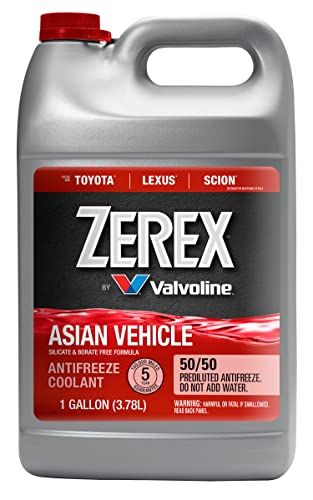
- Formulated to replace the OEM fluid in Asian make vehicles...
- 5 year/150, 000 mile . Silicate-free, long-life, phosphate...
- The long life formula provides protection for all cooling...
- Meets the following OEM and industry specifications: JIS K...
- Note: Please check the vehicle specification before...
Last update on 2026-06-23 / Affiliate links / Images from Amazon Product Advertising API
If the PDF is very large, it may not load in the preview below.
Some older TSBs had multiple PDFs — visit the NHTSA Website to view all PDFs.
If the TSB PDF does not show, download or view it on the NHTSA Website.
Click on the (+) Plus Sign
Then Click on Associated Document(s)
Search NHTSA Database for Recalls
Search NHTSA Database for Vehicle Investigations
View Latest Vehicle Investigations
Search NHTSA Database for Vehicle Complaints
View Latest Vehicle Complaints
TSB/Document ID: SU-1315
Replacement Service Bulletin Number:
MFR Communication Date: 2013-07-29
MFR Internal Campaign ID/Software Version:
Communication Type: Service Bulletin/Repair Instructions
NHTSA Components: ENGINE
MFR Component System:
MFR Component Subsystem:
Previous TSB | Next TSB |
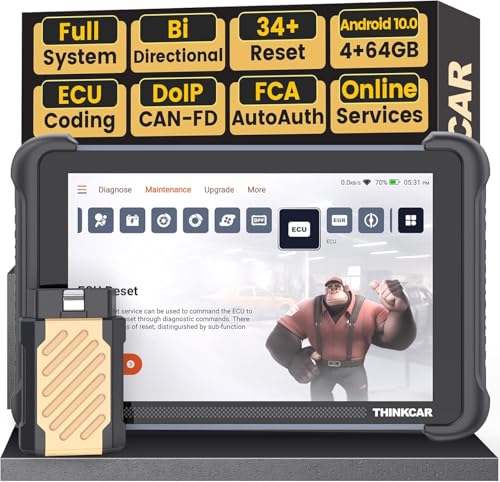
- [Notice] When you receive a used device, it may be a customer return resold by Amazon without inspection. You can exchange it for a new one through Amazon. As this situation is unavoidable, we sincerely apologize. For any issues, contacting us via Amazon's "Messages" is the best way. THINKSCAN 689BT Bidirectional Scan Tool Can Be Used Immediately After It is Turned On, Without Complicated Registration Process, Which is More Convenient & Quick.
- Full Bi-Directional Control & 3000+ Active Tests: Take control and test components like actuators, fuel injectors, relays, and cooling fans in real time. You’ll quickly see if the problem is in the part itself or the control module — saving you hours of guesswork and frustrating trial-and-error.
- Advanced ECU Coding Capabilities: Handle module matching and hidden feature activation with confidence. When you replace an ECU or want to customize settings, this obd2 scanner diagnostic bi directional tool gives you the professional-level capabilities you need without the dealership price tag.
- 34+ Useful Reset and Maintenance Functions: Complete everyday service tasks smoothly with a wide range of helpful reset and maintenance functions. Whether you’re keeping up with regular upkeep or tackling a specific job, this scanner makes maintenance simpler and less stressful for both DIYers and pros.
- Comprehensive Full System Diagnostics: Diagnose every major system — Engine, Transmission, ABS, SRS, TPMS, and more — all in one place. Finally stop wondering if you’re missing something important; get the full picture and clear codes with ease.
Last update on 2026-07-02 / Affiliate links / Images from Amazon Product Advertising API
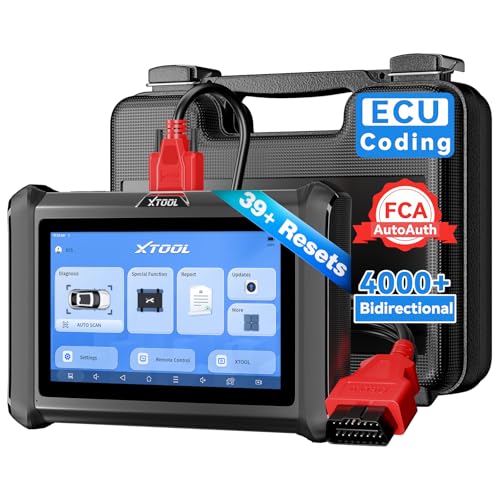
- Top Reasons to Choose the D7S OBD2 Scanner: XTOOL D7S car scan tool, an upgrade of XTOOL D7, offers comprehensive features for automotive technicians, workshops, and DIY enthusiasts 1. Upgraded Hardware: 2+64GB memory, rear camera, intuitive interface, foldable bracket 2. Complete Diagnostics: FCA
 Autoauth, OE-level all system scan, 39+ maintenance services, 4K+ bidirectional, CANFD/DoIP protocol 3. Advanced Capabilities: ECU c0ding, PMI functions 4. Wide Compatibility: Support 10,000+ models, covering 99% vehicle brands 5. Multi-language: Available in 22+ languages, No IP Restrictions 6. 3-Year Updates: Save 300 bucks on software updates for the latest features and optimizations
 - 2026 Upgraded D7S Car Scanner Features: The newly 2026 D7S V2.0 scanner for car brings exciting features for advanced vehicle diagnostics and enhanced user experience 1. FCA AutoAuth: Now supports FCA SGW module for Chrysler, for Jeep, for Dodge (2018+), for Fiat (2017+), enabling faster vehicle communication without gateway restrictions 2. PMI (Offline ECU Pr0gramming): Allows for Ford, for Lincoln, and for Mazda ECU pr0gramming for new modules 3. Optimized Diagnostic Report 2.0: Personalized reports with logos and customer info for auto shops. Note: Compatibility varies by cars, please check before order
- 39+ Services/Resets/Adaptations/Relearns/Calibrations: XTOOL D7S full system car scanner diagnostic tool tackles 99% of common car issues through its 36+ special functions, including Oil Reset, EPB, SAS, BMS, Throttle Reset, Injector C0ding, ABS Bleed, TPMS Reset, Power Balance, etc and also covers specific-vehicle functions like Crank Sensor Relearn, ABS Initialization, Cylinder Power Balance, Fuel Trim Reset, Idle Relearn etc. This car diagnostic scanner enhances efficiency, making repairs and maintenance hassle-free. Tip: DO NOT for All vehicles, please check compatibility first
- Cost-effective ECU C0ding Scan Tool for Specific Brands: Enhance your vehicle's performance with XTOOL D7S! This obd2 scanner all systems bidirectional offers advanced capabilities at an affordable price, supports online for BMW, for Benz and offline for BENZ, for MIT, along with PMI functions for Ford, for Mazda, and for Lincoln. Ideal for technicians and DIY enthusiasts, this automotive scanner diagnostic tool optimizes vehicle performance and enhances the driving experience. Note: Not for all cars and modules, please send car VIN to check the compatibility before purchase
- OE All System Diagnostic & 8 Pids Graphing: XTOOL D7S is a comprehensive all system bi directional obd2 scanner that delivers dealer-level diagnostics, completely controlling over your vehicle’s performance and health. This automotive scan tool can read and clear DTCs, view live data and ECU information, retrieve freeze frames, and perform active tests and full obd2 functions. This bi-directional scan tool can can identify your vehicle's make, model, and year information with just one click and show up to 8 PIDs live data with options for CSV viewing, playback, and recording for in-depth analysis. It is easy-to-use for both professionals and beginners, helping pinpoint issues efficiently
Last update on 2026-06-30 / Affiliate links / Images from Amazon Product Advertising API
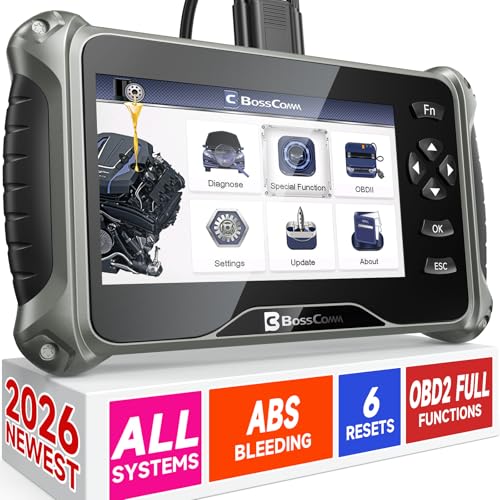
- 【✅Compared to BOSSCOMM IF742, IF745 Offers Full-System Diagnostics】The BOSSCOMM IF745 car diagnostic scanner is an upgraded model of IF742. In addition to supporting all OBD2 Code Reader functions and 6 reset options (ABS/EPB/SAS/BMS/Oil/Throttle), it expands diagnostics from 4 systems (Check Engine/ABS/SRS/Transmission) to vehicle All systems, including Steering, Suspension, and Body Electronics. This provides deeper, more comprehensive diagnostic capabilities.
- 【✨10 OBD2 Functions】The BOSSCOMM IF745 scan tool’s DTC Lookup instantly translates fault codes into user-friendly explanations, its I/M Readiness feature streamlines emissions testing with a single tap, and Freeze Frame lets you pinpoint the exact moment of a fault for in-depth root-cause diagnosis. Combined with a live data dashboard and advanced diagnostics (O2S, OBMon, EVAP), it delivers comprehensive insights for confident troubleshooting.
- 【✨Deep Diagnostics for All Vehicle System Modules】Beyond code reading/clearing and ECU information retrieval, our all-in-one data stream feature lets you inspect all current fault codes and their locations across the vehicle’s systems. This vehicle code reader helps you turn off dashboard warning lights and perform a comprehensive self-check of your car at home—no more back-and-forth trips to the repair shop or hefty inspection fees.
- 【✨6 Essential Resets: ABS Bleeding, Oil, EPB, SAS, Throttle, BMS】The BOSSCOMM IF745 obd2 scanner diagnostic tool swiftly purges air from brake lines to restore braking sensitivity, fine-tunes maintenance cycles to eliminate false alerts, resolves parking brake issues with one-click control, recalibrates steering sensors for stability, optimizes engine idling/acceleration for smoother performance, and deeply resets battery systems to extend lifespan and range via precise parameter adjustments.❗NOTE: Does NOT support bidirectional control, coding, or programming.
- 【✨10,000+ Car Models, AutoVIN, 13 Languages】The BOSSCOMM IF745 vehicle scanner diagnostic tool covers 73+ global car brands and offers support in 13 languages, making it perfect for DIYers, auto mechanics, or as a thoughtful gift. With a single-click AutoVIN feature, it instantly retrieves vehicle serial numbers, streamlining diagnostics for users globally. This adaptable tool balances user-friendliness with precision, catering to both personal and professional requirements.✅Unsure about compatibility? Compatibility will vary on vehicles' model and year, pls reach us via 📧 [email protected] 📧 before purchase.
Last update on 2026-07-02 / Affiliate links / Images from Amazon Product Advertising API
This product presentation was made with AAWP plugin.