
NHTSA ID Number: 10253770
Manufacturer Communication Number: 00-03-10-006P
TSB/Document Date: 2024-05-01
Summary
This service bulletin provides information for dealers/technicians on Tire Radial Force Variation (RFV).
Bulletin No.: 00-03-10-006P
Service Bulletin
Date: April, 2024
INFORMATION
Subject:
Information on Tire Radial Force Variation (RFV)
Models:
2024 and Prior GM Passenger Cars and Light Duty Trucks
Attention:
This bulletin also applies to any of the above models that may be Export
from North America vehicles.
This bulletin has been revised to add 2023-2024 Model Years. Please discard Corporate
Bulletin Number 00-03-10-006O.
Important:
• Before measuring tires on GM approved tire force
variation measurement equipment, the vehicle
MUST be driven a minimum of 24 km (15 mi) to
ensure removal of any flat-spotting. Refer to the
latest version of Corporate Bulletin Number
03-03-10-007: Tire/Wheel Characteristics of GM
Original Equipment Tires.
• GM approved tire force variation measurement
equipment MUST be calibrated prior to measuring
tire/wheel assemblies for each vehicle.
Note: If the equipment being used is capable of
performing a centering check, the centering check
must be completed before taking measurements of
balance or RFV.
The purpose of this bulletin is to provide guidance to
GM dealers when using GM approved tire force
variation measurement equipment. This type of
equipment can be a valuable tool in diagnosing vehicle
ride concerns. The most common ride concern
involving tire radial force variation is highway speed
(105-115 km/h (65-70 mph) shake on smooth roads.
Tire related smooth road highway speed shake can be
caused by three conditions: imbalance, out of round
and tire force variation. These three conditions are not
necessarily related. All three conditions must be
addressed.
Imbalance is normally addressed first, because it is the
simplest of the three to correct. Off-vehicle, two plane
dynamic wheel balancers are readily available and can
accurately correct imbalance. Balancer calibration and
maintenance, proper attachment of the wheel to the
balancer, and proper balance weights, are all factors
required for a quality balance. However, a perfectly
balanced tire/wheel assembly can still be “oval
shaped” and cause a vibration.
Copyright 2024 General Motors . All Rights Reserved.
Before balancing, perform the following procedures.
Tire and Wheel Diagnosis
1. Set the tire pressure to the placard values.
2. With the vehicle raised, ensure the wheels are
centered on the hub by loosening all wheel nuts
and hand-tightening all nuts first by hand while
shaking the wheel, then torque to specifications
using a torque wrench, NOT a torque stick.
3. Visually inspect the tires and the wheels. Inspect
for evidence of the following conditions and correct
as necessary:
• Missing balance weights
• Bent rim flange
• Irregular tire wear
• Incomplete bead seating
• Tire irregularities (including pressure settings)
• Mud/ice build-up in wheel
• Stones in the tire tread
• Remove any aftermarket wheels and/or tires and
restore vehicle to original condition prior to
diagnosing a smooth road shake condition.
4. Road test the vehicle using the PicoScope
(CH-51450) essential tool. Drive within posted
speed limits at 105-115 km/h (65-70 mph) for a
sufficient distance on a known, smooth road
surface to duplicate the condition. Determine if the
vehicle is sensitive to brake apply. If the brakes
are applied lightly and the pulsation felt in the
steering wheel increases, refer to the Brakes
section of the service manual that deals with
brake-induced pulsation. If you can start to hear
the vibration as a low boom noise (in addition to
feeling it), but cannot see it, the vehicle likely has
Page 2
April, 2024
a first order (one pulse per propshaft revolution)
driveline vibration. Driveline first order vibrations
are high enough in frequency that most humans
can start to hear them at highway speeds, but are
too high to be able to be easily seen. These issues
can be caused by driveline imbalance or
misalignment. If the vehicle exhibits this low boom
and the booming pulses in-and-out on a regular
basis (like a throbbing), chances are good that the
vehicle could have driveline vibration. This type of
vibration is normally felt more in the “seat of the
pants” than the steering wheel.
5. Next, record the Hertz (Hz) reading as displayed
by the PicoScope onto the tire data worksheet
found at the end of this bulletin. This should be
done after a tire break-in period of at least 24 km
(15 mi) at 72 km/h (45 mph) or greater, in order to
eliminate any possible tire flat-spotting. This
reading confirms what the vehicle vibration
frequency is prior to vehicle service and
documents the amount of improvement occurring
as the result of the various steps taken to repair.
Completing the Steering Wheel Shake Worksheet
below is required. A copy of the completed
worksheet must be saved with the R.O. and a
copy included with any parts returned to the
Warranty Parts Center for analysis. A reading of
35 to 50 Hz typically indicates a first order
propshaft vibration. Generally, a reading between
10 and 20 Hz indicates a tire/wheel vibration and if
this is the reading obtained, continue using this
bulletin.
If the tire 1st order vibration goes away and stays
away during this evaluation, the cause is likely
temporary tire flat-spotting. Tire flat-spotting
vibration may come and go at any speed over 72
km/h (45 mph) during the first 10 minutes of
operation, if vibration continues after 10 minutes of
driving at speeds greater than 72 km/h (45 mph),
temporary tire flat-spotting can be ruled out as the
cause for vibration.
6. If permanent flat-spotting is the cause, provide the
explanation that this is the nature of the tire if the
vehicle is parked for long periods of time. Refer to
the latest version of Corporate Bulletin Number
03-03-10-007: Information on Tire/Wheel Characteristics (Vibration, Balance, Shake, Flat Spotting)
of GM Original Equipment Tires.
7. If the road test indicates a shake/vibration exists,
check the imbalance of each tire/wheel assembly
on a known, calibrated, off-car dynamic balancer.
Make sure the mounting surface of the wheel
and the surface of the balancer are absolutely
clean and free of debris. Be sure to choose the
proper cone/collet for the wheel, and always
use the pilot bore for centering. Never center
the wheel using the hub-cap bore since it is
Bulletin No.: 00-03-10-006P
not a precision machined surface. Perform the
centering check if the equipment is capable of a
centering check. If any assembly calls for more
than ¼ ounce on either rim flange, remove all
balance weights and rebalance to as close to zero
as possible. If you can see the vibration (along
with feeling it) in the steering wheel (driving
straight without your hands on the wheel), it is very
likely to be a tire/wheel first order (one pulse per
revolution) disturbance. First order disturbances
can be caused by imbalance as well as nonuniformities in tires, wheels, or hubs. This first
order frequency is too low for a human to hear, but
if the amplitude is high enough, it can be seen.
If a vibration or shake still exists after balancing, any
out of round conditions, of the wheel, and force
variation conditions of the tire, must be addressed. GM
approved tire force variation measurement equipment
can address both (it is also a wheel balancer).
Tire radial force vibration (RFV) can be defined as the
amount of stiffness variation the tire will produce in one
revolution under a constant load. Radial force variation
is what the vehicle feels because the load (weight) of
the vehicle is always on the tires. Although free runout
of tires (not under load) is not always a good indicator
of a smooth ride, it is critical that total tire/wheel
assembly runout be within specification.
Tire force variation measurement equipment loads the
tire, similar to on the vehicle, and measures radial
force variation of the tire/wheel assembly. Note that the
wheel is affecting the tire's RFV measurement at this
point. To isolate the wheel, its runout must be
measured. This can be easily done on GM approved
tire force variation measurement equipment, without
the need to set up dial indicators. If the wheel meets
the runout specification, the tire's RFV can then be
addressed.
After measuring the tire/wheel assembly under load,
and the wheel alone, the machine then calculates
(predicts) the radial force variation of the tire. However,
because this is a prediction that can include mounting
inaccuracies, and the load wheel is much smaller in
diameter than used in tire production, this type of
service equipment should NOT be used to audit new
tires. Rather, it should be used as a service diagnostic
tool to minimize radial force variation of the tire/wheel
assembly.
GM approved tire force variation measurement
equipment does an excellent job of measuring wheel
runout, and of finding the low point of the wheel (for
runout) and the high point of the tire (for radial force
variation). This allows the tire to be matched mounted
to the wheel for lowest tire/wheel assembly force
variation.
Bulletin No.: 00-03-10-006P
April, 2024
The machine will simplify this process into easy steps.
The following assembly radial force variation numbers
should be used as a guide:
P-Metric tires of passenger
cars
18 lbs (8 kg) or less
P-Metric tires on light trucks
24 lbs (11 kg) or less
LT-tires on light trucks
35 lbs (16 kg) or less
When measuring RFV and match mounting tires
perform the following steps.
Measuring Wheel Runout and Assembly Radial
Force Variation/180 Matching Procedure (Hunter)
Important: The completed worksheet at the end of this
bulletin must be attached to the hard copy of the repair
order.
• Measure radial force variation and radial runout.
• If a road force/balancing machine is used, record
the radial force variation (RFV) on the worksheet
at the end of this bulletin. It may be of benefit to
have the lowest RFV assembly to the front left
corner. If the machine is not available and the
PicoScope data suggests there is an issue, swap
the tire and wheel assemblies from the front to the
back. Re-check on the PicoScope and if the
problem still exists, test another vehicle to find
assemblies that do not exhibit the same frequency.
If the subject vehicle exhibits vibration in the seat,
then swap only the rear assemblies and see if the
problem continues. If the subject vehicle exhibits
vibration in the steering wheel, swap only the front
assemblies and see if the problem continues. If
the subject vehicle continues to vibrate after
swapping two assemblies then swap all four. If the
vibration still exists, continue below.
Page 3
• If a runout/balancing machine is used, record the
radial runout of the tire/wheel assemblies on the
worksheet at the end of this bulletin. If one or more
of the tire/wheel assemblies are more than 0.040
in (1.02 mm), match mount the tire to the wheel to
get below 0.040 in (1.02 mm). For sensitive
customers, readings of 0.030 inch (0.76 mm) or
less are preferable, it may also be of benefit to
have the lowest runout assembly to the front left
corner. If the machine is not available and the
PicoScope data suggests there is an issue, swap
the tire and wheel assemblies from the front to the
back. Re-check on the PicoScope and if the
problem still exists, test another vehicle to find
tires that do not exhibit the same frequency and
swap those tires onto the subject vehicle.
Specification – Guideline
Aluminum Wheel/Tire Runouts on vehicle (max.
0.030 in (.762 mm))
Hub Mounting surface runouts (max. 0.005 in
(0.132 mm))
Wheel stud runouts (max. 0.010 in (0.254 mm))
• After match mounting, the tire/wheel assembly
must be rebalanced.
Note: Flangeless wheels are commonly used today
and the runout cannot be measured accurately with the
tire on the wheel. There is no machined surface on the
outside of the wheel like on the flanged wheel so for an
accurate runout measurement, the wheel should be
dismounted and a reading should be taken on the
inner bead seat area of the wheel or the (Hunter) 180
Matching procedure can be used (see below). The
runout spec is the same as a flanged wheel.
Page 4
April, 2024
Bulletin No.: 00-03-10-006P
4540628
(1) Flangeless Rim
(2) Flanged Rim
Hunter 180 Matching Procedure (this information can
also be found in the Hunter manual for your machine):
180 Matching with Flangeless Wheels (Hunter
machine)
On flangeless wheels, the 180 Matching procedure can
be used when using a Hunter 3rd, 4th or 5th generation machine. This can be used with the tire still on
the wheel.
4540494
• 180 Matching will minimize Road Force® in the
tire and wheel assembly. It requires a tire changer,
as the tire will be repositioned about the wheel
during the procedure. The 180 Matching
Bulletin No.: 00-03-10-006P
April, 2024
Page 5
procedure can be launched by touching the
RoadForce® button, then Procedure and then 180
Matching buttons.
4540495
There is a progress bar at the top of the screen to
show how far along the procedure has progressed.
1. Mount the assembly on the balancer.
2. Set the tire pressure to the vehicle manufacturer’s
specification.
3. Lower the hood to start the Road Force®
measurement.
4. Position the valve stem at 12:00 and touch “Enter
Valve Stem.”
5. Mark the tire with a piece of chalk or a marker with
a “V” opposite the valve stem as indicated. Touch
“OK” or tap the foot pedal when completed.
6. Use a tire changer and rotate the rim 180 degrees
relative to the tire, aligning the “V” mark with the
valve stem. Mount the assembly on the balancer.
Position valve stem at 12:00 and press “Enter
Valve Stem.”
7. Lower the hood to start the Road Force®
measurement.
8. After the final spin is completed, make marks on
the tire and rim as shown on screen and ForceMatch® the assembly.
If match mounting tires to in-spec wheels produces
assembly values higher than these, tire replacement
may be necessary. Replacing tires at lower values will
probably mean good tires are being condemned.
Because tires can sometimes become temporarily flatspotted, which will affect force variation, it is important
that the vehicle be driven at least 24 km (15 mi) at 89
km (55 mph) or more prior to measuring. Tire pressure
must also be adjusted to the usage pressure on the
vehicle's tire placard prior to measuring.
Most GM vehicles will tolerate radial force variation up
to these levels. However, some vehicles are more
sensitive, and may require lower levels. Also, there are
other tire parameters that GM approved tire force
variation measurement equipment cannot measure
that may be a factor. In such cases, TAC should be
contacted for further instructions.
Page 6
April, 2024
Important:
• When mounting a GM wheel to a wheel balancer/
force variation machine, always use the wheel's
center pilot hole. This is the primary centering
mechanism on all GM wheels; the bolt holes are
secondary. Usually a back cone method to the
machine should be used. For added accuracy and
repeatability, a flange plate should be used to
clamp the wheel onto the cone and machine. This
system is offered by all balancer manufacturers in
GM's dealer program.
Bulletin No.: 00-03-10-006P
Steering Wheel Shake Worksheet
When diagnosing vibration concerns, use the following
worksheet in conjunction with the appropriate Vibration
Analysis-Road testing procedure in the Vibration
Correction sub-section in SI.
Refer to the appropriate section of SI for specifications
and repair procedures that are related to the vibration
concern.
• Any type of service equipment that removes tread
rubber by grinding, buffing, or truing is NOT
recommended, and may void the tire warranty.
However, tires may have been ground by the tire
company as part of their tire manufacturing
process. This is a legitimate procedure.
• If the equipment being used is capable of
performing a centering check, the centering check
must be completed before taking measurements
of balance or RFV.
Steering Wheel Shake Worksheet
To:
Dealer:
Fax Number:
VIN__ __ __ __ __ __ __ __ __ __ __ __ __ __ __ __ __
Procedure Performed By:
Date:
Model:
Year:
Odometer:
VIN __ __ __ __ __ __ __ __ __ __ __ __ __ __ __ __ __
TAC Case #, if applicable:
Conditions During Road Test Procedures
As condition occurs: Engine RPM_____________
Vehicle Speed__________________
Vibration/Noise detected during the following road test procedures:
Engine RPM_______________ Vehicle Speed_______________
Slow Acceleration Test: Yes__________ No__________
Neutral Coast-Down Test: Yes__________ No__________
Downshift Test: Yes__________ No__________
Neutral Run-Up Test: Yes__________ No__________
Steering Input Test: Yes__________ No__________
When using the PicoScope, always take a snapshot. This will help determine which vibration shows up the most.
Important: Vibrate software can also be used to assist in vibration diagnosis. Refer to Vibrate Software Description and Operation in SI.
Vibration Analyzer Readings
Refer to Electronic Vibration Analyzer (EVA) Description and Operation in SI for more detailed information.
Important: As a reminder, place the PicoScope sensor where the vibration is mostly felt. Ensure the word “UP” on the sensor is
physically facing up. The typical areas are the seat track, the steering column or the instrument panel. Locating the PicoScope
sensor on additional area (i.e. the right fender, left fender, right quarter panel, left quarter panel, rear seat track, etc.) may also
assist in determining the component causing the vibration/noise. The key is to look for the same Hz reading with the greatest
amplitude G readings.
FILL OUT ONLY THE APPLICABLE PORTION OF THE WORKSHEET THAT APPLIES TO THE VIBRATION/NOISE:
Sensor at Steering Column:
1st Line MPH/KPH:__________ HZ:__________ Gs:__________
Bulletin No.: 00-03-10-006P
April, 2024
Page 7
Steering Wheel Shake Worksheet
2nd Line MPH/KPH:__________ HZ:__________ Gs:__________
Sensor at Roof:
1st Line MPH/KPH:__________ HZ:__________ Gs:__________
2nd Line MPH/KPH:__________ HZ:__________ Gs:__________
Sensor at Passenger Seat Rail:
1st Line MPH/KPH:__________ HZ:__________ Gs:__________
2nd Line MPH/KPH:__________ HZ:__________ Gs:__________
Tire Size and Brand:_____________________________________
Aluminum Wheel/Tire Runouts on vehicle (max. 0.030 in (.762 mm))
Refer to the latest version of Corporate Bulletin Number 00-03-10-006 for tire radial force variation. Right rear: Inner
lateral:__________ Center radial:__________
Left rear: Inner lateral:__________ Center radial:__________
Right front: Inner lateral:__________ Center radial:__________
Left front: Inner lateral:__________ Center radial:__________
Hub Mounting surface runouts (max. 0.005 in (0.132 mm))
Flange, right rear:__________ Hub, right front:__________
Flange, left rear:__________ Hub, left front:__________
Wheel stud runouts (max. 0.010 in (0.254 mm))
Flange, right rear:__________ Hub, right front:__________
Flange, left rear:__________ Hub, left front:__________
List Additional Repairs, If Applicable
___________________________________________________________________________________________________
___________________________________________________________________________________________________
GM bulletins are intended for use by professional technicians, NOT a "do-it-yourselfer". They are written to inform these
technicians of conditions that may occur on some vehicles, or to provide information that could assist in the proper
service of a vehicle. Properly trained technicians have the equipment, tools, safety instructions, and know-how to do a job
properly and safely. If a condition is described, DO NOT assume that the bulletin applies to your vehicle, or that your
vehicle will have that condition. See your GM dealer for information on whether your vehicle may benefit from the
information.
WE SUPPORT VOLUNTARY
TECHNICIAN
CERTIFICATION
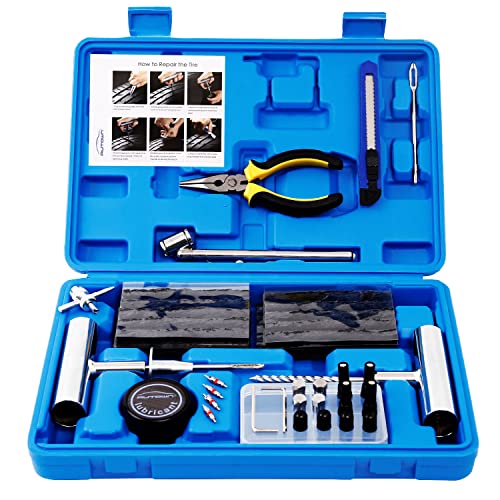

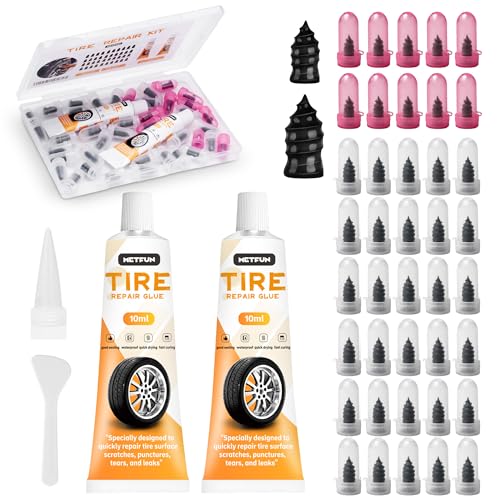
- 【Perfect Emergency Repair Solution】This kit includes...
- 【Premium Materials for Safe Repairs】Our tire screw plugs...
- 【2 Sizes for Every Puncture】Choose the right size for...
- 【5-Minute DIY Repair】Skip the auto shop and fix flats...
- 【Emergency-Ready Design】Compact & ready for...
Last update on 2026-06-23 / Affiliate links / Images from Amazon Product Advertising API
If the PDF is very large, it may not load in the preview below.
Some older TSBs had multiple PDFs — visit the NHTSA Website to view all PDFs.
If the TSB PDF does not show, download or view it on the NHTSA Website.
Click on the (+) Plus Sign
Then Click on Associated Document(s)
Search NHTSA Database for Recalls
Search NHTSA Database for Vehicle Investigations
View Latest Vehicle Investigations
Search NHTSA Database for Vehicle Complaints
View Latest Vehicle Complaints
TSB/Document ID: 00-03-10-006P
Replacement Service Bulletin Number:
MFR Communication Date: 2024-04-18
MFR Internal Campaign ID/Software Version:
Communication Type: Service Bulletin/Repair Instructions
NHTSA Components: WHEELS
MFR Component System:
MFR Component Subsystem:
Previous TSB | Next TSB |
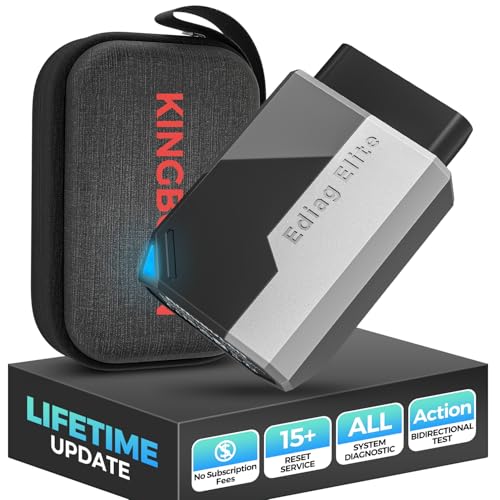
- Obd2 Bluetooth Scanner Lifetime Update: Ediag Elite offers revolutionary Advantage Lifetime Updates with unlimited access to the superior 15 reset service, bidirectional testing and full system diagnostics.The Ediag Elite is an excellent Bluetooth obd2 scanner diagnostic tool ideal for diy's and private car owners
- Bidirectional Control for Quickly Locating Problems: The Bidirectional Scan tool allows you to send commands directly from your smartphone to your vehicle for active testing. This feature helps to quickly narrow down problems such as air conditioning clutches, windows, doors, sunroofs, etc., reducing diagnostic time for mechanics and helping Diy users locate faults more easily. In addition, Ediag Elite provides fault analysis and repair guidance to help you solve problems efficiently.
- 15 Maintenance Resets: The current version introduces 15 popular special features: Oil Reset, Headlight Matching, Bleeding Reset, TPMS Reset, BMS Reset, Gear Box Relearn, Throttle Learning, Injector Coding, SAS Reset and more special functions in system diagnose menu. These functions make it easy for owners to carry out the necessary maintenance and servicing, ensuring that your vehicle stays in top condition, prolonging its service life and preventing common problems and breakdowns. Note: The Special function vary by model& year, Reach us check compatibility.
- Wide Compatibility CANFD & FCA
 Autoauth: Compatible with GM, Ford, Toyota, Chrysler, Honda, Mazda, Nissan, Mitsubishi, Hyundai, KIA with standard OBD2 port from 1996 to newer. More car brands and features will be released gradually. Newest Ediag Elite scanner supports CANFD Protocol and FCA cars. Note: Coverage may vary on different vehicle by model& year ,Please contact us to confirm compatibility before purchase.
 - Perfect for Monitoring The Health of Your Vehicle: Ediag Elite is designed to make vehicle maintenance simple and efficient. With intelligent AutoVIN quick recognition, it is easy to connect to your car without the need for manual input. Real-time data is visualized in a variety of formats, including graphs, numeric, meter displays and clear 4-in-1 data charts, allowing you to effortlessly monitor real-time data. Data logging/reporting is available for playback and further analysis.
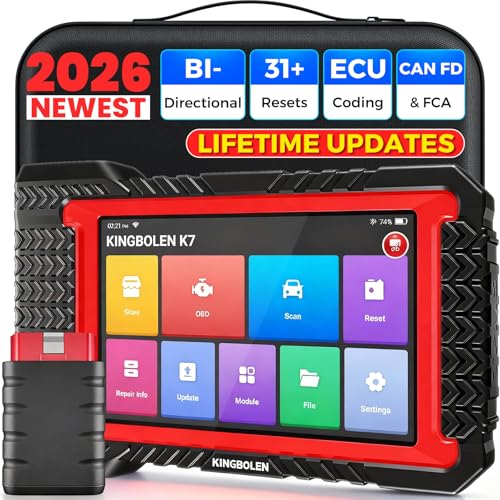
- No Annual Fees & 2026 Upgraded CAN FD: Why pay $199/year or more for updates? The 2026 newest Kingbolen K7 obd2 scanner features have been upgraded to Lifetime Updates without subscription fees, saving you significant costs in the long run. K7 scan tool also adds the CAN FD protocol for the latest GM models (2019+), enabling faster data transfer, reducing the risk of undetected errors
- 2026 Newest Top-tier Car Scanner: Kingbolen K7 diagnostic scan tool is equipped with most capabilities for daily repair/maintenance: Wireless diagnosis via Bluetooth, Bidirectional Test, ECU Online/Offline Code, 31+ Resets, PMI for Ford, Lincoln, Mazda, Global version for 100+ brand vehicles and 17 languages, no area limit, FCA AutoAuth
- OE-Level Full Systems Scan Tool: K7 professional diagnostic scanner with Auto Vin can do one-click to scan ECUs on most of vehicles, like pcm, ecm, eps, bcm, tpms, sas, a/c system... to read/clear code, view live data, freeze frame, read ecu info. 4-in-1 data stream graphics can make data viewing more intuitive. Detailed diagnostic reports will help you easily master the car situation as it can be shared by bluetooth or email! Adding workshop information can help your customers to know more
- Bidirectional Test/Active Test & ECU Code: Stop guessing and start fixing. Bidirectional scan tool Kingbolen K7 can perform real active test that can send commands to the vehicle's ECU to drive the actuators to work, like window, rear mirrors, sunroof, door, solenoids, wipers, headlamp, etc, helping you quickly find out bad parts and pinpoint faulty issues. K7 bidirectional scanner will be a good choice to save money and time on car repairs when performing complex maintenance and repair
- 31 Reset Functions: Avoid expensive dealership visits for simple services. Experience tells us that just a small repair service may cost a lot of money. Kingbolen K7 is a professional diagnostic scanner with 31 common maintenance services like Oil /SAS/EPB/TPMS Reset, Battery Matching, ABS Bleeding, Injector Code, etc. It effectively handles most of the car reset and relearning jobs, perfect for experienced DIYers and mechanics. Note: Functions in the menu vary across vehicles. Kindly check the compatibility before purchase
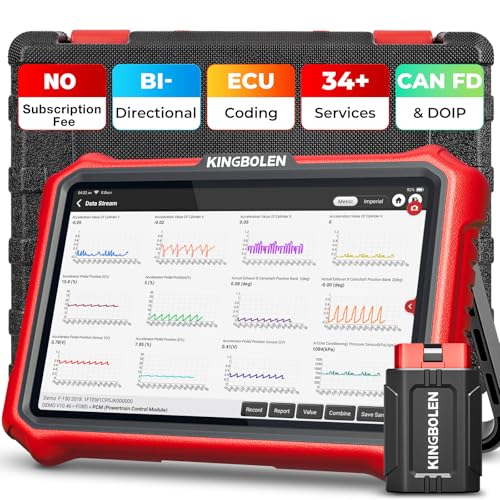
- 【Lifetime Database & Software Updates— No Subscription Fee, No Feature Lock, Save you $399/Y】KINGBOLEN K8 Pro's software can already be permanently upgraded and used for while software of other same price product still needs annual fee of almost $400. K8 pro scanner has packed all capabilities auto technicians would ever need for repair & maintenance services: Added CAN-FD & DOIP protocol, Bluetooth Wireless Diagnosis, Bidirectional Test, ECU Online/Offline Code & Guided Functions for VW, for Audi...34+ Restes, Autoauth for FCA SGW, Larger 4GB+64GB memory, 12600mAh battery, 8'' touch screen with 1280 * 800 Resolution. A Kickstand can allow the tablet to sit at a comfortable angle
- 【Newly Added CAN FD & DOIP Protocol】As Upgrade Version of Kingbolen K8, K8 Pro obd2 scanner supports CANFD and DOIP protocol, which will save you 200+ bucks as no need extra buy for special adapter. CANFD protocol suits for the latest GM(2019-), reducing the risk of undetected errors. The DoIP protocol (comes with DoIp cable) fits for 2017+ BMW(F&G chassis), for Jaguar & Land Rover after 2017, for Volvo after 2018. Plus, K8 Pro's Memory from 2G+32G expanded to 4G+64G, update period extended from 2 years to permanent
- 【34+ Hot Special Functions & V.A.G Guide】KINGBOLEN K8 pro bluetooth obd2 scanner covers almost all common services including Oil Reset, EPB, SAS, BMS Reset, ABS bleed, Throttle Reset, Suspension, Injector Code, Power Balance, Transmission Adaptation, Fuel Trim Learn, HVAC Control Module Calibrate, Language Change, A/F Settings, Stop/Start Reset, Crankshaft Sensor Relearn, TPMS, PMI function and etc. Imagine how much money and time you spend on car maintenance every year? K8 pro car scanner will be a good helper and saver for your car. V.A.G Guided function provides step-by-step guide to work for Volkswagen/Audi/Skoda. Note: Please send us model/year/vin to check compatibility before order
- 【Powerful Bidirectional Test/Active Test & ECU Code】As a bidirectional scan tool, KINGBOLEN K8 pro allows you to request information from a vehicle's ECU or send commands to the vehicle's modules to perform specific tests and functions, such as EVAP Tests, Turn on/off radiator fan, Window/Mirror/Door Lock Test, Pump and Value Tests, Sound horn Test, et. Without using the vehicle control system and dismantling car’s parts, it can quickly and accurately pinpoint the fault causes, simple operation saves time and money
- 【Wireless OE-Level All Systems Diagnostics】Equipped with Bluetooth VCI, you can do car diagnostics out of the car (up to 33F/10M) without being confined to a small space inside the car. Provides the convenience of Auto VIN, K8 pro allowing for easy access and diagnosis of all available modules on a wide range of vehicles, like PCM, ECM, BCM, TPMS, SAS, Fuel System, etc, to perform read/clear codes, view live data, freeze frame, perform active tests, and read ECU info... 12-In-1 Data Stream Graphics make data viewing more intuitive.Diagnostic reports can be shared via QR Code, Bluetooth or email.Built-in Browser and Fault Code Library allows you directly query the fault code when diagnosing
Last update on 2026-06-23 / Affiliate links / Images from Amazon Product Advertising API
This product presentation was made with AAWP plugin.