
NHTSA ID Number: 10249630
Manufacturer Communication Number: A23-050
TSB/Document Date: 2024-02-03
Summary
Service Bulletin - Customers have complained that the air conditioning system is not blowing cold air due to Oil/Refrigerant leaking from the A/C compressor shaft seal.
If the PDF is very large, it may not load in the preview below.
Some older TSBs had multiple PDFs — visit the NHTSA Website to view all PDFs.
If the TSB PDF does not show, download or view it on the NHTSA Website.
Click on the (+) Plus Sign
Then Click on Associated Document(s)


- ENGINEERED R134a REPLACEMENT - HIGH-EFFICIENCY FORMULATION...
- PREMIUM HIGH-PURITY SPECIFICATION (99.5%+) - Manufactured to...
- SIGNIFICANTLY LOWER CHARGE WEIGHT REQUIRED- Hydrocarbon...
- DESIGNED FOR CONSISTENT, EFFICIENT COOLING PERFORMANCE...
- PROFESSIONAL-STYLE SELF-SEALING VALVE- 6 oz net cans feature...
This product presentation was made with AAWP plugin.
Search NHTSA Database for Recalls
Search NHTSA Database for Vehicle Investigations
View Latest Vehicle Investigations
Search NHTSA Database for Vehicle Complaints
View Latest Vehicle Complaints
TSB/Document ID: A23-050
Replacement Service Bulletin Number:
MFR Communication Date: 2024-01-24
MFR Internal Campaign ID/Software Version:
Communication Type: Service Bulletin/Repair Instructions
NHTSA Components: VISIBILITY
MFR Component System:
MFR Component Subsystem:
Previous TSB | Next TSB |
Service Bulletin
January 24, 2024
23-050
Version 2
A/C Compressor Shaft Seal Leak
Supersedes 23-050, dated June 30,2023, to update the information.
AFFECTED VEHICLES
Year
Model
VIN Range
2019–20
Pilot
Elite, Touring, Black
ALL
2021
Pilot
ALL
ALL
2019–21
Passport
ALL
ALL
2020–21
Ridgeline
ALL
ALL
REVISION SUMMARY
•
There are extensive updates and American Honda recommends you review the entire bulletin.
•
TOOLS INFORMATION had critical information change, as highlighted in yellow.
SYMPTOM
Customer complaint of the A/C not blowing cold air.
POSSIBLE CAUSE
Oil/Refrigerant leak from the A/C compressor shaft seal.
CORRECTIVE ACTION
Do the inspection procedure and, if directed, replace the compressor shaft seal.
PARTS INFORMATION
Part Name
Part Number
Quantity
Seal Set Assembly (Kit Contains: Bolt, Washer Set, Pulley
C-Ring, Felt Washer, Shaft Seal, Seal C-Ring, Suction Port
Plug, Discharge Port Plug)
38918-64A-318
1
Discharge Hose O-Ring (1/2”)
80872-SN7-003
1
Suction Hose O-Ring (5/8”)
80871-SN7-003
1
CUSTOMER INFORMATION: The information in this bulletin is intended for use only by skilled technicians who have the proper tools, equipment,
and training to correctly and safely maintain your vehicle. These procedures should not be attempted by “do-it-yourselfers,” and you should not
assume this bulletin applies to your vehicle, or that your vehicle has the condition described. To determine whether this information applies, contact
an authorized Honda automobile dealer.
© 2024 American Honda Motor Co., Inc. – All Rights Reserved
Page 1 of 26
REQUIRED MATERIALS
Part Name
Part Number
Quantity
POE Compressor Oil
38899-RLV-A01
1
RB100EV Oil
38899-64A-A02
1
NOTE: POE Compressor Oil will be phased out and unavailable once RB100EV arrives in domestic inventory.
TOOL INFORMATION
Part Name
Part Number
Quantity
07AAC-5AAA100
1
07AAG-5AAA101
1
07AAE-5AAA101
1
7CVC Seal Press
07AAD-5J6A100
1
The above tools were auto-shipped to dealers in June 2023. For support or replacements, please contact Special Tools
Hotline at (800) 346-6327.
WARRANTY CLAIM INFORMATION
Operation
Number
Description
Flat Rate
Time
614130
Replace the A/C
compressor shaft seal
(includes inspection).
2.3 hr
620025
Evacuate and recharge
0.7 hr
Defect
Code
07408
Symptom
Code
03217
Template
ID
A23050A
Failed Part Number
38810-5J6-A22
Page 2 of 26
INSPECTION PROCEDURE
1. Remove the right-front tire.
2. Remove the engine Undercover.
3. Remove the drive belt.
Page 3 of 26
4. Inspect for oil on the armature plate surface of the compressor.
NOTE: If any oil is stuck to the armature plate surface of the compressor, then proceed to the repair procedure.
Page 4 of 26
5. If no oil is noticed, leave the compressor on the vehicle. Remove the center hub bolt while holding the armature plate
with the A/C clutch holder and remove the armature plate from the compressor. Then inspect both for oil.
NOTE:
•
•
If oil is present on the hub/armature plate, then proceed to the repair procedure.
If no oil is present, then proceed to step 6.
Examples of dry and oily clutch assemblies.
Page 5 of 26
6. Remove the felt washer from the compressor and gently place it on a clean sheet of paper.
NOTE: If oil transfers from the felt washer to the paper after 10 seconds, proceed to the repair procedure. If not,
continue to the next step.
7. Using a calibrated leak detector, check for a leak.
NOTE:
•
Use a leak detector for at least 5 minutes around the snout of the compressor.
•
An A/C compressor that has not been engaged will yield better results. The longer the A/C compressor has not
been run, the better chance you will have at detecting a leak.
•
A higher engine temperature produces more accurate results.
•
If a leak is detected, proceed to the repair procedure.
Page 6 of 26
8. If no oil or leak is found, reassemble the hub/armature plate with the original bolt and torque to (17 N·m or 13 lb-ft).
If this is a second time and no leak is found, reassemble the hub/armature plate with a new bolt and torque to 17 N.m (13
lb-ft).
NOTE:
•
Verify that the armature plate and pulley rotate smoothly and independently.
•
Measure the clearance between the pulley and armature plate all the way around. If clearance is not within
specified limits, remove the armature plate and add/or remove shims as needed.
•
Clearance: 0.30–0.70mm (0.012–0.027in).
•
Shims are available in three sizes: 0.3mm, 0.4mm, 0.5mm.
9. Install the drive belt, run the vehicle for ten minutes and redo step 7 again.
NOTE: If no leak or oil found after completing the second time, then continue with the normal leak check procedure of
other A/C components.
REPAIR PROCEDURE
Chance for fluids to enter eyes and/or hands which can cause injury. Use safety glasses and rubber gloves.
Click here to view a video of the seal repair procedure:
1. Connect an A/C recover/recycle/recharge machine to the high-pressure service port and the low-pressure service port
following the equipment manufacturer’s instructions.
Page 7 of 26
2. Recover the A/C refrigerant.
3. Remove the front bulkhead cover.
4. Remove the intake air guide.
5. Remove the bolts form the front center upper beam B.
Page 8 of 26
6. Unbolt the front bulkhead and move it aside, then remove the front center upper beam B.
NOTE: You may need to move the front center upper beam B back and forth to clear the center lip from the radiator to
remove it.
7. Remove A/C fan shroud.
8. Remove the passenger’s side front bulkhead brace.
Page 9 of 26
9. Disconnect the discharge and suction hose.
NOTE: Use the port plugs in the seal assembly kit to immediately seal the ports after disconnection. This avoids
moisture and dust contamination from entering the A/C compressor. Installing an A/C compressor into a contaminated
system can result in premature A/C compressor failure.
Page 10 of 26
10. Remove the A/C compressor.
NOTE: Lay a piece of cardboard at the radiator fins to avoid damage when removing the A/C compressor.
Page 11 of 26
11. If the armature plate has not been removed from the previous step, remove the center hub bolt while holding the
armature plate with the A/C clutch holder.
12. If the armature plate has not been removed from a previous step, remove the clutch while being careful not to
drop/lose any shims (usually 1–2).
Page 12 of 26
13. If the felt washer has not been removed from a previous step, use a pick to remove the felt washer.
14. Remove the pulley C-ring.
Page 13 of 26
15. Remove the pulley.
16. Remove the seal C-ring.
Page 14 of 26
17. Thoroughly clean the bore and shaft with a lint free cloth.
NOTE: Do not use compressed air. The bore needs to be very clean as to prevent debris from entering the compressor
once the seal is removed. Failure to remove all debris will result in future failure.
18. Remove the side of bracket.
Page 15 of 26
19. Place the press tool onto the A/C compressor and insert the holding pins (2). Make sure the press tool installs where
the press shaft should align with compressor shaft. The press tool will only align correctly in one orientation. The pins
must go all the way through.
Page 16 of 26
20. Add the press adapter tool.
21. Add grease to the press adapter button and press threads.
Page 17 of 26
22. Tighten the press until there is no clearance, then 3/4 turn (270°).
NOTE:
•
The purpose of this step is to break the compressor shaft seal loose.
•
Turning the handle more than 3/4 turn (270 degrees) can damage the tool and seal making it difficult to remove
the compressor shaft seal.
23. Release to remove the adapter and press.
24. Insert the Cylinder tool on to the A/C compressor.
Page 18 of 26
25. Insert the extractor tool, and make sure the 24 mm nut is positioned towards the top. Look into the cylinder window to
align the extractor tool onto the flange and press the handle fully down to grab the seal.
NOTE: the 24 mm nut will use a 36 mm wrench.
26. Stabilize the extractor tool using a 19 mm wrench on the top. Then, turn the handle clockwise until the resistance is
felt. Make sure that the space between the 19 mm wrench and the bottom portion of the extractor tool is minimal.
NOTE: To confirm the extractor is engaged, hold the extractor tool and lift the compressor up.
Page 19 of 26
27. Apply grease between the 24 mm nut and cylinder top.
Page 20 of 26
28. With the 19 mm wrench in place, lower the 24 mm nut down until it reaches the cylinder. Slowly and carefully adjust
until the extractor tool comes out freely with the seal.
NOTE:
•
Resistance will be felt while lowering 24 mm nut and will cease once the seal is extracted.
•
If the seal does not come out on the first step, repeat the process starting at step 13.
Page 21 of 26
29. Thoroughly clean the bore and shaft with a lint free cloth
NOTE: Do not use compressed air. The bore needs to be very clean as to prevent debris from entering the compressor
once the seal is installed. Failure to remove all debris will result in future failure.
30. Inspect the compressor shaft bore for visible damage; Inspect the seal guide for contamination or damage.
31. Lubricate the new seal outer surface, seal guide, and bore with new POE air conditioning oil.
NOTE: Avoid touching the center of the seal to prevent cross-contamination of the A/C refrigerant system.
Page 22 of 26
32. Insert the seal guide tool onto A/C compressor shaft.
33. Insert the new seal onto the seal guide tool.
NOTE: The seal is directional and must be placed with the metal side upward.
Page 23 of 26
34. Insert the press adapter tool over the seal guide. By hand, press down to seat the new seal about 5 mm below the top
edge of the bore and remove the press adapter.
Page 24 of 26
35. Insert the new seal C-ring with the teeth’s rounded side pointing down into the bore.
36. Install the press tool.
Page 25 of 26
37. Tighten the press by rotating the handle clockwise until it reaches the adapter tool. Slowly and carefully continue to
rotate the handle clockwise until the seal is pressed down roughly 10 mm below the top edge of the bore.
NOTE: Tighten the press until the C-clip is installed into the clip groove. There will be a sound or vibration felt when the
C-clip is fully set.
38. Remove the press and the adapter tool when complete.
39. Clean the pulley and A/C compressor friction surfaces with Honda Brake Cleaner or equivalent.
40. Install the pulley.
41. Install the pulley outer C-ring.
NOTE: C-ring for pulley and felt seal must be replaced.
42. Install new felt washer.
43. Measure existing shims with calipers and make sure the thickness is the same.
44. Install the clutch plate and shims.
45. Install the new clutch center flange bolt and tighten to 17 N.m (13 lb-ft).
46. Fill compressor with the contents of one can of POE compressor oil.
47. Mount the side brackets.
48. Install the compressor.
49. Connect the suction and discharge hoses.
NOTE: Make sure to replace O-rings as needed.
50. Install drive belt.
51. Install remaining parts.
52. If the system is OK, recharge A/C system. Fill the A/C system with the correct amount of A/C Refrigerant.
53. Set the A/C system to MAX COOL, and run the vehicle for ten minutes between 1,500-2,000 RPM.
NOTE: Use the calibrated leak detector in the area of the shaft seal.
54. Turn to the off mode, use the calibrated leak detector to check around the clutch and O-ring area, without the engine
running.
55. If no leak is detected, install the tire, and undercover.
Page 26 of 26

- [2026 Top-Tier Hardware and Software Upgrade]: Topdon ArtiDiag900 Lite scanner has enhanced hardware and latest features, including Android 11.0, 5x faster CPU, 10000mAh battery for 12 hours of continuous operation, stable wireless diagnosis with Bluetooth 5.0, 8-inch touchscreen. Added bi-directional control, wireless diagnosis, battery testing (optional), and DTC repair guide
- [TOPDON Bidirectional Scan Tool]: This bidirectional obd2 scanner sends commands to the vehicle's ECU for active testing, enabling users to accurately and quickly locate faulty components such as injectors, coolant pumps, windows, wipers, headlights, mirrors, etc. The bidirectional control scanner is the ideal choice for workshops/automotive repair shops as it significantly reduces mechanic's diagnostic time.
- [Wireless Bluetooth Diagnostic Experience]: The AD900 Lite scan tool comes with a Bluetooth 5.0 VCI, supporting a wireless diagnostic range of up to 33 feet (10 meters), allowing you to diagnose without being confined to cables or tight spaces. Stable and fast wireless diagnosis provides a comfortable repair environment. It also offers VCI cables to increase connectivity options.
- [DTC Repair Guide Function]: Easily diagnose issues with your vehicle and receive guidance on repairs with the topdon scan tool's fault code definitions for all systems,maximize your diagnostic capabilities. This function is compatible with Chrysler
 /Dodge/Jeep/Fiat 2010-2014 and expanding with continual updates,the AritDiag 900 Lite car diagnostic scanner is the must-have tool for any technician or DIY enthusiast.
 - [OE-Level Full System Diagnostics]:AritDiag900 Lite full system diagnostic scanner can scan ALL available modules(Engine, Transmission, Airbag, ABS, ESP, TPMS, Gateway, Steering, Radio, Air conditioning, ect.) to✔read ECU info, ✔read/clear codes, ✔view live data stream, ✔retrieves freeze-frame, ✔perform active tests, and more. With just a simple click, it provides you with accurate and in-depth diagnostics.
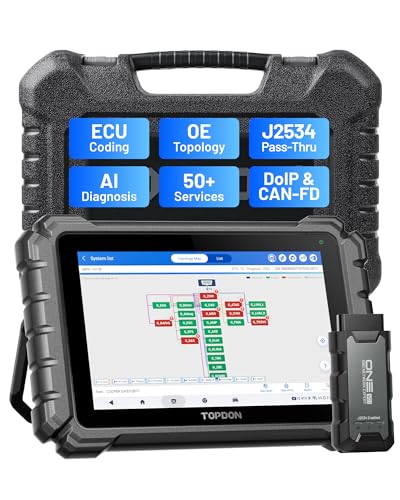
- Dual WiFi & 10.1" Touchscreen: Provides a stable, high-speed wireless link 3x faster than bluetooth, and a responsive, professional interface. Topdon ONE obd2 scanner diagnostic tool ensures smooth, non-lagging diagnostic scan, boosting mechanic efficiency
- J2534 Pass-Thru Support: The included ONE VCI supports the J2534 standard, allowing it to function as a pass-thru device when paired with OEM diagnostic software.Through TOPDON’s RLink platform, technicians can perform dealer-level coding, expanding in-house capabilities without investing in multiple factory automotive scan tools
- OE Topology Mapping: Visualize the vehicle’s ECU network exactly as it’s built.Zoom, pan, and highlight specific modules to pinpoint component issues with precision.Topology mapping displays real-time communication between modules
- Topfix AI Assistant: Covers 5 million plus fault codes and delivers instant causes, symptoms, and repair guidance with professional wiring diagrams for each code.Slashes diagnostic time, boosts first-time fix accuracy, and increases shop revenue
- 50 Plus Service Functions: Covers high-demand services like ADAS calibration, DPF regen, TPMS reset, ABS bleed, and throttle adaptation.Expands your service menu, allows you to charge premium rates, and turns away zero jobs due to lack of tooling. Vehicle-specific functionality may vary.

- Bi-Directional Control, Quickly Locate Problems: Turn your phone into a professional diagnostic tool. You can send commands from your phone to the ECU to test injectors, cooling fans, headlights, A/C clutch, windows, wipers, and more. See which one doesn't respond. Helps you quickly locate the problem and save time. No need to tear things apart, avoid blind disassembly.
- Full System Diagnostics, No Fault Hides: Unlike basic diagnostic tools that only cover 4 systems, TopScan can scan all systems. Read and clear trouble codes, view live data streams, and generate a complete vehicle health report – all issues are clear at a glance. Covers 10,000+ vehicle models and is compatible with 99.99% of vehicles.
- Flexible Subscription, Choose Advanced Features as Needed: TopScan Lite provides free-for-life access to core diagnostics, including full system scan, code reading, performance tests, and repair information. After purchase, advanced features (bi-directional control, service operations, live data, code clearing, and AI functions) are free-for-the-first-year. After the first year, if you want to use advanced features, you need to subscribe on a monthly, quarterly, or yearly basis. As new models and reset functions are updated, the tool will also be continuously upgraded.
- AI Assistant - TopFix: Think of TopFix as your personal AI mechanic. It leverages a repair database and OEM data to deliver clear, step-by-step repair solutions. Features include AI Q&A, one-click translation, and a full repair log, making your diagnostic process simpler and more efficient.
- 8+ Hot Resets, Keep Your Car in Top Shape: One-tap resets for oil, throttle, EPB, steering angle, DPF, ABS, BMS, and airbag. It enables car owners to easily perform essential maintenance, ensuring the vehicle stays in optimal condition and extends its service life.
This product presentation was made with AAWP plugin.
Last update on 2026-05-11 / Affiliate links / Images from Amazon Product Advertising API