NHTSA ID Number: 10239073
Manufacturer Communication Number: 059-B17-00
TSB/Document Date: 2023-07-11
Summary
Brake Line Instruction Sheet
If the PDF is very large, it may not load in the preview below.
Some older TSBs had multiple PDFs — visit the NHTSA Website to view all PDFs.
If the TSB PDF does not show, download or view it on the NHTSA Website.
Click on the (+) Plus Sign
Then Click on Associated Document(s)
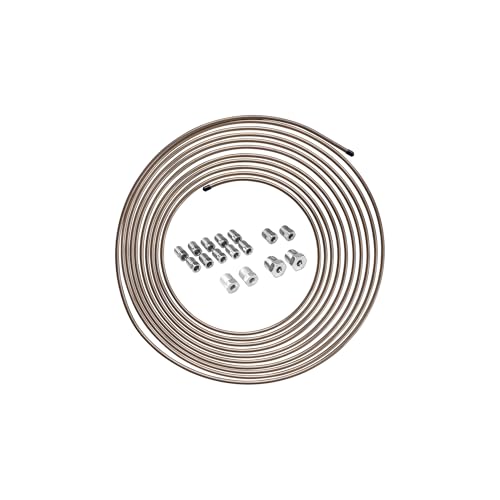
- Nickel-copper alloy is very flexible making for super easy...
- Corrosion and Rust Resistant: Copper-nickel alloy resists...
- SAE and ISO Certified: This tubing is tested and verified to...
- Complete Kit with 16 Inverted Flare Fittings: Includes 25 ft...
- Ideal Replacement for Steel Brake Lines: Copper-nickel brake...

- PACKAGE INCLUDE - MuHize Brake Line Kit Replacement with...
- SUPER EASY BENDING & FLARING - MuHize brake lines are easy...
- HIGHER QUALITY - MuHize brake lines are made with unique...
- WIDELY APPLICATION - MuHize 3/16 brake line tubing kit...
- PROFESSIONAL - MuHize focus on outstanding features and...
This product presentation was made with AAWP plugin.
Search NHTSA Database for Recalls
Search NHTSA Database for Vehicle Investigations
View Latest Vehicle Investigations
Search NHTSA Database for Vehicle Complaints
View Latest Vehicle Complaints
TSB/Document ID: 059-B17-00
Replacement Service Bulletin Number:
MFR Communication Date: 2023-07-11
MFR Internal Campaign ID/Software Version:
Communication Type: Service Bulletin/Repair Instructions
NHTSA Components: EQUIPMENT
MFR Component System:
MFR Component Subsystem:
Previous TSB | Next TSB |
INSTALLATION INSTRUCTIONS
Brake Line Kits
Connecting to the trailer brake actuator:
CAUTION
Actuators are designed explicitly for drum or disc brake applications. Make
sure you have the correct actuator for your brake type. Severe operational
problems can arise with the incorrect matching of brake type and actuator.
•Flexible brake hoses must allow the suspension to travel
from the fully loaded position through its full possible range
downward, and any potential farther travel down into a pothole
and any rebounding travel upward. A damaged or broken brake
hose can cause immediate loss of braking on all wheels.
•Ensure that all brake lines, whether steel or flexible material,
are routed and secured to prevent any possibility of chafing,
material fatigue in any way, or any contact with moving items. A
damaged brake line or hose can burst under pressure and cause
immediate braking loss on all wheels.
•DOT-3 is the recommended fluid for all Dexter hydraulic braking
systems. DO NOT USE petroleum-based hydraulic fluid in these
lines or any Dexter braking system; petroleum-based fluids will
cause a system failure.
•Wear safety glasses and gloves when handling brake fluids.
If working on an existing trailer, properly drain any existing
brake fluid from the system and dispose of it per state and local
regulations. Never reuse brake fluid.
If installing a pump on your trailer, mount in dry, protected, visible area
with clearance for airflow as close to the front of the trailer as possible
according the manufacturer’s instructions.
The hydraulic brake line system length exiting the pump is unlimited.
Conversely, the tow vehicle connection’s wiring length supplying the
Electric/Hydraulic pump should be as short as possible. An air/hydraulic
or electric/hydraulic actuator pump may have either a steel brake line or
brake hose with a 3/16” inverted flare male end installed directly into the
pump’s outlet. A steel line should include some flexibility (usually, a “Z”
shaped change of direction in the line near to the pump is sufficient) to
allow the pump to be unbolted and removed for service if later needed.
If you add a surge brake actuator to your trailer, remove your coupler from
the front of your trailer and bolt the brake actuator coupler in its place per
the actuator manufacturer’s direction.
Short flexible brake hoses are required to connect to the actuator
master cylinder on the Dexter DX8.0, DX12.5, and DX20EX actuators.
Their master cylinders are on spring-loaded mounts, and their master
cylinder thus moves relative to the actuator outer case in operation.
All other Dexter actuator models may have a steel brake line or a brake
hose with a 3/16” inverted flare male end installed directly into the
inverted flare output fitting of the actuator master cylinder. If a steel
line, it should be routed to allow some flexibility to enable the actuator
to be unbolted and removed for service if later needed. Usually, a “Z”
shaped change of direction in the line near to the actuator or a pigtail
coil at the far end of the line is sufficient).
Installation, maintenance, or repair on any trailer should be performed
only by qualified persons knowledgeable of the system. Also, there are
numerous variations in procedures, techniques, tools, and component
choices to adequately address each unique trailer design. This
document cannot possibly anticipate all such variations and provide
advice and caution as to each. Accordingly, anyone who undertakes to
construct, install, maintain, or repair a vehicle brake system or brake
system components, must first establish that they neither compromise
their personal safety nor the vehicle integrity by their choice of methods,
tools, or parts selected.
If the surge brake actuator or brake system has an electric backup solenoid
installed, use a wrench or other tool on the solenoid’s brass end where
the brake line enters to stabilize the solenoid while tightening the brake
line(s) into it. The black electric solenoid coil itself is not designed to resist
tightening torque and can be distorted to the point of failure if it is gripped
or twisted with a wrench or a twisting force is applied to it.
CAUTION
Do not lift or support the trailer on any part of the axle or
suspension system. Never go under any trailer unless it is securely
supported on jack stands rated for the load. Improperly supported
vehicles can fall unexpectedly and cause serious injury or death.
If the actuator master cylinder has an orifice connector mounted at its exit,
DO NOT remove or modify the orifice connector to install the trailer main
brake line. The orifice should connect directly to the main brake line to
provide proper fluid flow characteristics for the system.
Trailer hydraulic braking systems all include an actuator mounted at or near the
front of the trailer that generates between 1,000 and 1,600 lbs. per square
inch of brake fluid pressure to operate the brakes. The brake fluid distribution
system consists of steel brake lines and flexible brake hoses to transfer brake
fluid under pressure to each wheel’s brakes. The brake line system must resist
that high pressure, the effects of vibration and the elements, and provide
sufficient flexibility to allow the axles or wheel ends to move up and down.
Please refer to figures on the last page for brake line layout.
©2021-2023 Dexter Axle Company | www.dexteraxle.com
If the main brake line exiting the actuator runs in a tubular trailer frame,
include swivel fittings at one or both ends to ease installation and avoid
installing any joints in the line inside the tube.
If the trailer has a folding tongue section, a flexible brake hose is required.
Ensure that the hose length selected will allow the tongue to be fully
opened without stretching the hose but not be too long and allow the hose
to pinch, kink, or get caught in the tongue mechanism when it is closed.
-1-
059-B17-00 Rev. A | 2023.06
Brake lines and hoses should never be routed on the bottom of trailer
chassis frame rails where road debris or any later lifting or supporting of
the trailer with a jack or jack stands can damage them.
Brake lines, hoses, and connecting fittings installation:
The brake line system should be installed considering the long-term
effects of vibration, component movement, and environmental exposure.
Brake lines should be secured every 36” on a trailer frame to avoid
vibration damage. If a brake line is crossing an axle tube, secure the line to
the tube every 18 to 24”.
The brake line system layout and component selection must allow for 4.5”
of axle of suspension travel relative to the trailer frame. Flexible hoses are
required anywhere in the system where components move relative to one
another.
Dexter recommends any “T” or cross fittings be secured to the trailer
frame in a way that prevents vibration from loosening the brake line joints
at the fitting. Most of these fittings either have an integral round hole to
secure the “T” to a trailer
frame or axle tube, or the
fitting may come with a
separate bracket. Do not
drill axle tubes to install
brake line attachment
fasteners. It is acceptable
to run a screw or small
bolt through the mounting
holes in the “T” fitting or
bracket. The “T” fittings may be secured to a cross axle tube by spot
rosette welding the hole in the bracket to the axle tube or by stud welding
an external fastener to the axle tube. The “T” fittings and any cross-axle
brake lines can be secured using UV-resistant zip ties, stainless steel zip
ties, or stainless steel hose clamps. If securing brake lines with zip ties,
the maximum recommended tie spacing is 24”. Do not over tighten or
crush brake lines if using hose clamps or zip ties to secure.
Select the brake line lengths and route them to minimize the system’s
number of connections or joints. It is permissible to:
ƒ
Run the main brake line down the trailer frame on one side only and
then route the lines across a trailer cross member or axle to reach
the other side of the trailer, or:
ƒ
Run two main brake lines down each side of the trailer frame, and
then plumb individual line drops to the axle wheel ends.
For the best braking performance, use rigid steel tubing for the majority of
the system length, using flexible hose when necessary. Braking performance
is best if flexible brake hoses in the system are 24” or less length each. On
heavy, long trailers with three or more axles, Dexter recommends a ¼” steel
main line from the actuator for the best brake response.
Dexter recommends that on trailers with concealed brake fluid distribution
joints, that portion of the system be leak tested before it is hidden. The
best approach is to leak test the entire system after the brakes are
installed, but before the brake lines are concealed and before connecting
the actuator. To leak check the system, use 50-100 pounds per square
inch of dry shop air to pressurize the system. Then close a tightly sealing
valve on the test air supply and use a calibrated air pressure gauge to see
if the system air pressure drops, indicating a potential leak in one or more
joints in the system. This initial air test gives the added benefit of preadjusting the disc brake calipers/pads to their operating position when
the air pressure is applied.
Protect brake lines and hoses where they cross through frame and body
members, near moving parts, etc. If a steel or rubber brake line passes
through a hole without a grommet or other anti-chafing material, the line
or hose must be secured so that it is centered in the hole and cannot
flex enough to touch the hole’s edge. Otherwise, use a rubber grommet
or similar cushioning device to prevent contact between a brake line/
hose and a nearby item or a surrounding hole. In that case, the grommet
design should be that it remains in place permanently under the vibration
conditions of the trailer, and the grommet material shall not deteriorate
over time due to the elements.
If it is necessary to add any additional brake lines, fittings, and hoses
not supplied by Dexter to complete the system, they must be rated for
3000 pounds per square inch pressure and meet FMCSA FMVSS 106
requirements. Dexter recommends 3/16” steel brazed double wall tubing
per S.A.E. J527 for use with all our actuators and brake products. Use 45°
double-flare tube ends for connections per S.A.E. J533.
Use a six-sided line wrench
or crows-foot wrench
where possible on hex
brake line fasteners to
avoid rounding them
off. When tightening two
lines that go into the
same union or joining
fitting, hold the line on the
opposite side of the fitting
with a second wrench
to avoid twisting lines or
loosening fittings downstream in the system.
CAUTION
NEVER CUT ANY BRAKE LINE TUBING!! Brake line tubing cannot be
patched or hand flared and comply with D.O.T. approved systems.
Never use any copper tubing for any part of a hydraulic brake
system. Ensure connecting fittings have compatible threads/seats,
incorrect combinations will leak. Do not use any thread sealant on
inverted flare type brake line fittings.
Routing and mounting steel brake lines
Route brake lines within the trailer chassis in a manner that protects
them from damage by road debris or low ground clearance and secure
all tubing for maximum protection from pinching, vibration, corrosion,
or road hazards. Secure the brake lines/hoses to the trailer frame with
sufficient clips or attachment devices to support them for the application.
Do not drill axle tubes to install brake line attachment fasteners.
Apply the tightening torque to the brake lines/fittings in a smooth and
controlled motion. The tightening torque for a 3/16” inverted flare fitting is:
Brake lines that horizontally cross an axle tube or trailer chassis frame rail
shall be installed on the upward or rearward facing side of the axle tube or
frame rail to minimize the possibility of road impact damage.
©2021-2023 Dexter Axle Company | www.dexteraxle.com
ƒ
If one or both fittings are brass: 60-75 in.-lbs., 5 ft.-lbs. or just snug
using a 6” long line wrench.
ƒ
If both of the fittings are steel, or a steel fitting inserted into a cast
iron fitting: 120 in.-lbs. or 10 ft.-lbs..
ƒ
¼” steel inverted flare fittings tightened to 120 in.-lbs or 10 ft.-lbs.
Air bubbles will tend to rise to the highest point in the brake line; therefore,
-2-
059-B17-00 Rev. A | 2023.06
route the brake lines to run as level as possible relative to the trailer frame to
avoid high spots, which may trap air and make the system harder to bleed. It
is acceptable to select a rigid brake line slightly longer than needed and use
up the line’s excess length by installing a pigtail coil in the line. On the other
hand, selecting an excessively long rigid line that requires a higher number of
or large diameter shortening coils can create multiple high spots that trap air
bubbles during bleeding, thus increasing overall installation time.
ƒ
If a flexible hose connects to a rigid steel brake line on either of its
ends, anchor both hose ends to avoid repetitive motion in the rigid
lines that could fatigue them.
Connecting to the brakes at the trailer wheels
Follow the trailer axle/brake manufacturer’s instructions for installing brake
assemblies on the axle ends. Dexter recommends brakes on all trailer wheels.
CAUTION
Do not allow any debris to enter the brake lines/hydraulic system when
installing the brake lines. For example, it may be necessary to cover the
brake line ends with masking tape or use temporary line end caps while
sliding a line inside a trailer frame rail.
CAUTION
When installing the brake system or any part of servicing, never let
a brake caliper, drum brake assembly, or axle ever hang by its own
weight on a flexible brake hose. If this happens, replace the hose
with a new one.
Kinked and/or damaged brake lines can cause fluid flow restriction
or later fatigue cracks resulting in poor braking or no brakes at all.
Install calipers or brakes with the bleeder screw on the top and the brake
line inlet at the bottom.
When bending steel brake line tubing, always use proper bending tools to
assure sound connections and prevent kinks in the tubing. Tubing bends
of radii less than less than 6” require the use of tools similar to those in the
picture.
Fixed piston style brake calipers and hydraulic drum brakes mounted on
a spring axle may have rigid metal lines routed along the axle tube directly
to them. If so, the rigid metal line on the axle should have a radiused “Z”
bend in it near the brake to make the line flexible enough to remove the
caliper or brake assembly for service. If a floating piston style caliper is
in the same spring axle arrangement, the “Z” or a pigtail flexibility loop in
the rigid line must additionally allow the caliper body to move outward a
minimum of ½” as the brake pads wear.
Routing and mounting flexible brake hoses
A flexible brake hose is required
wherever a trailer or braking
component moves relative to a
fixed brake line. Do not attempt
to make a flexible metal brake
line section to allow repeated
component motion by pigtail
coiling a steel brake line.
A flexible brake hose is the required connection to all drum or disc brakes
on torsion axle ends, and is recommended for all floating piston style
calipers on spring axles.
Many Dexter disc brake calipers have a banjo style brake fluid inlet that
may be positioned at various inlet angles to allow the brake line to enter
from an optimum direction. If Dexter disc brake calipers came without
fittings, the fittings can be added at brake system installation. These inlets
have a hollowed-out banjo bolt that clamps a brass inlet fitting between
two copper washers. In the case where an existing “banjo style” brass
inlet fitting must be repositioned from its original tightened position to
a new inlet angle during installation, always replace the original copper
washers and then re-torque the banjo bolt to the caliper manufacturer’s
specification. An example single inlet fitting arrangement compatible with
Dexter calipers with a 7/16-20 threaded inlet is shown on the next page.
Brake hoses have a stripe to show if the hoses are twisted during
installation. Use the hose end’s swiveling feature to ensure the hose is
installed and tightened with minimal twist. When installing a male/female
hose, hold the hose’s female end with a 5/8” line wrench to avoid twists.
If a brake hose includes an integral 90-degree bend at its male end, orient
its 90-degree bend so the hose’s rubber portion is pointing as directly as
possible to the hose’s female end before tightening the male hose end
swivel fitting.
Ensure the brake hoses allow at least 4-1/2” of suspension movement,
with spring axle movement being approximately vertical and torsion axle
movement in a radius. The hose installation shall be such that no portion
of the hose can drop below the cross-axle tube elevation to avoid snagging
on-road objects or obstacles. The hose installation shall prevent the
possibility of contact between the hose and a rotating tire or wheel.
Initial Road Test of Trailer
After installing the actuator, brakes, and brake lines as described above,
proceed immediately to the “BRAKE FLUID FILLING AND BLEEDING”
instructions in the applicable brake actuator service manual.
CAUTION
Most brake hoses with one male end and one female end have a feature
on the female end that allows the female end of the hose location to be
secured with a bracket and C-Clip. Where a brake hose is subjected to
repeated flexing, any ends of that hose that connect to a metal brake line
should be secured to a non-moving portion of the trailer. Some scenarios
where hoses are subjected to repeated flexing are:
ƒ
ƒ
Failure to fill the system with brake fluid and bleeding air out of
the system promptly after installation may result in brake actuator
or system corrosion and cause brake failure.
Check each system joint and brake hose for leaks after the system is
initially fully pressurized with fluid and after bleeding all the system’s air.
The female end of a flexible hose is attached to a bracket on the
trailer frame and the male end of the hose is attached to a moving
wheel end or a moving cross axle tube.
Test the unit to confirm that the trailer brakes are operating correctly in a
safe location before resuming regular travel. After the first few stops and
the brakes have seated, check the brake fluid in the actuator reservoir and
top off the fluid again to the proper level. Check for a system leak if brake
fluid runs out or needs added more than once.
The female end of a flexible hose is secured to a stationary torsion
axle mounting bracket and the male end of the hose is connected to
a brake on the moving torsion axle end.
©2021-2023 Dexter Axle Company | www.dexteraxle.com
-3-
059-B17-00 Rev. A | 2023.06
Figure 1: Tandem Axle Brake Line using T fittings
Figure 2: Triple Axle Brake Line using T fittings
Figure 3: Tandem Axle Brake Line using cross fittings
Figure 4: Triple Axle Brake Line using cross fittings
AP Numbers (if required)
Fitting:
Bolt:
034-323-00
007-307-00
Note: Typical torsion axle
trailer diagram shown. The
diagram for a leaf spring axle
is similar except that any brake
line exiting a trailer frame
leading to a leaf spring axle
tube or brake shall be a flexible
hose.
Washer: 005-169-00
©2021-2023 Dexter Axle Company | www.dexteraxle.com
-4-
059-B17-00 Rev. A | 2023.06

- 🔥🔥🔥2026 New Functions Making X7HD the Top Dog - Big Surprise!!! ANCEL X7HD truck scanner 10 major functional advantages .✅>Full HDOBD/OBD2 Function ✅>ALL System Diagnostic ✅>42+ Reset Function ✅>Active Test / Bi-Directional Control✅>ECU Coding✅>Graphing Live Data✅>Wide Compatibility ✅>2 Yrs Free Update✅>Remote Operation✅>Bluetooth 5.0 & Wifi In addition, 8 major hardware advantages: ✅>6000 mAh✅>10.1 inch Tablet✅>2G RAM
 ✅>32G ROM (Expandable to 128GB)✅>Data Record & Replay & Print✅>Android 10.0✅>Bluetooth 5.0 & Wifi✅>14 Languages
 - 🚛OEM DPF Forced Regen & Cylinder Cutout Test & more - ANCEL X7HD diesel scanner diagnostic tool not only supports DPF regeneration, DPF reset, DPF related information reset, DPR state reset, DPD forced regeneration etc, which helps you better solve the exhaust aftertreatment system problems, but also supports activate motor to do exhaust air in ABS Automatically. Moreover, it features TPMS activation, cylinder cut-off and learning functions
- 🚛Advanced ECU Coding & Programming - ANCEL X7HD 10.1inch truck scanner diagnostic tool is equipped with advanced ECU coding, supports Level calibration, Idle speed learning and Adjustment, Camshaft timing control learning, Control unit adaptations, Injector Codes, Read/Write VIN, Road speed limit optional vehicle speed set, etc... PLEASE NOTE that ECU codes are not compatible with all vehicles, please send us your VIN# to check vehicle compatibility
- 🚛42+ Reset Functions & Bidirectional Control - 2026 newest top heavy duty truck scan tool, comes with 42+ special services (ECU, Speed Limit and Idle Reset, Oil Reset, Injector Coding, EPB, ABS, SRS, Suspension, Throttle, etc. and always keep growing), which meet all your various needs for service and maintenance
- 🚛10 Inch All Systems Diesel Scanner & Full HDOBD/OBD2 Modes - ANCEL X7HD diesel truck scan tool supports all systems scan, such as Engine, Brake, Retarder, TECU Transmission, Tachograph, ABS, SRS, TPMS, EPB, SAS, ESP, and other vehicle systems, comes with 10 obd2 service modes: read/erase error codes, Data Stream, I/M Readiness, Vehicle Information, Actuations, DTC Lookup, EVAP, view freeze frame, etc

- 【Extensive Compatibility】HD601 heavy duty truck scanner supports 12V & 24V commercial vehicles and all major truck models that comply with standard protocols (SAE J1939, SAE J1708, ISO 14230-4, ISO 15765-4 and ISO 9141-2, ISO 27145-4 and Euro6). Fits for Cummins, Paccar, Detroit, Caterpillar, Freightliner, International, Peterbilt, Ford Heavy Truck, Class 4-Class 8 trucks, etc. It also supports engine diagnosis on most cars, minivans, light trucks and pickups
- 【 Full System Diagnostic】HD601 Diesel Scanner supports all system scans of heavy trucks compliant with standard protocols SAE J1939 & J1708, such as Engine, ABS, Transmission, Braking System, ESP, EPS, Fuel System, etc, It is a great scan tool for Cummins, Caterpillar, Detroit, Caterpillar, Maxxforce, Bendix,Wabash, Wabaco, Haldex, Allison, Eaton heavy trucks, With this truck tool, you can get deep analysis data about the system and do some repairs by yourself, saving much time and money. Note: Only heavy truck vehicles that comply with the above protocol can diagnose the entire system
- 【Enhanced Diesel OBD Scanner】The HD601 Diesel OBD Scanner offers unparalleled diagnostic capabilities for heavy-duty trucks. Beyond code reading, clearing, and live data display, it retrieves vehicle information, freeze frames, and DTCs. With 6, 9, and 16 pin cables, it ensures compatibility with various engines. This scanner's real-world testing prowess ensures comprehensive support for a wide array of heavy-duty truck engines, making it an indispensable tool for truck diagnostics
- 【DTC Library】+【Life Time Free Update】The built-in DTC library allows you to retrieve the codes directly without searching for the definition in the book. Whether you are a professional mechanic or a DIY car owner, HD601 diesel scanner explains the existing problem, makes it easier for you to understand code definitions and helps you locate vehicle faults. Note: This device cannot directly solve the fault. Plus, you get a lifetime free internet updates, so you always have the latest software for diagnostics in English and Spanish languages.
- 【Friendly Design, Easy of Use】This scanner is plug and play, simple and convenient, and very friendly for beginners. With improved buttons for easy menu navigation. The excellent 2.8 inch LCD color screen makes it easy to view the displayed results and gives you a better overview of your car's problem areas and the identified codes. In addition, the processor is super-fast and responds without lagging, providing maximum comfort and efficiency in diagnostic and service work

- Why NEXAS NL102 Truck Scan Tool? The NL102 outshines other truck scanner with its extensive diagnostic features. It offers full system diagnostics for major trucks meeting standard protocols, along with complete OBD2 functionality. Beyond read fault codes, clear codes and live data display, it enables vehicle info retrieval, freeze frame capture, and DTC lookup. Equipped with 6-pin, 9-pin, 16-pin connectors, it ensures broad truck compatibility. Plus, enjoy lifetime free updates in English, Spanish, and French, keeping your diagnostic scanner software current.
- Wide Compatibility - Friendly Reminder: To avoid compatibility issues, please confirm with us via Amazon Messages before purchasing. This heavy duty truck scanner is compatible with all heavy-duty trucks and semi that adhere to standard protocols (J1587, J1939, J1708). It covers a wide range of vehicle models, including Cummins, Detroit, Caterpillar, Freightliner, International, Kenworth, John Deere, Peterbilt, Sterling, Mack, Paccar, Western Star, Mercedes-Benz, Volvo, Scania, MAN, Renault, ERF, Foden, Seddon-Atkinson, Iveco, DAF, SISU, STEYR, ISUZU etc. Equipped with 6-pin, 9-pin, and 16-pin connectors for versatile device compatibility, ensuring stable plug-and-play connections.
- Save Hundreds of Money for All Heavy Duty Trucks – This diesel diagnostic scanner supports accurate full-system scans for all heavy-duty trucks that comply with standard protocols (J1587, J1939, and J1708). It can read and clear trouble codes across a range of vehicle systems, including the engine, transmission, instrument panel, drivetrain, brake system, suspension, ABS, ESP, EPS, fuel system, etc. The truck scanner communicates directly with your truck's computer to provide real-time data stream analysis, letting you pinpoint issues with precision. This cuts down on waste from unnecessary part replacements, saving you time and hundreds or even thousands of dollars.
- All OBD2 Functions + Battery Health Monitoring – Unlike many obd2 scanners on the market that only cover partial OBD2 features, ours gives you full OBD2 capability: read & clear codes, live data, freeze frame data, I/M readiness checks, EVAP tests, on-board monitor, O2 sensor tests, vehicle info, and DTC lookup. That means more detailed insights for pros and DIYers alike. The NL102 isn't just a code scanner – it's a battery saver. Regularly check your car's battery health, and catch issues before it dies completely. No more unexpected no-starts in the driveway or on the road. It diagnoses battery condition accurately, helping you avoid costly last-minute repairs.
- Plug and Play & One-click for DTC: NEXAS diesel scanner is user-friendly. It comes with an intuitive screen and easy-to-understand interface, making it accessible even for non-professionals to get started. And the built-in DTC library in the code reader allows you to directly retrieve codes without searching for definitions in books, making it easier to understand the code definitions and solve problems more quickly.

This product presentation was made with AAWP plugin.
Last update on 2026-05-13 / Affiliate links / Images from Amazon Product Advertising API