
NHTSA ID Number: 10177899
Manufacturer Communication Number: A012072203300122
TSB/Document Date: 2020-08-06
Summary
This bulletin provides instructions on how to clean the secondary air ports if they have too much carbon and cause a restriction.
01 MIL on, DTC P049100 and P049200 are stored at the same time in the ECM
01 20 72 2033001/22 July 20, 2020. Supersedes Technical Service Bulletin Group 01 number 20-62 dated May 6,
2020 for reasons listed below.
Model(s)
Year
VIN Range
Vehicle-Specific Equipment
A6
2009 - 2016
All
3.2 FSI AVS and 3.0 TFSI
A7
2013 - 2016
All
3.2 FSI AVS and 3.0 TFSI
S4
2010 – 2012,
2014 - 2016
All
3.2 FSI AVS and 3.0 TFSI
A8, Q7
2011 - 2016
All
3.2 FSI AVS and 3.0 TFSI
A5, S5
Cabriolet,
and Q5
2010 - 2016
All
3.2 FSI AVS and 3.0 TFSI
Condition
REVISION HISTORY
Revision
Date
Purpose
22
-
Revised Service (Added alternate MVB)
Revised Warranty (Updated Claim Type and Labor Operations)
21
05/06/2020
Revised Warranty (Updated Claim Types)
20
04/16/2020
Revised Warranty (Updated Claim Type and Labor Operations)
Revised Required Parts and Tools (Updated Tool number)
Customer states:
MIL on.
Workshop findings:
Mileage is greater than 15,000 miles.
Both of the following DTCs are stored in the engine control module (ECM), J623 (address word 0001):
DTC P049100 (Secondary Air System Insufficient Flow, Bank 1).
DTC P049200 (Secondary Air System Insufficient Flow, Bank 2).
Page 1 of 13
© 2020 Audi of America, Inc.
All rights reserved. Information contained in this document is based on the latest information available at the time of printing and is subject to the copyright and other intellectual property rights of Audi of
America, Inc., its affiliated companies and its licensors. All rights are reserved to make changes at any time without notice. No part of this document may be reproduced, stored in a retrieval system, or transmitted
in any form or by any means, electronic, mechanical, photocopying, recording, or otherwise, nor may these materials be modified or reposted to other sites, without the prior expressed written permission of the
publisher.
Technical Background
Under certain driving conditions, the secondary air ports in the cylinder head can accumulate carbon over time,
causing a restriction.
Production Solution
Not applicable.
Service
Note:
Before performing this repair for the first time, it is mandatory that the technician complete Audi Academy
Course #940134 and assessment #940134B. Otherwise, the warranty claim will be denied. The course and
assessment can be found on the Audi Academy CRC site. Specific video sections are referenced in the
instructions below.
Section 1A: Perform ODIS Testing – For all but A6 (C6) 3.2FSI and Q7 3.0T
1.
Delete all DTCs. Bring the engine to operating temperature.
2.
Go to Control Modules >> 01 Engine Control Module >> Control module OBD >> Basic Settings >>
Checking Secondary Air System.
3.
Select MVB: MASS_SA_REL[0] or SAF_DIF[1] and MASS_SA_REL[1] or SAF_DIF[2].
4.
Perform test (Press brake and gas pedal at the same time, start test on ODIS tester).
5.
While the Basic Setting test is running, check if the secondary air pump runs normally (no unusual noises).
In addition, check for a leak in the secondary air hose routing between the pump and combi valves.
6.
Immediately after the test is complete, read MASS_SA_REL[0] or SAF_DIF[1] and MASS_SA_REL[1] or
SAF_DIF[2]. Depending on the software level and engine code, the air mass flow will be displayed in one
of two ways:
For the old software version:
If the value is between 0.1 and 0.7, and there were no issues with the pump and hoses, the system
needs to be cleaned. Follow the instructions below.
For the new software version:
If the value is between 13 and 16, and there were no issues with the pump and hoses, the system
needs to be cleaned. Follow the instructions below.
Page 2 of 13
© 2020 Audi of America, Inc.
All rights reserved. Information contained in this document is based on the latest information available at the time of printing and is subject to the copyright and other intellectual property rights of Audi of
America, Inc., its affiliated companies and its licensors. All rights are reserved to make changes at any time without notice. No part of this document may be reproduced, stored in a retrieval system, or transmitted
in any form or by any means, electronic, mechanical, photocopying, recording, or otherwise, nor may these materials be modified or reposted to other sites, without the prior expressed written permission of the
publisher.
Section 1B: Perform ODIS Testing – For A6 (C6) 3.2FSI and Q7 3.0T only
1.
Go to Control Modules >> 01 Engine Control Module >> Control module OBD >> Basic Settings >> test 77.
2.
While performing test 77, check if the secondary air pump is running and make sure it does not make any
abnormal or unusual noise:
If test 77 fails but the pump is running and does not make any abnormal/unusual noise, perform the
cleaning process below.
If the pump is not running or if it makes an abnormal/unusual noise, this TSB does not apply.
Tip: Always use the latest version of this TSB.
Section 2: Prepare the Vehicle for Power Washing
1. Move the exhaust sliding bushings
(that connect the catalytic converter
and muffler) back, then lower the
catalytic converter pipes (Figure 7).
For Q7, unbolt muffler from the
catalytic converter. Cover mufflers
with a plastic bag to prevent water
from entering.
Cleaning water will drain out of the
catalytic converter pipes during the
cleaning process.
Figure 7. Lowered catalytic converter pipes.
2. Remove all spark plugs and cover the engine harness plugs for the coils (for water protection).
3. Drain the coolant so that it can be reused.
4. Bring the front end of the car into service position (for Q5, A6, A8, S4, and S5 Cabriolet) to make room in the
front of the engine. The Q7 has enough room for access to the front of the cylinder heads.
Page 3 of 13
© 2020 Audi of America, Inc.
All rights reserved. Information contained in this document is based on the latest information available at the time of printing and is subject to the copyright and other intellectual property rights of Audi of
America, Inc., its affiliated companies and its licensors. All rights are reserved to make changes at any time without notice. No part of this document may be reproduced, stored in a retrieval system, or transmitted
in any form or by any means, electronic, mechanical, photocopying, recording, or otherwise, nor may these materials be modified or reposted to other sites, without the prior expressed written permission of the
publisher.
5. For 3.0T only: remove the coolant
supply lines (intercooler of the
supercharger) in the front of the
engine (Figure 8).
Figure 8. Front coolant pipes to be removed for 3.0T.
6. Remove the following components:
Coolant pipe (Figure 9, image 1).
Coolant flange (Figure 9, image
2).
Pulley and if needed bracket, of
power steering pump (Figure 9,
image 3).
Pulley of the water pump (Figure
9, image 4).
Coolant tube (Figure 9, image 5).
Dipstick tube (Figure 9, image 6).
Figure 9. Engine component removal.
Note:
When removing the dipstick tube, turn it 180 degrees, and then reinstall it for water protection.
Page 4 of 13
© 2020 Audi of America, Inc.
All rights reserved. Information contained in this document is based on the latest information available at the time of printing and is subject to the copyright and other intellectual property rights of Audi of
America, Inc., its affiliated companies and its licensors. All rights are reserved to make changes at any time without notice. No part of this document may be reproduced, stored in a retrieval system, or transmitted
in any form or by any means, electronic, mechanical, photocopying, recording, or otherwise, nor may these materials be modified or reposted to other sites, without the prior expressed written permission of the
publisher.
Note:
To loosen the coolant tube, remove 2 bolts (Figure 10, image A and C), open clip
(Figure 10, image B), and pry bushing apart as shown in training video (Figure 10,
image D). There is no need to loosen the AC compressor.
Cover opening of right coolant pipe to prevent coolant circuit contamination.
Figure 10. Loosening the
coolant tube.
7. Remove the main port freeze plug by
hitting the marked area with a small
punch until it turns (Figure 11).
Remove with pliers.
Figure 11. Marked area on main port of freeze plug.
Section 3: Prepare to Power Wash Tool Setup
Warning:
Read the pressure washer user manual and follow these safety instructions.
Always insert special cleaning hose into adaptor and engine before turning pressure washer on.
If switching special cleaning to a different port, turn pressure washer off and release residual pressure by
pulling the trigger before removing the special cleaning hose from the engine.
Wear safety glasses and gloves.
1. Become familiar with the special tool set VAS6825 (Figure 12):
Page 5 of 13
© 2020 Audi of America, Inc.
All rights reserved. Information contained in this document is based on the latest information available at the time of printing and is subject to the copyright and other intellectual property rights of Audi of
America, Inc., its affiliated companies and its licensors. All rights are reserved to make changes at any time without notice. No part of this document may be reproduced, stored in a retrieval system, or transmitted
in any form or by any means, electronic, mechanical, photocopying, recording, or otherwise, nor may these materials be modified or reposted to other sites, without the prior expressed written permission of the
publisher.
Special hose with scale for cleaning
single ports (Figure 12, image 1).
Special hose for cleaning the main
ports (Figure 12, image 2).
Hose adaptor for the special hose
with scale (Figure 12, image 3).
Engine adaptor for bank one (Figure
12, image 4a).
6
Engine adaptor for bank two (Figure
12, image 4b).
Figure 12. Special tool set VAS6825.
2. To catch water, put a pan under the front of the engine and under the disconnected catalytic converter pipes.
3. Install engine adaptors on the
appropriate banks (Figure 13 and Figure
14).
Figure 13. Engine adaptor on bank one.
Page 6 of 13
© 2020 Audi of America, Inc.
All rights reserved. Information contained in this document is based on the latest information available at the time of printing and is subject to the copyright and other intellectual property rights of Audi of
America, Inc., its affiliated companies and its licensors. All rights are reserved to make changes at any time without notice. No part of this document may be reproduced, stored in a retrieval system, or transmitted
in any form or by any means, electronic, mechanical, photocopying, recording, or otherwise, nor may these materials be modified or reposted to other sites, without the prior expressed written permission of the
publisher.
Figure 14. Engine adaptor on bank two.
4. To ensure proper pressure washer function, use a ¾-inch water supply hose (no longer than 60 feet) to
supply pressure washer.
The Audi-supplied pressure washer comes with a 22mm male-to-male adapter (to connect the special tool to
trigger gun), a pressure gauge (to connect between pressure washer and high-pressure hose), and a 220V
power adapter.
Make sure that pressure is at least 1800 psi when using the special single port cleaning hose (the hose with
the scale). Use the table below to compensate for low water pressure:
psi While Cleaning Single Ports
Cleaning Time in Minutes
Less than 1900
Pressure too low – check the water supply
1900
4
2000 or higher
3
Section 4: Power Wash the Ports
Cleaning Main Secondary Port:
1. Insert special main port cleaning hose (the hose without the scale) two inches into the engine adaptor.
2. Turn the pressure washer on.
3. Holding the cleaning hose tightly, pull the pressure washer trigger.
4. Gradually move the cleaning hose into the port, going back and forth until the combi valve is reached. All
water comes out at adaptor #4.
5. Continue going back and forth through the whole port until only clean water drains out of the cylinder head.
Page 7 of 13
© 2020 Audi of America, Inc.
All rights reserved. Information contained in this document is based on the latest information available at the time of printing and is subject to the copyright and other intellectual property rights of Audi of
America, Inc., its affiliated companies and its licensors. All rights are reserved to make changes at any time without notice. No part of this document may be reproduced, stored in a retrieval system, or transmitted
in any form or by any means, electronic, mechanical, photocopying, recording, or otherwise, nor may these materials be modified or reposted to other sites, without the prior expressed written permission of the
publisher.
6. Do the same with the other cylinder head.
Cleaning Single Ports:
1. Because every port has a different distance to the cylinder head, use the table below to position the hose
adaptor for the special single port cleaning hose (the hose with the scale) correctly into the hose. The back
side of the hose adaptor must align with the number on the scale of the cylinder to be cleaned (Figure 15).
The longitudinal slot on the hose adaptor must align with the black line on the scale for correct rotational
positioning (Figure 15).
Dimensions Port 1
2
3
Bank One
10.5
19.5
28.5
Bank Two
13.7
22.7
31.8
Figure 15: Arrow indicating how the back side of the adaptor must align with the scale. The red dotted line
indicating how the longitudinal slot must align with the black line on the scale.
2. After adjusting the position of the hose adaptor,
insert the special single port cleaning hose into the
hose adaptor, and bring it back into locking position
(Figure 16).
Figure 16. Locking position/transverse longitudinal
movement and of the hose adaptor
3. While cleaning, make sure that the pressure washer is supplying pressure greater than 1800 psi.
Page 8 of 13
© 2020 Audi of America, Inc.
All rights reserved. Information contained in this document is based on the latest information available at the time of printing and is subject to the copyright and other intellectual property rights of Audi of
America, Inc., its affiliated companies and its licensors. All rights are reserved to make changes at any time without notice. No part of this document may be reproduced, stored in a retrieval system, or transmitted
in any form or by any means, electronic, mechanical, photocopying, recording, or otherwise, nor may these materials be modified or reposted to other sites, without the prior expressed written permission of the
publisher.
4. Based on the washer’s pressure, clean the port based on the table below. While cleaning, continuously move
the hose adaptor within the longitudinal and transverse slots (Figure 16).
Psi While Cleaning Single Ports
Cleaning Time in Minutes
- 💯【Conta.ct us for Support Directly】If you met any...
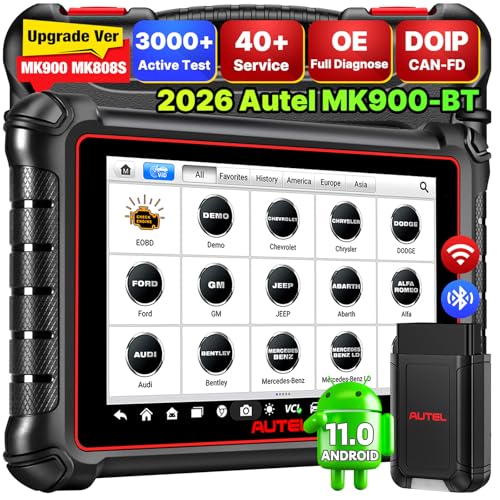
- 🔥🔥🔥【2026 AUTEL FLAGSHIP MK900BT MK900-BT, NEW...
- 🚗【3000+ ACTIVE TESTS (50➡3000+), SAME AS MS...
- 🚗【40+ HOT SERVICES FOR 150 MAKES (28+➡40+)】Full...
- 🚗【OE ALL SYSTEM DIAGNOSE, AUTO SCAN 2.0: SCAN LICENSE...

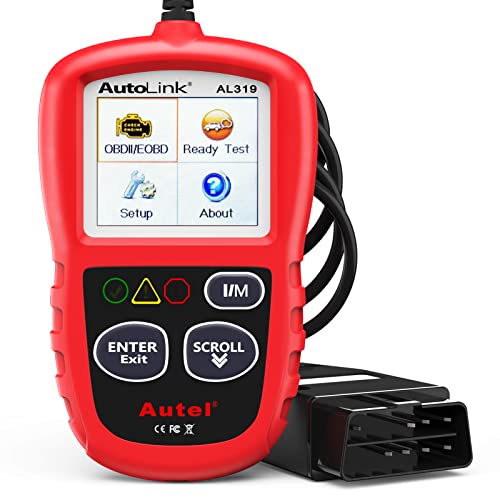
- 【TURN OFF CEL】 This AL319 car scanner diagnostic tool...
- 【EXTENSIVE APPLICATION】 Autel AL319 Compatible with...
- 【FOR END USER & DIYERS】 This error code reader AL319 is...
- 【USER-FRIENDLY DESIGN】 This OBD2 scanner and check...
- 【HIGH-QUALITY SERVICES】 12 months war.ranty from the...
If the PDF is very large, it may not load in the preview below.
Some older TSBs had multiple PDFs — visit the NHTSA Website to view all PDFs.
If the TSB PDF does not show, download or view it on the NHTSA Website.
Click on the (+) Plus Sign
Then Click on Associated Document(s)
Search NHTSA Database for Recalls
Search NHTSA Database for Vehicle Investigations
View Latest Vehicle Investigations
Search NHTSA Database for Vehicle Complaints
View Latest Vehicle Complaints
TSB/Document ID: A012072203300122
Replacement Service Bulletin Number:
MFR Communication Date: 2020-07-20
MFR Internal Campaign ID/Software Version:
Communication Type: Service Bulletin/Repair Instructions
NHTSA Components: ENGINE AND ENGINE COOLING
MFR Component System:
MFR Component Subsystem:
Previous TSB | Next TSB |

- [2026 Top-Tier Hardware and Software Upgrade]: Topdon ArtiDiag900 Lite scanner has enhanced hardware and latest features, including Android 11.0, 5x faster CPU, 10000mAh battery for 12 hours of continuous operation, stable wireless diagnosis with Bluetooth 5.0, 8-inch touchscreen. Added bi-directional control, wireless diagnosis, battery testing (optional), and DTC repair guide
- [TOPDON Bidirectional Scan Tool]: This bidirectional obd2 scanner sends commands to the vehicle's ECU for active testing, enabling users to accurately and quickly locate faulty components such as injectors, coolant pumps, windows, wipers, headlights, mirrors, etc. The bidirectional control scanner is the ideal choice for workshops/automotive repair shops as it significantly reduces mechanic's diagnostic time.
- [Wireless Bluetooth Diagnostic Experience]: The AD900 Lite scan tool comes with a Bluetooth 5.0 VCI, supporting a wireless diagnostic range of up to 33 feet (10 meters), allowing you to diagnose without being confined to cables or tight spaces. Stable and fast wireless diagnosis provides a comfortable repair environment. It also offers VCI cables to increase connectivity options.
- [DTC Repair Guide Function]: Easily diagnose issues with your vehicle and receive guidance on repairs with the topdon scan tool's fault code definitions for all systems,maximize your diagnostic capabilities. This function is compatible with Chrysler
 /Dodge/Jeep/Fiat 2010-2014 and expanding with continual updates,the AritDiag 900 Lite car diagnostic scanner is the must-have tool for any technician or DIY enthusiast.
 - [OE-Level Full System Diagnostics]:AritDiag900 Lite full system diagnostic scanner can scan ALL available modules(Engine, Transmission, Airbag, ABS, ESP, TPMS, Gateway, Steering, Radio, Air conditioning, ect.) to✔read ECU info, ✔read/clear codes, ✔view live data stream, ✔retrieves freeze-frame, ✔perform active tests, and more. With just a simple click, it provides you with accurate and in-depth diagnostics.
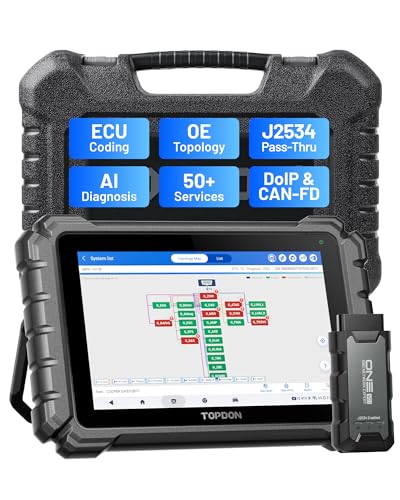
- Dual WiFi & 10.1" Touchscreen: Provides a stable, high-speed wireless link 3x faster than bluetooth, and a responsive, professional interface. Topdon ONE obd2 scanner diagnostic tool ensures smooth, non-lagging diagnostic scan, boosting mechanic efficiency
- J2534 Pass-Thru Support: The included ONE VCI supports the J2534 standard, allowing it to function as a pass-thru device when paired with OEM diagnostic software.Through TOPDON’s RLink platform, technicians can perform dealer-level coding, expanding in-house capabilities without investing in multiple factory automotive scan tools
- OE Topology Mapping: Visualize the vehicle’s ECU network exactly as it’s built.Zoom, pan, and highlight specific modules to pinpoint component issues with precision.Topology mapping displays real-time communication between modules
- 50 Plus Service Functions: Covers high-demand services like ADAS calibration, DPF regen, TPMS reset, ABS bleed, and throttle adaptation.Expands your service menu, allows you to charge premium rates, and turns away zero jobs due to lack of tooling. Vehicle-specific functionality may vary
- Advaned ECU Coding: 10 of the most serviced brands in North America, including full ECU coding and flash hidden support for BMW, VW, Au-di, Benz, Porsche, Toyota, Ni ssan and more. Enables module replacement, feature customization, and personal settings with automatic backup or restore.Lets your shop safely offer high-margin customization services, attracting more customers and boosting profit

- Bi-Directional Control, Quickly Locate Problems: Turn your phone into a professional diagnostic tool. You can send commands from your phone to the ECU to test injectors, cooling fans, headlights, A/C clutch, windows, wipers, and more. See which one doesn't respond. Helps you quickly locate the problem and save time. No need to tear things apart, avoid blind disassembly.
- Flexible Subscription, Choose Advanced Features as Needed: TopScan Lite provides free-for-life access to core diagnostics, including full system scan, code reading, performance tests, and repair information. After purchase, advanced features (bi-directional control, service operations, live data, code clearing, and AI functions) are free-for-the-first-year. After the first year, if you want to use advanced features, you need to subscribe on a monthly, quarterly, or yearly basis. As new models and reset functions are updated, the tool will also be continuously upgraded.
- Full System Diagnostics, No Fault Hides: Unlike basic diagnostic tools that only cover 4 systems, TopScan can scan all systems. Read and clear trouble codes, view live data streams, and generate a complete vehicle health report – all issues are clear at a glance. Covers 10,000+ vehicle models and is compatible with 99.99% of vehicles.
- AI Assistant - TopFix: Think of TopFix as your personal AI mechanic. It leverages a repair database and OEM data to deliver clear, step-by-step repair solutions. Features include AI Q&A, one-click translation, and a full repair log, making your diagnostic process simpler and more efficient.
- 8+ Hot Resets, Keep Your Car in Top Shape: One-tap resets for oil, throttle, EPB, steering angle, DPF, ABS, BMS, and airbag. It enables car owners to easily perform essential maintenance, ensuring the vehicle stays in optimal condition and extends its service life.
Last update on 2026-06-11 / Affiliate links / Images from Amazon Product Advertising API
This product presentation was made with AAWP plugin.