
NHTSA ID Number: 10166284
Manufacturer Communication Number: A0019252011732_1
TSB/Document Date: 2019-10-21
Summary
00 Software Version Management (SVM), operating instructions
00 Software Version Management (SVM), operating instructions
00 19 25 2011732/11 September 17, 2019. Supersedes Technical Service Bulletin Group 00 number 14-65 dated
July 15, 2014 for reasons listed below.
Model(s)
Year
VIN Range
Vehicle-Specific Equipment
All
2002 – 2025
All
Not Applicable
Condition
REVISION HISTORY
Revision
Date
Purpose
11
-
Revised header (Added model years)
Revised bulletin to include the latest information
10
07/15/2014
Revised entire bulletin to include ODIS information
9
02/07/2012
Revised header (Added model years)
Revised Technical Background
Revised Service (Added image)
This Technical Service Bulletin (TSB) details the general process for carrying out a Software Version
Management (SVM) software update for any TSB or Update.
Troubleshooting information is included at the end of the Service section.
Technical Background
Glossary of Terms & Acronyms used in this service bulletin
SVM:
Software Version Management.
ODIS:
Offboard Diagnostic Information System.
ECU:
Electronic Control Unit (i.e. ECM,
TCM, BCM, gateway, cluster, etc.)
ECM:
TCM:
CARPORT:
The database that stores the last known
good configuration for each VIN.
XCHG:
Abbreviation for “exchange” or
replacement (i.e. SVM Code
XCHG15A005).
ASAM-MCD:
ASAM - Measurement, Calibration, and
Diagnostics.
Page 1 of 16
© 2019 Audi of America, Inc.
All rights reserved. Information contained in this document is based on the latest information available at the time of printing and is subject to the copyright and other intellectual property rights of Audi of
America, Inc., its affiliated companies and its licensors. All rights are reserved to make changes at any time without notice. No part of this document may be reproduced, stored in a retrieval system, or transmitted
in any form or by any means, electronic, mechanical, photocopying, recording, or otherwise, nor may these materials be modified or reposted to other sites, without the prior expressed written permission of the
publisher.
ETKA:
ET = Ersatzteil (Spare Parts) & KA =
Katalog (Catalog).
MMI:
Multi-Media Interface.
ASAM:
Association for Standardization of
Automation and Measuring Systems.
MIB:
Modular Infotainment System (ENG).
MOST:
Media-Oriented System Transport.
Service42:
Server hosting the SVM application.
VAS:
Volkswagen Automotive Service
Equipment.
Version42:
Engineering database hosting the ECU
data and configuration files.
ZUG:
Refers to the software package, or
train, of an ECU. “Zug” is a German
word for the train.
FoD:
Function on Demand (after-sales features
or functions that are activated over the air
or SVM).
FPK:
Free-Programmable Cluster (AKA
Virtual Cockpit).
Modularer Infotainment Baukasten (GER).
SVM Basics
SVM was developed to ensure that the hardware and software of each ECU is correct before the vehicle leaves
the dealership repair facility.
A VAS 5051B, VAS 5052A, VAS 6150(A/B/C) or VAS 6160 diagnostic tool is required for reading the vehicle
control module data and sending it to the SVM server (also called an “SVM communication”). The SVM
communication data flow is illustrated below (Figure 1).
Note:
ODIS should be updated to the latest software level before beginning diagnosis or coding.
Diagnostic head 6154 is required on all 2019 and newer vehicles.
Starting with 2019 and newer vehicles the hood is required to be open when programming, this is due to
security architecture in the vehicle.
Windows 10 does not support the 5054x diagnostic head.
Page 2 of 16
© 2019 Audi of America, Inc.
All rights reserved. Information contained in this document is based on the latest information available at the time of printing and is subject to the copyright and other intellectual property rights of Audi of
America, Inc., its affiliated companies and its licensors. All rights are reserved to make changes at any time without notice. No part of this document may be reproduced, stored in a retrieval system, or transmitted
in any form or by any means, electronic, mechanical, photocopying, recording, or otherwise, nor may these materials be modified or reposted to other sites, without the prior expressed written permission of the
publisher.
Figure 1. SVM communication data flow.
SVM Menu Options
The displayed items (Figure 2) may vary based on
the vehicle connected:
1. Erasing DTC memory
2. SVM – Activations
3. SVM – Activations (FoD)
4. SVM – Code input
5. SVM – Erase Activations
6. SVM – Function on Demand
7. SVM – communication, checking
8. SVM – Specified/actual comparison (Only
used on models up to 2017 A4 B9. Function has
Figure 2. SVM main menu options.
Page 3 of 16
© 2019 Audi of America, Inc.
All rights reserved. Information contained in this document is based on the latest information available at the time of printing and is subject to the copyright and other intellectual property rights of Audi of
America, Inc., its affiliated companies and its licensors. All rights are reserved to make changes at any time without notice. No part of this document may be reproduced, stored in a retrieval system, or transmitted
in any form or by any means, electronic, mechanical, photocopying, recording, or otherwise, nor may these materials be modified or reposted to other sites, without the prior expressed written permission of the
publisher.
been moved to the “Check module configuration”
under the guided function for each module).
See the corresponding section below for an explanation of the functions.
SVM - Activations
Purpose:
Used to recover existing activations or to activate new features/functions in an installed control
module:
When used to recover an existing activation, no activation code is required because the
license authorization is already on the server.
When used to activate a new function/feature, a new activation code (and possibly a PIN or
customer code) may be required.
How it works:
New SVM activation codes are used to add features or functions to a vehicle that were not
previously there. Trailer hitch installations and navigation database updates are examples of
when an activation code is used to add functions or features to a vehicle.
Instead of purchasing navigation map data, the customer must purchase an “activation packet”
to unlock the map update installed in the MMI system. The activation packet consists of an
activation code, activation number, and PIN. Once the activation packet information is used on a
vehicle, it is permanently connected to that vehicle in the SVM database and cannot be used on
any other vehicle. This is entered via SVM – Activations.
Map update SD cards can be used on multiple vehicles however an activation document is
needed for every car the software is installed on. See ETKA for the corresponding map update
software to be used with the activation document. For more information regarding map updates,
see TSB 2037809 91: How to update MMI MIB navigation map - potential customer concerns.
Recovery activation is used in service if a module is replaced. When a control module is
replaced that requires activation codes, these are pulled from the SVM server. This occurs
during the ODIS replacement test plan which avoids the need to re-purchase the same
activation documents in the future.
Additional
Information:
Starting with the Audi e-tron quattro and MY 2020 and newer vehicles, all activations are now
stored within the Gateway. Previously, activations were split between the MMI (005F) and the
Gateway (0019). This is important to understand when diagnosing concerns related to missing
or inactive functions. Activated functions will change the available items displayed on the MMI
screen.
Page 4 of 16
© 2019 Audi of America, Inc.
All rights reserved. Information contained in this document is based on the latest information available at the time of printing and is subject to the copyright and other intellectual property rights of Audi of
America, Inc., its affiliated companies and its licensors. All rights are reserved to make changes at any time without notice. No part of this document may be reproduced, stored in a retrieval system, or transmitted
in any form or by any means, electronic, mechanical, photocopying, recording, or otherwise, nor may these materials be modified or reposted to other sites, without the prior expressed written permission of the
publisher.
SVM – Erase Activations
Purpose:
To erase the activations inside the control module. This would be done in an attempt to repair
activations that have become corrupt causing functionality issues in the vehicle. Some control modules have a
maximum number of allowed activations that can be stored at one time. If there are incorrect or illegal activations
stored they count towards the maximum number of allowed activations. In this scenario using the erase
activations function can be helpful.
SVM – Function on Demand (FoD)
Purpose:
Function on demand is a new feature starting with the 2019 Audi e-tron quattro. This function
allows for new features to be activated or deactivated based on customer purchase or subscription.
SVM - Code input
Purpose:
Code input is used to update the software in the vehicle. It is used for any updates that cannot
be performed with SVM - Specified/actual comparison (or SVM - Check Module Configuration,
depending on model).
How it works:
When an SVM code is entered, a “Quick Test” is automatically performed. This test immediately
verifies whether or not the SVM code is valid (before the update is attempted) by sending the
VIN and SVM code for rough verification before other information is read out of the car and sent
to SVM.
If a hardware change is necessary, the software update will not be performed and the
message “the SVM code is not valid for the vehicle” or “check hardware against ETKA”
appears.
If SVM determines that it will not be able to code and/or parameterize the control module
after the update, it will indicate that the SVM code is valid for the vehicle, but the update
cannot be completed. (In such cases, contact TAC for assistance).
If no issue is found, SVM will perform the update.
Some newer MMI and FPK software updates require the software to be downloaded from the
SD creator ahead of time to complete the SVM update. For more information about the SD
Creator process, see TSB 2047812: 00 SD Creator: how to set up and use the SD Creator
for obtaining vehicle software updates via the MirrorServer.
After the update is complete, a specified/actual comparison is performed for the updated
diagnostic addresses in order to calculate the new coding and parameter data1 set for the
control module and to set a new reference in the CARPORT database.
Additional
Information:
Before an SVM code input is attempted, it is important that the condition is correctly
diagnosed and that only a valid code from an applicable TSB is used. Incorrect SVM codes
can cause conflicts in the SVM database.
Page 5 of 16
© 2019 Audi of America, Inc.
All rights reserved. Information contained in this document is based on the latest information available at the time of printing and is subject to the copyright and other intellectual property rights of Audi of
America, Inc., its affiliated companies and its licensors. All rights are reserved to make changes at any time without notice. No part of this document may be reproduced, stored in a retrieval system, or transmitted
in any form or by any means, electronic, mechanical, photocopying, recording, or otherwise, nor may these materials be modified or reposted to other sites, without the prior expressed written permission of the
publisher.
SVM codes can be used to document manual software updates (which are performed with a
CD, DVD, or SD card), such as MMI software package (ZUG) updates. An SVM code for an
MMI update will document changes in the SVM database and provide coding and/or
parameterization suggestions, but it does not perform software updates.
SVM codes for MMI software package (ZUG) updates will only be successful if all control
modules are already updated to the correct level (including those that were recently
replaced).
SVM exchange codes (XCHG) may be used to aid in the installation of new service parts
when a specified/actual comparison cannot code or parameterize the replacement control
module (such as with all Audi airbag control modules). XCHG codes can be found with the
parts bulletin listed in ETKA, or in an applicable TSB. See Figure 3 for the location of SVM
codes found in ETKA.
Figure 3. Location of SVM code in ETKA.
It is critical that the XCHG code is run immediately after a new control module is installed in
the vehicle. If a specified/actual comparison is performed instead of the XCHG code, an
invalid vehicle reference can be created in the SVM database which can prevent the XCHG
code from functioning. (In such cases, contact TAC for assistance). Typically, GFF runs the
XCHG code in the control module replacement routine automatically, or it will ask if an XCHG
code was provided.
SVM - Specified/actual comparison
Purpose:
(Note that this option is not available on model year 2015 and newer A3 vehicles and 2017
models forward -- see SVM - Check module configuration, below, for A3 information).
Page 6 of 16
© 2019 Audi of America, Inc.
All rights reserved. Information contained in this document is based on the latest information available at the time of printing and is subject to the copyright and other intellectual property rights of Audi of
America, Inc., its affiliated companies and its licensors. All rights are reserved to make changes at any time without notice. No part of this document may be reproduced, stored in a retrieval system, or transmitted
in any form or by any means, electronic, mechanical, photocopying, recording, or otherwise, nor may these materials be modified or reposted to other sites, without the prior expressed written permission of the
publisher.
By comparing the current vehicle data with the stored server data, a specified/actual
comparison ensures that all control modules that are installed in the vehicle have the same
part numbers, software versions, coding, and parameter data that were last recorded. If any
discrepancies are found, SVM displays a notification.
Specified/actual comparison does not suggest software updates; it only looks for the last
recorded hardware/software part numbers and last recorded software versions.
How it works:
When a specified/actual comparison is performed, the actual part numbers and actual
software versions in the vehicle (the “actual” data) are sent to the servers. This “actual” data
is compared to the “specified” data stored for the vehicle in the CARPORT database.
The specified/actual comparison will document any changes that have been made to a
control module’s hardware part numbers and software versions if they are valid
supersessions. It will also inform the user if the changes are accepted or rejected.
When a new control module is installed, the specified/actual comparison calculates the
coding and new parameter data set. If a “hardware change suggestion” is given, a conflict
exists within the vehicle reference for the control module (SVM expects a different part
number or software version).
Additional
Information:
SVM will not allow a new control module to be installed if it has an older version of the
software, even if the control module has the same hardware/software part numbers. In this
case, the new control module will need to be updated with the latest software if available on
SD/SVM code card OR the correct module installed. If this is not possible contact TAC for
assistance.
If any hardware changes are suggested as a result of an SVM code being executed, a new
vehicle reference will not be set in the CARPORT database (in order to prevent any bad data
from being documented). As a result, repeat coding and/or parameterization suggestions
may be given with all subsequent SVM communications. It is recommended that all hardware
change suggestions be resolved before any SVM codes are entered. Once the hardware
change issue is resolved, the SVM code must be run again in order to set the reference. This
process is complete when a message appears explaining that no further actions are needed.
SVM - Check module configuration
Purpose:
(Note that this option is only available on model year 2015 and newer A3 and 2017 B9 and newer
models -- see SVM - Specified/actual comparison, above, for other vehicles). It is found when
right-clicking on the module from the control module list display in GFF.
This function ensures that a control module that is installed in the vehicle has the correct part
numbers, software versions, coding, parameter data, and adaptation values by comparing the
current vehicle data with the stored server data.
Check module configuration does not suggest software updates; it only looks for the last
recorded hardware/software part numbers, last recorded software versions, and performs all
necessary adaptations.
Page 7 of 16
© 2019 Audi of America, Inc.
All rights reserved. Information contained in this document is based on the latest information available at the time of printing and is subject to the copyright and other intellectual property rights of Audi of
America, Inc., its affiliated companies and its licensors. All rights are reserved to make changes at any time without notice. No part of this document may be reproduced, stored in a retrieval system, or transmitted
in any form or by any means, electronic, mechanical, photocopying, recording, or otherwise, nor may these materials be modified or reposted to other sites, without the prior expressed written permission of the
publisher.
How it works: The functionality is the same as that of a specified/actual comparison (see above), but there are
separate communications from each control module, rather than one communication from the
entire vehicle.
Additional
Information:
When a new control module is installed, this function calculates the coding, the new parameter
data set, and any applicable adaptations required for the control module. (Not all control
modules will support the setting of adaptations in SVM; ensure that the proper GFF
replacement test plan is followed).
If a control module is being replaced, it is necessary to perform the replacement test plan
which can be found under the Control Modules tab in ODIS. This ensures all functions of the
If the PDF is very large, it may not load in the preview below.
Some older TSBs had multiple PDFs — visit the NHTSA Website to view all PDFs.
If the TSB PDF does not show, download or view it on the NHTSA Website.
Click on the (+) Plus Sign
Then Click on Associated Document(s)
Search NHTSA Database for Recalls
Search NHTSA Database for Vehicle Investigations
View Latest Vehicle Investigations
Search NHTSA Database for Vehicle Complaints
View Latest Vehicle Complaints
TSB/Document ID: A0019252011732_1
Replacement Service Bulletin Number:
MFR Communication Date: 2019-09-17
MFR Internal Campaign ID/Software Version:
Communication Type: Service Bulletin/Repair Instructions
NHTSA Components: ELECTRICAL SYSTEM
MFR Component System:
MFR Component Subsystem:
Previous TSB | Next TSB |
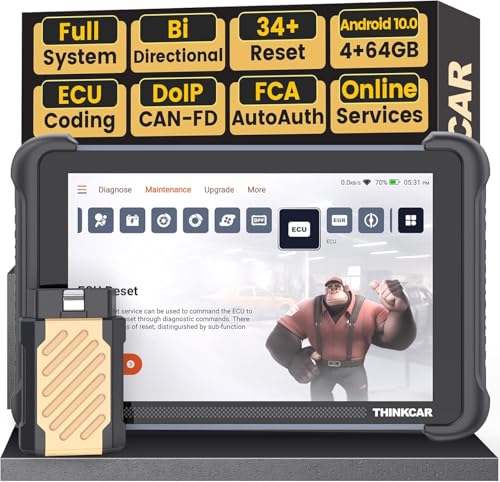
- [Notice] When you receive a used device, it may be a customer return resold by Amazon without inspection. You can exchange it for a new one through Amazon. As this situation is unavoidable, we sincerely apologize. For any issues, contacting us via Amazon's "Messages" is the best way. THINKSCAN 689BT Bidirectional Scan Tool Can Be Used Immediately After It is Turned On, Without Complicated Registration Process, Which is More Convenient & Quick.
- Full Bi-Directional Control & 3000+ Active Tests: Take control and test components like actuators, fuel injectors, relays, and cooling fans in real time. You’ll quickly see if the problem is in the part itself or the control module — saving you hours of guesswork and frustrating trial-and-error.
- Advanced ECU Coding Capabilities: Handle module matching and hidden feature activation with confidence. When you replace an ECU or want to customize settings, this obd2 scanner diagnostic bi directional tool gives you the professional-level capabilities you need without the dealership price tag.
- 34+ Useful Reset and Maintenance Functions: Complete everyday service tasks smoothly with a wide range of helpful reset and maintenance functions. Whether you’re keeping up with regular upkeep or tackling a specific job, this scanner makes maintenance simpler and less stressful for both DIYers and pros.
- Comprehensive Full System Diagnostics: Diagnose every major system — Engine, Transmission
 , ABS, SRS, TPMS, and more — all in one place. Finally stop wondering if you’re missing something important; get the full picture and clear codes with ease.
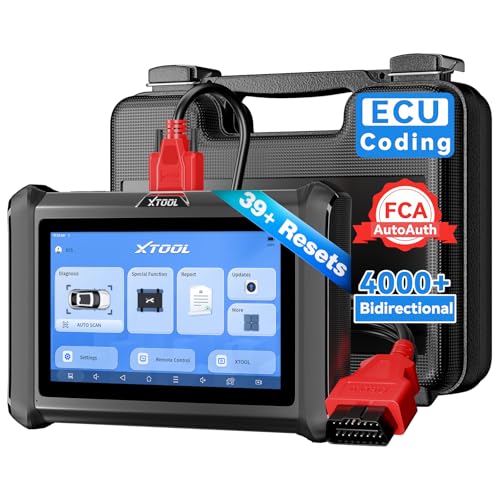
- Top Reasons to Choose the D7S OBD2 Scanner: XTOOL D7S car scan tool, an upgrade of XTOOL D7, offers comprehensive features for automotive technicians, workshops, and DIY enthusiasts 1. Upgraded Hardware: 2+64GB memory, rear camera, intuitive interface, foldable bracket 2. Complete Diagnostics: FCA Autoauth, OE-level all system scan, 39+ maintenance services, 4K+ bidirectional, CANFD/DoIP protocol 3. Advanced Capabilities: ECU coding, PMI functions 4. Wide Compatibility: Support 10,000+ models, covering 99% vehicle brands 5. Multi-language: Available in 22+ languages, No IP Restrictions 6. 3-Year Updates: Save 300 bucks on software updates for the latest features and optimizations
- 2026 Upgraded D7S Car Scanner Features: The newly 2026 D7S V2.0 scanner for car brings exciting features for advanced vehicle diagnostics and enhanced user experience 1. FCA AutoAuth: Now supports FCA SGW module for Chrysler, for Jeep, for Dodge (2018+), for Fiat (2017+), enabling faster vehicle communication without gateway restrictions 2. PMI (Offline ECU Programming): Allows for Ford, for Lincoln, and for Mazda ECU programming for new modules 3. Optimized Diagnostic Report 2.0: Personalized reports with logos and customer info for auto shops. Note: Compatibility varies by cars, please check before order
- Cost-effective ECU Coding Scan Tool for Specific Brands: Enhance your vehicle's performance with XTOOL D7S! This obd2 scanner all systems bidirectional offers advanced capabilities at an affordable price, supports online for BMW, for Benz and offline for BENZ, for MIT, along with PMI functions for Ford, for Mazda, and for Lincoln. Ideal for technicians and DIY enthusiasts, this automotive scanner diagnostic tool optimizes vehicle performance and enhances the driving experience. Note: Not for all cars and modules, please send car VIN to check the compatibility before purchase
- OE All System Diagnostic & 8 Pids Graphing: XTOOL D7S is a comprehensive all system bi directional obd2 scanner that delivers dealer-level diagnostics, completely controlling over your vehicle’s performance and health. This automotive scan tool can read and clear DTCs, view live data and ECU information, retrieve freeze frames, and perform active tests and full obd2 functions. This bi-directional scan tool can can identify your vehicle's make, model, and year information with just one click and show up to 8 PIDs live data with options for CSV viewing, playback, and recording for in-depth analysis. It is easy-to-use for both professionals and beginners, helping pinpoint issues efficiently
- 3 Years Software Update, Value for Money: With 3 years of software updates and 22+ languages(no IP restrictions), XTOOL D7S auto scanner code scanner ensures ongoing compatibility for the latest car models and improved diagnostic functions. This all system vehicle diagnostic scanner comes with a 30-day return policy and a 24-month repair for dependable performance. XTOOL are dedicated to your satisfaction, so enjoy seamless support and lifetime expert assistance. Should you encounter any issues or concerns, don’t hesitate to reach out XTOOL. D7S with newest update with 22 languages freely transfer without authorization, check details from setting-language or from XTOOL
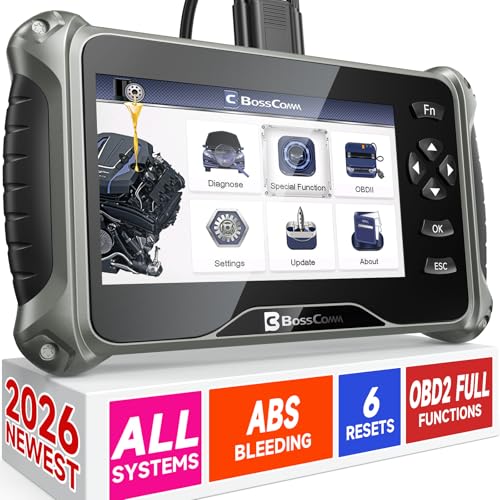
- 【✅Compared to BOSSCOMM IF742, IF745 Offers Full-System Diagnostics】The BOSSCOMM IF745 car diagnostic scanner is an upgraded model of IF742. In addition to supporting all OBD2 Code Reader functions and 6 reset options (ABS/EPB/SAS/BMS/Oil/Throttle), it expands diagnostics from 4 systems (Check Engine/ABS/SRS/Transmission) to vehicle All systems, including Steering, Suspension, and Body Electronics. This provides deeper, more comprehensive diagnostic capabilities.
- 【✨6 Essential Resets: ABS Bleeding, Oil, EPB, SAS, Throttle, BMS】The BOSSCOMM IF745 obd2 scanner diagnostic tool swiftly purges air from brake lines to restore braking sensitivity, fine-tunes maintenance cycles to eliminate false alerts, resolves parking brake issues with one-click control, recalibrates steering sensors for stability, optimizes engine idling/acceleration for smoother performance, and deeply resets battery systems to extend lifespan and range via precise parameter adjustments.❗NOTE: Does NOT support bidirectional control, coding, or programming.
- 【✨Deep Diagnostics for All Vehicle System Modules】Beyond code reading/clearing and ECU information retrieval, our all-in-one data stream feature lets you inspect all current fault codes and their locations across the vehicle’s systems. This vehicle code reader helps you turn off dashboard warning lights and perform a comprehensive self-check of your car at home—no more back-and-forth trips to the repair shop or hefty inspection fees.
- 【✨10 OBD2 Functions】The BOSSCOMM IF745 scan tool’s DTC Lookup instantly translates fault codes into user-friendly explanations, its I/M Readiness feature streamlines emissions testing with a single tap, and Freeze Frame lets you pinpoint the exact moment of a fault for in-depth root-cause diagnosis. Combined with a live data dashboard and advanced diagnostics (O2S, OBMon, EVAP), it delivers comprehensive insights for confident troubleshooting.
- 【✨10,000+ Car Models, AutoVIN, 13 Languages】The BOSSCOMM IF745 vehicle scanner diagnostic tool covers 73+ global car brands and offers support in 13 languages, making it perfect for DIYers, auto mechanics, or as a thoughtful gift. With a single-click AutoVIN feature, it instantly retrieves vehicle serial numbers, streamlining diagnostics for users globally. This adaptable tool balances user-friendliness with precision, catering to both personal and professional requirements.✅Unsure about compatibility? Compatibility will vary on vehicles' model and year, pls reach us via 📧 [email protected] 📧 before purchase.
This product presentation was made with AAWP plugin.