
NHTSA ID Number: 10164658
Manufacturer Communication Number: NTB19-060
TSB/Document Date: 2019-09-10
Summary
2015-2018 NV200 AND 2014-2017 TAXI; DTC P17F0, P17F1, P0776, P2813, P1715, AND/OR P0841 STORED IF YOU CONFIRM One or more of the following DTCs are stored: P0776, P2813, P0841, P17F0, P17F1, P1715 IMPORTANT: +?-+ If DTCs other than those listed above are stored, this bulletin does not apply. +?-+ If the customer states the engine stalled while going from 'P' or 'N' range to 'R' or 'D' range, this bulletin does not apply. +?-+ If DTC P17F0 and/or P17F1 are the only DTCs stored and there is no customer complaint of judder, this bulletin does not apply. +?-+ If DTC P1715 is the only code stored, this bulletin does not apply. ACTION See Repair Flow Chart on page 2 to confirm if this bulletin applies.
next to the dowel pins.
Figure 78
Dowel Pin
Guide Pin
Figure 79
40/98
NTB19-060
61.
Raise the Lifting Fixture so that the CVT assembly weight is mostly supported by the
Lifting Fixture and just slightly raised off of the work surface.
62.
Loosen the side cover with a slide hammer at the three points (tool location marks)
shown in Figure 80.
Rotate between the three (3) locations on the side cover until the CVT case
separates from the sub-assembly; this can take more than one rotation to loosen
sealant.
CAUTION: DO NOT use a pry-bar, chisel, etc. to separate the side cover from
the CVT case.
NOTE: Apply rust penetrant to the two dowel pins as needed.
Tool location marks
Figure 80 shows a similar side
cover and is for reference only
Dowel
pin
Dowel
pin
63.
Figure 80
Raise the Lifting Fixture to remove the
“side cover with pulleys and belt subassembly” (sub-assembly) from the
CVT case (Figure 81).
CAUTION: Make sure the primary
speed sensor is removed from the
sub-assembly.
The speed sensor will be reused.
DO NOT discard the speed sensor.
This sub-assembly will not be
reused.
Figure 81
41/98
NTB19-060
64.
Remove the lifting fixture from the sub-assembly.
65.
Re-install all six (6) original bolts into the old sub-assembly.
Thoroughly clean the mating surfaces of the CVT case (Figure 82) that the subassembly was just separated from (a plastic scraper can be used).
Confirm that the dowel pins have remained in the CVT case. If not, remove them
from the sub-assembly and reattach them back to the CVT case.
NOTE: The Guide Pins can be temporarily removed for cleaning purposes.
CAUTION:
o DO NOT use sanding discs, metal blades, or similar abrasive tools.
o Use brake cleaner or equivalent solvent and lint-free towels only.
o Make sure brake cleaner or solvents used are compatible with local regulations.
o Prevent debris from entering in the CVT.
o Make sure rust and debris have been cleaned off of dowel pins and receiving holes.
66.
Replace the O-ring on the CVT case side with a new one from the PARTS KITS
REFERENCE TABLE; discard the original O-ring (Figure 83).
Coat the O-ring with CVT fluid before installing.
Mating surfaces
O-ring
Figure 82
67.
Figure 83
Remove the thrust bearing from the
planetary carrier plate (Figure 84).
This thrust bearing will be
reused. DO NOT discard.
CAUTION: If not found on the
planetary carrier plate, the thrust
bearing may still be attached to the
primary pulley.
Thrust bearing
Figure 84
42/98
NTB19-060
68.
Rotate the shift select lever counter clockwise to the “L” range position
(Figure 85), so that the parking pawl is at its lowest position (Figure 86).
Parking
pawl
Shift select lever
Figure 85
69.
Figure 86
Attach the Lifting Fixture to the new sub-assembly, and then raise the sub-assembly
out of the shipping box.
First remove the six (6) bolts from the new sub-assembly and then remove their Orings before installing the Lifting Fixture.
These bolts will be reused.
These O-rings will not be reused.
CAUTION: To prevent cross threading, always tighten the bolts by hand.
Refer to step 58 through step 60 for lifting fixture attachment information.
Lifting Fixture
Sub-assembly
Figure 87
43/98
NTB19-060
70.
Apply one continuous 2.0 mm diameter bead of sealant along the center of the CVT
case side mating surface (Figure 88).
Sealant:
Loctite 5460 (see PARTS INFORMATION on page 91)
Color: Pink
IMPORTANT:
Confirm that the mating surfaces are clean before applying sealant.
Make sure that the starting point and the ending point of the sealant is between
two bolt holes. Overlap both ends of the bead by 3 – 5 mm.
CAUTION: Be careful not to contact or contaminate the sealant. If the sealant has
been disturbed or contaminated in any way before case assembly, thoroughly clean
the mating surfaces of the CVT case and re-start from step 70.
Figure 88
44/98
NTB19-060
71.
Install the original thrust bearing on the primary pulley of the new sub-assembly
(Figure 89).
IMPORTANT: The thrust bearing surface must lay flush with the primary pulley. Any
additional height will affect the total end play that is measured later in this procedure.
CAUTION: The thrust bearing has two sides. Reference Figure 90 for bearing
orientation.
Apply a small amount of petroleum jelly or equivalent to the original thrust bearing
to hold it in place on the primary pulley.
Primary pulley
Thrust bearing
Thrust bearing; must sit
flush with primary pulley
surface
Figure 90
Figure 89
45/98
NTB19-060
72.
Coat the primary pulley bearing, secondary pulley gear teeth and the secondary
bearing with CVT fluid prior to installation (Figure 91 and Figure 92).
CAUTION: Do NOT drip any CVT fluid onto the sealant.
The following Figures are for reference only and may or may not have the sealant in
place, or have the old sealant removed. Clean the surfaces and apply sealant when
and where instructed.
Coat these
surfaces with
CVT fluid
Output gear
Figure 91
73.
Figure 92
While lowering the sub-assembly, route the Guide Pins into the appropriate CVT bolt
holes one at a time (the Guide Pins are different lengths for easy assembly).
IMPORTANT: Do NOT allow the output gear to contact the lubrication tube when the
side cover is positioned over the guide pins (Figure 94 and Figure 95).
Lubrication
tube
Figure 93
Figure 94
46/98
NTB19-060
F.
IMPORTANT:
Before continuing, it is recommended that you review and understand the instructions on
pages 47 to 51.
The sub-assembly will lower into the CVT case without applying extra vertical force.
IF THE SUB-ASSEMBLY DOES NOT LOWER COMPLETELY,
INTERFERENCE IS PRESENT.
! PHYSICAL
Key Technique: Raise to remove weight on interference, adjust as necessary, and
then lower again.
Use the “visual gap size” below (Figure 95 and Figure 96), between the sub-assembly and
the CVT case, to determine the cause of interference.
44 mm - Page 46
38 mm - Page 47
CASE GAP = ?
19 mm - Page 48
6 mm Page 49
Figure 95
Case gap
Figure 96
47/98
NTB19-060
74.
Carefully, lower the Lifting Fixture to install the sub-assembly into the CVT case until a
38 mm (1.5 inch) gap is present between the sub-assembly and CVT case. See
Figure 101 on page 49.
Look in to the bearing bore to confirm the output gear is centered (Figure 98).
Place hands on top of the sub-assembly to keep it level and guide it into the
CVT case.
If the sub-assembly will not lower farther than 44 mm (1.75 inches) the
output gear did not clear the bearing bore (Figure 97).
Sub-assembly will not lower past 44 mm (1.75 inches)?
Interference is present between the output gear and bearing bore.
Sub-assembly
44 mm (1.75
inch) gap
CVT case
Output gear
Bearing bore
Output gear
Figure 97
Bearing bore
CVT case
Figure 98
48/98
NTB19-060
CAUTION: In the following steps be careful not to contact or contaminate the sealant. If the
sealant has been disturbed or contaminated in any way before case assembly, remove the
sealant completely and re-start from step 70 on page 44.
75.
Align the parking rod with the parking pawl as follows:
IMPORTANT: Perform step 75 while there is a 38 mm (1.5 inch) gap between the the
sub-assembly and CVT case (Figure 101).
a. Rotate the shift select lever clockwise on the side of the CVT to adjust the parking
rod to the highest position.
b. Use a magnet, or similar tool, to align the parking rod in the CVT case (
in
Figure 100) with the opening in the parking pawl (
in Figure 99) in the side
cover.
NOTE: If the parking rod is not located correctly it will keep the case from
lowering.
The following Figures are for reference only.
Side cover
Parking pawl
Parking rod
Pocket
magnet
Figure 99
CVT case
Figure 100
Sub-assembly
38 mm (1.5
inch) gap
CVT case
Figure 101
49/98
NTB19-060
76.
Continue to slowly lower the sub-assembly into the CVT case.
If the primary and the secondary pulley bearings do not align properly with their
bores (Figure 102) or are at an angle, a gap of 19 mm (0.75 inches) may be
present.
As needed, level the sub-assembly as it is lowered into the CVT case to help the
primary and the secondary pulley bearings align in their bores.
MINOR LEVELING ADJUSTMENTS with limited weight on the sub-assembly will
help the installation. Vertical force is not needed.
Once the sub-assembly is LEVEL, the primary and the secondary pulley bearings
will smoothly align while lowering.
Sub-assembly will not lower past 19 mm (0.75 inches)?
If this occurs Do NOT force the sub-assembly into the case.
a. Raise the sub-assembly slightly.
b. Level the sub-assembly (visually check the gap between case and sub-assembly
side cover and confirm that it is even all around).
c. Gently lower the sub-assembly.
d. Gently shake the sub-assembly horizontally, lower, raise and repeat as needed
to help align.
e. Lower to engage the dowel pins and a 6 mm (0.25 inch) gap is between the subassembly and CVT case.
Sub-assembly
Primary
pulley bearing
19 mm (0.75
inch) gap
Secondary
pulley bearing
Bearing bore
CVT Case
Bearing bore
Figure 102
50/98
NTB19-060
IMPORTANT: In the following steps the case halves must sit flush against each other
without a gap before installing the bolts. The bolts CANNOT be used to draw the cases
together. DO NOT APPLY VERTICAL FORCE.
77.
Once the dowel pins are cleared, ease the sub-assembly down onto the CVT case
until the case halves are flush.
Confirm the dowel pins are clean and aligned and are not catching on the subassembly case cover.
WARNING: Be careful not to get fingers caught between the CVT case and subassembly when seating.
Sub-assembly will not lower past 6 mm (0.25 inches)?
If the sub-assembly will not lower past 6 mm (0.25 inches), the primary pulley splines are
not aligned.
If this occurs Do NOT force sub-assembly into case.
a. Raise the sub-assembly slightly so the weight is not completely on the primary
pulley splines.
b. Slightly rotate the primary pulley through the bottom of the CVT and then lower
the sub-assembly.
c. Repeat as needed.
Sub-assembly
Primary pulley
6 mm (0.25
inch) gap
Belt
element
CVT
case
Primary pulley
splines
Touch side of primary
pulley to align splines
Planetary
carrier splines
Do not place fingers
below primary pulley
Figure 103
51/98
NTB19-060
Rotate the shift select lever
78.
Confirm the parking rod operation as
follows:
a. Rotate the shift select lever counter
clockwise and confirm that all
detents for each of the P-R-N-D-L
are felt.
b. Rotate the lever clockwise to return
the rod back to the P position.
c. Are all of the detents felt?
YES: Proceed to step 79.
Figure 104
NO: If the lever does not rotate
or if all detents are not felt:
1) Raise the sub-assembly and remove all sealant.
2) Restart from step 70 on page 44.
79. Remove the guide pins.
52/98
NTB19-060
80.
Install the new side cover bolts (Figure 105).
Torque the first eight (8) bolts marked as
in the sequence numbered in
Figure 105 below, and then torque the rest of the bolts in a clockwise direction.
Bolt torque: 45 N•m (4.6 kg-m, 33 ft-lb) 19 pieces.
8
4
2
6
Torque un-numbered bolts
in clockwise direction
3
1
5
7
Figure 105
81.
Remove the Lifting Fixture.
82.
Install six (6) new O-rings, from the Parts Kits Reference Table on page 95, to the
six (6) new pulley bearing retainer bolts that were removed from the new subassembly on page 43, step 69.
83.
Install the six (6) new pulley bearing
retainer bolts finger tight.
Do not use tools to install.
Figure 106
53/98
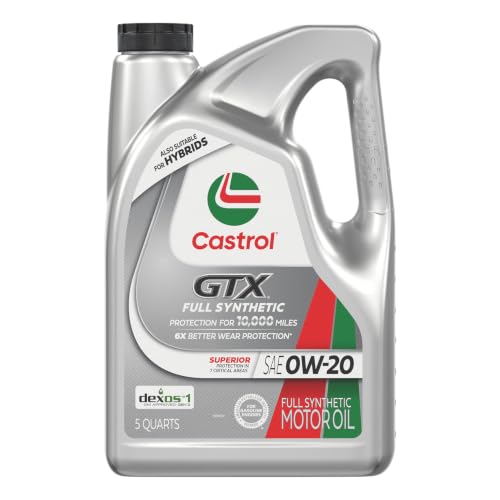
- 6X better wear protection on critical engine parts than...
- 1.3X better sludge protection than industry standards*
- 3X Stronger against viscosity breakdown than leading full...
- Protection for 10,000 miles between oil changes
- Meets or exceeds the following specifications: API SP/SN...

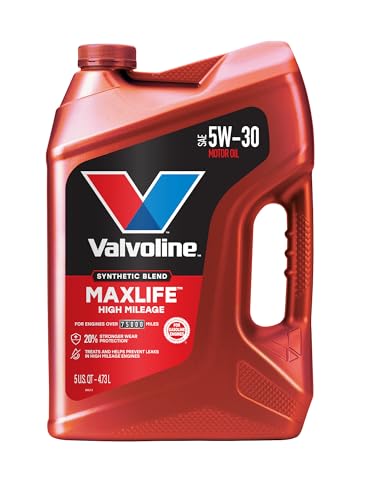
- Formulated for engines with 75,000 miles or more, Valvoline...
- Delivers 20% better wear protection and 15% better sludge...
- Extra detergents safeguard against friction, corrosion and...
- Advanced friction-fighting additives help maximize...
- Provides performance benefits for high mileage, new and...
Last update on 2026-06-23 / Affiliate links / Images from Amazon Product Advertising API
If the PDF is very large, it may not load in the preview below.
Some older TSBs had multiple PDFs — visit the NHTSA Website to view all PDFs.
If the TSB PDF does not show, download or view it on the NHTSA Website.
Click on the (+) Plus Sign
Then Click on Associated Document(s)
Search NHTSA Database for Recalls
Search NHTSA Database for Vehicle Investigations
View Latest Vehicle Investigations
Search NHTSA Database for Vehicle Complaints
View Latest Vehicle Complaints
TSB/Document ID: NTB19-060
Replacement Service Bulletin Number:
MFR Communication Date: 2019-08-01
MFR Internal Campaign ID/Software Version:
Communication Type: Service Bulletin/Repair Instructions
NHTSA Components: POWER TRAIN
MFR Component System:
MFR Component Subsystem:
Previous TSB | Next TSB |
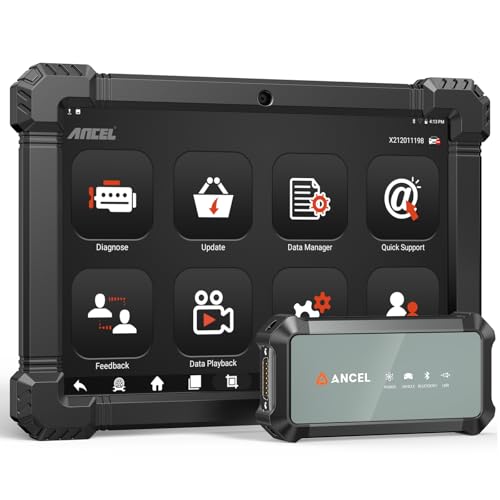
- 2026 ALL-IN-ONE HEAVY DUTY TRUCK SCANNER – BUILT FOR DIESEL DIAGNOSTICS:The ANCEL X7HD PRO combines full-system diagnostics, bi-directional control, ECU coding, HDOBD/OBD2 functions, and 42+ reset services in one powerful heavy duty truck scanner. This diesel scan tool helps technicians, fleet owners, and repair shops diagnose problems faster, reduce downtime, and complete more repairs without switching between multiple truck diagnostic tools. Features a 10.1" Android tablet, Bluetooth & Wi-Fi, live data graphing, and 2 years of f-ree updates
- 42+ RESET FUNCTIONS – MORE THAN A BASIC TRUCK CODE READER:Perform essential service functions including forced DPF regeneration, injector coding, speed limiter adjustment, idle adjustment, oil reset, ABS
 reset, SRS reset, EPB reset, throttle reset, and suspension calibration. Designed for real truck maintenance and fleet service, this commercial truck diagnostic scanner helps reduce dealer visits, avoid unnecessary downtime, and handle more repair jobs with one diesel diagnostic tool
 - ACTIVE TEST & ECU CODING – ADVANCED BIDIRECTIONAL SCAN TOOL FOR TRUCKS:Quickly locate faults by activating components and sending commands directly to vehicle systems. Test injectors, ABS, throttle, cooling systems, and other modules in real time without unnecessary disassembly. ECU coding and module matching help adapt replacement parts, restore factory settings, and reduce repeat repairs, making this semi truck scan tool ideal for advanced troubleshooting and daily shop work
- FULL-SYSTEM HDOBD/OBD2 DIAGNOSTICS – WIDE TRUCK & ENGINE COVERAGE:Read and clear codes, monitor live data, freeze frame, and diagnose engine, transmission, ABS, body, and other major systems. Compatible with Freightliner, Kenworth, Peterbilt, Volvo, Mack, International, and other commercial truck brands, plus Cummins, Caterpillar, Detroit, Paccar, and Navistar diesel engines. Also supports full OBD2/EOBD diagnostics for standard vehicles, making it a versatile truck obd2 scanner for mixed fleets and repair shops
- PROFESSIONAL HARDWARE + RELIABLE SUPPORT – BUILT FOR DAILY SHOP USE:This professional diesel diagnostic computer features a 10.1" touchscreen, Android 10.0 system, 6000mAh battery, Bluetooth/Wi-Fi connectivity, and built-in front & rear cameras for documenting repairs and remote troubleshooting. Includes 2 years of fr-ee updates, 1-year w-arranty, and responsive technical support. Contact [email protected] before purchase to confirm compatibility and supported functions for your truck or diesel engine

- 【Built for Heavy Duty Diesel Diagnostics】Designed for SAE J1939 and J1708 compliant trucks, buses, and diesel-powered commercial vehicles. HD601 truck scanner diagnostic tool helps owner-operators, small fleets, mobile technicians, and independent repair shops quickly identify fault codes, view live data, and make informed repair decisions—saving time, reducing downtime, and avoiding unnecessary shop visits
- 【Full System Diagnostics+All HD OBD Modes】The New HD601 heavy duty truck scanner delivers full-system diagnostics on SAE J1939 and J1708-compliant commercial vehicles—digging into engine, transmission, ABS, fuel, every system that keeps your rig rolling. It supports all HD OBD modes, giving you live data, freeze frame, ECU info, vehicle info, emissions data tracking, plus code reading and clearing. Not just what broke, but why—so you fix it right the first time. Pinpoint issues faster, cut repair costs, and spend less time on the shoulder
- 【Wide Heavy-Duty Vehicle Coverage】Supports a wide range of heavy-duty vehicle manufacturers and systems, including Freightliner, Kenworth, Peterbilt, Volvo, International, Detroit, Cummins, Paccar, Allison, Eaton, Bendix, Wabco, and more. Coverage varies by vehicle make, model, year, and system configuration. Contact our support team before purchase if compatibility verification is needed
- 【Speaks Major Truck Protocol】The New HD601 diesel truck scanner is built for American-made trucks—and supports the heavy‑duty protocols you' re most likely to run into on the road: SAE J1939, J1708/J1587, ISO 15765‑4, ISO 14230‑4, ISO 9141‑2, J1850 PWM/VPW, ISO 27145‑4, and EURO‑6. For most trucks, model years, and systems, it speaks the language your vehicle understands. Just plug it in and start diagnosing—no guesswork, no gatekeeping. Note: vehicle functions and module availability may vary by manufacturer and model year
- 【Save Hundreds on Diagnostic Fees】Why pay $150–300 for someone to read your codes? With the New ANCEL heavy duty truck scanner, you can pull fault codes yourself—in minutes, without leaving the truck. One or two uses pays for the tool. After that, every diagnostic is money back in your pocket. Smart investment for owner-operators, techs, and small fleets. Read and clear stored fault codes in minutes. Active fault codes may require repairs before they can be cleared
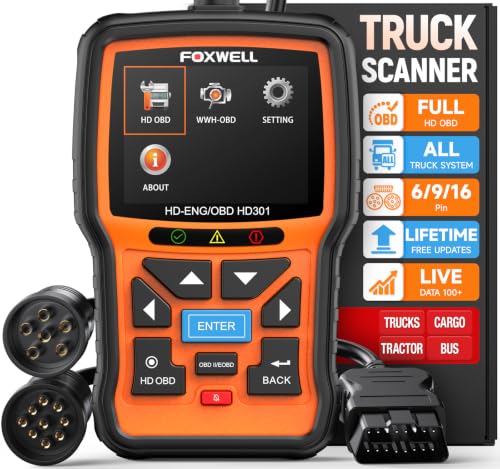
- 【One Tool, Total Fleet Coverage: 6/9/16 Pin Ready】Featuring an integrated 16-pin OBD2 connector and professional-grade 6-pin & 9-pin adapters, this heavy duty truck scanner provides extensive support for J1939, J1708, J1587, ISO 14230-4, ISO 15765-4 and ISO 9141-2, ISO 27145-4 protocols. It offers reliable diagnostic coverage for major American diesel brands—including Cummins, Paccar, Caterpillar, Detroit, and Freightliner—making it a versatile semi truck scanner for managing any diverse fleet.
- 【2 in 1 Diesel Code Reader & Advanced HD OBDII】Equipped with professional-grade diesel scanner capabilities, the HD301 diesel scanner features intuitive Read/Erase codes and turn off the "Check Engine" light. With the built-in DTC Lookup library, you can instantly access fault code definitions on-device without searching the internet. It also retrieves hundreds of essential live sensor data—such as coolant temperature, fuel pressure, and engine RPM—in a stable text format for precise and rapid troubleshooting. (Please note that the HD301 can not support DPF Regen.)
- 【Full System Truck Diagnostic】The FOXWELL HD301 heavy duty scan tool is engineered to deeply access and scan all available electronic control modules specifically for truck, including Engine, Transmission, ABS, SRS, Chassis, and Body Control. This professional truck scanner diagnostic tool allows you to identify issues across the entire vehicle, ensuring your rig stays in peak condition for the long haul.
- 【Versatile for most big Rigs: Commercial, Passenger & Beyond】Engineered for more than just trucks, this heavy duty scan tool offers extensive coverage for pickups, buses, trailers, and even marine vessels. From construction machinery (excavators, loaders) to agricultural equipment (tractors, harvesters), it provides a true all-in-one diagnostic solution.
- 【Plug-and-Play & No Subscription】Designed for the road! No WiFi, no batteries, and no complex App setup required. Simply plug it into your vehicle’s diagnostic port to start scanning immediately. Enjoy lifetime free software updates to keep your HD301 diesel truck scanner current with the latest vehicle models and features—without any hidden subscription fees—While overcoming language barriers with support for Spanish and English.
Last update on 2026-06-23 / Affiliate links / Images from Amazon Product Advertising API
This product presentation was made with AAWP plugin.