
NHTSA ID Number: 10163231
Manufacturer Communication Number: SD-01-333-US-004
TSB/Document Date: 2019-07-29
Summary
Bendix Tu-Flo 550 Air Compressor service data sheet update.
SD-01-333
®
Bendix® Tu-Flo® 550 Air Compressor
Discharge Upper &
Lower Valve Stop
Air Discharge
Unloader
Cover
Water Outlet
Water
Inlet
Discharge
Valve
Air Inlet
Discharge
Valve Seat
Crankcase
Discharge
Valve Spring
Governor
Mounting
Pad
Crankcase
Connecting
Rod
Piece No.
Tag
Crankshaft
Exterior
Cross Section
Cylinder
Head
Unloader
Inlet Valve
Tu-Flo 550 for
Navistar®
Inlet Valve
Seat
Inlet
Inlet Valve
Spring
OE and Service New Bendix ® Tu-Flo ® 550 air
compressors manufactured for Navistar® after April
2006, contain two parallel ribs on the sides of the body
as shown here. These ribs identify the air compressor
as a genuine Bendix® product. If the Navistar version
OE or Service New air compressor being serviced was
manufactured after this date and does not contain these
ribs, it is not a genuine Bendix® product.
End View Of Cylinder Head
Figure 1 – Bendix® Tu-Flo® 550 Air Compressor
1
GENERAL SAFETY GUIDELINES
WARNING! PLEASE READ AND FOLLOW THESE INSTRUCTIONS
TO AVOID PERSONAL INJURY OR DEATH:
When working on or around a vehicle, the following guidelines should be observed AT ALL TIMES:
▲ Park the vehicle on a level surface, apply the
parking brakes and always block the wheels.
Always wear personal protection equipment.
▲ Stop the engine and remove the ignition key
when working under or around the vehicle.
When working in the engine compartment,
the engine should be shut off and the ignition
key should be removed. Where circumstances
require that the engine be in operation, EXTREME
CAUTION should be used to prevent personal
injury resulting from contact with moving,
rotating, leaking, heated or electrically-charged
components.
▲ Do not attempt to install, remove, disassemble
or assemble a component until you have read,
and thoroughly understand, the recommended
procedures. Use only the proper tools and
observe all precautions pertaining to use of those
tools.
▲ If the work is being performed on the vehicle’s
air brake system, or any auxiliary pressurized air
systems, make certain to drain the air pressure
from all reservoirs before beginning ANY work
on the vehicle. If the vehicle is equipped with a
Bendix® AD-IS® air dryer system, a Bendix® DRM™
dryer reservoir module, or a Bendix® AD-9si® air
dryer, be sure to drain the purge reservoir.
▲ F o l l o w i n g t h e v e h i c l e m a n u f a c t u r e r ’s
recommended procedures, deactivate the
electrical system in a manner that safely removes
all electrical power from the vehicle.
▲ Never exceed manufacturer’s recommended
pressures.
▲ Never connect or disconnect a hose or line
containing pressure; it may whip and/or cause
hazardous airborne dust and dirt particles. Wear
eye protection. Slowly open connections with
care, and verify that no pressure is present. Never
remove a component or plug unless you are
certain all system pressure has been depleted.
▲ Use only genuine Bendix ® brand replacement
parts, components and kits. Replacement
hardware, tubing, hose, fittings, wiring, etc. must
be of equivalent size, type and strength as original
equipment and be designed specifically for such
applications and systems.
▲ Components with stripped threads or damaged
parts should be replaced rather than repaired.
Do not attempt repairs requiring machining or
welding unless specifically stated and approved
by the vehicle and component manufacturer.
▲ Prior to returning the vehicle to service, make
certain all components and systems are restored
to their proper operating condition.
▲ For vehicles with Automatic Traction Control
(ATC), the ATC function must be disabled (ATC
indicator lamp should be ON) prior to performing
any vehicle maintenance where one or more
wheels on a drive axle are lifted off the ground
and moving.
▲ The power MUST be temporarily disconnected
from the radar sensor whenever any tests USING
A DYNAMOMETER are conducted on a vehicle
equipped with a Bendix® Wingman® system.
▲ You should consult the vehicle manufacturer's operating and service manuals, and any related literature,
in conjunction with the Guidelines above.
DESCRIPTION
The function of the air compressor is to provide and
maintain air under pressure to operate devices in the air
brake and/or auxiliary air systems. The Bendix® Tu-Flo® 550
compressor is a two cylinder single stage, reciprocating
compressor with a rated displacement of 13.2 cubic feet
per minute at 1250 RPM.
The compressor assembly consists of two major
subassemblies, the cylinder head and the crankcase.
The cylinder head is an iron casting which houses the
inlet, discharge, and unloader valves. (See Figure 1). The
cylinder head contains the air inlet port and is designed
with both top and side air discharge ports. Three water
2
coolant ports provide a choice of coolant line connections.
Governor mounting surfaces are provided at both the front
and the rear of the cylinder head. The head is mounted
on the crankcase and is secured by six cap screws. The
Tu-Flo 550 compressor is designed such that the cylinder
head can be installed in one of two positions which are 180°
apart. The crankcase houses the cylinder bores, pistons,
crankshaft and main bearings, and provides the flange or
base mounting surface.
Various mounting and drive configurations, as shown in
Figure 3, are supplied as required by the vehicle engine
designs. A nameplate identifying the compressor piece
number and serial number is attached to the side of the
crankcase. (See Figure 4).
Unloader Cover
Plate
Air Discharge
Air
Discharge
Water
Air Inlet
Water
Water
Governor
Figure 2 – Cylinder Head
Mack®
Extended
Mack
"Foxhead"
Detroit
Diesel®
Cat
Base
Mount
Figure 3 – Flange Configurations
TU-FLO 550 COMPRESSOR
®
BENDIX NO.
SERIAL NO.
MANUFACTURED BY BENDIX
Figure 4 – Nameplate
OPERATION
The compressor is driven by the vehicle engine and
is operating continuously while the engine is running.
Actual compression of air is controlled by the compressor
unloading mechanism and the governor. The governor,
which is generally mounted on the compressor, maintains
the brake system air pressure to a preset maximum and
minimum pressure level.
INTAKE AND COMPRESSION OF AIR
(LOADED)
During the down stroke of the piston, a slight vacuum is
created between the top of the piston and the cylinder head,
causing the inlet valve to move off its seat and open. (Note:
The discharge valve remains on its seat.) Atmospheric air
is drawn through the air strainer and the open inlet valve
into the cylinder (See Figure 5). As the piston begins its
upward stroke, the air that was drawn into the cylinder on
the down stroke is being compressed. Air pressure on the
inlet valve plus the force of the inlet spring, returns the
inlet valve to its seat and closes. The piston continues the
upward stroke and compressed air pushes the discharge
valve off its seat and air flows by the open discharge valve,
into the discharge line and to the reservoirs (See Figure
6). As the piston reaches the top of its stroke and starts
down, the discharge valve spring and air pressure in the
discharge line returns the discharge valve to its seat. This
prevents the compressed air in the discharge line from
returning to the cylinder bore as the intake and compression
cycle is repeated.
3
Air
Discharge
Port
Discharge
Valve
Closed
Inlet
Valve
Open
Piston
Moving
Down
Governor
Port
Air
Inlet
Port
Discharge
Valve
Closed
Inlet Valve
Held Open
By Unloader
Piston
Figure 7 – Operational-Unloaded
Governor
Port
Air
Inlet
Port
Discharge
Valve
Open
Unloader
Piston
Air
Inlet
Port
Figure 5 – Operational-Loaded (Intake)
Air
Discharge
Port
Discharge
Port
Governor
Port
Inlet
Valve
Closed
Piston
Moving
Up
Figure 6 – Operational-Loaded (Compression)
NON-COMPRESSION OF AIR (UNLOADED)
When air pressure in the reservoir reaches the cut-out
setting of the governor, the governor allows air to pass
from the reservoir, through the governor and into the cavity
above the unloader pistons. The unloader pistons move
down, holding the inlet valves off their seats (See Figure 7).
With the inlet valves held off their seats by the unloader
pistons, air is pumped back and forth between the two
cylinders, and the discharge valves remain closed. When
air pressure from the reservoir drops to the cut-in setting
of the governor, the governor closes and exhausts the air
from above the unloader pistons. The unloader springs
force the pistons upward and the inlet valves return to their
seats. Compression is then resumed.
4
COMPRESSOR & THE AIR BRAKE SYSTEM
GENERAL
The compressor is part of the total air brake system, more
specifically, the charging portion of the air brake system.
As a component in the overall system its condition, duty
cycle, proper installation, and operation will directly affect
other components in the system.
Powered by the vehicle engine, the air compressor builds
the air pressure for the air brake system. The air compressor
is typically cooled by the engine coolant system, lubricated
by the engine oil supply, and has its inlet connected to the
engine induction system.
As the atmospheric air is compressed, all the water vapor
originally in the air is carried along into the air system, as
well as a small amount of the lubricating oil as vapor. If an
air dryer is not used to remove these contaminants prior
to entering the air system, the majority, but not all, will
condense in the reservoirs. The quantity of contaminants
that reach the air system depends on several factors
including installation, maintenance, and contaminant
handling devices in the system. These contaminants must
either be eliminated prior to entering the air system or after
they enter.
DUTY CYCLE
The duty cycle is the ratio of time the compressor spends
building air to the total engine running time. Air compressors
are designed to build air (run "loaded") up to 25% of the
time. Higher duty cycles cause conditions that affect air
brake charging system performance which may require
additional maintenance. Factors that add to the duty cycle
are: air suspension, additional air accessories, use of an
The Air Brake Charging System supplies the
Discharge
Line
Optional “Ping” Tank
Air Dryer
compressed air for the braking system as well as other air
accessories for the vehicle. The system usually consists
of an air compressor, governor, discharge line, air dryer,
and service reservoir.
Optional Bendix® PuraGuard® QC
Oil Coalescing Filter
Compressor
Governor
(Governor plus Synchro Valve
for the Bendix® DuraFlo 596™
Compressor)
Service
Reservoir
(Supply Reservoir)
Reservoir Drain
Figure 8 – System Drawing
undersized compressor, frequent stops, excessive leakage
from fittings, connections, lines, chambers or valves, etc.
Refer to Table A in the Troubleshooting section for a guide
to various duty cycles and the consideration that must be
given to maintenance of other components.
COMPRESSOR INSTALLATION
While the original compressor installation is usually
completed by the vehicle manufacturer, conditions of
operation and maintenance may require additional
consideration. The following presents base guidelines.
DISCHARGE LINE
The discharge line allows the air, water- and oil-vapor
mixture to cool between the compressor and air dryer or
reservoir. The typical size of a vehicle's discharge line,
(see column 2 of Table A in the Troubleshooting section)
assumes a compressor with a normal (less than 25%) duty
cycle, operating in a temperate climate. See Bendix and/or
other air dryer manufacturer guidelines as needed.
DISCHARGE LINE TEMPERATURE
When the temperature of the compressed air that enters
the air dryer is within the normal range, the air dryer can
remove most of the charging system oil. If the temperature
of the compressed air is above the normal range, oil as
oil-vapor is able to pass through the air dryer and into the
air system. Larger diameter discharge lines and/or longer
discharge line lengths can help reduce the temperature.
The air dryer contains a filter that collects oil droplets, and
a desiccant bed that removes almost all of the remaining
water vapor. The compressed air is then passed to the air
brake service (supply) reservoir. The oil droplets and the
water collected are automatically purged when the governor
reaches its "cut-out" setting.
For vehicles with accessories that are sensitive to small
amounts of oil, we recommend installation of a Bendix®
PuraGuard® QC oil coalescing filter, designed to minimize
the amount of oil present.
The discharge line must maintain a constant slope down
from the compressor to the air dryer inlet fitting or reservoir
to avoid low points where ice may form and block the flow.
If, instead, ice blockages occur at the air dryer or reservoir
inlet, insulation may be added here, or if the inlet fitting is
a typical 90° fitting, it may be changed to a straight or 45°
fitting. Shorter discharge line lengths or insulation may be
required in cold climates.
While not all compressors and charging systems are
equipped with a discharge line safety valve, this component
is recommended. The discharge line safety valve is
installed in the cylinder head (Tu-Flo® 550/750) or close to
the compressor discharge port and protects against over
pressurizing the compressor in the event of a discharge
line freeze up.
Hole
Thread
Figure 9 – Discharge Line Safety Valve
5
3. Pressurized induction - Compressor inlet is connected
to the pressure side of the supercharger or turbocharger.
See the tabulated technical data on page 18 of this manual
for specific requirements for steps 2 and 3.
Oil
Inlet
If a previously unturbocharged compressor is being
turbocharged, it is recommended that the inlet cavity screen
(238948) be installed with an inlet gasket (291909N) on
both sides of the screen.
Figure 10 – Lubrication
LUBRICATION
The vehicle's engine provides a continuous supply of oil
to the compressor. Oil is routed from the engine to the
compressor oil inlet. An oil passage in the compressor
crankshaft allows oil to lubricate the connecting rod
crankshaft bearings. Connecting rod wrist pin bushings
and crankshaft ball bearings are spray lubricated. An oil
return line connected from the compressor drain outlet
to the vehicle engine crankcase allows for oil return. On
flange mounted models the oil drains back directly to the
engine through the mounting flange.
COOLING
Air flowing through the engine compartment from the
action of the engine’s fan and the movement of the vehicle
assists in cooling the compressor. Coolant flowing from the
engine’s cooling system through connecting lines enters
the head and passes through internal passages in the
cylinder head and is returned to the engine. Proper cooling
is important in maintaining discharge air temperatures
below the maximum recommended 400° F (204° C).
Figure 11 illustrates the various approved coolant flow
connections. See the tabulated technical data in the back
of this manual for specific requirements.
AIR INDUCTION
There are three methods of providing clean air to the
Tu-Flo® 550 compressor:
1. Naturally aspirated Local Air Strainer - Compressor
utilizes its own attached air strainer (polyurethane
sponge or pleated paper dry element).
2. Naturally aspirated Engine Air Cleaner - Compressor
inlet is connected to the engine air cleaner or the
vacuum side (engine air cleaner) of the supercharger
or turbocharger.
6
Water
In
Water
Out
or
(1 Port
Only)
Water Out
Water
Out
Water
In
Water
In
Figure 11 – Cooling
or
(1 Port


- [J2534 Pass-Thru Programmer] - TOPDON RLink J2534 is...
- [All-in-One OEM Reprogramming and Diagnostics] - When...
- [Tested, Trusted, and Proven for Accuracy] - TOPDON RLink...
- [One-Click Installation, Continuous Updates] - The exclusive...
- [Works with Windows Compatibility and OEM Software...

Last update on 2026-05-22 / Affiliate links / Images from Amazon Product Advertising API
If the PDF is very large, it may not load in the preview below.
Some older TSBs had multiple PDFs — visit the NHTSA Website to view all PDFs.
If the TSB PDF does not show, download or view it on the NHTSA Website.
Click on the (+) Plus Sign
Then Click on Associated Document(s)
Search NHTSA Database for Recalls
Search NHTSA Database for Vehicle Investigations
View Latest Vehicle Investigations
Search NHTSA Database for Vehicle Complaints
View Latest Vehicle Complaints
TSB/Document ID: SD-01-333-US-004
Replacement Service Bulletin Number:
MFR Communication Date: 2019-03-18
MFR Internal Campaign ID/Software Version:
Communication Type: Service Bulletin/Repair Instructions
NHTSA Components: EQUIPMENT
MFR Component System:
MFR Component Subsystem:
Previous TSB | Next TSB |

- Scanner POR V2.0 with all obd2 services
- Do the scanning for engine
- Support OBDII/EOBD Ten Modes of Operation

- 【Designed for Most Mercedes-Benz
 , Sprinter and Smart from 1996-2023】As every car model of Benz has its-owned specific car system and ECUs, not all models are equipped with a complete vehicle ECU, which may cause the scanner to be unable to perform all listed reset services on some models, or even completely incompatible. Like For Sprinter's newer models, it support diagnostic functions only, lacking support for specialized service functions.. So please tell us the car's VIN and required service before purchase for compatibility check. You may also refer to the instructions in the eighth image of the main product photos to perform your inquiry.
 - 【Up to 38 Reset Services】MB V3.0 2026 Version diagnostic tool performs Up to 38 maintenance services - Oil Rest , SAS, EPB, ETC, D-P-F, TPMS, ABS, Suspension, Air Conditioner, Head Lamp, Body Stability, Engine Control, Seat, Fuel Pump, Air-Filter, Engine Idle, Door, Im-mo-bilizer, Injector Coding, Transmission Control, Miscellaneous, Adblue, BMS, Cluth, Water Pump, NOxSensor, Rain/Light Sensor, Start/Stop, Radar/Camera, Cylinder Shutoff Test, Speed Limit Assist, Control Unit Reset, Oxygen Sensor, Seat Belt, Cruise Control System, Turbocharger, Crankshaft, Language Setting and etc. (Tips: Please update the software after receiving the product to obtain new service functions)
- 【OE-Level All System OBD2 Scanner】iCarsoft MB V3.0 (2026 Version) diagnostic scanner offers comprehensive OBDII services, allowing you to quickly scan all systems, including the Engine, ABS, SAS, SRS, TPMS, TCM, Fuel Pump System, ESP, EPB, EPS, Suspension, SCM, Adaptive Systems, and more. It supports functions such as reading and erasing codes, checking I/M readiness, viewing freeze frame data, performing O2 sensor tests, conducting on-board monitoring, testing the evap system, auto VIN retrieval, and reading both generic and specific codes, as well as DTCs and battery tests.
- 【Bidirectional Scan Tool】iCarsoft MB V3.0 (2026 Version) Bidirectional scanner supports activate or control a vehicle system or component, allows commanding cars’ modules and receiving info from the ECU to perform active tests on individual components, including EVAP/ABS Motor Pump/Windows/Sunroof and more, to pinpoint fault causes & resolve issues,and allows you to re-learn certain components after making repairs or replacement.
- 【Real Time Record & Graph View】iCarsoft MB V3.0 (2026 Version) can automatically record vehicle text history and identify vehicle information. Preserve real-time data information. View & Graph Live Data. Support Data Review and Print. Multi-language: English, German, Dutch, Spanish, French and so on. We promise to offer Lifetime updates (Lifetime free Update via PC), and confidence in products. We also provide 1 year warranty + extra lifetime hardware free repair if you need it in the future. We prioritize user experience & strive to meet your expectations. Please do feel free to reach out to us if you have any question or problem about the usage, our tech team will service you in time.
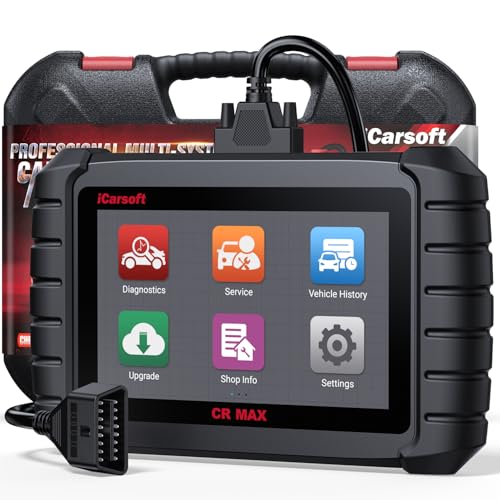
- WHY CHOOSE THE 2025 CR MAX -Upgrade the latest diagnostic capabilities for all vehicles after 1996: upgrade to 49+maintenance services; 46 extra specific functions; real all systems/all control modules diagnose; over 40K+ bidirectional actuation tests for diagnosing all control moduels of cars; Powerful full OBD2 Functions; built-in ECU Coding for BMW/ Audi/ VW/ RollsRoyce; Fr ee V.A.G Guide Function; Battery retistration for new battery adaptation and more. It covers all vehicle diagnostic services and some special professional vehicle maintenance servces, assists you to do home DIY vehicle maintenance or car repair as a pro technician.
- NEWEST IN INNOVATION FULL OBD2 SERVICES- iCarsoft auto car diagnostic scanner compatible with CAN-FD, CR MAX can do it all-reads and clears trouble codes, ALL SYSTEM DIAGNOSIS such as engine, transmission, ABS and airbag etc. CR MAX code reader for all cars can perform I/M Readiness, Live Data, Freeze Frame, Vehicle Information, Monitor Test, On-Board Monitor, E vap System Test,O2 Sensor Test,DTC Library Lookup,etc. (Warm Tips: If you car is after 2023,please contact us for compatibility; 3. It comes with 16PIN OBD2 diagnostic adapter, please check your car diagnostic socket if it is 16pin socket, if your car is 14pin diagnostic socket please contact us for the solution.)
- 49 RESET+ 46 SERVICES- Performs: Oil Reset, EPB,SAS,Throttle, D-P - F, Battery, ABS, Injector, TPMS, Suspension, AC, Head Lamp, Body Stablity, Engine, Tramsmission, Airbag, Seat, Door-Win-Roof, Fuel Pump, Door, E-G- R.+21 NEWEST SERVICES( Need update scanner)-AdBlue, Clutch, Crankshaft, High Voltage Battery, Cruise Control, NO xSensor, Rain Sensor, Stop And Start, Turbocharger, Head Up Display, Radar Camera, Vehicle Setup, Cyliner Misfire Check,Speedlimitassist, ControlUnitReset,OxygenSensor, Seatbelt. Extra 46+ extra services based on car brand.(Tips: Quantity of reset/ calibration fucitons are based on car system that your vehicle model has)
- REVOLUTIONARY 40000+BIDIRECTIONAL ACTIVE TESTS: Upgraded CR Max scanner equip with numberous of actuational test items for covering all available vehicle control modules, no longer only do simple light test or window test like other scanners, performs hardware modules test and software control modules test for checking car units or new updated control moduels work well or not after maintenance/ repair/ re-installation/ control system updated (Example for Benz- Roller Sun Blind test; Backup Camera test ;Self-test; EPB test; Transport Mode test;Boost Pressure Positioner test; Fuel Pump test; AND MORE!!).(Warm tip: The available test items are based on control modules your car has)
- ECU CODING+ BATTERY REGISTRATION- Powerful ECU Coding service for BMW/MINI/RollsRoyce / Audi/VW/Seat/Skoda/Bentley/Bugatti/Lamborghini, Improves Engine Power Performance and Optimizes Fuel Efficiency and Match New Hardware Unit to car and Customized a comfortable Driving Modes and Fixes & Updates Original Software Bug. The battery test function for checking car battery health, perform battery reset (BMS ) for replacing a damaged or aging car battery with a new one and register new battery to car ECU
Last update on 2026-05-22 / Affiliate links / Images from Amazon Product Advertising API
This product presentation was made with AAWP plugin.