
NHTSA ID Number: 10162639
Manufacturer Communication Number: NTB17-034i
TSB/Document Date: 2019-07-15
Summary
2013-2017 SENTRA AND VERSA SEDAN, AND 2014-2017 VERSA NOTE; CVT JUDDER AND/OR P0746/P0965/P17F0/P0846 STORED This bulletin applies only to vehicles equipped with a Continuously Variable Transmission (CVT). This bulletin has been amended. See AMENDMENT HISTORY on the last page. Please discard previous versions of this bulletin.
Look in the PG section index for ADDITIONAL SERVICE WHEN REMOVING
BATTERY NEGATIVE TERMINAL.
This list often includes items such as radio, power windows, clock, sunroof,
etc.
IMPORTANT:
c. Perform ADDITIONAL SERVICE REQUIRED starting on page 97.
Belt Damaged
5. Install the original (removed) oil pan
gasket and oil pan temporarily with at
least two oil pan bolts, hand tight.
IMPORTANT: DO NOT discard the
remaining oil pan bolts. These bolts will
be re-used.
Figure 20C
6. Replace the belt and pulley sub-assembly and valve body.
Go to Remove CVT from the Vehicle and Disassemble External Parts on the
next page.
24/138
NTB17-034i
Remove CVT from the Vehicle and Disassemble External Parts
1. Remove the CVT from the vehicle.
Refer to the ESM, section TM – Transaxle & Transmission for CVT removal.
2. Put the CVT assembly on a work bench
with the oil pan side down.
CAUTION: Take care not to damage the
oil pan.
Torque converter
3. Remove the torque converter.
The torque converter will be reused
during reassembly.
Figure 1D
4. Drain the CVT fluid out of the torque
converter.
Figure 2D
25/138
NTB17-034i
5. Remove the output speed sensor, primary speed sensor and secondary speed sensor
from the CVT (Figure 3D).
These sensors will be reused.
Inspect all three sensors for debris on the magnet and clean as necessary.
6. Remove the O-rings from all three speed sensors.
Discard the removed O-rings. These will be replaced during reassembly.
Primary speed sensor
Secondary speed sensor
Figure 3D
Output speed sensor
26/138
NTB17-034i
Remove the Oil Filter
1. Remove the oil filter from the CVT case
as follows:
Oil filter cover bolt
a. Remove the oil filter cover bolt.
This bolt will be reused.
Oil filter cover
Figure 1E
Locking tab
b. Rotate the oil filter cover
counterclockwise approximately 15
degrees or until the cover clears the
locking tab.
c. Pull the oil filter cover away from the
CVT case to remove.
Figure 2E
2. Pull the oil filter with grommet away from the CVT case to remove.
Discard the removed filter with grommet (non-reusable).
NOTE: Grommet may separate from the filter and remain on the CVT case.
Grommet
Oil filter
Figure 3E
27/138
NTB17-034i
3. Remove the O-ring from the oil filter
cover.
Discard the removed O-ring (nonreusable).
Figure 4E
4. Thoroughly wipe and clean the inside of
the oil filter cover.
Brake cleaner may be used during
this step to thoroughly remove any
residual material.
Figure 5E
5. Thoroughly wipe and clean the filter bore
(highlighted in green) of the CVT case.
Filter bore
Figure 6E
28/138
NTB17-034i
Remove the Oil Pan and Torque Converter Housing
1. Reposition the CVT assembly on the
work bench with the torque converter
housing side facing up.
Use plastic or wood blocks to stabilize
the CVT assembly on the work bench
if needed.
NOTE: CVT fluid will drain from the CVT
case when the oil pan is removed.
2. Remove the oil pan and oil pan gasket
which were installed to the CVT
temporarily. Bolts will be reused.
Discard the removed oil pan gasket.
Figure 1F
Keep the original oil pan for installation during reassembly.
3. Remove the nineteen (19) bolts shown in Figure 2F from the torque converter housing.
Do not discard these bolts. They will be temporarily re-used later in this procedure.
NOTE: Some bolts are not visible in Figure 2F. Yellow circles give the general area of
bolt locations.
4. Remove the torque converter housing from the CVT case.
Use a Slide Hammer (J-25721-A) at the three locations shown in Figure 2F if
needed.
The input shaft thrust bearing washer may be attached to the torque converter housing,
remove it and put it aside; it will be reused.
Tool location is behind
torque converter
housing
Torque converter
housing
Figure 2F
29/138
Tool location is behind
torque converter
housing
NTB17-034i
Remove the Oil Seals from the Torque Converter Housing
1. Remove the torque converter oil seal from the torque converter housing with a suitable
tool.
Take care not to damage the seal-to-case surface when removing seal.
Discard the torque converter oil seal (non-reusable).
2. Remove the differential side oil seal from the torque converter housing with a suitable
tool.
Discard the differential side oil seal (non-reusable).
Torque converter
housing
Differential side
oil seal
Torque converter
oil seal
Figure 1G
30/138
NTB17-034i
Remove the CVT Internal Components
Reduction
gear assembly
Lip seal
1. Remove the final drive assembly and the
reduction gear assembly at the same
time by lifting both straight up.
O-ring
Final drive
assembly
Figure 1H
Lip seal
2. Remove the lip seal from the CVT case.
Discard the removed lip seal (nonreusable).
Figure 2H
O-ring
3. Remove the O-ring from the CVT case.
Discard the removed O-ring (nonreusable).
Figure 3H
31/138
NTB17-034i
4. Remove the O-ring from the input shaft.
Discard the removed O-ring (non-reusable).
5. Remove the thrust bearing from the drive sprocket and set aside to reuse during reassembly.
NOTE: The thrust washer for the thrust bearing may either be on the drive sprocket or
may have remained with the torque converter housing when it was removed.
The thrust washer will be reused later in this procedure.
If present, the thrust
washer would cover
the bearing.
Input shaft O-ring
Thrust
bearing
Drive
sprocket
Figure 4H
6. Spread the snap ring shown in Figure 5H and then remove both sprockets and the
chain.
Sprockets
and chain
Snap ring
Figure 5H
32/138
NTB17-034i
Parking rod
Detent plate
7. Remove the parking rod from the detent
plate.
Rotate the parking rod vertically to
align the tab on the parking rod
(Figure 7H) with the slot on the detent
plate and then separate from the
detent plate.
Figure 6H
Align tab
with slot
Detent plate
Figure 7H
33/138
NTB17-034i
Reverse
brake tube
8. Remove the two (2) bolts shown in Figure
8H and then remove the reverse brake
tube from the CVT.
2 Bolts
Do not discard. These will be reused
during assembly.
Figure 8H
Sleeve
9. Remove the sleeve from the reverse brake
tube.
Discard the removed sleeve (nonreusable).
Figure 9H
10. Remove the six (6) bolts shown in Figure
10H and then remove the chain cover.
Do not discard. These will be reused
during assembly.
Chain cover
Figure 10H
34/138
NTB17-034i
11. Remove the input shaft assembly and the
oil pump cover (dummy cover) from the
CVT as a unit.
Hold the input shaft assembly by the
end, as shown in Figure 11H, and pull
straight up to remove.
CAUTION: If the input shaft is not
held at the end the dummy cover,
shaft and bearing will separate.
Input shaft assembly
and the oil pump
cover (dummy cover)
Figure 11H
12. Confirm the “type” of bearing used on the end of the input shaft, and then proceed to the
indicated step.
For type “A” Roller Bearing proceed to step 13 on page 36.
For type “B” Ball Bearing skip to step 15 on page 37.
For type “C” Sealed Ball Bearing skip to step 15 on page 37.
Bearing type A
Figure 12H
35/138
Bearing type B and C.
Type C shown
NTB17-034i
13. Remove the outer race of the roller
bearing from the counter bearing bore of
the CVT case by hand.
CAUTION: Do not use excessive force to
remove the bearing race. A magnet can
be used to lift this bearing if needed.
NOTE: The outer race of the roller
bearing might remain on the shaft when
removing the input shaft and dummy
cover.
CVT case
Outer race
Figure 13H
14. Inspect type “A” bearing (Roller bearing)
as follows:
Inspect the bearing outer race and
input shaft for flaking and/or pitting.
Install the bearing outer race onto the
input shaft assembly with the “bearing
number” facing the gear, and then
rotate the bearing while applying an
axial load by hand to check for any
abnormality.
CAUTION: DO NOT drop the outer
race of the bearing.
Input shaft
Were any abnormalities found or
felt in the bearing (sound, flat
spots, flaking)?
Figure 14H
o NO: Put bearing and shaft aside and then skip to step 16 on page 37.
o YES:
a) Document the abnormalities found with video and then contact the PCC
for authorization to replace the CVT. See page 137 for PCC contact
information.
b) Loosely re-assemble the CVT in the reverse order of disassembly with the
original parts.
c) Refer to the ESM, section TM – Transaxle & Transmission for CVT
replacement.
36/138
NTB17-034i
15. Inspect type “B” and type “C” bearings
(ball bearing) as follows:
Apply an axial load and rotate the
bearing by hand to check for any
abnormality (sound, flat spot, flaking).
Were any abnormalities observed
in the bearing when applying an
axial load (sound, flat spots,
flaking)?
o NO: Proceed to step 16.
o YES:
Figure 15H
a) Document the abnormalities found with video and then contact the PCC
for authorization to replace the CVT. See page 137 for PCC contact
information.
b) Loosely re-assemble the CVT in the reverse order of disassembly with the
original parts.
c) Refer to the ESM, section TM – Transaxle & Transmission for CVT
replacement.
16. If the bearing is judged to be OK, remove
the shim (Figure 16H) from the bottom of
the counter bearing bore.
A magnet can be used to remove the
shim if needed.
This shim will be reused later in this
procedure.
Counter bearing
bore
Shim
Figure 16H
17. Remove the differential side oil seal from
the CVT case by driving it away from the
case with a suitable tool.
Discard the differential side oil seal
(non-reusable).
CVT case
Take care not to damage the
seal-to-case surface when removing
seal.
Differential side oil seal
Figure 17H
37/138
NTB17-034i
3 mm punch
18. Rotate the manual shaft (Figure 18H)
until it stops in the park position (see
Figure 19H).
Park position
Roll pin
IMPORTANT: Confirm that the detent
plate is in the PARK position before
proceeding. Do not remove the roll pin
in any other position. This will allow
pin removal and avoid damage to the
case.
19. Remove the roll pin completely from the
manual shaft with a 3 mm punch.
Manual shaft
Discard the roll pin (non-reusable).
Figure 18H
CAUTION: Do not enlarge the hole by
using an inappropriately sized punch.
IMPORTANT: Do not leave the roll pin in
the CVT case.
Detent spring
Park position
20. Remove the detent spring bolt shown in
Figure 19H and then remove the detent
spring from the CVT case.
Do not discard the bolt. It will be
reused during reassembly.
Figure 19H

- REDUCED - oxidation and lower volatility at high temperature
- ALLOWS - high-temp operation without varnishing valves and...
- IMPROVED THERMAL STABILITY - maintains viscosity levels, and...
- POPULAR TRANSMISSION FLUID FOR - Dexron-VI, MerconSP...
- WHY RED LINE - Established in 1979, Red Line Products...

- CUTTING EDGE TECHNOLOGY - Shockproof technology designed to...
- QUIET SMOOTH SHIFTING - V-Twin Transmission oil dampens...
- IMPROVES PERFORMANCE - Transmission fluid that dramatically...
- POPULAR POWESPORTS OIL FOR - UTVs & Side by Sides, ATVs...
- WHY RED LINE - Established in 1979, Red Line Products...
Last update on 2026-06-12 / Affiliate links / Images from Amazon Product Advertising API
If the PDF is very large, it may not load in the preview below.
Some older TSBs had multiple PDFs — visit the NHTSA Website to view all PDFs.
If the TSB PDF does not show, download or view it on the NHTSA Website.
Click on the (+) Plus Sign
Then Click on Associated Document(s)
Search NHTSA Database for Recalls
Search NHTSA Database for Vehicle Investigations
View Latest Vehicle Investigations
Search NHTSA Database for Vehicle Complaints
View Latest Vehicle Complaints
TSB/Document ID: NTB17-034i
Replacement Service Bulletin Number:
MFR Communication Date: 2019-06-26
MFR Internal Campaign ID/Software Version:
Communication Type: Service Bulletin/Repair Instructions
NHTSA Components: POWER TRAIN
MFR Component System:
MFR Component Subsystem:
Previous TSB | Next TSB |
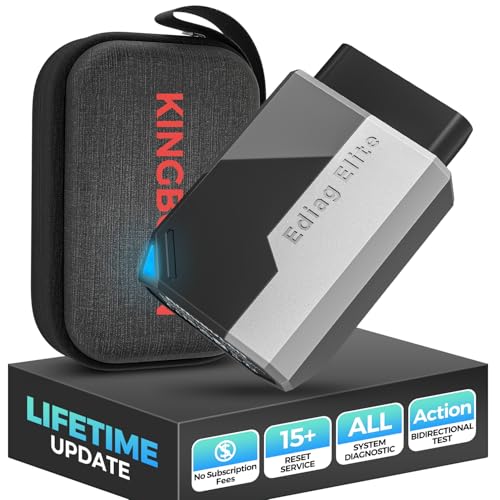
- Obd2 Bluetooth Scanner Lifetime Update: Ediag Elite offers revolutionary Advantage Lifetime Updates with unlimited access to the superior 15 reset service, bidirectional testing and full system diagnostics.The Ediag Elite is an excellent Bluetooth obd2 scanner diagnostic tool ideal for diy's and private car owners
- Bidirectional Control for Quickly Locating Problems: The Bidirectional Scan tool allows you to send commands directly from your smartphone to your vehicle for active testing. This feature helps to quickly narrow down problems such as air conditioning clutches, windows, doors, sunroofs, etc., reducing diagnostic time for mechanics and helping Diy users locate faults more easily. In addition, Ediag Elite provides fault analysis and repair guidance to help you solve problems efficiently.
- 15 Maintenance Resets: The current version introduces 15 popular special features: Oil Reset, Headlight Matching, Bleeding Reset, TPMS Reset, BMS Reset, Gear Box Relearn, Throttle Learning, Injector Coding, SAS Reset and more special functions in system diagnose menu. These functions make it easy for owners to carry out the necessary maintenance and servicing, ensuring that your vehicle stays in top condition, prolonging its service life and preventing common problems and breakdowns. Note: The Special function vary by model& year, Reach us check compatibility.
- Wide Compatibility CANFD & FCA
 Autoauth: Compatible with GM, Ford, Toyota, Chrysler, Honda, Mazda, Nissan, Mitsubishi, Hyundai, KIA with standard OBD2 port from 1996 to newer. More car brands and features will be released gradually. Newest Ediag Elite scanner supports CANFD Protocol and FCA cars. Note: Coverage may vary on different vehicle by model& year ,Please contact us to confirm compatibility before purchase.
 - Perfect for Monitoring The Health of Your Vehicle: Ediag Elite is designed to make vehicle maintenance simple and efficient. With intelligent AutoVIN quick recognition, it is easy to connect to your car without the need for manual input. Real-time data is visualized in a variety of formats, including graphs, numeric, meter displays and clear 4-in-1 data charts, allowing you to effortlessly monitor real-time data. Data logging/reporting is available for playback and further analysis.
 Autoauth: Compatible with GM,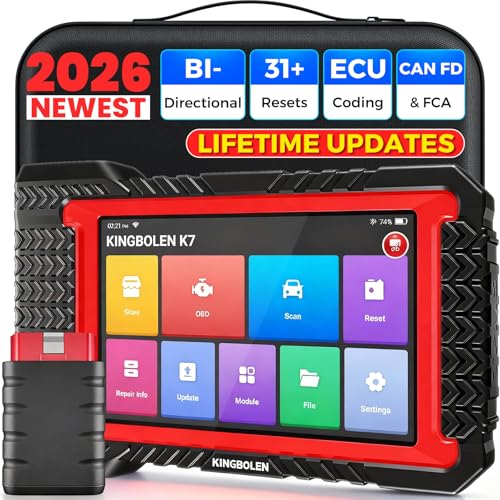
- No Annual Fees & 2026 Upgraded CAN FD: Why pay $199/year or more for updates? The 2026 newest Kingbolen K7 obd2 scanner features have been upgraded to Lifetime Updates without subscription fees, saving you significant costs in the long run. K7 scan tool also adds the CAN FD protocol for the latest GM models (2019+), enabling faster data transfer, reducing the risk of undetected errors
- 2026 Newest Top-tier Car Scanner: Kingbolen K7 diagnostic scan tool is equipped with most capabilities for daily repair/maintenance: Wireless diagnosis via Bluetooth, Bidirectional Test, ECU Online/Offline Code, 31+ Resets, PMI for Ford, Lincoln, Mazda, Global version for 100+ brand vehicles and 17 languages, no area limit, FCA AutoAuth
- OE-Level Full Systems Scan Tool: K7 professional diagnostic scanner with Auto Vin can do one-click to scan ECUs on most of vehicles, like pcm, ecm, eps, bcm, tpms, sas, a/c system... to read/clear code, view live data, freeze frame, read ecu info. 4-in-1 data stream graphics can make data viewing more intuitive. Detailed diagnostic reports will help you easily master the car situation as it can be shared by bluetooth or email! Adding workshop information can help your customers to know more
- Bidirectional Test/Active Test & ECU Code: Stop guessing and start fixing. Bidirectional scan tool Kingbolen K7 can perform real active test that can send commands to the vehicle's ECU to drive the actuators to work, like window, rear mirrors, sunroof, door, solenoids, wipers, headlamp, etc, helping you quickly find out bad parts and pinpoint faulty issues. K7 bidirectional scanner will be a good choice to save money and time on car repairs when performing complex maintenance and repair
- 31 Reset Functions: Avoid expensive dealership visits for simple services. Experience tells us that just a small repair service may cost a lot of money. Kingbolen K7 is a professional diagnostic scanner with 31 common maintenance services like Oil /SAS/EPB/TPMS Reset, Battery Matching, ABS Bleeding, Injector Code, etc. It effectively handles most of the car reset and relearning jobs, perfect for experienced DIYers and mechanics. Note: Functions in the menu vary across vehicles. Kindly check the compatibility before purchase

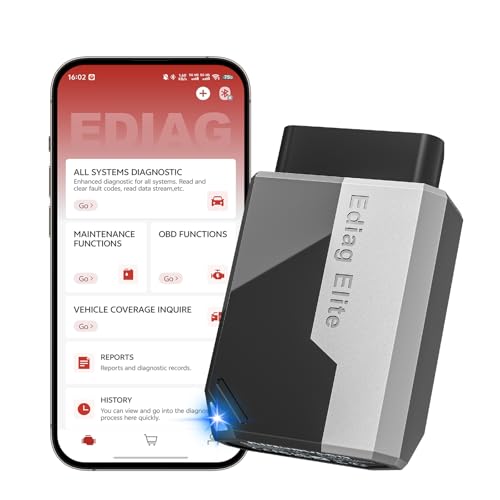
- 【Cost-effective Diagnostic Scan Tool】Lifetime updates without fee, No subscription fee required, No IP restrictions, Ediag Elite bluetooth scanner stands out. It can perform in-depth Full System diagnostics,15+ Reset Services, powerful Active Test, CANFD & FCA AutoAuth. Connect your phone via Bluetooth for diagnosis, providing a faster, smarter and smoother diagnostic experience. Easy to put in pocket, convenient to carry, keep track of the car's status anytime, anywhere. Best bang for your bucks.
- 【15+ Reset Service, Easy Problem Solving】 KINGBOLEN Ediag Elite obd2 scanner diagnostic scan tool comes with 15+ professional reset functions, including: Oil Reset, ABS Bleeding, Injector Code, SAS Reset, TPMS Reset, BMS Reset, AFS Reset, Sunroof Calibration, Brake Reset and more special functions in system diagnose menu. The ideal bluetooth scanner for mechanics and DIY enthusiasts, which can save unnecessary maintenance costs and significantly shorten repair time.
- 【Comprehensive Full Systems Diagnostic】 The Ediag Elite obd2 scanner bluetooth supports full system In-Depth diagnosis. It can read/clear fault codes, read real-time data/freeze frame, module information, and perform testing and reset functions for ECM, BCM, ABS, SRS, TPMS, TCM, BMS, SAS, A/C & RTM systems ect. It works with most car models after 1996, cover more than 150+ car brands. Supports 22 global languages for your convenience(EN, FR, ES, DE, IT, RU, PT, JP, TU...)
- 【Powerful Bidirectional Scan Tool & Active Test】 The obd2 code reader for Ediag Elite can perform real time active test that can send commands to the vehicle’s ECU to drive the actuators to work, such as turn on the radiator fan, modulate the throttle, open/close windows, etc. It can help you quickly find out the bad components and the cause of the fault, which can save you a lot of time. With BT 5.2 wireless connectivity, you can enjoy wireless diagnostics up to 33 feet.
- 【FCA AutoAuth & CANFD Compatibility】 Ediag Elite scan tool offers support with FCA Gateway Access, allowing you to perform protected functions on FCA vehicles, including Chrysler, Dodge, Jeep, Alfa Romeo, Fiat vehicles, etc.(Note:just allows you to access the FCA, but need to have your own FCA account) Supports the CAN-FD protocol, provide high-speed vehicle diagnostic communication and data transfer, working perfectly on GM vehicles produced after 2020, saving $100 to buy a CAN FD adapter.
Last update on 2026-06-12 / Affiliate links / Images from Amazon Product Advertising API
This product presentation was made with AAWP plugin.