
NHTSA ID Number: 10130492
Manufacturer Communication Number: NTB17-034e
TSB/Document Date: 2018-03-26
Summary
2013-2017 SENTRA AND VERSA SEDAN, AND 2014-2017 VERSA NOTE; CVT JUDDER AND/OR P0746/P0965 STORED This bulletin applies only to vehicles equipped with a Continuously Variable Transmission (CVT). This bulletin has been amended to add model years to Applied Vehicle, update Table B and make changes to page 116. No other changes were made. Please discard previous versions of this bulletin.
NG
Figure 4B
Proceed to the next page.
9/129
NTB17-034e
Is there any evidence of broken parts or excessive debris?
o YES: Replace the CVT assembly as follows:
a. Document the debris found with video (see page 129 for details).
b. Re-install the CVT oil pan gasket and oil pan.
c. Call the PCC for CVT replacement authorization (see page 129 for contact
information).
d. Refer to the Electronic Service Manual (ESM), section TM – Transaxle &
Transmission for CVT replacement.
o NO: Proceed to next step to continue the repair.
10. Remove the magnets from the oil pan.
NOTE: The CVT pan may come with two (2) or three (3) magnets.
Clean the magnets.
Reinstall the magnets to the oil pan in their original positions.
3 bolts
11. Remove the three (3) strainer bolts, and
then remove the strainer from the valve
body.
These bolts will be reused.
Strainer
Figure 5B
10/129
NTB17-034e
Nut and washer
12. Remove the nut and washer, and then
remove the manual plate shown in Figure
6B.
Use a screwdriver to hold the manual
plate (Figure 7B) to keep the shaft
from rotating while removing the nut.
Manual plate
Do not discard nut and washer. These
will be reused during assembly.
Figure 6B
Manual plate
Figure 7B
13. Clean around the CVT unit harness
connector to prevent foreign materials
from entering into the CVT case.
14. Remove ONLY the eleven (11) valve
body bolts with markings as shown in
Figure 8B.
Do NOT remove the bolts with a
single dot over the “7”.
The bolts removed will be reused.
15. Press the CVT unit harness connector
down into the transaxle case, and then
remove the valve body from the transaxle
case.
Valve body
bolts
Figure 8B
Correct bolt
CAUTION: Do not damage the CVT unit harness connector.
11/129
NTB17-034e
CVT Belt Visual Inspection
1. Secure the front right tire with a suitable
strap.
This will assist in making the belt turn
during the borescope belt inspection
step.
2. Mark the front left tire with a suitable
marking.
This will assure all 360° of the belt is
inspected.
Figure 1C
3. Using the steps on pages 13-18 inspect the entirety of the two sides of the belt that
come in contact with the pulleys (see Figure 2C):
IMPORTANT:
Reference the pictures on pages 19-22 for comparison.
Use borescope J-51951 with mirror attachment.
Be sure to remove the protective film from the mirror before the first use.
Clean the camera lens and mirror before each inspection. Use 90% isopropyl
alcohol, and a lens swab from Lens Swab packet J-51963 listed in PARTS
INFORMATION.
Before inspecting, make sure the camera handle’s AA batteries are fresh and the
LCD monitor’s battery is charged.
Inspect these sides
Do not inspect
these sides
Figure 2C: New belt
12/129
NTB17-034e
a. Install the Clutch Engagement Tool (J-52273) to the CVT case with two bolts where
shown in Figure 3C finger tight.
Bolt torque not to exceed: 2.26 N•m (0.23 kg-m, 20 in-lb.)
CAUTION:
Do not over torque the bolts. The threads are easily damaged.
Make sure an O-ring is installed to the Clutch Engagement Tool (J-52273)
before installation.
NOTE: The O-ring for the Clutch Engagement Tool comes with the attachment. To
obtain only the O-ring, refer to PARTS INFORMATION for the part number.
Front of
vehicle
Clutch Pack
Clutch
Engagement
Tool (J-52273)
Figure 3C
b. Connect the Hand pump from Evap
Pressure Test Kit (J-42909) to the
Clutch Engagement Tool (J-52273)
and pump to 20 PSI.
Hand pump
IMPORTANT:
Proper pressure has been
achieved when the CVT belt
moves while the left front wheel
is rotated and the vehicle is in
NEUTRAL with the right front
wheel secured.
Do NOT over pressurize the
system as internal damage to
the CVT could result.
Figure 4C
Hand pump should be removed from the Clutch Engagement Tool (J-52273)
quick connect once the clutch has been engaged and the belt is observed
moving with tire rotation.
Pressure will be retained.
13/129
NTB17-034e
c. Insert the borescope where shown in Figure 5C as follows:
I.
Face the mirror of the borescope toward the driver’s side of the vehicle (CVT
side cover).
II.
Insert the lens approximately 7.5 inches from the CVT oil pan gasket surface
as shown in Figure 6C on page 15.
III.
And then view the side of the belt that contacts the pulley.
Look through here to
help guide borescope
Front of
vehicle
Insert borescope
here at location 1
Belt
Driver’s
side
Insert borescope
here
Face the mirror in the
direction indicated by
the yellow arrow
Figure 5C
14/129
NTB17-034e
Shown removed from the
vehicle and without side
cover for clarity, and is for
reference only
View point is on
opposite side of belt
Borescope
7.5 inches
Borescope position,
inserted from bottom
Figure 6C
d. Using the mark applied to the left front
tire for reference, slowly and carefully
rotate the front left tire one full turn in
either direction to view all of the belt.
Holding the borescope (camera
flexible tube) with one hand allows
rotation of the tire with the other
hand (see Figure 7C).
If evidence of belt slip is identified
as shown on pages 18-21, skip to
step 5 on page 23.
If the belt does not move when
rotating the front left tire, return to
step 3b on page 13.
Figure 7C
e. If the inspection result confirms that no slippage has occurred on the observed side,
inspect the other side of the belt as follows:
I.
Print page 16 and then shape the borescope camera flexible tube like the image
in Figure 8C.
15/129
NTB17-034e
For the following steps print this
page as a template to adjust
the borescope camera flexible
tube to match.
Do not shrink or enlarge
sheet size when printing.
Figure 8C: Template for
borescope camera flexible tube
is shown actual size.
New picture
Figure is 9
inches long
4 inches
15°
Camera view
Face the mirror in the
direction of the yellow arrow.
Figure 8C
16/129
NTB17-034e
II.
Face the mirror of the borescope toward passenger side (Engine side).
III.
Insert the borescope in the second location where shown in Figure 9C.
IV.
Insert the lens approximately 8.7 inches from the CVT case rim as shown in
Figure 10C on the next page.
V.
And then view the side of the belt that contacts the pulley.
Front of
vehicle
Insert borescope at
location 2 and also look
through here to help guide
borescope
Passenger
side
Insert borescope
here
Face the mirror in the
direction indicated by
the yellow arrow
Belt
Figure 9C
17/129
NTB17-034e
Shown removed from the
vehicle and without side
cover for clarity, and is for
reference only
Borescope
View point
Borescope position,
inserted from bottom
8.7 inches
Figure 10C
f. Using the mark applied to the left front tire for reference, slowly and carefully rotate
the front left tire one full turn in either direction to view all of the belt.
Holding the borescope (camera flexible tube) with one hand allows rotation of the
tire with the other hand (see Figure 7C).
IMPORTANT: If the belt does not move when rotating the front left tire, supply
additional air with hand pump (J-45664) to re-engage the clutch as necessary.
Look for evidence of belt slip as shown on pages 18-21.
g. Remove the Clutch Engagement Tool (J-52273) from the CVT.
CAUTION: The remaining CVT fluid may spray when the Clutch Engagement Tool is
removed. Place a rag over the Clutch Engagement tool and SLOWLY loosen the two
bolts until the audible depressurization is noted.
h. Is the inspection result OK (no evidence of slip) for 360° rotation of both sides of the
belt?
YES: Go to step 4 on page 23 (No Belt Damage).
NO: Go to step 5 on page 23 (Belt Damaged).
18/129
NTB17-034e
Figure 11C New belt
Figure 12C:
19/129
NTB17-034e
Pictures in Figure 13C and 14C were taken with borescope J-51951.
OK
OK
Visual
lineslines
Visual
Figure 13C: Belt is OK
OK
OK
Visual
lineslines
Visual
Figure 14C: Belt is OK
20/129
NTB17-034e
NG
Scuffing
Figure 15C: Example of NG belt
NG
Lines
“smeared”
Figure 16C: Example of NG belt
21/129
NTB17-034e
Pictures in Figure 17C-19C were taken with borescope J-51951
NG
Figure 17C: Example of NG belt
NG
Figure 18C: Example of NG belt
NG
Figure 19C: Example of NG belt
22/129
NTB17-034e
No Belt Damage – Only Valve Body is Replaced
4. Install a new valve body in the reverse order of disassembly:
Refer to Install the Valve Body and Oil Pan on page 81.
And then,
a. Connect both battery cables, negative cable last.
b. Reset/reinitialize systems as needed.
Refer to the ESM, section PG – Power Supply & Ground Elements, for a
listing of systems that require reset/initialization after reconnecting the 12V
battery.
Look in the PG section index for ADDITIONAL SERVICE WHEN REMOVING
BATTERY NEGATIVE TERMINAL.
This list often includes items such as radio, power windows, clock, sunroof,
etc.
IMPORTANT:
c. Perform ADDITIONAL SERVICE REQUIRED starting on page 94.
Belt Damaged
5. Install the original (removed) oil pan
gasket and oil pan temporarily with at
least two oil pan bolts, hand tight.
IMPORTANT: DO NOT discard the
remaining oil pan bolts. These bolts will
be re-used.
Figure 20C
6. Replace the belt and pulley sub-assembly and valve body.
Go to Remove CVT from the Vehicle and Dissemble External Parts on the next
page.
23/129
NTB17-034e
Remove CVT from the Vehicle and Dissemble External Parts
1. Remove the CVT from the vehicle.
Refer to the ESM, section TM – Transaxle & Transmission for CVT removal.
2. Put the CVT assembly on a work bench
with the oil pan side down.
CAUTION: Take care not to damage the
oil pan.
Torque converter
3. Remove the torque converter.
The torque converter will be reused
during reassembly.
Figure 1D
4. Drain the CVT fluid out of the torque
converter.
Figure 2D
24/129
NTB17-034e
5. Remove the output speed sensor, primary speed sensor and secondary speed sensor
from the CVT (Figure 3D).
These sensors will be reused.
Inspect all three sensors for debris on the magnet and clean as necessary.
6. Remove the O-rings from all three speed sensors.
Discard the removed O-rings. These will be replaced during reassembly.
Primary speed sensor
Secondary speed sensor
Figure 3D
Output speed sensor
25/129
NTB17-034e
Remove the Oil Filter
1. Remove the oil filter from the CVT case
as follows:
Oil filter cover bolt
a. Remove the oil filter cover bolt.
This bolt will be reused.
Oil filter cover
Figure 1E
Locking tab
b. Rotate the oil filter cover
counterclockwise approximately 15
degrees or until the cover clears the
locking tab.
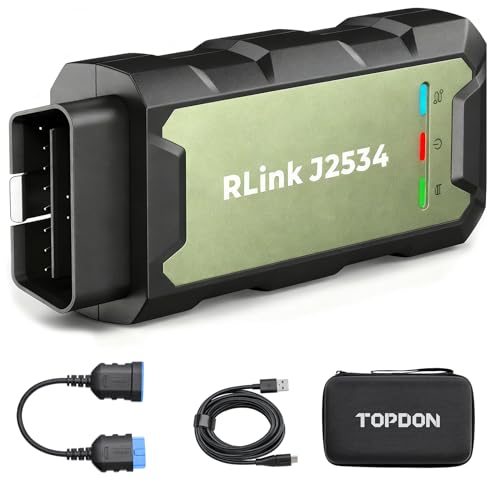
- Advanced VCI Box, Industry-leading J2534 Pass-Thru...
- High-Speed OEM-Level Diagnostics & Programming: Unlock true...
- Coverage for 17 Car Brands & Ultra Reliability: Works...
- User-Friendly RLink Platform & Expert Support: TOPDON’s...
- 6.6 ft USB-C Cable & Portable Storage Case: The RLink J...
 VCI 16Pin Cable 1pc x CD...
Last update on 2026-06-12 / Affiliate links / Images from Amazon Product Advertising API
If the PDF is very large, it may not load in the preview below.
Some older TSBs had multiple PDFs — visit the NHTSA Website to view all PDFs.
If the TSB PDF does not show, download or view it on the NHTSA Website.
Click on the (+) Plus Sign
Then Click on Associated Document(s)
Search NHTSA Database for Recalls
Search NHTSA Database for Vehicle Investigations
View Latest Vehicle Investigations
Search NHTSA Database for Vehicle Complaints
View Latest Vehicle Complaints
TSB/Document ID: NTB17-034e
Replacement Service Bulletin Number:
MFR Communication Date: 2018-02-01
MFR Internal Campaign ID/Software Version:
Communication Type: Service Bulletin/Repair Instructions
NHTSA Components: POWER TRAIN
MFR Component System:
MFR Component Subsystem:
Previous TSB | Next TSB |

- [2026 Top-Tier Hardware and Software Upgrade]: Topdon ArtiDiag900 Lite scanner has enhanced hardware and latest features, including Android 11.0, 5x faster CPU, 10000mAh battery for 12 hours of continuous operation, stable wireless diagnosis with Bluetooth 5.0, 8-inch touchscreen. Added bi-directional control, wireless diagnosis, battery testing (optional), and DTC repair guide
- [TOPDON Bidirectional Scan Tool]: This bidirectional obd2 scanner sends commands to the vehicle's ECU for active testing, enabling users to accurately and quickly locate faulty components such as injectors, coolant pumps, windows, wipers, headlights, mirrors, etc. The bidirectional control scanner is the ideal choice for workshops/automotive repair shops as it significantly reduces mechanic's diagnostic time.
- [Wireless Bluetooth Diagnostic Experience]: The AD900 Lite scan tool comes with a Bluetooth 5.0 VCI, supporting a wireless diagnostic range of up to 33 feet (10 meters), allowing you to diagnose without being confined to cables or tight spaces. Stable and fast wireless diagnosis provides a comfortable repair environment. It also offers VCI cables to increase connectivity options.
- [DTC Repair Guide Function]: Easily diagnose issues with your vehicle and receive guidance on repairs with the topdon scan tool's fault code definitions for all systems,maximize your diagnostic capabilities. This function is compatible with Chrysler
 /Dodge/Jeep/Fiat 2010-2014 and expanding with continual updates,the AritDiag 900 Lite car diagnostic scanner is the must-have tool for any technician or DIY enthusiast.
 - [OE-Level Full System Diagnostics]:AritDiag900 Lite full system diagnostic scanner can scan ALL available modules(Engine, Transmission, Airbag, ABS, ESP, TPMS, Gateway, Steering, Radio, Air conditioning, ect.) to✔read ECU info, ✔read/clear codes, ✔view live data stream, ✔retrieves freeze-frame, ✔perform active tests, and more. With just a simple click, it provides you with accurate and in-depth diagnostics.

- Bi-Directional Control, Quickly Locate Problems: Turn your phone into a professional diagnostic tool. You can send commands from your phone to the ECU to test injectors, cooling fans, headlights, A/C clutch, windows, wipers, and more. See which one doesn't respond. Helps you quickly locate the problem and save time. No need to tear things apart, avoid blind disassembly.
- Flexible Subscription, Choose Advanced Features as Needed: TopScan Lite provides free-for-life access to core diagnostics, including full system scan, code reading, performance tests, and repair information. After purchase, advanced features (bi-directional control, service operations, live data, code clearing, and AI functions) are free-for-the-first-year. After the first year, if you want to use advanced features, you need to subscribe on a monthly, quarterly, or yearly basis. As new models and reset functions are updated, the tool will also be continuously upgraded.
- Full System Diagnostics, No Fault Hides: Unlike basic diagnostic tools that only cover 4 systems, TopScan can scan all systems. Read and clear trouble codes, view live data streams, and generate a complete vehicle health report – all issues are clear at a glance. Covers 10,000+ vehicle models and is compatible with 99.99% of vehicles.
- AI Assistant - TopFix: Think of TopFix as your personal AI mechanic. It leverages a repair database and OEM data to deliver clear, step-by-step repair solutions. Features include AI Q&A, one-click translation, and a full repair log, making your diagnostic process simpler and more efficient.
- 8+ Hot Resets, Keep Your Car in Top Shape: One-tap resets for oil, throttle, EPB, steering angle, DPF, ABS, BMS, and airbag. It enables car owners to easily perform essential maintenance, ensuring the vehicle stays in optimal condition and extends its service life.
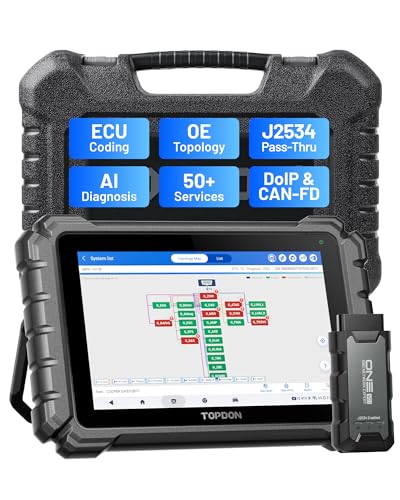
- Dual WiFi & 10.1" Touchscreen: Provides a stable, high-speed wireless link 3x faster than bluetooth, and a responsive, professional interface. Topdon ONE obd2 scanner diagnostic tool ensures smooth, non-lagging diagnostic scan, boosting mechanic efficiency
- J2534 Pass-Thru Support: The included ONE VCI supports the J2534 standard, allowing it to function as a pass-thru device when paired with OEM diagnostic software.Through TOPDON’s RLink platform, technicians can perform dealer-level coding, expanding in-house capabilities without investing in multiple factory automotive scan tools
- OE Topology Mapping: Visualize the vehicle’s ECU network exactly as it’s built.Zoom, pan, and highlight specific modules to pinpoint component issues with precision.Topology mapping displays real-time communication between modules
- 50 Plus Service Functions: Covers high-demand services like ADAS calibration, DPF regen, TPMS reset, ABS bleed, and throttle adaptation.Expands your service menu, allows you to charge premium rates, and turns away zero jobs due to lack of tooling. Vehicle-specific functionality may vary
- Advaned ECU Coding: 10 of the most serviced brands in North America, including full ECU coding and flash hidden support for BMW, VW, Au-di, Benz, Porsche, Toyota, Ni ssan and more. Enables module replacement, feature customization, and personal settings with automatic backup or restore.Lets your shop safely offer high-margin customization services, attracting more customers and boosting profit
Last update on 2026-06-12 / Affiliate links / Images from Amazon Product Advertising API
This product presentation was made with AAWP plugin.