NHTSA ID Number: 10126349
Manufacturer Communication Number: 05-03-07-009H
TSB/Document Date: 2017-12-22
Summary
This warranty administration bulletin provides retail, wholesale and fleet personnel with General Motors recommendations for customer concerns related to wheel alignment.
Bulletin No.: 05-03-07-009H
Date: Oct-2015
Subject:
Wheel Alignment Specifications, Requirements and Recommendations for GM Vehicles
Models:
2016 and Prior GM Passenger Cars and Light Duty Trucks
This Bulletin has been revised to update information in the Wheel Alignment Job Card Questionnaire and remove sections
Mileage Policy and Warranty Documentation Requirements. Please discard Corporate Bulletin Number 05-03-07-009G.
Purpose
The purpose of this bulletin is to provide retail, wholesale and fleet personnel with General Motors’ recommendations for customer concerns related to wheel
alignment. For your convenience, this bulletin updates and centralizes all of GM's Standard Wheel Alignment Service Procedures, and bulletins on wheel
alignment warranty service.
Important: PLEASE FAMILIARIZE YOURSELF WITH THESE UPDATES BEFORE PERFORMING YOUR NEXT GM WHEEL ALIGNMENT SERVICE.
The following key steps are a summary of this bulletin and are REQUIRED in completing a successful wheel alignment service.
1.
Verify the vehicle is in an Original Equipment condition for curb weight, tires, wheels, suspension and steering configurations. Vehicles modified in
any of these areas are not covered for wheel alignment warranty.
2.
Review the customer concern relative to “Normal Operation” definitions.
3.
Document wheel alignment warranty claims appropriately for labor operations 8070012 and 8070032. A copy of the alignment machine printout
showing before and after alignment specifications must be attached to the job card. Please refer to Article 1.1.13 (1.4.19 Canada) of the Service
Policies and Procedures for complete documentation requirements and labor operation restrictions for transactions involving wheel alignments, toe
adjustments and wheel balancing.
Verify Original Equipment Condition of the Vehicle
•
Verify that Original Equipment Tires and Wheels or Official GM Accessory Tires and Wheels are on the vehicle.
•
Verify that aftermarket suspension “Lift” or “Lowering” Kits or other suspension alterations have NOT been done to the vehicle.
•
Check for accidental damage to the vehicle; for example, severe pothole or curb impacts, collision damage that may have affected the wheel alignment of
the vehicle; e.g., engine cradles, suspension control arms, axles, wheels, wheel covers, tires may show evidence of damage/impact.
•
Check to be sure vehicle has seen “Normal Use” rather than abuse; e.g., very aggressive driving may show up by looking at the tires and condition of the
vehicle.
•
Check for other additional equipment items that may significantly affect vehicle mass such as large tool boxes, campers, snow plow packages (without the
snowplow RPO), etc., especially in trucks and cutaway/incomplete vehicles. Significant additional mass can affect trim height and wheel alignment of the
vehicle and may necessitate a customer pay wheel alignment when placed semi-permanently in the vehicle (Upfitter instructions are to realign the
vehicle after placement of these types of items. (This typically applies to trucks and incomplete vehicles that can be upfit with equipment such as the
above.)
Customer Concerns and “Normal Operation” Conditions
Possible Concerns
The following are typical conditions that may require wheel alignment warranty service:
1.
Lead/Pull: defined as "at a constant highway speed on a typical straight road, the amount of effort required at the steering wheel to maintain the
vehicle’s straight heading."
1
Important: Please evaluate for the condition with hands-on the steering wheel. Follow the “Vehicle Leads/Pulls” diagnostic tree located in SI to
determine the cause of a lead/pull concern. Lead/Pull concerns can be due to road crown or road slope, tires, wheel alignment or even in rare
circumstances a steering gear issue. Lead/pull concerns due to road crown are considered “Normal Operation” and are NOT a warrantable condition -the customer should be advised that this is “Normal Operation.”
Important: Some customers may comment on a “Lead/Pull” when they hold the steering wheel in a level condition. If so, this is more likely a “steering
wheel angle” concern because the customer is “steering” the vehicle to obtain a “level” steering wheel.
2.
Steering wheel angle to the left or right (counter-clockwise or clockwise, respectively): Defined as the steering wheel angle (clocking) deviation from
“level” while maintaining a straight heading on a typical straight road.
3.
Irregular or Premature tire wear: Slight to very slight "feathering" or "edge" wear on the shoulders of tires is NOT considered unusual and should
even out with a tire rotation; if the customer is concerned about a “feathering” condition of the tires, the customer could be advised to rotate the tires
earlier than the next scheduled mileage/maintenance interval (but no later than the next interval). Be sure to understand the customer’s driving habits as
this will also heavily influence the tire wear performance; tire wear from aggressive or abusive driving habits is NOT a warrantable condition.
Important: Slight or mild feathering, cupping, edge or heel/toe wear of tire tread shoulders is “normal” and can show up very early in a tire/vehicle
service mileage; in fact, some new tires can show evidence of feathering from the factory. These issues do NOT affect the overall performance and
tread life of the tire. Dealer personnel should always check the customer’s maintenance records to ensure that tire inflation pressure is being maintained
to placard and that the tires are being rotated (modified-X pattern) at the proper mileage intervals. Wheel alignments are NOT to be performed for the
types of “Normal” Tire Feathering shown in Figures 1-4 below.
Figure 1: Full Tread View – “NORMAL” Tire “Feathering” Wear on the Shoulder/Adjacent/Center Ribs
Figure 2: Tire Shoulder View Example 1 - “NORMAL” Tire "Feathering" Wear on the Shoulder
2
Figure 3: Tire Shoulder View Example 2 - “NORMAL” Tire "Feathering" Wear
Figure 4: Detail Side View of Tire Shoulder Area - “NORMAL” Tire “Feathering” Wear
3
Important: When a wheel alignment is deemed necessary for tire wear, be sure to document on the repair order, in as much detail as possible, the
severity and type of tire wear (e.g., severe center wear or severe inside or outside shoulder wear) and the position of the tire on the vehicle (RF, LF,
LR, RR). Please note the customer’s concern with the wear such as, noise, appearance, wear life, etc. A field product report with pictures of the tire
wear condition is recommended. Refer to the latest version of Corporate Bulletin Numbers 02-00-89-002 (Canada, 10-00-89-006) and 07-00-89-036.
4.
Other repairs that affect wheel alignment; e.g., certain component replacement such as suspension control arm replacement, engine cradle
adjustment/replace, steering gear replacement, steering tie rod replace, suspension strut/shock, steering knuckle, etc. may require a wheel alignment.
Important: If other components or repairs are identified as affecting the wheel alignment, policy calls for the wheel alignment labor time to be charged
to the replaced/repaired component’s labor operation time rather than the wheel alignment labor operations.
Important: Vibration type customer concerns are generally NOT due to wheel alignment except in the rare cases; e.g., extreme diagonal wear across
the tread. In general, wheel alignments are NOT to be performed as an investigation/correction for vibration concerns.
“Normal Operation” Conditions
Vehicle Lead/Pull Due to Road Crown or Slope:
As part of “Normal Operation,” vehicles will follow side-to-side or left to right road crown or slope. Be sure to verify from the customer the types of roads they
are driving as they may not recognize the influence of road crown on vehicle lead/pull and steering wheel angle. If a vehicle requires significant steering effort to
prevent it from “climbing” the road crown there may be an issue to be looked into further.
Important: A wheel alignment will generally NOT correct vehicles that follow the road crown since this is within “Normal Operation.”
Trough Wander/Tramlining:
Some customers may comment about their vehicle having a tendency to pull left or right depending on road conditions. Typical descriptions may refer to the
vehicle not tracking properly or that the car wanders. Additional comments may include that the car follows grooves or inconsistencies in the road to the extent
that the vehicle must be steered or directed with additional force to overcome these roadway characteristics.
Trough Wander / Tramlining
4
What is Tramlining?
"Tramlining" is an industry term used to describe a vehicle's tendency to follow the longitudinal ruts and/or grooves present in the road. (Also called “trough
wander”). The name comes from the feeling on a tram or trolley as the vehicle follows along the tracks. Any vehicle can exhibit tramlining due to uneven
pavement or severe rutting in the roads surface. All vehicles tramline to some degree, however vehicles equipped with low aspect ratio, wide tires tend to be
more sensitive to this condition (e.g. Corvette, Camaro, CTS-V, Chevrolet SS).
Vehicles experiencing this condition can feel “pulled” in both directions depending on the positions of the tires in the trough (ruts).
If a similarly equipped vehicle experiences the same condition as the customer’s car, the customer’s car is most likely experiencing tramlining, which is a normal
characteristic of a car with low aspect ratio, wide tires.
Important: It should be noted that adjusting alignment settings will NOT improve this condition.
Wheel Alignment Equipment and Process
Wheel alignments must be performed with a quality machine that will give accurate results when performing checks. "External Reference" (image-based
camera technology) is preferred. Please refer to the latest version of Corporate Bulletin Number 05-00-89-029: General Motors Dealership Critical Equipment
Requirements and Recommendations.
Requirements:
•
Computerized four wheel alignment system.
•
Computer capable of printing before and after alignment reports.
•
Computer capable of time and date stamp printout.
•
Racking system must have jacking capability.
•
Racking system must be capable of level to 1.6 mm (1/16 in).
•
Appropriate wheel stops and safety certification.
•
Built-in turn plates and slip plates.
•
Wheel clamps capable of attaching to 20" or larger wheels
•
Racking capable of accepting any GM passenger car or light duty truck.
•
Operator properly trained and ASE-certified (U.S. only) in wheel alignment.
Recommendations:
Racking should have front and rear jacking capability.
Equipment Maintenance and Calibration:
Alignment machines must be regularly calibrated in order to give correct information. Most manufacturers recommend the following:
•
Alignment machines with "internal reference" sensors should be checked (and calibrated, if necessary) every six months.
5
•
Alignment machines with "external reference" (image-based camera technology) should be checked (and calibrated, if necessary) once a year.
•
Racks must be kept level to within 1.6 mm (1/16 in).
•
If any instrument that is part of the alignment machine is dropped or damaged in some way, check the calibration immediately.
Check with the manufacturer of your specific equipment for their recommended service/calibration schedule.
Wheel Alignment Process
When performing wheel alignment measurement and/or adjustment, the following steps should be taken:
Preliminary Steps:
1.
Verify that the vehicle has a full tank of fuel (compensate as necessary).
2.
Inspect the wheels and the tires for damage.
3.
Inspect the tires for the proper inflation and irregular tire wear.
4.
Inspect the wheel bearings for excessive play.
5.
Inspect all suspension and steering parts for looseness, wear, or damage.
6.
Inspect the steering wheel for excessive drag or poor return due to stiff or rusted linkage or suspension components.
7.
Inspect the vehicle trim height.
8.
Compensate for frame angle on targeted vehicles (refer to Wheel Alignment Specifications in SI).
Satisfactory vehicle operation may occur over a wide range of alignment angles. However, if the wheel alignment angles are not within the range of
specifications, adjust the wheel alignment to the specifications. Refer to Wheel Alignment Specifications in SI. Give consideration to excess loads, such as tool
boxes, sample cases, etc. Follow the wheel alignment equipment manufacturer's instructions.
Measure/Adjust:
Important: Prior to making any adjustments to wheel alignment on a vehicle, technicians must verify that the wheel alignment specifications loaded into their
wheel alignment machine are up-to-date by comparing these to the wheel alignment specifications for the appropriate model and model year in SI. Using
incorrect and/or outdated specifications may result in unnecessary adjustments, irregular and/or premature tire wear and repeat customer concerns.
Important: When performing adjustments to vehicles requiring a 4-wheel alignment, set the rear wheel alignment angles first in order to obtain proper front
wheel alignment angles.
Perform the following steps in order to measure the front and rear alignment angles:
1.
Install the alignment equipment according to the manufacturer's instructions.
2.
Jounce the front and the rear bumpers 3 times prior to checking the wheel alignment.
3.
Measure the alignment angles and record the readings.
If necessary, adjust the wheel alignment to vehicle specification and record the before and after measurements. Refer to Wheel Alignment Specifications in SI.
Important: Technicians must refer to SI for the correct wheel alignment specifications. SI is the only source of GM wheel alignment specifications that is kept
up-to-date throughout the year.
Test drive the vehicle to ensure a proper repair.
Understanding the Effects of Wheel Alignment on a Vehicle vs. Customer Complaints (Quick Reference
Section)
Note: Refer to SI for complete alignment specifications.
•
Prior to any measurement on the alignment machine, you must confirm the current specifications and tolerances as listed in GM’s Service Information
System. Do not assume that numbers in the alignment machine are correct, as it may not have been recently updated.
•
Always use the correct specifications for that vehicle based on confirmed vehicle option content.
•
It is important to always include as much information as possible in the RO – including the confirmed customer complaint and the complete before and
after alignment measurements on the vehicle.
Steering Wheel Angle Complaints:
A true steering wheel angle complaint can be diagnosed as a vehicle that goes straight down the road without extra steering input, but the steering wheel angle
is clocked to one side or the other. Make sure to always note which direction the steering wheel is clocked on the Repair Order (“Left/CCW” or “Right/CW”).
If a steering wheel angle complaint has been verified, it should be noted that front and rear toes are the only alignment values that affect the angle of the steering
wheel.
Vehicle Pull Complaints:
6
Prior to any adjusts, the vehicle must be driven to confirm the customer complaint. Use this drive to verify that the vehicle does have a pull and it is not a
steering wheel angle issue. Try and use same stretch of road for all drives so that you understand the different characteristics of that specific road.
A true vehicle pull only complaint will have the vehicle pull to one side or the other regardless of steering wheel angle. It may require more than normal effort to
keep the vehicle going straight.
Important: It is possible for customers to confuse a steering wheel off angle issue as a vehicle pull, as they may be trying to hold the wheel centered (level) on
a straight road which would be adding a slight steering input to the wheels. If this is the case, please note this on the Repair Order, including the direction the
vehicle is pulling.
Please note the following on what can cause a vehicle pull:
•
•
Alignment settings
Tires: If a pull complaint has been verified but all the alignment settings all are within specifications, the issue may be in the tires. Certain tire differences left to
right may cause a vehicle pull. Swapping the front tires left to right and re-evaluating is a simple way to verify a tire issue.
Important: Always ensure tire pressures are set to correct specifications before and after evaluating a vehicle.
Important: Always note if tires are directional and not able to be permanently swapped side to side.
Alignment Information
Alignment Settings:
Positive Value
Negative Value
Front Cross Camber (LH minus RH)
Pulls Left
Pulls Right
Front Cross Caster (LH minus RH)
Pulls Right
Pulls Left
Front and Rear Toe
Does Not Cause Vehicle Pulls
Does Not Cause Vehicle Pulls
Important: Front or rear toe values being out of specifications do not cause a true vehicle pull. If only front or rear toe values are out of specification on a
confirmed vehicle pull issue, something else is causing the pull.
Important: If Cross Camber and Cross Caster are within GM specifications listed in the Service Information System, it generally means they are not the
reason for a vehicle pull complaint.
Note: Although not normally an adjustable setting on many vehicles, you should always verify the caster repair procedure in GM’s Service Information System.
Road Slope:
It is important to always note road slope during a drive, high angles can cause a vehicle to drift one way or the other. As flat of road as possible should be used
for evaluations.
Effect of Road Slope
Trough Wander / Tramlining
Troughs or grooves in the road can pull a vehicle to either side depending on where in the groove the tire is. The tires will always want to pull the vehicle up the
wall of the trough.
7
Trough Wander / Tramlining
Wheel Alignment Job Card Questionnaire
Note: For vehicles with less than 500 miles (800 km) on the odometer, please fill in the blanks. Additional help can be found in the “Vehicle
Lead/Pull Diagnostics” located in SI under Suspension – General Diagnosis. It is also recommended that the dealership complete a Field
Product Report to notify GM of this condition. Refer to Bulletin Numbers 02-00-89-002 (Canada: 10-00-89-006) and 07-00-89-036 for more
information on Field Product Reporting.
TAC Case # if applicable:
Vehicle Concern Information
Customer Concern:
Tire Wear____ Steering Wheel Off-Angle___
Lead/Pull____ Other ___________________
Was the customer concern duplicated? Yes___ No___
Is the tire pressure within +/- 3 psi (+/- 20 kPa) of the tire placard? Yes___ No___
If No, record the tire pressures (psi):
LF____ RF____ LR____ RR____
Tire Wear (If Applicable)
Please check all boxes that apply:
Left Front Tire:
Even Wear___ Inside Shoulder___
Center___ Outside Shoulder___ Cupping/Feathering___
Right Front Tire:
Even Wear___ Inside Shoulder___
Center___ Outside Shoulder___ Cupping/Feathering___
8
Customer Concern:
Tire Wear____ Steering Wheel Off-Angle___
Lead/Pull____ Other ___________________
Was the customer concern duplicated? Yes___ No___
Is the tire pressure within +/- 3 psi (+/- 20 kPa) of the tire placard? Yes___ No___
If No, record the tire pressures (psi):
LF____ RF____ LR____ RR____
Tire Wear (If Applicable)
Please check all boxes that apply:
Left Front Tire:
Even Wear___ Inside Shoulder___
Center___ Outside Shoulder___ Cupping/Feathering___
Right Front Tire:
Even Wear___ Inside Shoulder___
Center___ Outside Shoulder___ Cupping/Feathering___
Left Rear Tire:
Even Wear___ Inside Shoulder___
Center___ Outside Shoulder___ Cupping/Feathering___
Right Rear Tire:
Even Wear___ Inside Shoulder___
Wheel Alignment Job Card Questionnaire
Center___ Outside Shoulder___ Cupping/Feathering___
Steering Wheel Off-Angle (If Applicable)
Which way was the steering wheel off angle?
Lead/Pull (If Applicable)
Which way does the vehicle lead or pull? Right___ Left___
Were the front tires swapped side to side? Yes___ No___
Was the vehicle checked for brake drag? Yes___ No___
GM bulletins are intended for use by professional technicians, NOT a "do-it-yourselfer". They are written to inform these technicians of conditions that may
occur on some vehicles, or to provide information that could assist in the proper service of a vehicle. Properly trained technicians have the equipment, tools,
safety instructions, and know-how to do a job properly and safely. If a condition is described, DO NOT assume that the bulletin applies to your vehicle, or that
your vehicle will have that condition. See your GM dealer for information on whether your vehicle may benefit from the information.
9
WE SUPPORT VOLUNTARY TECHNICIAN CERTIFICATION
10

- 💯【Conta.ct us for Support Directly】If you met any...
- 🔥🔥🔥【2026 AUTEL FLAGSHIP MK900BT MK900-BT, NEW...
- 🚗【3000+ ACTIVE TESTS (50➡3000+), SAME AS MS...
- 🚗【40+ HOT SERVICES FOR 150 MAKES (28+➡40+)】Full...
- 🚗【OE ALL SYSTEM DIAGNOSE, AUTO SCAN 2.0: SCAN LICENSE...

- 【TURN OFF CEL】 This AL319 car scanner diagnostic tool...
- 【EXTENSIVE APPLICATION】 Autel AL319 Compatible with...
- 【FOR END USER & DIYERS】 This error code reader AL319 is...
- 【USER-FRIENDLY DESIGN】 This OBD2 scanner and check...
- 【HIGH-QUALITY SERVICES】 12 months war.ranty from the...
Last update on 2026-06-23 / Affiliate links / Images from Amazon Product Advertising API
If the PDF is very large, it may not load in the preview below.
Some older TSBs had multiple PDFs — visit the NHTSA Website to view all PDFs.
If the TSB PDF does not show, download or view it on the NHTSA Website.
Click on the (+) Plus Sign
Then Click on Associated Document(s)
Search NHTSA Database for Recalls
Search NHTSA Database for Vehicle Investigations
View Latest Vehicle Investigations
Search NHTSA Database for Vehicle Complaints
View Latest Vehicle Complaints
TSB/Document ID: 05-03-07-009H
Replacement Service Bulletin Number:
MFR Communication Date: 2015-10-02
MFR Internal Campaign ID/Software Version:
Communication Type: Service Bulletin/Repair Instructions
NHTSA Components: WHEELS
MFR Component System:
MFR Component Subsystem:
Previous TSB | Next TSB |
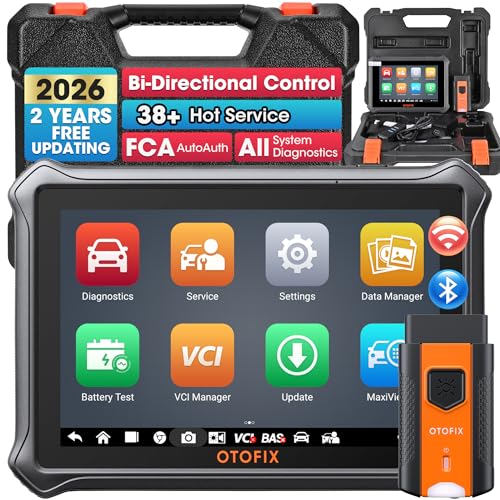
- 🎉[OTOFIX D1 Lite, Perfect Cost-effective Diagnostic Tool]: OTOFIX D1 Lite, a newest bidirectional scan tool from OTOFIX company, is a great choice for DIYers and repair shops. 👉This obd2 scanner diagnostic tool packs all practical functions: OE level all systems diagnoses, Bi-Directional Control, 38+ reset services fixing 99% of common problems, support DoIP & CANDF protocols and FCA
 AutoAuth, high-end hardware configuration. Worldwide vehicles and 🔥2 Years Free Updating🔥 covered.
 - 🎉[Bi-Directional Scan Tool, Active Test]: OTOFIX D1 Lite bluetooth obd2 scanner can also command ECUs and monitor the operation of the actuators to track down the problems of certain parts, like windows, sunroof, wipers, fuel pumps, etc., saving repair time & trouble. This makes OTOFIX D1 Lite the most cost-effective bidirectional scan tool.
- 🎉[2026 Newest, 38+ Hot Reset Functions]: Equipped with 38+ reset functions in one, the OTOFIX D1 lite automotive scanner diagnostic tool allows you to troubleshoot 99% of common vehicle problems. You can use this car diagnostic scanner holding enough functions to easily repair common vehicle models in your repair shops. Including Oil Reset, Injector Coding, Throttle, DPF Reset, SCR Reset, Gear Learning, Clutch Learning, Suspension, etc. Note* Reset functions vary by model.
- 🎉[OE Level Full Systems Diagnostics]: Unlike the 2-system and 4-system diagnostic tools, the OTOFIX auto scan tool can complete comprehensive system diagnostics within 5 minutes. It accesses and scans all available onboard systems like for Engine /AT /ABS /EPB /BMS /TPMS /SRS /SAS /Audio System /BCM /Air Conditioning / etc., to read & clear codes, view live data, and check ECU information. Note: Active test is not involved.
- 🎉[Powerful Hardware Configuration]: Designed with a fashion appearance & a 7” touchscreen and a weight of 463g, this OTOFIX D1 Lite OBD2 diagnostic scanner scan tool is convenient for everywhere and easy to use & store. Android9.0 OS and 2+64GB memory enhance multi-task smoothness and diagnostic operation, no more wasting too much time. 5800mAh battery allows hours-lasting use. WiFi & VCI1 also bring faster communication for your diagnostics.
- 🏆【2026 TOP OBD2 Scanner Diagnostic Tool】OTOFIX D1 Lite wireless obd2 scanner has upgraded hardware configuration and car coverage. The newly upgraded D1 Lite with 🔥OS Android 9.0🔥1.5Ghz 4 core high efficiency processor🔥2GB RAM+64GB ROM large storage🔥5800mAh large battery, more stable and longer lasting diagnostics🔥 38+ Reset🔥action tests🔥full system diagnostic🔥Supports MV105 endoscope🔥21+ Language Supports🔥100000+ vehicle coverage to meet all your daily maintenance needs.
- 👍【Bi-Directional Control / Active Test】D1 Lite obd2 scanner has bidirectional control(worth $300+), which is the most beloved feature among mechanic. If your headlights or car windows are broken, going to a repair shop will cost a lot of money. You can use D1 Lite to send execution commands to the ECU module and identify the repair status. Such as ABS, car windows, doors, valves, wipers, headlights, etc., effectively shorten diagnostic time and reduce diagnostic costs.
- 🔥【All Systems Diagnostics, In-depth Checking】This advanced OBD2 Scanner D1 Lite can perform OE-level diagnosis of all systems including engine, transmission, airbag, ABS, ESP, TPMS, gateway, steering, radio, and air conditioning for more than 100 brands. This diagnostic scanner supports essential functions, such as reading ECU version info, reading and clearing fault codes, and reading data streams.With just a simple click, it provides you with accurate and in-depth diagnostics.
- 🏆【38+ Reset Hot Functions】For repair workshops, holding an OTOFIX D1 Lite Auto scanner is a strong advantage over others. Its 38+ maintenance functions provide various solutions for all module repairs, including Oil Reset, TPMS Reset, Injector Coding, Suspension, Throttle Matching, etc., which will usher your repair business to a new pinnacle. Continuously updating will never make the functionality & compatibility out-of-date.
- 🏆【150+ Models, 10000+ Car Coverage & 16 Languages】D1 Lite is a comprehensive car diagnostic scan tool, help you to troubleshoot car issues fast for 95% US, European, Asian auto makes. ✅ With frequent updates and optimizations allow D1 Lite to cover more vehicles to meet your needs. ✅ Multilingual menu allows auto mechanics around the world to use it without language barriers. 🚩Note: Kindly send us the S/N of the device to authorize new language updates before changing the menu language.
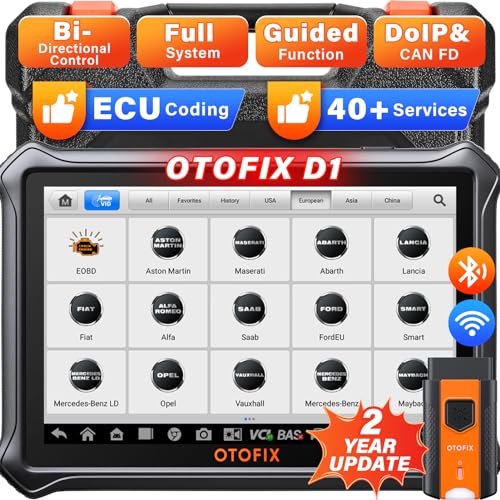
- 2026 Newest Wireless Bluetooth Scan Tool D1: OTOFIX D1 Diagnostic scanner is upgraded version with Enhanced Hardwares & Newest Functions, FASTER and SMARTER! ✅Alternative Bluetooth 5.0 +USB connect✅2G+64GB✅Android 9.0 OS✅5G & 2.4 GHz Dual WiFi✅5800mAh battery👍VAG Guided Function👍ECU Online Coding👍CANFD&DOIP👍40+ Services👍Bi-Directional Control👍Full Systems Diagnose👍2 Years Free Update👍150+ Vehicle Coverage🎁Contact to get gift: otofixaftersales-amz@ outlook.com
- ECU Coding to Unlock the Hidden Features: OTOFIX D1 obd2 scanner diagnostic tool newly adds ECU Coding which can Online Coding(ONLY for VW/Au.di/Sk0da), Variant Coding/Offline Programming, Flash Hidden Functions, Reset Adaptive Data, Match Replaced Components, Customize OE-Settings. Such as: halogen fog lamps retrofitted with xenon fog lamps, different capacity battery retrofit, disbale auto start-stop, sunroof initialization, injector calibration, etc. PS: Coding functions vary by model&year.
- Full Bidirectional Control for Active Car Tests: The D1 OTOFIX scanner also offers bi-directional control, allowing you to perform powerful active tests on car subsystems. This means that you can check the working status and functionality of open & close solenoids, energize injectors, turn cooling fan on & off, and more, all from the device itself.🚩The D1 bi-directional obd2 scanner can quickly help you to check if a system or component goes well,Improving 200% Efficiency.**Note that Active Tests available depend on the make/model/year of your car.
- 40+ Popular Maintenance Functions: OTOFIX D1 obd scanner for car performs 40+ hot services, including Oil Reset, EPB, TPMS, BMS, E.GR, G.PF, D.PF, SAS Calibration, ABS Bleeding, Injector Coding, Gearbox Match, Suspension, Crankshaft Relearn, Power Balance, etc., still growing. Great choice for DIYers, technician, repair shop. 🚩Get MORE special functions from "Car Brand>System>Service". Check compatibility before purchase via 📧 otofixaftersales-amz@ outlook.com.
- OE-Level All Systems Diagnostic + One-Click AutoVIN & AutoSCAN: OTOFIX D1 scanner automotriz gives you the ability to troubleshoot entire car systems including engion system,transmission system,body system,chassis,etc. 🚩One of the standout features of the D1 obd2 scanner diagnostic tool is the one-click AutoVIN & AutoScan function. This feature allows you to quickly and easily scan all diagnosable ECUs with just one click, and identify any problems hidden in your vehicle's systems.
Last update on 2026-06-23 / Affiliate links / Images from Amazon Product Advertising API
This product presentation was made with AAWP plugin.