
NHTSA ID Number: 10122162
Manufacturer Communication Number: SSP 920243
TSB/Document Date: 2017-11-08
Summary
This eSelf-Study Program introduces you to the technology of the third generation of EA888 4 cylinder engines.
eSelf-Study Program 920243
The Audi 1.8L and 2.0L Third Generation
EA888 Engines
1
Audi of America, LLC
Service Training
Created in the U.S.A.
Created 11/2013
Course Number 920243
©2013 Audi of America, LLC
All rights reserved. Information contained in this manual is based on
the latest information available at the time of printing and is subject to
the copyright and other intellectual property rights of Audi of America,
LLC., its affiliated companies and its licensors. All rights are reserved
to make changes at any time without notice. No part of this document
may be reproduced, stored in a retrieval system, or transmitted in any
form or by any means, electronic, mechanical, photocopying, recording
or otherwise, nor may these materials be modified or reposted to other
sites without the prior expressed written permission of the publisher.
All requests for permission to copy and redistribute information should
be referred to Audi of America, LLC.
Always check Technical Bulletins and the latest electronic service repair
literature for information that may supersede any information included
in this booklet.
Revision 2: 12/2013
2
Contents
Introduction..........................................................................................5
Development goals ....................................................................................................................................................... 6
Brief technical description ........................................................................................................................................... 7
Technical features ........................................................................................................................................................ 8
Engine mechanicals............................................................................ 10
Overview ......................................................................................................................................................................10
Cylinder block ..............................................................................................................................................................10
Oil pan ..........................................................................................................................................................................11
Crankshaft assembly ..................................................................................................................................................12
Chain drive ...................................................................................................................................................................14
Balance shafts .............................................................................................................................................................15
Auxiliaries mounting bracket .....................................................................................................................................16
Cylinder head ..............................................................................................................................................................18
Integral exhaust manifold .........................................................................................................................................21
Positive crankcase ventilation ...................................................................................................................................23
Oil supply............................................................................................ 28
System overview .........................................................................................................................................................28
Oil supply .....................................................................................................................................................................30
Oil filler cap .................................................................................................................................................................32
Switchable piston cooling jets ...................................................................................................................................32
Cooling system................................................................................... 34
System overview .........................................................................................................................................................34
Innovative Thermal Management (ITM) ...................................................................................................................36
Air supply and charging...................................................................... 49
System overview .........................................................................................................................................................49
Air routing system for transversely mounted engines ............................................................................................50
Air routing system for longitudinal mounted engines ............................................................................................51
Intake manifold ..........................................................................................................................................................52
Turbocharger ...............................................................................................................................................................53
Fuel system........................................................................................ 57
System overview .........................................................................................................................................................57
Mixture formation / dual injection system ...............................................................................................................58
Operating modes ........................................................................................................................................................59
Engine management system.............................................................. 62
System overview example – 1.8l TFSI engine ..........................................................................................................62
Differences between 1.8L longitudinally and transversely mounted engines ......................................................64
Differences between components in the engines with 1.8 l and 2.0 l displacement ...........................................65
Component differences for the 2015 Audi S3 .........................................................................................................66
Differences between the exhaust turbochargers ....................................................................................................67
Differences between combustion methods .............................................................................................................68
Special tools....................................................................................... 69
Self Study Programs........................................................................... 70
Knowledge Assessment..................................................................... 71
3
This eSSP contains video links which you
can use to access interactive media.
This eSelf Study Program teaches a basic knowledge of the design and functions of new models,
Note
new automotive components or technologies.
It is not a Repair Manual!
All values given are intended as a guideline only.
For maintenance and repair work, always refer to the current technical literature.
4
Reference
Introduction
The launch of the new 1.8L and 2.0L TFSI engines marks the
beginning for the third generation of the successful EA888
four cylinder engine family from Audi. The motives for this
development are increasingly stringent exhaust emission
standards, better fuel economy and reduced CO2 emissions.
To achieve these goals, the engines have been completely
revised.
This “global engine” is manufactured at Audi’s Hungarian
plant in Györ; in Silao, Mexico; Shanghai and Dallan China.
In the future it will also be produced in Changchun. Like the
second generation versions of this engine, it is available in
both 1.8L and 2.0L displacements. It is used for a variety of
vehicle platforms and Group brands and is available in a wide
range of power ratings.
Another design requirement was that the engines be suitable for use in all markets, including those where low grade
fuel is prevalent.
Please note:
Some illustrations of the 1.8L engine in this eSelf-Study
Program are for the world-wide market. With the North
American introduction of the third generation EA888
engines, the 1.8L engine will not have a continuously adjustable exhaust camshaft nor AVS.
Learning objectives of this eSelf Study Program:
This eSelf-Study Program introduces you to the technology
of the third generation of EA888 4 cylinder engines. Upon
completing this eSelf-Study Program, you will be able to
answer the following questions:
•
What are the key technical modifications behind the
development of the EA888 engine family?
•
•
How do the innovative, new technologies work?
What changes do the 1.8L and 2.0L engines bring to
customer service?
606_001
Reference
For a detailed technical description of the first generation engine, please refer to eSelf-Study Program 921703,
The Audi 2.0 Liter Chain-driven TFSI Engine.
Reference
To find more about the modifications to the first and second generation engines, please refer to eSelf-Study
Program 922903, The 2.0L 4V TFSI Engine with AVS.
5
Development goals
The main goals for developing the third generation of the
EA888 engine family were to meet more stringent exhaust
emission standards and provide compatibility of the engine
with various modular platforms.
The engineers in Ingolstadt placed special emphasis on the
following priorities during the development cycle:
•
A high proportion of identical parts for all engine
versions
•
•
•
Reducing engine weight
The following innovative, new technologies are featured:
•
•
•
Exhaust manifold integrated into the cylinder head
•
Innovative Thermal Management system with fully
electronic coolant temperature control
Dual injection system with direct and port injection**
New, compact turbocharger module with cast steel
turbine housing, electrical wastegate actuator and
oxygen sensor upstream of the turbine
Minimizing intra-engine friction
Increasing power output and torque in conjunction with
good fuel economy
Modular adaptation
To use the third generation of the EA888 engine family as a
"global engine" in the modular longitudinal application
(MLB) and the modular transverse application (MQB), it was
necessary to revise its dimensions, mounting and connecting
points.
Engine mounts and a dipstick are used if the engine is transversely mounted. If the engine is longitudinally mounted,
use is made of engine supports and a sealing cap in place of
a dipstick.
CO2 reduction
To meet emission limits while reducing CO2 output, the
following design modifications have been made:
Downsizing/downspeeding*
Friction and weight reduction
• Balance shafts partially mounted in needle bearings
• Smaller main crankshaft bearing diameter
• Lower oil level
• Reduced tensioning force in the auxiliary drive
Cylinder head
• Cylinder head with Integrated Exhaust Manifold (IEM)
• Weight-reduced exhaust turbocharger housing
• Electrical wastegate actuator
Injection
• FSI and MPI fuel injectors**
Thermal management
• Rotary slide valve control
Reducing friction
The chain tensioners have been optimized for the reduced oil
pressure. In addition to this, the tensioning force of the
chains has been reduced, in turn reducing friction.
Also, the crankshafts are made with smaller main bearing
diameters which produce less friction.
The poly-Vee belt drive configuration is identical for longitudinal and transverse mounted engines. However, the alternators and A/C compressors are model-dependent.
* The term downspeeding is used to describe the reduction in engine speed achieved by altering the overall transmission ratio. Use of a drive
ratio optimized for fuel efficiency makes it possible to achieve reductions in fuel consumption similar to those achievable by reducing engine
displacement. The higher power output and average pressure level of turbocharged engines allows the operating point to be shifted towards
lower engine speeds and higher engine loads. This means that the engine can be operated in an rpm range that is more favorable in terms
of fuel economy. Downspeeding concepts generally go hand in hand with downsizing concepts - a combination particularly well suited to
turbocharged direct injection gasoline engines.
** The initial offering of the 3rd generation engine in the North American market will be equipped only with FSI. The dual injection system
with both MPI and FSI will be introduced in later models.
6
Brief technical description
Engine type
• Four-cylinder in-line gasoline engine with direct injection
and MPI*
• Exhaust turbocharging with charge air cooling
• Chain driven camshafts
• Balance shafts - partially supported by needle bearings
Animation showing the overall engine.
Valve control
• Four valves per cylinder, double overhead camshafts
• Continuous intake and exhaust camshaft adjustment on
the 2.0L engine
• Continuous intake camshaft adjustment on the 1.8L
engine
• Audi valvelift system (only on the exhaust camshaft of
2.0L version in the North American market)
Engine Management
• Electronic engine management system with EPC
• Combined direct and port injection systems*
• Adaptive O2 sensor control
• Mapped ignition with high voltage ignition coils
• Cylinder-selective adaptive knock control
* The initial offering of the 3rd generation engine in the
North American market will be equipped only with FSI. The
dual injection system with both MPI and FSI may be introduced in later models.
606_057
7
Technical features
1.8l TFSI engine
Engine code
CNSB
Installation position
transverse
Displacement cu in (cm3)
109.7 (1798)
Power output at rpm
170 hp at 5100 - 6200
(125 kW at 5100 - 6200)
Torque at rpm
184 lb ft at 1250 - 5000
(250 Nm at 1250 - 5000)
Bore
3.24 in (82.5 mm)
Stroke
3.31 in (84.1 mm)
Compression ratio
9.6 : 1
Main crankshaft bearing diameter
1.88 in (48 mm)
Engine management system
Simos 12
Fuel type
Premium 91 AKI
Emissions standard
SULEV
Firing Order
1–3–4–2
Knock control
yes
Turbocharging
yes
internal
(camshaft adjustment)
Intake manifold flaps
yes
Intake camshaft adjustment - continuous
yes
Exhaust camshaft adjustment - continuous
no
High pressure injectors (FSI)
yes
Injectors in the intake manifold (MPI)
no
Secondary air system
yes
Audi valvelift system - for exhaust valves
no
Rotary slide valve
yes
Regulated oil pump
yes
Tumble flaps
yes
1.8L & 2.0L engines overview
8
2.0l TFSI engine
Engine code
CNTA
CYFB
Installation position
longitudinal
transverse
Displacement
121.0 cu in
(1983 cm3)
121.0 cu in
(1983 cm3)
Power output
220 hp at 4500 - 6250
(162 kW at 4500 - 6250)
285 hp at 5500 - 6200
(206 kW at 5500 - 6200)
Torque at rpm
258 lb ft at 1500 - 4500
(350 Nm at 1500 - 4500)
280 lb ft at 1800 - 5500
(380 Nm at 1800 - 5500)
Bore
3.24 in (82.5 mm)
3.24 in (82.5 mm)
Stroke
3.65 in (92.8 mm)
3.65 in (92.8 mm)
Compression ratio
9.6 : 1
9.3 : 1
Main crankshaft bearing diameter in mm
52
52
Engine management system
Simos 12
Simos 12
Fuel type
Premium 91 AKI
Premium 91 AKI
Emissions standard
SULEV
LEV3
Firing order
1–3–4–2
1–3–4–2
Knock control
yes
yes
Turbocharging
yes
yes
internal
(camshaft adjustment)
internal
(camshaft adjustment)
Intake manifold flaps
yes
yes
Intake camshaft adjustment - continuous
yes
yes
Exhaust camshaft adjustment - continuous
yes
yes
High pressure injectors (FSI)
yes
yes
Injectors in the intake manifold (MPI)
no
no
Secondary air system
yes
yes
Audi valvelift system - for exhaust valves
yes
yes
Rotary slide valve
yes
yes
Regulated oil pump
yes
yes
Tumble flaps
no
no
Drumble
yes
yes
1)
1.8L & 2.0L engines overview
1)
Please see page 64
9
Engine mechanicals
Overview
In addition to significantly reducing the weight of the cylinder block, a second cooling-side oil gallery has been developed to accommodate the electrically switchable piston
cooling jets. The cross-sections of the coolant and oil return
lines have been modified and the position of the knock
sensors has also been optimized.
The balance shafts are now partially supported by needle
bearings to reduce friction and ensure their robustness for
start-stop or hybrid applications. The weight of the balance
shafts has also been reduced which lowers the inertia
required to move them.
The oil return line on the "hot" side of the engine has been
completely reconfigured.
Weight saving measures (1.8l TFSI engine)
The third generation of the EA888 engine family delivers a
total weight saving of approximately 17.1 lb (7.8 kg).
To achieve these savings, the following components have
been modified or are used for the first time:


- [J2534 Pass-Thru Programmer] - TOPDON RLink J2534 is...
- [All-in-One OEM Reprogramming and Diagnostics] - When...
- [Tested, Trusted, and Proven for Accuracy] - TOPDON RLink...
- [One-Click Installation, Continuous Updates] - The exclusive...
- [Works with Windows Compatibility and OEM Software...

This product presentation was made with AAWP plugin.
If the PDF is very large, it may not load in the preview below.
Some older TSBs had multiple PDFs — visit the NHTSA Website to view all PDFs.
If the TSB PDF does not show, download or view it on the NHTSA Website.
Click on the (+) Plus Sign
Then Click on Associated Document(s)
Search NHTSA Database for Recalls
Search NHTSA Database for Vehicle Investigations
View Latest Vehicle Investigations
Search NHTSA Database for Vehicle Complaints
View Latest Vehicle Complaints
TSB/Document ID: SSP 920243
Replacement Service Bulletin Number:
MFR Communication Date: 2014-01-17
MFR Internal Campaign ID/Software Version:
Communication Type: Service Bulletin/Repair Instructions
NHTSA Components: ENGINE
MFR Component System:
MFR Component Subsystem:
Previous TSB | Next TSB |
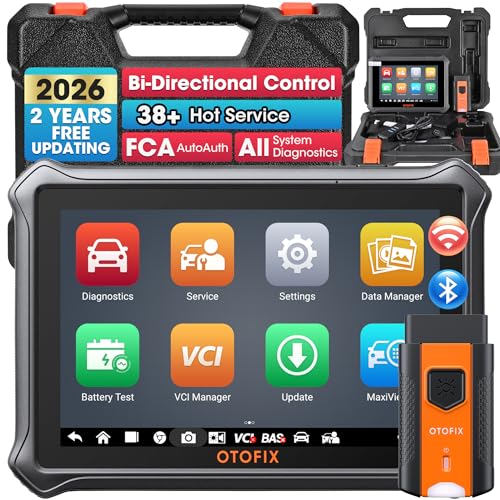
- 🎉[OTOFIX D1 Lite, Perfect Cost-effective Diagnostic Tool]: OTOFIX D1 Lite, a newest bidirectional scan tool from OTOFIX company, is a great choice for DIYers and repair shops. 👉This obd2 scanner diagnostic tool packs all practical functions: OE level all systems diagnoses, Bi-Directional Control, 38+ reset services fixing 99% of common problems, support DoIP & CANDF protocols and FCA
 AutoAuth, high-end hardware configuration. Worldwide vehicles and 🔥2 Years Free Updating🔥 covered.
 - 🎉[Bi-Directional Scan Tool, Active Test]: OTOFIX D1 Lite bluetooth obd2 scanner can also command ECUs and monitor the operation of the actuators to track down the problems of certain parts, like windows, sunroof, wipers, fuel pumps, etc., saving repair time & trouble. This makes OTOFIX D1 Lite the most cost-effective bidirectional scan tool.
- 🎉[2026 Newest, 38+ Hot Reset Functions]: Equipped with 38+ reset functions in one, the OTOFIX D1 lite automotive scanner diagnostic tool allows you to troubleshoot 99% of common vehicle problems. You can use this car diagnostic scanner holding enough functions to easily repair common vehicle models in your repair shops. Including Oil Reset, Injector Coding, Throttle, DPF Reset, SCR Reset, Gear Learning, Clutch Learning, Suspension, etc. Note* Reset functions vary by model.
- 🎉[OE Level Full Systems Diagnostics]: Unlike the 2-system and 4-system diagnostic tools, the OTOFIX auto scan tool can complete comprehensive system diagnostics within 5 minutes. It accesses and scans all available onboard systems like for Engine /AT /ABS /EPB /BMS /TPMS /SRS /SAS /Audio System /BCM /Air Conditioning / etc., to read & clear codes, view live data, and check ECU information. Note: Active test is not involved.
- 🎉[Powerful Hardware Configuration]: Designed with a fashion appearance & a 7” touchscreen and a weight of 463g, this OTOFIX D1 Lite OBD2 diagnostic scanner scan tool is convenient for everywhere and easy to use & store. Android9.0 OS and 2+64GB memory enhance multi-task smoothness and diagnostic operation, no more wasting too much time. 5800mAh battery allows hours-lasting use. WiFi & VCI1 also bring faster communication for your diagnostics.
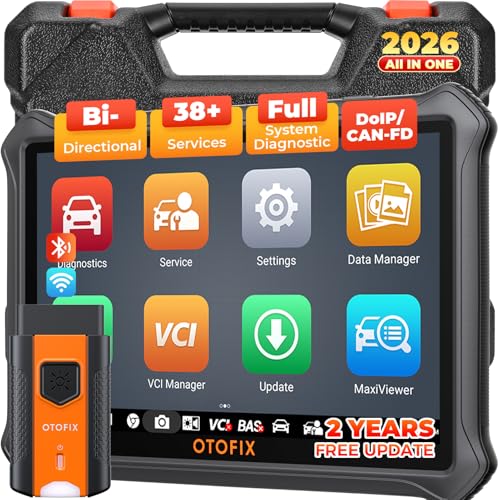
- 🏆【2026 TOP OBD2 Scanner Diagnostic Tool】OTOFIX D1 Lite wireless obd2 scanner has upgraded hardware configuration and car coverage. The newly upgraded D1 Lite with 🔥OS Android 9.0🔥1.5Ghz 4 core high efficiency processor🔥2GB RAM+64GB ROM large storage🔥5800mAh large battery, more stable and longer lasting diagnostics🔥 38+ Reset🔥action tests🔥full system diagnostic🔥Supports MV105 endoscope🔥21+ Language Supports🔥100000+ vehicle coverage to meet all your daily maintenance needs.
- 👍【Bi-Directional Control / Active Test】D1 Lite obd2 scanner has bidirectional control(worth $300+), which is the most beloved feature among mechanic. If your headlights or car windows are broken, going to a repair shop will cost a lot of money. You can use D1 Lite to send execution commands to the ECU module and identify the repair status. Such as ABS, car windows, doors, valves, wipers, headlights, etc., effectively shorten diagnostic time and reduce diagnostic costs.
- 🔥【All Systems Diagnostics, In-depth Checking】This advanced OBD2 Scanner D1 Lite can perform OE-level diagnosis of all systems including engine, transmission, airbag, ABS, ESP, TPMS, gateway, steering, radio, and air conditioning for more than 100 brands. This diagnostic scanner supports essential functions, such as reading ECU version info, reading and clearing fault codes, and reading data streams.With just a simple click, it provides you with accurate and in-depth diagnostics.
- 🏆【38+ Reset Hot Functions】For repair workshops, holding an OTOFIX D1 Lite Auto scanner is a strong advantage over others. Its 38+ maintenance functions provide various solutions for all module repairs, including Oil Reset, TPMS Reset, Injector Coding, Suspension, Throttle Matching, etc., which will usher your repair business to a new pinnacle. Continuously updating will never make the functionality & compatibility out-of-date.
- 🏆【150+ Models, 10000+ Car Coverage & 16 Languages】D1 Lite is a comprehensive car diagnostic scan tool, help you to troubleshoot car issues fast for 95% US, European, Asian auto makes. ✅ With frequent updates and optimizations allow D1 Lite to cover more vehicles to meet your needs. ✅ Multilingual menu allows auto mechanics around the world to use it without language barriers. 🚩Note: Kindly send us the S/N of the device to authorize new language updates before changing the menu language.
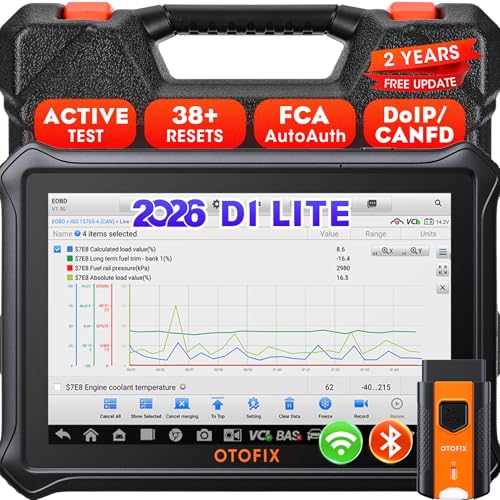
- 【2026 OTOFIX D1 Lite Gives the Best Value for Money】OTOFIX D1 Lite bidirectional scan tool is more FASTER and SMARTER with 2026 Enhanced Hardwares & New Functions! 👍Alternative Bluetooth +USB connect 👍2G+64GB 👍4x ARM Cortex-A35 (1.5GHz) Processor (5X Faster CPU) 👍Android 9.0 OS 👍5G GHz WiFi 👍CANFD&DOIP 👍 FCA AutoAuth 👍38+ Services 👍3K+ Bi-Directional Control 👍Full Systems Diagnose 👍2 Years Update 👍150+ Vehicle Coverage.
- 👍【Active Tests】 OTOFIX D1 Lite is a bi-directional scan tool that can send commands to, and also receive information from vehicle control modules. This way, you can quickly locate and repair faulty auto parts. For Example: send direct commands to ask the vehicle to turn on/off the radiator fan, lights, sound horn, fuel pump, modulate throttle, open/close windows, operate mirrors and more. *Note that only available tests will be displayed in the menu.
- 👍【38+ Service Functions】 OTOFIX D1 Lite scan tool offers 38+ of the hottest service functions that are commonly used for car repairs. That include Oil reset/SAS/EPB/BMS/Throttle/ABS bleeding, and 2065-new SUS/ADBLUE/NOX/Headlamp resets (and more) to help restore your car status after repairs are done. Compared to other diagnostic scanners for cars, the OTOFIX D1 Lite scanner is much more fully-featured. *Note that specific functions available depend on the make/model/year of your car.
- 👍【All System Diagnostics + Cloud Report Management】 This 2026 car scanner OTOFIX D1 Lite provides troubleshooting and data for all ECUs: read/clear DTCs, view graphic live data/VIN, and locate system faults for safe driving. With Cloud Report Management, you can save detailed reports to cloud servers and easily shared them with others via QR codes/emails/text messages. Others can access these reports from any device (smartphones/tablets/PCs …) anytime, and you can better manage repair work.
- 👍【99% Car Coverage】 This one-station car scanner diagnostic for all cars works on 150+ major car brands across the world. 1) It supports CAN-FD/DoIP protocols: compatible with GMCAVALIER/TRAX/Encore/Envision/GL8(LSY)/CT4/CT5 after 2019; Volvo after 2018; Land Rover/Jaguar after 2017; and BM.W F/G all chassis. 2) For models equipped with security modules (such as Renault & 2018+ FCA SGW), its built-in AutoAuth allows you to easily break diagnostic barriers after registration.
This product presentation was made with AAWP plugin.
Last update on 2026-06-06 / Affiliate links / Images from Amazon Product Advertising API