
NHTSA ID Number: 10122162
Manufacturer Communication Number: SSP 920243
TSB/Document Date: 2017-11-08
Summary
This eSelf-Study Program introduces you to the technology of the third generation of EA888 4 cylinder engines.
Engine inlet
Rotary slide valve 2
DC adjustment
motor
Supply line to radiator
606_010
Return line from
oil cooler
Rotary slide valve 1
Worm gear
Belt drive
Coolant pump
Return line from heater, turbocharger and transmission
Return line from radiator
39
Engine warm-up and operation is divided into three phases of regulation
Adjustment angle
Warm-up and regulation over 160°
Temperature control range for
After-run over a total of 95°
Warm-up range
After-run range
partial and full load
Switch on engine
Mini -
-
Static
volume
stream
s522_107
The following pages describe the engine temperature regulation from the warm-up range, the temperature control
range and finally to the after-run range. This is a highly
simplified representation and does not include the electrical
drive of the Engine Temperature Control Actuator N493 or
the main water pump drive.
40
Temperature regulation sequence
During warm-up, the engine runs through three phases:
• Static coolant
• Mini-volume stream
• Enable engine oil cooler
The different phases are accomplished through the positions
of the rotary valves. The objective is to use the energy generated by the fuel combustion to heat the engine as much as
possible. However, if passenger compartment heating is
required during the "static coolant" phase, heat energy is
provided to the interior.
Turbocharger
Non-return valves
Cylinder head with
integrated exhaust
manifold
Passenger compartment heat exchanger
Cylinder block
After-run Coolant
Pump V51
Climatronic Coolant
Engine oil cooler
Shut-off Valve N422
Rotary valve 2
Rotary valve 1
Coolant pump
Engine Temperature
Control Actuator
Emergency mode
Main radiator
N493
thermostat
s522_092
41
Warm-up with static coolant
To keep the heat from the fuel combustion in the engine,
Rotary valve 2 is closed. This interrupts the coolant flow
from the engine coolant pump to the cylinder block. Rotary
valve 1 blocks return from the engine oil cooler and the
return from the main radiator.
Climatronic Coolant Shut-off Valve N422 interrupts the
coolant flow to the passenger compartment heat exchanger
and Coolant After-run Pump V51 is not activated.
V451
Engine block
N422
Rotary valve 2
Rotary valve 1
Main radiator
s522_092
Warm-up with mini-volume flow
Turbocharger
This control phase in the warm-up range protects the cylinder head and the turbocharger from overheating from the
static coolant in the exhaust manifold.
At a Rotary valve 1 angle position of 145°, Rotary valve 2 is
engaged and begins to open. A small coolant flow begins
through the cylinder block, the cylinder head and the turbocharger returning back to the rotary valve module and
coolant pump.
Rotary valve 2
Rotary valve 1
s522_093
42
Warm-up with mini-volume flow and heating in
the vehicle interior
If heating is required in the passenger compartment during
this phase, N422 opens and After-run Coolant Pump V51
starts delivery. Rotary valve 2 temporarily interrupts the
coolant flow to the cylinder block.
Heat exchanger
The coolant is directed through the cylinder head, turbocharger and heat exchanger. This, however, causes the
warm-up phase of the engine to take longer.
N422 and V51 are also always activated to comply with
requirements in the subsequent control ranges. The coolant
flow to the engine block is reduced or blocked by rotary valve
2 as required.
V451
Engine block
N422
Rotary valve 2
s522_094
Warm-up with map-controled engine active
In this stage, the engine oil cooler is enabled during the
warm-up phase of the engine. Rotary valve 1 moves to a
120° angle position opening the passage to the oil cooler.
Because Rotary valve 2 is still engaged, it also turns more
and enlarges the coolant flow through the cylinder block. A
large amount of heat distribution occurs in the engine block
and excess heat is discharged via the oil cooler.
Rotary valve 2
Engine
oil
cooler
Rotary valve 1
s522_095
43
Temperature control range
The innovative thermal management moves seamlessly from
the warm-up range to the temperature control range. Here,
rotary valve module regulation is dynamic and depends on
the engine load.
To conduct excess heat away, the connection to the main
radiator from the rotary valve module is opened. To do this,
positions rotary valve 1 in an angle position of 0° and 85°,
depending on how much heat has to be conducted away. At a
rotary valve 1 angle position of 0° the connection to the
main water cooler is fully opened.
Rotary valve 2
Rotary valve 1
Main radiator
s522_096
If the engine is running at a lower load and speed (partial
load range), the thermal management adjusts the coolant
temperature to 225 °F (107°C). Since the full cooling power
is not required, rotary valve 1 temporarily closes the connection to the main radiator. If the temperature rises above this
threshold value, the connection to the main radiator is
opened again. Constant opening and closing is necessary to
keep the temperature as much as possible at a constant
225 °F (107°C).
When load and engine speed increase, coolant temperature
is reduced to 185 °F (85 °C) (full load range) by first completely opening the connection to the main radiator.
Rotary valve 2
Rotary valve 1
Main radiator
s522_102
44
After-run range when switching off the engine
To prevent the coolant from boiling in the cylinder head and
in the turbocharger when the engine is switched off, the ECM
initiates an after-run function. It can be active for up to 15
minutes after the engine is switched off.
During the after-run function, Rotary valve 1 of N493 is
positioned at an angle between 160 degrees and 255
degrees. The greater the after-run requirement, the higher
the angle position. At 255 degrees of opening angle, the
passage to the return line of the main radiator is fully open
so maximum heat is dissipated.
Rotary valve 2 is in the after-run position and not engaged
with Rotary valve 1. V51 circulates coolant through two
sub-streams in the coolant circuit.
V451
N422
One sub-stream flows over the cylinder head and back to
V51. A second sub-stream flows via the turbocharger
through Rotary valve 1 to the main radiator and also to
After-run Coolant Pump V51.
Rotary valve 2
The cylinder block is not supplied with coolant in the run-on
position.
Rotary valve 1
Main radiator
s522_106
45
Emergency running mode strategy
If the coolant temperature in N493 exceeds 235 °F (113 °C),
the emergency thermostat opens a bypass to the main
radiator. This allows the driver to continue driving the
vehicle to a limited extent if N493 is defective.
If the ECM doesn't receive feedback from N493, it moves
Rotary valve 1 to a maximum engine cooling position regardless of engine load and operating temperature.
If N493 should fail, for example, the electric motor fails or
the rotary valve drive should jam, further measures are
initiated:
•
V451
A fault message is displayed in the instrument cluster
and at the same time engine speed is limited to 4000
rpm. A warning tone is issued and the EPC is illuminated.
•
The actual engine coolant temperature is also displayed
in the instrument cluster.
•
Climatronic Coolant Shut-off Valve N422 is opened.
•
After-run Coolant Pump V51 is activated to ensure
cylinder head cooling.
•
A DTC is logged in the Engine Control Module.
If the rotary valve position sensor signal is implausible or the
sensor fails, the ECM activates Rotary valve 1 to a maximum
cooling position as a failsafe.
N422
Rotary valve 2
Rotary valve 1
Emergency mode thermostat
s522_097
Vehicles with DSG transmissions
On vehicles with DSG transmissions, the coolant circuit is
expanded to include a transmission heat exchanger and
Transmission Coolant Valve N488.
Gear oil cooler
Auxiliary radiator
Coolant shut-off valve N82
s522_101
46
Functional diagram of Engine Temperature Control Actuator N493
Connections
1
Sensor ground (connection in engine wiring harness)
2
Sensor signal
3
Sensor + (5 V connection in engine wiring loom)
4
Actuator –
5
Actuator +
2
3
4
5
1
606_021
Transmission Coolant Valve N488
N488 controls the flow of warm coolant from the engine to
the transmission gear oil cooler.
It is held open by mechanical spring force when not activated and closes when the engine is started. The coolant
flow to the transmission opens at a coolant temperature of
176 °F (80 °C) and closes again at 194 °F (90 °C). This helps
the manual transmission to attain its optimal friction
temperature.
When required, the solenoid valve is activated by the ECM.
Electrical connection
Coolant flow to the engine
Solenoid coil
606_022
Coolant flow
to the cooler
47
Coolant Recirculation Pump V50
This pump is used as a circulation pump for the passenger
compartment heat exchanger in vehicles with longitudinally
mounted engines. It is activated by Climatronic Control
Module J255 via a PMW signal. It is diagnosed through J255.
Function
Coolant Recirculation Pump V50 is activated when the ignition is switched on depending on the coolant temperature
and the desired interior temperature setting of Climatronic
Control Module J255.
When V50 is running, coolant is circulated between the
engine and the passenger compartment heat exchanger.
Climatronic Coolant Shut-off Valve N422
Coolant Recirculation Pump V50
606_056
N422 is installed on longitudinally mounted engines. The
valve permits or prevents coolant flow to the passenger
compartment heat exchanger. See page 35, figure 606_023.
Function
Climatronic Coolant Shut-off Valve N422 is identical to
Transmission Coolant Shut-off Valve N488 (see previous page).
It is open (allowing coolant flow) when it is not energized and
closes (preventing coolant flow) when current is applied.
It is opened by spring force and closes when the engine is
started.
The valve opens when the heating, run-on cooling and
start-stop functions are activated. N422 is controlled by
Climatronic Control Module J255 and requires adaptation using
the VAS Scan Tool.
Coolant After-run Pump V51
Coolant Shut-off Valve N82
V51 is installed on vehicles with transversely mounted
engines. It is identical to Coolant Recirculation Pump V50
used in vehicles with longitudinally mounted engines. It is
activated by the ECM with a PWM signal after receiving a
request from Climatronic Control Module J255.
Coolant Shut-off Valve N82 is activated by the Engine Control
Module.
V51 also assists the engine coolant pump to increase coolant
flow through the passenger compartment heat exchanger at
defined engine speeds thus providing higher heating output.
It also helps reduce turbocharger temperature more quickly
which helps extend engine oil life.
48
Depending on the requested temperature in the passenger
compartment, N82 shuts off the coolant flow through the
passenger compartment heat exchanger. This is done for
example, to heat up the engine.
Air supply and charging
System overview
C
A
B
D
E
V465
N249
F
G31
Exhaust gases
N316
J338
G186
G187
G188
G
Intake air (vacuum)
Charge air (charge pressure)
G336
Wastegate (charge pressure)
606_025
G42 with G71
Key:
A
Exhaust flow
G31
Charge Air Pressure Sensor
B
Exhaust turbocharger
G42
Intake Air Temperature Sensor
C
Air filter
G71
Manifold Absolute Pressure Sensor
D
Fresh air flow
G186 EPC Throttle Drive
E
Wastegate valve
G187 EPC Throttle Drive Angle Sensor 1
F
Charge air cooler
G188 EPC Throttle Drive Angle Sensor 2
G
Intake manifold flaps
G336 Intake Manifold Runner Position Sensor
J338 Throttle Valve Control Module
N249 Turbocharger Recirculation Valve
N316 Intake Manifold Runner Control Valve
V465 Charge Pressure Actuator
Note
The Charge Pressure Actuator V465 must be replaced after removing the lock nut from the linkage.
After replacement, the charge pressure actuator must be adapted using the Scan Tool.
49
Air routing system for transversely mounted engines
Turbocharger (B)
Turbocharger Recirculation
Valve N249
Air filter
(C)
Charge Pressure Actuator
V465
606_037
Intake manifold
Charge air cooler
(F)
Intake Manifold Runner Control Valve
N316
Intake Manifold
Runner Position
Sensor G336
Air intake
(D)
Intake Air Temperature Sensor G42 with
Manifold Absolute Pressure Sensor G71
Throttle Valve Control Module J338
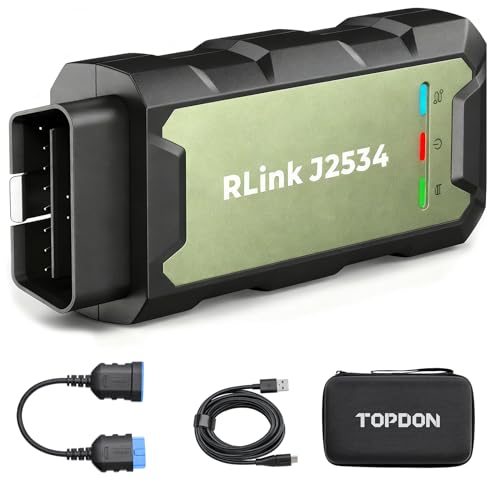
- Advanced VCI Box, Industry-leading J2534 Pass-Thru...
- High-Speed OEM-Level Diagnostics & Programming: Unlock true...
- Coverage for 17 Car Brands & Ultra Reliability: Works...
- User-Friendly RLink Platform & Expert Support: TOPDON’s...
- 6.6 ft USB-C Cable & Portable Storage Case: The RLink J...
Last update on 2026-06-12 / Affiliate links / Images from Amazon Product Advertising API
If the PDF is very large, it may not load in the preview below.
Some older TSBs had multiple PDFs — visit the NHTSA Website to view all PDFs.
If the TSB PDF does not show, download or view it on the NHTSA Website.
Click on the (+) Plus Sign
Then Click on Associated Document(s)
Search NHTSA Database for Recalls
Search NHTSA Database for Vehicle Investigations
View Latest Vehicle Investigations
Search NHTSA Database for Vehicle Complaints
View Latest Vehicle Complaints
TSB/Document ID: SSP 920243
Replacement Service Bulletin Number:
MFR Communication Date: 2014-01-17
MFR Internal Campaign ID/Software Version:
Communication Type: Service Bulletin/Repair Instructions
NHTSA Components: ENGINE
MFR Component System:
MFR Component Subsystem:
Previous TSB | Next TSB |

- [2026 Top-Tier Hardware and Software Upgrade]: Topdon ArtiDiag900 Lite scanner has enhanced hardware and latest features, including Android 11.0, 5x faster CPU, 10000mAh battery for 12 hours of continuous operation, stable wireless diagnosis with Bluetooth 5.0, 8-inch touchscreen. Added bi-directional control, wireless diagnosis, battery testing (optional), and DTC repair guide
- [TOPDON Bidirectional Scan Tool]: This bidirectional obd2 scanner sends commands to the vehicle's ECU for active testing, enabling users to accurately and quickly locate faulty components such as injectors, coolant pumps, windows, wipers, headlights, mirrors, etc. The bidirectional control scanner is the ideal choice for workshops/automotive repair shops as it significantly reduces mechanic's diagnostic time.
- [Wireless Bluetooth Diagnostic Experience]: The AD900 Lite scan tool comes with a Bluetooth 5.0 VCI, supporting a wireless diagnostic range of up to 33 feet (10 meters), allowing you to diagnose without being confined to cables or tight spaces. Stable and fast wireless diagnosis provides a comfortable repair environment. It also offers VCI cables to increase connectivity options.
- [DTC Repair Guide Function]: Easily diagnose issues with your vehicle and receive guidance on repairs with the topdon scan tool's fault code definitions for all systems,maximize your diagnostic capabilities. This function is compatible with Chrysler
 /Dodge/Jeep/Fiat 2010-2014 and expanding with continual updates,the AritDiag 900 Lite car diagnostic scanner is the must-have tool for any technician or DIY enthusiast.
 - [OE-Level Full System Diagnostics]:AritDiag900 Lite full system diagnostic scanner can scan ALL available modules(Engine, Transmission, Airbag, ABS, ESP, TPMS, Gateway, Steering, Radio, Air conditioning, ect.) to✔read ECU info, ✔read/clear codes, ✔view live data stream, ✔retrieves freeze-frame, ✔perform active tests, and more. With just a simple click, it provides you with accurate and in-depth diagnostics.

- Bi-Directional Control, Quickly Locate Problems: Turn your phone into a professional diagnostic tool. You can send commands from your phone to the ECU to test injectors, cooling fans, headlights, A/C clutch, windows, wipers, and more. See which one doesn't respond. Helps you quickly locate the problem and save time. No need to tear things apart, avoid blind disassembly.
- Flexible Subscription, Choose Advanced Features as Needed: TopScan Lite provides free-for-life access to core diagnostics, including full system scan, code reading, performance tests, and repair information. After purchase, advanced features (bi-directional control, service operations, live data, code clearing, and AI functions) are free-for-the-first-year. After the first year, if you want to use advanced features, you need to subscribe on a monthly, quarterly, or yearly basis. As new models and reset functions are updated, the tool will also be continuously upgraded.
- Full System Diagnostics, No Fault Hides: Unlike basic diagnostic tools that only cover 4 systems, TopScan can scan all systems. Read and clear trouble codes, view live data streams, and generate a complete vehicle health report – all issues are clear at a glance. Covers 10,000+ vehicle models and is compatible with 99.99% of vehicles.
- AI Assistant - TopFix: Think of TopFix as your personal AI mechanic. It leverages a repair database and OEM data to deliver clear, step-by-step repair solutions. Features include AI Q&A, one-click translation, and a full repair log, making your diagnostic process simpler and more efficient.
- 8+ Hot Resets, Keep Your Car in Top Shape: One-tap resets for oil, throttle, EPB, steering angle, DPF, ABS, BMS, and airbag. It enables car owners to easily perform essential maintenance, ensuring the vehicle stays in optimal condition and extends its service life.
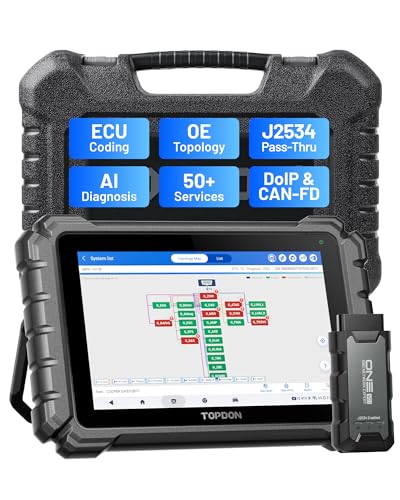
- Dual WiFi & 10.1" Touchscreen: Provides a stable, high-speed wireless link 3x faster than bluetooth, and a responsive, professional interface. Topdon ONE obd2 scanner diagnostic tool ensures smooth, non-lagging diagnostic scan, boosting mechanic efficiency
- J2534 Pass-Thru Support: The included ONE VCI supports the J2534 standard, allowing it to function as a pass-thru device when paired with OEM diagnostic software.Through TOPDON’s RLink platform, technicians can perform dealer-level coding, expanding in-house capabilities without investing in multiple factory automotive scan tools
- OE Topology Mapping: Visualize the vehicle’s ECU network exactly as it’s built.Zoom, pan, and highlight specific modules to pinpoint component issues with precision.Topology mapping displays real-time communication between modules
- 50 Plus Service Functions: Covers high-demand services like ADAS calibration, DPF regen, TPMS reset, ABS bleed, and throttle adaptation.Expands your service menu, allows you to charge premium rates, and turns away zero jobs due to lack of tooling. Vehicle-specific functionality may vary
- Advaned ECU Coding: 10 of the most serviced brands in North America, including full ECU coding and flash hidden support for BMW, VW, Au-di, Benz, Porsche, Toyota, Ni ssan and more. Enables module replacement, feature customization, and personal settings with automatic backup or restore.Lets your shop safely offer high-margin customization services, attracting more customers and boosting profit
Last update on 2026-06-12 / Affiliate links / Images from Amazon Product Advertising API
This product presentation was made with AAWP plugin.