
NHTSA ID Number: 10118412
Manufacturer Communication Number: A011703 2033001-
TSB/Document Date: 2017-10-04
Summary
This bulletin provides instructions on how to clean the secondary air ports if they have too much carbon and cause a restriction.
01 MIL on (P0491 and P0492 stored at same time)
01 17 03 2033001/11 February 23, 2017. Supersedes Technical Service Bulletin Group 01 number 17-01 dated
February 13, 2017 for reasons listed below.
Model(s)
Year
VIN Range
Vehicle-Specific Equipment
S4
2010 - 2012
All
3.2 FSI AVS and 3.0 TFSI
A5, S5
cabriolet
2010 - 2016
All
3.2 FSI AVS and 3.0 TFSI
A6
2009 - 2016
All
3.2 FSI AVS and 3.0 TFSI
A7
2013 - 2016
All
3.2 FSI AVS and 3.0 TFSI
Q5
2010 - 2016
All
3.2 FSI AVS and 3.0 TFSI
Q7
2011 - 2016
All
3.2 FSI AVS and 3.0 TFSI
Condition
REVISION HISTORY
Revision
Date
Purpose
11
-
Revised Warranty (Updated table)
10
02/13/2017
Revised header data (Added engine code and model years)
9
10/13/2016
Revised Service (clarified TSB use if Secondary Air motor is defective)
Revised Warranty (added info CTUA engine)
Customer states the following:
MIL on.
Both of the following DTCs are stored in the engine control module, J623 (address word 0001):
DTC P0491 (Secondary Air System Insufficient Flow, Bank 1)
DTC P0492 (Secondary Air System Insufficient Flow, Bank 2)
Mileage is greater than 15,000 miles.
Page 1 of 15
© 2017 Audi of America, Inc.
All rights reserved. Information contained in this document is based on the latest information available at the time of printing and is subject to the copyright and other intellectual property rights of Audi of
America, Inc., its affiliated companies and its licensors. All rights are reserved to make changes at any time without notice. No part of this document may be reproduced, stored in a retrieval system, or transmitted
in any form or by any means, electronic, mechanical, photocopying, recording, or otherwise, nor may these materials be modified or reposted to other sites, without the prior expressed written permission of the
publisher.
Technical Background
Under certain driving conditions, the secondary air ports in the cylinder head can accumulate carbon over time,
causing a restriction.
Production Solution
Not applicable.
Service
Please note that before performing this repair for the first time, it is mandatory that the technician
complete Audi Academy Course #940134 and assessment #940134B. Otherwise, the warranty claim will
be denied. The course and assessment can be found on the Audi Academy CRC site. Specific video
sections are referenced in the instructions below.
Perform ODIS Testing - For all but A6 (C6) 3.2FSI and Q7 3.0T:
1. Delete all DTCs. Bring the engine to operating temperature.
2. Go to Control Modules >> 01 Engine Control Module >> Control module OBD>> Basic Settings >>
Checking Secondary Air System.
3. Select MVB: MASS_SA_REL[0] and MASS_SA_REL[1].
4. Perform test (Press brake and gas pedal at the same time, start test on ODIS tester).
5. While Basic Setting test is running, check if the secondary air pump runs normally (no unusual
noises). In addition, check for a leak in the secondary air hose routing between the pump and combi
valves.
6. Immediately after the test is complete, read MASS_SA_REL[0] and MASS_SA_REL[1]. Depending
on the software level and engine code, the air mass flow will be displayed in one of two ways:
For old software version:
If the value is between 0.1 and 0.7, and there were no issues with the pump and hoses, the
system needs to be cleaned. Follow the instructions below.
For new software version:
If the value is between 13 and 16, and there were no issues with the pump and hoses, the system
needs to be cleaned. Follow the instructions below.
Page 2 of 15
© 2017 Audi of America, Inc.
All rights reserved. Information contained in this document is based on the latest information available at the time of printing and is subject to the copyright and other intellectual property rights of Audi of
America, Inc., its affiliated companies and its licensors. All rights are reserved to make changes at any time without notice. No part of this document may be reproduced, stored in a retrieval system, or transmitted
in any form or by any means, electronic, mechanical, photocopying, recording, or otherwise, nor may these materials be modified or reposted to other sites, without the prior expressed written permission of the
publisher.
Perform ODIS Testing - For A6 (C6) 3.2FSI and Q7 3.0T only:
1. Go to Control Modules >> 01 Engine Control Module >> Control module OBD>> Basic Settings >>
test 77.
2. While performing test 77, check if the secondary air pump is running and make sure it does not make
any abnormal or unusual noise:
If test 77 fails but the pump is running and does not make any abnormal/unusual noise, perform
the cleaning process below.
If the pump is not running or if it makes abnormal/unusual noise, this TSB does not apply.
Tip: Always use the latest version of this TSB.
Prepare for Power Washing:
1. Move the exhaust sliding
bushings (that connect the
catalytic converter and
muffler) back, then lower the
catalytic converter pipes
(Figure 7).
For Q7, unbolt muffler from
catalytic converter. Cover
mufflers with plastic bag to
prevent water from entering.
Cleaning water will drain out
of the catalytic converter
pipes during the cleaning
process.
Figure 7. Lowered catalytic converter pipes.
2. Remove all spark plugs and cover the engine harness plugs for the coils (for water protection).
3. Drain the coolant so that it can be reused.
Page 3 of 15
© 2017 Audi of America, Inc.
All rights reserved. Information contained in this document is based on the latest information available at the time of printing and is subject to the copyright and other intellectual property rights of Audi of
America, Inc., its affiliated companies and its licensors. All rights are reserved to make changes at any time without notice. No part of this document may be reproduced, stored in a retrieval system, or transmitted
in any form or by any means, electronic, mechanical, photocopying, recording, or otherwise, nor may these materials be modified or reposted to other sites, without the prior expressed written permission of the
publisher.
4. Bring front end of the car into service position (for Q5, A6, S4, and S5 cabrio) to make room in the
front of the engine. The Q7 has enough room for access to the front of the cylinder heads.
5. For 3.0T only: remove the
coolant supply lines
(intercooler of supercharger)
in the front of the engine
(Figure 8).
Figure 8. Front coolant pipes to be removed for 3.0T.
6. Remove the following components:
Coolant pipe (Figure 9,
image 1).
Coolant flange (Figure 9,
image 2).
Pulley and if needed
bracket, of power steering
pump (Figure 9, image 3).
Pulley of water pump
(Figure 9, image 4).
Coolant tube (Figure 9,
image 5).
Dipstick tube (Figure 9,
image 6).
Figure 9. Engine component removal.
Note:
When removing the dipstick tube, turn it 180 degrees, and then reinstall it for water protection.
Page 4 of 15
© 2017 Audi of America, Inc.
All rights reserved. Information contained in this document is based on the latest information available at the time of printing and is subject to the copyright and other intellectual property rights of Audi of
America, Inc., its affiliated companies and its licensors. All rights are reserved to make changes at any time without notice. No part of this document may be reproduced, stored in a retrieval system, or transmitted
in any form or by any means, electronic, mechanical, photocopying, recording, or otherwise, nor may these materials be modified or reposted to other sites, without the prior expressed written permission of the
publisher.
Note:
To loosen the coolant tube, remove 2 bolts (Figure 10, image A and C),
open clip (Figure 10, image B), and pry bushing apart as shown in
training video (Figure 10, image D). There is no need to loosen the AC
compressor.
Cover opening of right coolant pipe to prevent coolant circuit
contamination.
Figure 10. Loosening the
coolant tube.
7. Remove main port freeze
plug by hitting the marked
area with a small punch until
it turns (Figure 11). Remove
with pliers.
Figure 11. Marked area on main port of freeze plug.
Prepare to Power Wash:
Warning:
Read pressure washer user manual and follow these safety instructions.
Always insert special cleaning hose into adaptor and engine before turning pressure washer on.
If switching special cleaning to a different port, turn pressure washer off and release residual pressure
by pulling the trigger before removing the special cleaning hose from the engine.
Wear safety glasses and gloves.
Page 5 of 15
© 2017 Audi of America, Inc.
All rights reserved. Information contained in this document is based on the latest information available at the time of printing and is subject to the copyright and other intellectual property rights of Audi of
America, Inc., its affiliated companies and its licensors. All rights are reserved to make changes at any time without notice. No part of this document may be reproduced, stored in a retrieval system, or transmitted
in any form or by any means, electronic, mechanical, photocopying, recording, or otherwise, nor may these materials be modified or reposted to other sites, without the prior expressed written permission of the
publisher.
1. Become familiar with the special tool set VAS6825 (Figure 12):
Special hose with
scale for cleaning
single ports
(Figure 12, image
1).
Special hose for
cleaning the main
ports (Figure 12,
image 2).
6
Hose adaptor for
the special hose
with scale (Figure
12, image 3).
Engine adaptor
Figure 12. Special tool set VAS6825.
for bank one
(Figure 12, image
4a).
Engine adaptor
for bank two
(Figure 12, image
4b).
2. To catch water, put a pan under the front of the engine and under the disconnected catalytic
converter pipes.
3. Install engine adaptors on the appropriate banks (Figure 13
and Figure 14).
Figure 13. Engine adaptor on bank one.
Page 6 of 15
© 2017 Audi of America, Inc.
All rights reserved. Information contained in this document is based on the latest information available at the time of printing and is subject to the copyright and other intellectual property rights of Audi of
America, Inc., its affiliated companies and its licensors. All rights are reserved to make changes at any time without notice. No part of this document may be reproduced, stored in a retrieval system, or transmitted
in any form or by any means, electronic, mechanical, photocopying, recording, or otherwise, nor may these materials be modified or reposted to other sites, without the prior expressed written permission of the
publisher.
Figure 14. Engine adaptor on bank two.
4. To ensure proper pressure washer function, use a ¾-inch water supply hose (no longer than 60 feet)
to supply pressure washer.
The Audi-supplied pressure washer comes with a 22mm male-to-male adapter (to connect special
tool to trigger gun), a pressure gauge (to connect between pressure washer and high pressure hose),
and a 220V power adapter.
Make sure that pressure is at least 1800 psi when using the special single port cleaning hose (the
hose with the scale). Use the table below to compensate for low water pressure:
psi While Cleaning Single Ports
Cleaning Time in Minutes
Less than 1900
Pressure too low – check water supply
1900
4
2000 or higher
3
Power Wash the Ports
Cleaning Main Secondary Port:
1. Insert special main port cleaning hose (the hose without the scale) two inches into the engine
adaptor.
2. Turn the pressure washer on.
3. Holding the cleaning hose tightly, pull the pressure washer trigger.
Page 7 of 15
© 2017 Audi of America, Inc.
All rights reserved. Information contained in this document is based on the latest information available at the time of printing and is subject to the copyright and other intellectual property rights of Audi of
America, Inc., its affiliated companies and its licensors. All rights are reserved to make changes at any time without notice. No part of this document may be reproduced, stored in a retrieval system, or transmitted
in any form or by any means, electronic, mechanical, photocopying, recording, or otherwise, nor may these materials be modified or reposted to other sites, without the prior expressed written permission of the
publisher.
4. Gradually move the cleaning hose into the port, going back and forth until the combi valve is reached.
All water comes out at the adaptor #4.
5. Continue going back and forth through the whole port until only clean water drains out of the cylinder
head.
6. Do the same with the other cylinder head.
Cleaning Single Ports:
1. Because every port has a different distance to the cylinder head, use the table below to position the
hose adaptor for the special single port cleaning hose (the hose with the scale) correctly into the
hose. The back side of the hose adaptor must align with the number on the scale of the cylinder to be
cleaned (Figure 15). The longitudinal slot on the hose adaptor must align with the black line on the
scale for correct rotational positioning (Figure 15).
Dimensions Port
1
2
3
Bank One
10.5
19.5
28.5
Bank Two
13.7
22.7
31.8
Figure 15: Arrow indicating how the back side of the adaptor must align with the scale. Red dotted line
indicating how the longitudinal slot must align with the black line on the scale.
Page 8 of 15
© 2017 Audi of America, Inc.
All rights reserved. Information contained in this document is based on the latest information available at the time of printing and is subject to the copyright and other intellectual property rights of Audi of
America, Inc., its affiliated companies and its licensors. All rights are reserved to make changes at any time without notice. No part of this document may be reproduced, stored in a retrieval system, or transmitted
in any form or by any means, electronic, mechanical, photocopying, recording, or otherwise, nor may these materials be modified or reposted to other sites, without the prior expressed written permission of the
publisher.
2. After adjusting the position of the hose adaptor,
insert the special single port cleaning hose into
the hose adaptor, and bring it back into locking
position (Figure 16).
Figure 16. Locking position / transvers longitudinal
movement and of the hose adaptor
3. While cleaning, make sure that the pressure washer is supplying pressure greater than 1800 psi.
4. Based on the washer’s pressure, clean the port based on the table below. While cleaning,
continuously move the hose adaptor within the longitudinal and transvers slots (Figure 16).
psi While Cleaning Single Ports
Cleaning Time in Minutes
Less than 1900
Pressure too low – check water supply
1900
4
2000 or more
3
Tip: After ten seconds of cleaning, all of the water should be draining out of the exhaust. If water is
draining out of the engine adaptor, check the position of the hose adaptor on the hose.
5.
Do the same for all remaining cylinders.
Page 9 of 15
© 2017 Audi of America, Inc.
All rights reserved. Information contained in this document is based on the latest information available at the time of printing and is subject to the copyright and other intellectual property rights of Audi of
America, Inc., its affiliated companies and its licensors. All rights are reserved to make changes at any time without notice. No part of this document may be reproduced, stored in a retrieval system, or transmitted
in any form or by any means, electronic, mechanical, photocopying, recording, or otherwise, nor may these materials be modified or reposted to other sites, without the prior expressed written permission of the
publisher.
6.
It is recommended that after cleaning, all single
ports are checked with snap-on boroscope
BK6000 (or similar, with 90-degree lens), to
make sure all ports are clean (Figure 17).
Figure 17. Clean single port.
7.
When all carbon is removed, install a new main port plug using an 8mm socket with a short
extension, paying special attention to install it squarely. The outer edge of the plug should be
recessed ~0.5mm – 1mm behind the outer cylinder head edge.
- 💯【Conta.ct us for Support Directly】If you met any...
- 🔥🔥🔥【2026 AUTEL FLAGSHIP MK900BT MK900-BT, NEW...
- 🚗【3000+ ACTIVE TESTS (50➡3000+), SAME AS MS...
- 🚗【40+ HOT SERVICES FOR 150 MAKES (28+➡40+)】Full...
- 🚗【OE ALL SYSTEM DIAGNOSE, AUTO SCAN 2.0: SCAN LICENSE...

- 【TURN OFF CEL】 This AL319 car scanner diagnostic tool...
- 【EXTENSIVE APPLICATION】 Autel AL319 Compatible with...
- 【FOR END USER & DIYERS】 This error code reader AL319 is...
- 【USER-FRIENDLY DESIGN】 This OBD2 scanner and check...
- 【HIGH-QUALITY SERVICES】 12 months war.ranty from the...
If the PDF is very large, it may not load in the preview below.
Some older TSBs had multiple PDFs — visit the NHTSA Website to view all PDFs.
If the TSB PDF does not show, download or view it on the NHTSA Website.
Click on the (+) Plus Sign
Then Click on Associated Document(s)
Search NHTSA Database for Recalls
Search NHTSA Database for Vehicle Investigations
View Latest Vehicle Investigations
Search NHTSA Database for Vehicle Complaints
View Latest Vehicle Complaints
TSB/Document ID: A011703 2033001-
Replacement Service Bulletin Number:
MFR Communication Date: 2017-02-23
MFR Internal Campaign ID/Software Version:
Communication Type: Service Bulletin/Repair Instructions
NHTSA Components: ENGINE
MFR Component System:
MFR Component Subsystem:
Previous TSB | Next TSB |
- [Notice] When you receive a used device, it may be a customer return resold by Amazon without inspection. You can exchange it for a new one through Amazon. As this situation is unavoidable, we sincerely apologize. For any issues, contacting us via Amazon's "Messages" is the best way. THINKSCAN 689BT Bidirectional Scan Tool Can Be Used Immediately After It is Turned On, Without Complicated Registration Process, Which is More Convenient & Quick.
- Full Bi-Directional Control & 3000+ Active Tests: Take control and test components like actuators, fuel injectors, relays, and cooling fans in real time. You’ll quickly see if the problem is in the part itself or the control module — saving you hours of guesswork and frustrating trial-and-error.
- Advanced ECU Coding Capabilities: Handle module matching and hidden feature activation with confidence. When you replace an ECU or want to customize settings, this obd2 scanner diagnostic bi directional tool gives you the professional-level capabilities you need without the dealership price tag.
- 34+ Useful Reset and Maintenance Functions: Complete everyday service tasks smoothly with a wide range of helpful reset and maintenance functions. Whether you’re keeping up with regular upkeep or tackling a specific job, this scanner makes maintenance simpler and less stressful for both DIYers and pros.
- Comprehensive Full System Diagnostics: Diagnose every major system — Engine, Transmission, ABS, SRS, TPMS, and more — all in one place. Finally stop wondering if you’re missing something important; get the full picture and clear codes with ease.
- Top Reasons to Choose the D7S OBD2 Scanner: XTOOL D7S car scan tool, an upgrade of XTOOL D7, offers comprehensive features for automotive technicians, workshops, and DIY enthusiasts 1. Upgraded Hardware: 2+64GB memory, rear camera, intuitive interface, foldable bracket 2. Complete Diagnostics: FCA
 Autoauth, OE-level all system scan, 39+ maintenance services, 4K+ bidirectional, CANFD/DoIP protocol 3. Advanced Capabilities: ECU c0ding, PMI functions 4. Wide Compatibility: Support 10,000+ models, covering 99% vehicle brands 5. Multi-language: Available in 22+ languages, No IP Restrictions 6. 3-Year Updates: Save 300 bucks on software updates for the latest features and optimizations
 - 2026 Upgraded D7S Car Scanner Features: The newly 2026 D7S V2.0 scanner for car brings exciting features for advanced vehicle diagnostics and enhanced user experience 1. FCA AutoAuth: Now supports FCA SGW module for Chrysler, for Jeep, for Dodge (2018+), for Fiat (2017+), enabling faster vehicle communication without gateway restrictions 2. PMI (Offline ECU Pr0gramming): Allows for Ford, for Lincoln, and for Mazda ECU pr0gramming for new modules 3. Optimized Diagnostic Report 2.0: Personalized reports with logos and customer info for auto shops. Note: Compatibility varies by cars, please check before order
- 39+ Services/Resets/Adaptations/Relearns/Calibrations: XTOOL D7S full system car scanner diagnostic tool tackles 99% of common car issues through its 36+ special functions, including Oil Reset, EPB, SAS, BMS, Throttle Reset, Injector C0ding, ABS Bleed, TPMS Reset, Power Balance, etc and also covers specific-vehicle functions like Crank Sensor Relearn, ABS Initialization, Cylinder Power Balance, Fuel Trim Reset, Idle Relearn etc. This car diagnostic scanner enhances efficiency, making repairs and maintenance hassle-free. Tip: DO NOT for All vehicles, please check compatibility first
- Cost-effective ECU C0ding Scan Tool for Specific Brands: Enhance your vehicle's performance with XTOOL D7S! This obd2 scanner all systems bidirectional offers advanced capabilities at an affordable price, supports online for BMW, for Benz and offline for BENZ, for MIT, along with PMI functions for Ford, for Mazda, and for Lincoln. Ideal for technicians and DIY enthusiasts, this automotive scanner diagnostic tool optimizes vehicle performance and enhances the driving experience. Note: Not for all cars and modules, please send car VIN to check the compatibility before purchase
- OE All System Diagnostic & 8 Pids Graphing: XTOOL D7S is a comprehensive all system bi directional obd2 scanner that delivers dealer-level diagnostics, completely controlling over your vehicle’s performance and health. This automotive scan tool can read and clear DTCs, view live data and ECU information, retrieve freeze frames, and perform active tests and full obd2 functions. This bi-directional scan tool can can identify your vehicle's make, model, and year information with just one click and show up to 8 PIDs live data with options for CSV viewing, playback, and recording for in-depth analysis. It is easy-to-use for both professionals and beginners, helping pinpoint issues efficiently
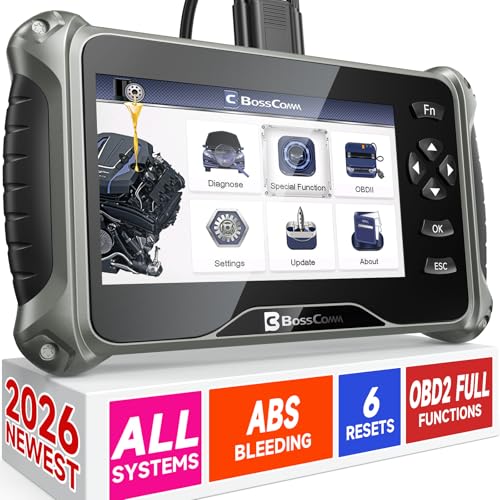
- 【✅Compared to BOSSCOMM IF742, IF745 Offers Full-System Diagnostics】The BOSSCOMM IF745 car diagnostic scanner is an upgraded model of IF742. In addition to supporting all OBD2 Code Reader functions and 6 reset options (ABS/EPB/SAS/BMS/Oil/Throttle), it expands diagnostics from 4 systems (Check Engine/ABS/SRS/Transmission) to vehicle All systems, including Steering, Suspension, and Body Electronics. This provides deeper, more comprehensive diagnostic capabilities.
- 【✨10 OBD2 Functions】The BOSSCOMM IF745 scan tool’s DTC Lookup instantly translates fault codes into user-friendly explanations, its I/M Readiness feature streamlines emissions testing with a single tap, and Freeze Frame lets you pinpoint the exact moment of a fault for in-depth root-cause diagnosis. Combined with a live data dashboard and advanced diagnostics (O2S, OBMon, EVAP), it delivers comprehensive insights for confident troubleshooting.
- 【✨Deep Diagnostics for All Vehicle System Modules】Beyond code reading/clearing and ECU information retrieval, our all-in-one data stream feature lets you inspect all current fault codes and their locations across the vehicle’s systems. This vehicle code reader helps you turn off dashboard warning lights and perform a comprehensive self-check of your car at home—no more back-and-forth trips to the repair shop or hefty inspection fees.
- 【✨6 Essential Resets: ABS Bleeding, Oil, EPB, SAS, Throttle, BMS】The BOSSCOMM IF745 obd2 scanner diagnostic tool swiftly purges air from brake lines to restore braking sensitivity, fine-tunes maintenance cycles to eliminate false alerts, resolves parking brake issues with one-click control, recalibrates steering sensors for stability, optimizes engine idling/acceleration for smoother performance, and deeply resets battery systems to extend lifespan and range via precise parameter adjustments.❗NOTE: Does NOT support bidirectional control, coding, or programming.
- 【✨10,000+ Car Models, AutoVIN, 13 Languages】The BOSSCOMM IF745 vehicle scanner diagnostic tool covers 73+ global car brands and offers support in 13 languages, making it perfect for DIYers, auto mechanics, or as a thoughtful gift. With a single-click AutoVIN feature, it instantly retrieves vehicle serial numbers, streamlining diagnostics for users globally. This adaptable tool balances user-friendliness with precision, catering to both personal and professional requirements.✅Unsure about compatibility? Compatibility will vary on vehicles' model and year, pls reach us via 📧 [email protected] 📧 before purchase.
This product presentation was made with AAWP plugin.