
NHTSA ID Number: 10099701
Manufacturer Communication Number: AJA02922
TSB/Document Date: 2017-05-19
Summary
"JOB AID - DO YOU HAVE A VEHICLE WITH A STEERING WHEEL SHIMMY OR CHASSIS VIBRATION THAT YOU FEEL AT HIGHWAY SPEEDS AND YOU KNOW IT IS NOT A NORMAL CHARACTERISTIC OF THE VEHICLE? MANY THINGS CAN CAUSE THIS PROBLEM, FOR EXAMPLE: OUT-OF-BALANCE TIRES, RIMS, FRONT WHEEL HUBS, OR FRONT BRAKE DISCS WRONG TIRE PRESSURES TIRE(S) THAT ARE NOT FULLY SEATED ON THE RIM(S) EXCESSIVE TIRE RUNOUT UNDER LOAD DAMAGED TIRES (CUTS, MISSING RUBBER, ETC.) USE OF AFTERMARKET PARTS (TIRES, RIMS, STEERING COMPONENTS, OR SUSPENSION COMPONENTS) DAMAGE"
Job Aid
January 2016
02922 Version 1
Excessive Steering Wheel Shimmy or Chassis Vibration
AFFECTED VEHICLES
General Information
INTRODUCTION
Do you have a vehicle with a steering wheel shimmy or chassis vibration that you feel at highway speeds and you know it
is not a normal characteristic of the vehicle? Many things can cause this problem, for example:
•
•
•
•
•
•
•
Out-of-balance tires, rims, front wheel hubs, or front brake discs
Wrong tire pressures
Tire(s) that are not fully seated on the rim(s)
Excessive tire runout under load
Damaged tires (cuts, missing rubber, etc.)
Use of aftermarket parts (tires, rims, steering components, or suspension components)
Damage
This job aid looks at the entire issue of steering wheel shimmy and chassis vibration and what it takes to fix the problem.
It includes these topics:
•
•
•
•
•
•
•
Test-Driving the Vehicle
Interpreting the Vibration
Understanding Phase Matching
Balancing the Wheels
Matching the Wheels to the Hubs
Calibrating the Wheel Balancer
Reading Tire/Rim Runout with a Hunter GSP9700 Wheel Balancer
CUSTOMER INFORMATION: The information in this bulletin is intended for use only by skilled technicians who have the proper tools,
equipment, and training to correctly and safely maintain your vehicle. These procedures should not be attempted by “do-it-yourselfers,” and you
should not assume this bulletin applies to your vehicle, or that your vehicle has the condition described. To determine whether this information
applies, contact an authorized Honda automobile dealer.
© 2016 American Honda Motor Co., Inc. – All Rights Reserved
Page 1 of 9
TEST-DRIVING THE VEHICLE
Follow these steps and answer the questions in the order they are asked. If possible, have someone along to record your
answers.
1. Test-drive the vehicle exactly as described on your RO.
2. Describe the vibration.
NOTE: If the vibration is caused by something other than the wheels (transmission, engine, exhaust, etc.), end your
test-drive right now. Check SIS for applicable service information.
•
•
•
Where do you feel the vibration is coming from?
Does the vibration go away after a few minutes of driving? Does it come and go?
Does the steering wheel shimmy? (It feels like it is shaking left and right.)
3. Slow down until the vibration goes away. Now, speed up in 5 mph increments, holding that speed for 15 seconds or
more before speeding up again. At what speed do you start to feel the vibration again? As you continue speeding up,
does the vibration get stronger, weaker, or does it just stay the same?
4. Drive for about 2 miles on straight and curved roads at the speed where you felt the vibration strongest in step 3.
•
•
When driving straight ahead, is the vibration constant or does it come and go?
When following a curve, is the vibration constant or does it come and go?
5. Shift into Neutral. Does the vibration go away?
6. Drive under the conditions that you feel the vibration the most. Speed up, applying different foot pressure to the
accelerator pedal (gentle, medium, and hard). Does the vibration stay the same or is there a specific foot pressure
where it changes?
7. Climb a hill at a steady speed. Does the vibration stay the same or does it get stronger as you climb? Apply different
pressures like you did in step 6. Does the vibration stay the same or does it get stronger when you apply a particular
foot pressure?
8. Test-drive a known-good vehicle that is the same model, year, and trim level as your customer’s vehicle and is
completely stock. Drive it exactly as you did in steps 2 thru 7. Now, compare your two test-drives.
•
•
If your customer’s vehicle is similar or better than the known-good vehicle, the vibration is a normal characteristic
of the vehicle.
If your customer’s vehicle is noticeably worse than the known-good vehicle, you need to interpret the vibration
before moving ahead.
Page 2 of 9
INTERPRETING THE VIBRATION
Cold Start Vibrations
Temperature /Time-Related Flat Spots
When you park a vehicle overnight in cold temperatures or for a few days, weeks, or months, the tires can form what are
commonly called flat spots. These flat spots can cause a noticeable vibration when traveling at low speeds and go away
after just a few miles of driving.
Due to their construction and materials, many heavy-duty and high-performance tires may retain their shape in which they
were last parked. Unfortunately, that can become a problem when the tires go through wide swings in ambient
temperature or they have been sitting overnight in cold temperatures or for a very long time.
When a tire is suspended in the air (there is no load on it), each of the sidewall cords has the same tension. As the tire
rolls on the ground, each of those sidewall cords goes from a relaxed state to a loaded state with every rotation. And this
happens about 800 times every mile.
This constant deflection generates heat, which makes the tires more flexible. But once you park the vehicle and those
tires start to cool, the spot that is touching the ground (the tire’s footprint) flattens and the cords around that spot relax as
the tire presses down from the vehicle’s weight.
The cords at the top of the tire, however, are held at their maximum tension. If it is cold overnight or you do not drive the
vehicle for a while, the tire will retain its position, forming a flat spot. After a cold start, the axle rises and falls in response
to that flat spot, causing a noticeable vibration. But as the tire warms up, it softens and normally rounds out. With the axle
now riding steady, the vibration goes away.
A flat spot can be just temporary, where the tire rounds out after it warms up. But sometimes it can also be permanent,
in which that flat spot effectively destroys the tire’s ride quality. A flat spot’s severity often depends on the tire’s size, its
construction, the load it is under, the ambient temperature, and how long it has been sitting and at what temperature.
If the tire has a temporary flat spot, do not replace the tire just because of it. Of course, if that flat spot is permanent, the
only real cure is tire replacement.
Abrasion-Related Flat Spots
Tires can also develop flat spots if the brakes lock up, causing them to skid. This is more likely to happen in vehicles
without ABS or VSA, or if you misuse the parking brake. Since these flat spots are obviously permanent, the only real
cure is tire replacement.
Constant Vibrations
A badly mounted tire bead can cause vibrations that you can feel right through the seat, the floor, and the steering column
while driving. The steering wheel can also shimmy. In rare cases, more than one tire can be the culprit.
If the tire looks new and you suspect a badly mounted bead, you need to measure the tire/rim runout if you have access
to a Hunter GSP9700 wheel balancer. If you do not have access to one, you need to mount a known-good stock tire and
rim and test-drive your customer’s vehicle under the same conditions listed on your RO.
Page 3 of 9
Intermittent Vibrations
Vibrations coming from tires, rims, hubs, and brakes happen when you are going 50 mph or faster. And they tend to get
stronger when you reach about 70 mph.
NOTE: If you feel the vibration only when driving between 45 and 55 mph, you may be dealing with a vibration from
another source.
Intermittent wheel vibration normally is not affected by these factors:
•
•
•
•
•
•
Engine speed
Gear selection (this includes Neutral)
Engine load
Hill climbing
Acceleration
Deceleration
But if it is affected by one of these factors, then stop right here. You may be dealing with a vibration from another source
(exhaust, engine, A/C, etc.)
Often, the wheel vibration is intermittent because of phase matching.
Steering Wheel Shimmy
Steering wheel shimmy can be caused by static tire imbalance. Static balance is simply the wheel’s weight distribution
while it is at rest.
When one part of the wheel (the tire, rim, hub, or brake disc) is heavier by more than 7 grams, you can feel it as a
shimmy. If one tire is out of balance, the shimmy will be constant. If two wheels are out of balance, it will be intermittent
because of phase matching. You may notice that the vibration tends to come and go more often when driving on curved
roads. This is a good indication of phase matching.
UNDERSTANDING PHASE MATCHING
The most critical speed for tire-induced vibration is from 55 to 65 mph. At those speeds, a tire spins at a rate of anywhere
from 10 to 15 times per second.
When two out-of-balance tires are spinning so their heavy spots hit the road at different times, they are said to be out of
phase and, at a certain point, their vibrations can actually cancel each other out. But if both tires are spinning so their
heavy spots are now hitting the road at the same time, they are said to be in phase and their vibrations can actually add
together.
When those vibrations cancel each other out, you get steering wheel shimmy. When they add together, you get chassis
vibration (floorboard shake), although in some vehicles, the steering wheel can be more sensitive than the floor.
As the tires continually come into and out of phase, the steering wheel shimmy continually comes and goes. You feel it
increase, reach a peak, then diminish over and over again.
And when you drive on a curved road or change lanes, that shimmy will happen even more often. For instance, when you
turn to the left, the outside tire must travel farther than the inside tire, so it spins faster. This constant changing in spin
rate while making turns results in more frequent vibration cancelling and adding action than you would get just cruising
down a straight road.
One final note: The cause of each tire-induced vibration does not need to be the same for phase matching to happen. It is
entirely possible to have one tire with a poorly seated bead while the other one has a heavy spot.
Page 4 of 9
BALANCING THE WHEELS
1. Before you start, drive the vehicle to heat up the tires. Then, raise the wheels on a lift within 10 minutes of
completing your drive. You must do this to avoid temporary flat spots that could affect the wheel balance.
2. Use the proper centering cone attachment for the wheel that you are balancing. The centering cone must have a
low taper and fit inside the hub bore.
3. Mount the wheel onto the wheel balancer shaft and secure it in place using the proper attachments. If the wheel has a
lot of flat surface around its hub bore, a rubber cup attachment works well. But if it has a lot of uneven surfaces (some
wheels do because of their elaborate design), you must use a flange plate with studs like the one shown here to
ensure accurate center mounting.
4. Make sure the wheel balancer is calibrated. If it needs calibration, go to CALIBRATING THE WHEEL BALANCER.
5. Set the wheel balancer to dynamic balance.
6. Turn off the measurement rounding feature (you want the measurements to read in 1-gram increments).
7. Balance the wheel until its total imbalance reads less than 5 grams on each side.
8. Set the wheel balancer to static balance.
9. Turn off the measurement rounding feature (you want the measurements to read in 1-gram increments).
Page 5 of 9
10. Measure the imbalance of the wheel, but do not add any weight. Use chalk for the tire and a permanent marker for
the inner rim flange to mark where the weight should go. This is the lightest spot of the wheel. The light spot should
be less than 5 grams. When you are done, go to MATCHING THE WHEELS TO THE HUBS.
MATCHING THE WHEELS TO THE HUBS
1. Match the light spot on the wheel to the heavy spot on the front brake disc and hub assembly. The heavy spot is that
ground-off area on the edge of the disc, although not all vehicles have these markings.
2. Turn the brake disc by hand so the heavy spot is facing straight up.
3. Mount the wheel to the hub with the light spot (chalk mark) facing straight up. You want to get the heavy spot on the
disc and the light spot on the wheel to line up as closely as possible. The wheel studs may keep you from getting a
perfect match, but that is OK. Then, test-drive the vehicle. If the vibration goes away, you are done with this repair.
If it is still there, you may need to measure the tire/rim runout with a Hunter GSP9700 wheel balancer and do tire/rim
matching.
Page 6 of 9
4. If you cannot find the heavy spot on the disc, mount the wheel and test-drive the vehicle. If you notice there is still too
much vibration, remove the wheel, mark one of the studs with a felt-tip pen for reference, then remount the wheel onto
the next stud to the right of your reference. Test-drive the vehicle. If the vibration goes away, you are done with this
repair; otherwise, repeat this process until you find the ideal mounting location. If the vibration still will not go away,
you may need to measure the tire/rim runout with a Hunter GSP9700 wheel balancer and do tire/rim matching.
CALIBRATING THE WHEEL BALANCER
Do this procedure when you are balancing a wheel type or size that you have never balanced before, when you suspect
there is a problem with your wheel balancer, or after you have done about 100 wheel balances.
1. Turn off the measurement rounding feature (you want the measurements to read in 1-gram increments).
2. Balance a damage-free alloy wheel and tire assembly until both the inner and outer rims read zero imbalance.
3. Loosen the wing nut attachment, turn the wheel half a turn (180°), retighten the wing nut, and recheck the balance.
•
•
If the imbalance reads 5 grams or less, the zero calibration is OK. Rebalance the wheel to read zero, then go to
step 5 to check the static balance.
If the imbalance reads more than 5 grams, go to step 4.
4. Loosen the wing nut attachment, turn the wheel a quarter turn (90°), retighten the wing nut, and recheck the balance.
•
•
If the imbalance now reads 5 grams or less, the wheel is not centered on the wheel balancer. Make sure you are
using the proper centering cone, cup, and wing nut for the wheel you are balancing. If you are not sure, check out
the operator’s manual or ask the manufacturer what attachments you need. When you have the proper
attachments, go back to step 1.
If the imbalance still reads more than 5 grams, the wheel balancer needs calibrating, repair, or both. Call the
manufacturer for the nearest repair representative.
5. Mount a 5-gram weight to the outer rim and recheck the balance. The wheel balancer should read 5 ± 2 grams of
imbalance that is 170° to 190° from that 5-gram weight.
•
•
If 5 ± 2 grams of imbalance was read, the static balance calibration is OK. Go to step 6 to check the dynamic
balance.
If 5 ± 2 grams of imbalance was not read, the wheel balancer needs calibrating. Call the manufacturer for the
nearest repair representative.
6. At 180° from the weight you added to the outer rim, mount a 5-gram weight to the inner rim and recheck the balance.
The wheel balancer should read 5 ± 2 grams of imbalance 170° to 190° from both of the weights you mounted.
•
•
If 5 ± 2 grams of imbalance was read, the dynamic balance calibration is OK and the wheel balancer is ready to
use.
If 5 ± 2 grams of imbalance was not read, the wheel balancer needs calibrating. Call the manufacturer for the
nearest repair representative.
Most steering wheel shimmy or chassis vibration problems can be fixed by balancing the wheels and matching them to
the hubs. But if that does not work, you may need to measure the tire/rim runout. Excessive runout under load can cause
vibration that wheel balancing will simply not fix.
Page 7 of 9
READING TIRE/RIM RUNOUT WITH A HUNTER GSP9700 WHEEL BALANCER
To reduce the effect of runout, you must find the radial force variation (RFV) of each tire and rim, then match the tires to
the rims by indexing their peak RFV areas. Matching tires to rims this way helps cut down on wheel vibration.
To accurately read tire/rim runout, you need equipment that can simulate road force on a wheel and show you the peak
RFV area on the tire and on the rim. The Hunter GSP9700 wheel balancer, besides being a wheel balancer, can
accurately calculate peak RFV readings on tires and rims. If your shop does not have a GSP9700, visit Hunter’s
GSP9700 website at www.GSP9700.com or find another shop in your area that does.
NOTE:
•
•
•
•
•
•
If you need to replace tires, always use OEM tires. For replacement tires, call The Tire Rack at 877-327-8473.
Make sure this repair procedure is followed to the letter, whether it is done in your shop or by an outside vendor.
RFV consists of four parts: total indicated runout (TIR), 1st harmonic radial force variation (RFV-1), 2nd harmonic
radial force variation (RFV-2), and 3rd harmonic radial force variation (RFV-3). All tire/rim matching done in this
repair procedure is based on RFV-1.
The rest of this repair procedure refers to RFV as road force measurement (RFM); it is Hunter’s trade name.
To check wheel balancing calibration, see CALIBRATING THE WHEEL BALANCER or refer to the operator’s manual.
To check RFM calibration (you need to do this about once a week), use the calibration tools that came with the wheel
balancer and follow the on-screen instructions.
1. To ensure you are getting the right tire/rim runout readings, raise the vehicle so all four wheels are off the ground
within 10 minutes of completing your test-drive. You must do this to avoid temporary flat spots that could affect the
wheel balance.
2. Make sure all four tire pressures read exactly as listed on the driver’s doorjamb label.
3. Mark each tire’s position (L/F, R/F, L/R, and R/R).
4. Remove all wheel weights and clean off any mud from the rims. Wheel weights will keep you from reading RFM and
any extra weight will cause wheel imbalance.
5. Clean out any pebbles, mud, or other debris trapped between the tire treads. Anything causing a bump on the tires
will throw off RFM and balancer readings.
6. Inspect the wheels for damage. Tire or rim damage can cause high RFM readings and wheel imbalance.
7. Make sure the arbor and baseplate threads on the wheel balancer are clean.
8. Make sure all mating surfaces between the wheel and the wheel balancer are clean, then mount the wheel.
NOTE: Use the GSP9700 centering check feature (it is on software version 2.1 or higher) to check for a possible
centering error between the rim and the wheel balancer.
9. Use the wheel balancer to find the initial RFM readings (pounds and peak locations) of the tire, the rim, and the
tire/rim combination. For more information, see the operator’s manual. If the RFM is higher than 10 pounds, do the
match mounting procedure in the manual. If the RFM is still higher than 10 pounds after doing that, replace the tire.
Page 8 of 9
10. After you have found the problem wheel, remount the tire.
•
•
•
•
•
Fully deflate the tire and break the bead seal from the rim.
Clean off any dirt, tar, or rocks from the rim and inspect the tire bead area for any debris that could keep the bead
from properly sealing on the rim.
Use tire mounting paste to coat all of the areas where the tire touches the rim (inner and outer tire beads, rim
flange, middle of the rim). Never use soap and water or a silicone spray. If your shop does not have tire mounting
paste, there are a number of brands commercially available. If the vehicle has direct TPMS, be careful not to get
any of that paste on the tire pressure sensor.
Seal the tire beads on the rim by fully inflating the tire to the max pressure shown on the sidewall.
Fully deflate the tire, then inflate it to the recommended cold inflation pressure listed on the driver’s doorjamb
label.
11. Mount the wheel on the vehicle and go for a test-drive. If the vibration is gone, you are done with this repair. If it is still
there, then look for other possible causes.
Page 9 of 9

- Mixes well with conventional fluids
- Low-moisture formula provides excellent vapor lock...
- Ideal for hydraulic and disc brakes


- Provides an extra margin of safety in extreme braking...
- Mix of polyglycol ethers ensures hot brake-system operation...
- Excellent for ABS, disc and drum brake systems
- Delivers braking power when needed by avoiding a spongy...
- Both wet and dry boiling points exceed the minimum...
Last update on 2026-06-23 / Affiliate links / Images from Amazon Product Advertising API
If the PDF is very large, it may not load in the preview below.
Some older TSBs had multiple PDFs — visit the NHTSA Website to view all PDFs.
If the TSB PDF does not show, download or view it on the NHTSA Website.
Click on the (+) Plus Sign
Then Click on Associated Document(s)
Search NHTSA Database for Recalls
Search NHTSA Database for Vehicle Investigations
View Latest Vehicle Investigations
Search NHTSA Database for Vehicle Complaints
View Latest Vehicle Complaints
TSB/Document ID: AJA02922
Replacement Service Bulletin Number:
MFR Communication Date: 2016-01-18
MFR Internal Campaign ID/Software Version:
Communication Type: Service Bulletin/Repair Instructions
NHTSA Components: WHEELS
MFR Component System:
MFR Component Subsystem:
Previous TSB | Next TSB |

- WHY CHOOSE THE 2025 CR MAX -Upgrade the latest diagnostic capabilities for all vehicles after 1996: upgrade to 49+maintenance services; 46 extra specific functions; real all systems/all control modules diagnose; over 40K+ bidirectional actuation tests for diagnosing all control moduels of cars; Powerful full OBD2 Functions; built-in ECU Coding for BMW
 / Audi/ VW/ RollsRoyce; Fr ee V.A.G Guide Function; Battery retistration for new battery adaptation and more. It covers all vehicle diagnostic services and some special professional vehicle maintenance servces, assists you to do home DIY vehicle maintenance or car repair as a pro technician.
 - NEWEST IN INNOVATION FULL OBD2 SERVICES- iCarsoft auto car diagnostic scanner compatible with CAN-FD, CR MAX can do it all-reads and clears trouble codes, ALL SYSTEM DIAGNOSIS such as engine, transmission, ABS and airbag etc. CR MAX code reader for all cars can perform I/M Readiness, Live Data, Freeze Frame, Vehicle Information, Monitor Test, On-Board Monitor, E vap System Test,O2 Sensor Test,DTC Library Lookup,etc. (Warm Tips: If you car is after 2023,please contact us for compatibility; 3. It comes with 16PIN OBD2 diagnostic adapter, please check your car diagnostic socket if it is 16pin socket, if your car is 14pin diagnostic socket please contact us for the solution.)
- 49 RESET+ 46 SERVICES- Performs: Oil Reset, EPB,SAS,Throttle, D-P - F, Battery, ABS, Injector, TPMS, Suspension, AC, Head Lamp, Body Stablity, Engine, Tramsmission, Airbag, Seat, Door-Win-Roof, Fuel Pump, Door, E-G- R.+21 NEWEST SERVICES( Need update scanner)-AdBlue, Clutch, Crankshaft, High Voltage Battery, Cruise Control, NO xSensor, Rain Sensor, Stop And Start, Turbocharger, Head Up Display, Radar Camera, Vehicle Setup, Cyliner Misfire Check,Speedlimitassist, ControlUnitReset,OxygenSensor, Seatbelt. Extra 46+ extra services based on car brand.(Tips: Quantity of reset/ calibration fucitons are based on car system that your vehicle model has)
- REVOLUTIONARY 40000+BIDIRECTIONAL ACTIVE TESTS: Upgraded CR Max scanner equip with numberous of actuational test items for covering all available vehicle control modules, no longer only do simple light test or window test like other scanners, performs hardware modules test and software control modules test for checking car units or new updated control moduels work well or not after maintenance/ repair/ re-installation/ control system updated (Example for Benz- Roller Sun Blind test; Backup Camera test ;Self-test; EPB test; Transport Mode test;Boost Pressure Positioner test; Fuel Pump test; AND MORE!!).(Warm tip: The available test items are based on control modules your car has)
- ECU CODING+ BATTERY REGISTRATION- Powerful ECU Coding service for BMW/MINI/RollsRoyce / Audi/VW/Seat/Skoda/Bentley/Bugatti/Lamborghini, Improves Engine Power Performance and Optimizes Fuel Efficiency and Match New Hardware Unit to car and Customized a comfortable Driving Modes and Fixes & Updates Original Software Bug. The battery test function for checking car battery health, perform battery reset (BMS ) for replacing a damaged or aging car battery with a new one and register new battery to car ECU
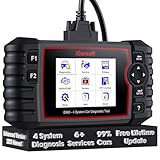
- 【Looking for More Professional Vehicle Scan Tool?】iCarsoft E660 2026 Upgrade Version OBD2 scan tool can do it all-reads and clears trouble codes on Engine system, ABS system, Transmission system and Airbag system, And with 6 reset function. It covers more than 59 vehicle makes from 1996-2023 models ( included most USA/ Asia / EU vehicle brand) with full OBDII. (As every car model has its-owned specific car system and ECUs, not all car models have full car ECUs which may prevent the scanner from performing all listed system diagnostics or reset services. Therefore, please email to us with car VIN and services required to do scanner's services for a compatibility check before purchasing.)
- 【OE-Level 4 Systems OBD2 Scanner】iCarsoft E660 2026 Upgrade Version diagnostic scanner offers comprehensive OBDII services, allowing you to quickly scan Engine system. It supports functions such as reading and erasing codes, checking I/M readiness, viewing freeze frame data, performing O2 sensor tests, conducting on-board monitoring, testing the evap system, auto VIN retrieval, and reading both generic and specific codes, as well as DTCs and battery tests.
- 【4 Systems Diagnosis for 10000+ Vehicles】 iCarsoft E660 2026 Upgrade Version adopts unique diagnostic software, works well for most Porsche, Benz, BMW, US Ford, Land Rover, Jaguar, Audi, VW, Volvo, Honda, Nissan, Infiniti, Toyota, Lexus, Scion, Isuzu, Hyundai, Kia, Daewoo, Mazda, Sprinter, Mini, Seat, Skoda, SAAB, EU Ford, Holden, AUS Ford, Acura, Subaru, Mitsubishi, Dacia, Renault, Fiat, GM, Chrysler, Citroen, Peugeot, Opel, Smart,Suzuki, Vauxhall, Alfa-Romeo, Lancia and etc.
- 【6 Reset Services】iCarsoft E660 2026 Upgrade Version is a diagnostic tool that offers professional maintenance services, including Oil Reset, EPB, BMS, ETC, SAS, TPMS Reset. It can help you easily reset oil change indicators, recalibrate steering angle sensors, relearn replaced electric parking brake and so on. For optimal vehicle performance and maintenance convenience. (Tips: Please update the softwareafter receiving the product to obtain new service functions)
- 【118+ Real Time Record & Live Graph View】iCarsoft E660 2026 Upgrade Version can automatically record vehicle text history and identify vehicle information. Preserve real-time data information. View & Graph Live Data. Support Data Review and Print. 15 languages: English, German, Dutch, Spanish, French and so on. We promise to offer Lifetime updates (Lifetime free Update via PC), and confidence in products. We also provide 1 year warranty + extra lifetime hardware free repair if you need it in the future. We prioritize user experience & strive to meet your expectations. Please do feel free to reach out to us if you have any question or problem about the usage.

- 【All-in-One Diagnostic Tool for Porsche + 2 Extra Vehicle Brands】New POR V4.0 is a professional car scanner specifically engineered with dedicated software pre-installed for Porsche. You can also download 2 additional software packages FOR FREE from 26 supported brands (e.g., for Benz, for BMW, for Audi, for Land Rover).Upgraded to adopt quad-core 1.3GHz processor and HD touchscreen and professional diagnsotic OS for faster& smooth diagnsotic.LIFETIME FREE UPDATES, NO SUBSCRIPTION COST! PLEASE TELL US YOUR CAR INFORMATION TO OBTAIN A LIST OF ALL COMPATIBLE SERVICES FOR YOUR CAR FIRST (FOR EXAMPLE: BATTERY REGISTRATION FUNCTION IS NOT COMPATIBLE WITH PORSCHE 997.2)
- 【29 MAINTENANCE SERVICES FOR PORSCHE SERIES CARS】 It can perform the 29 reset service for Porsche series cars-Oil Reset; SAS; EPB; BMS; ETC; DP ; ABS Bleeding; Injector Coding; TPMS; Air Suspension; Air Conditioner; Head Lamp; Body Stablity Control; Engine Control; Transmission; AirBag; Seat; DWR; MIS; EG; ODO; Clutch; High Voltage Battery; Cruise Control; Radar/Camera; Vehicle Setup,etc. Up to 49 vehicle-maintenance-services for the extra 2 vehicle brands you installed (Tip: Not all services will be worked on every car mode. Some vehicle models may be lack of certain ECU-control modules to make some services may not work).
- UPGRADE SERVICES: Breaks down 29 services to 234 sub-service for car owners/machinist to perform maintenance based on corresponding sub-modules! The detailed sub-service for sub-modules assist to perform precise vehicle maintenance.Improving the accuracy of car maintenance and reducing potential failure risks caused by whole-module maintenance to main modules.such as Oil Reset is refined into Reset maintenance interval/Reset service interval/Service Reset; Engine Control Reset is refined into Delete adaptation data/Short tests/System tests/Swirl-flap actuator/Bleeding high temperature coolant circuit and more.(sub-services vary based on vehicle model/year)
- 【EXTRA VEHICLE MAINTENANC SERVICES FOR SPECIFIC SYSTEMS】Have no ability to perferm calibration to special/specific systems/modules? This OBD2 scanner solve your troubles- for common systems/modules & for specific sytems/modules, assist you to perform diagnsing/calibration/reset/relearn services for non-common modules to finish your car maintenance/ diagnostic (eg: Central Computer system/module :Function activation/Multimedia interface test/AM Field Strength/Current FM Field Strength/FM Field Strength/MOST system reserve/Self-test/Deactivate Production Mode/Reset to factory settings/MOST System Test). (Tip: The services vary based on the vehicle brands)
- 【 MORE PROFESSIONAL BI-DIRECTIONAL ACTUATION TESET 】Exclusive POR V4.0 comes with powerful bidirectional testing capability,do actuaction test for deeper unit-checking after replacement or overhaul (1333 test items for Porsche, like:Fuel high-pressure fuel injector 1-4, Empty tank, Radiator fan, OTA-FC Connectivity, backrest, Backup battery, and more; 2136 test items for Audi; 1670 test items for Benz; 1599 test items for Volvo; 1360 test items for VW; 2705 test items for GM etc.). Help to check your car units work well or not after vehicle maintenance or daily car-body check, keep drives always in safety.(Warm tip:The quantity of test item is based on the units your car has)
Last update on 2026-06-23 / Affiliate links / Images from Amazon Product Advertising API
This product presentation was made with AAWP plugin.