
NHTSA ID Number: 10057460
Manufacturer Communication Number: SD-13-4986
TSB/Document Date: 2015-06-01
Summary
BENDIX ESP ES-80 CONTROLLER: INFORMATION TO ENHANCE BRAKING OF AIR-BRAKED HEAVY, MEDIUM-DUTY TRUCKS, TRACTORS & BUSES, ELECTRONIC CONTROL UNIT, WHICH ARE ONE OUT OF THREE ABS DEVICES, WHICH IS USED. *LJ
speed sensors show that the vehicle is in motion.
ABS OPERATION
Bendix® ABS uses wheel speed sensors, ABS pressure
modulator valves, and an ECU to control either four or six
wheels of a vehicle. The Bendix ESP EC‑80 Controller
monitors individual wheel turning motion during braking,
and adjusts or modulates the brake pressure at the wheel
end. When excessive wheel slip — or wheel lock-up — is
detected, the Bendix ESP EC‑80 Controller will activate
the pressure modulator valves to automatically reduce
the brake pressure at one or more of the wheel ends.
By these actions, the ABS system helps to maintain the
vehicle's lateral stability and steerability during heavy brake
applications and during braking on slippery surfaces.
Steer Axle Control
Although both wheels of the steer axle have their own
wheel speed sensor and pressure modulator valve, the
Bendix ESP EC‑80 Controller blends the applied braking
force between the two steering axle brakes. This Bendix
patented brake application control, called Modified
Individual Regulation (MIR), is designed to help reduce
steering wheel pull during an ABS event on road surfaces
with poor traction, or areas of poor traction (e.g. asphalt
road surfaces with patches of ice).
9
Single Drive Axle Control (4x2 Vehicle)
For vehicles with a single rear drive axle (4x2), the brakes
are operated independently by the Bendix® ESP® EC‑80™
Controller, based on the individual wheel behavior.
Dual Drive Axle Control (4S/4M Configuration)
For vehicles with dual drive axles (6x4) using a 4S/4M
configuration, one ABS modulator controls both of the
right-side rear wheels; the other modulator controls both
of the left-side rear wheels. Both wheels on each side
receive equal brake pressure during an ABS stop. The
rear wheel speed sensors must be installed on the axle
with the lightest load.
Dual Rear Axle Control (6S/6M Configuration)
For vehicles with dual rear axles (6x4, 6x2) using a 6S/6M
configuration, the rear wheels are controlled independently.
Therefore, brake application pressure at each wheel is
adjusted according to the individual wheel behavior on
the road surface.
corresponding stopping distance with conventional ABS
control, vehicle steerability and stability would be reduced.
Bendix ESP EC‑80 Controllers have an optional dash
switch that initiates a modified ABS control mode (known
as "off-road ABS") that more effectively accommodates
these soft road conditions to shorten stopping distance
while maintaining optimal vehicle steerability and stability.
Note: Off-road mode is not available if the vehicle is
equipped with Hill Start / Hill Start Assist (HS or HSA).
The ABS off-road mode should not be used on
normal, paved road surfaces because vehicle
stability and steerability may be reduced. The ABS
Indicator Lamp will flash slowly to indicate to the
driver that the ABS off-road mode is engaged.
6x2 Vehicles with 6S/5M Configuration
6x2 vehicles can utilize a 6S/5M configuration, with the
additional axle (a non-driven rear axle) having two sensors,
but only one Pressure Modulator Valve (PMV). In this case,
the PMV controls both wheels on the additional axle. The
additional axle wheels would receive equal brake pressure,
based on the wheel that is currently experiencing the most
wheel slip.
Normal Braking
During normal braking, brake pressure is delivered through
the ABS PMV and into the brake chamber. If the ECU
does not detect excessive wheel slip, it will not activate
ABS control, and normal vehicle service braking is applied.
Retarder Brake System Control
On surfaces with low traction, application of the retarder
can lead to high levels of wheel slip at the drive axle wheels,
which can adversely affect vehicle stability.
To prevent this, the Bendix ESP EC‑80 Controller switches
off the retarder as soon as a lock-up is detected at one (or
more) of the drive axle wheels.
When the ECU is placed in the ABS off-road mode (on
vehicles equipped with this optional feature), it will switch
off the retarder only when ABS is active on a steer axle
wheel and a drive axle wheel.
Optional ABS Off-Road Mode
On some road conditions, particularly when the driving
surface is soft, the stopping distance with conventional
ABS may be longer than without ABS. This can occur
when a locked wheel on soft ground or loose gravel plows
up the road surface in front of the tire, changing the rolling
friction value. Although vehicle stopping distance with a
locked wheel (in the absence of ABS) may be shorter than
10
When ABS off-road mode is engaged, stability
functions are disabled at speeds below approximately
25 mph/40 kph. The ATC/ESP dash lamp will illuminate
to indicate to the driver that the stability system is
disabled.
The vehicle manufacturer should provide the optional ABS
off-road function only for vehicles that operate on unpaved
surfaces — or that are used in off-road applications — and
is responsible for ensuring that vehicles equipped with the
ABS off-road function meet all FMVSS-121 requirements
and have adequate operator indicators and instructions.
The vehicle operator activates the off-road function with a
switch on the dash panel. A flashing ABS Indicator Lamp
indicates to the driver that the ABS off-road function is
engaged. To exit the ABS off-road mode, depress and
release the switch. A new ignition cycle will also cause
the ECU to exit the ABS off-road mode.
All-Wheel Drive (AWD) Vehicles
AWD vehicles with an engaged interaxle differential (steer
axle to rear axle) / AWD transfer case, may have negative
effects on ABS performance. Optimum ABS performance
is achieved when the lockable differentials are disengaged,
allowing individual wheel control.
Bendix ESP EC‑80 Controllers can be programmed
specifically for this configuration to control the differential
lock/unlock solenoid in the AWD transfer case. When
programmed to do so, the ECU will disengage the locked
interaxle/AWD transfer case during an ABS event and
reengage it once the ABS event has ended.
ATC OPERATION
Disabling ATC Differential Braking
ATC Functional Overview
ATC differential braking is disabled under the following
conditions:
Just as ABS improves vehicle stability during braking,
Automatic Traction Control (ATC) improves vehicle stability
and traction during vehicle acceleration. The Bendix ®
ESP® EC‑80™ Controller's ATC function uses the same
wheel speed information and modulator control as the
ABS function. The Bendix ESP EC‑80 Controller detects
excessive drive wheel speed; compares the speed to the
front, non-driven wheels; and reacts to help bring the wheel
spin under control. The Controller can be configured to use
engine torque limiting and/or differential braking to control
wheel spin. For optimal ATC performance, both methods
are recommended.
ATC/ESP Lamp Output/ATC Mud/Snow Switch
Input
Bendix ESP EC‑80 Controllers operate the ATC/ESP dash
lamp as follows.
The ATC/ESP dash lamp illuminates:
1. During power up (e.g. when the vehicle is started) for
approximately 2.5 seconds and turns off after the self
test is completed, providing no Diagnostic Trouble
Codes (DTCs) are present.
2. When ESP or ATC is disabled for any reason.
3. During an ESP or ATC event (the lamp will flash rapidly
at a rate of 2.5 times per second).
4. When the ECU is placed in the ATC off-road mode
(the lamp will flash steadily at a rate of once every 2.5
seconds). This notifies the vehicle operator that the
ATC Mud/Snow mode is active.
5. When the ECU is placed in the ABS off-road mode.
When in this mode, ESP will be disabled below 25 mph
and its inactive status will be indicated by a steadily
illuminated ATC/ESP lamp.
Differential Braking
Differential braking within ATC is automatically activated
when drive wheel(s) on one side of the vehicle are spinning
excessively. This typically occurs on road surfaces
with patches of ice. The traction system will then lightly
apply the brake to the drive wheel(s) that are spinning
excessively. The vehicle differential will then drive the
wheels on the other side of the vehicle.
Differential braking (as part of ATC functionality) is available
at vehicle speeds up to 25 mph/40 kph.
1. During power up (e.g. when the vehicle is started), until
the ECU detects a service brake application.
2. If the ECU receives a J1939 message indicating that
the vehicle is parked.
3. When the dynamometer test mode is active. The
Dynamometer test mode is entered using the diagnostic
Blink Code Switch or by using a diagnostic tool (such
as Bendix® ACom® Diagnostics).
4. In response to a serial communications request from
a diagnostic tool.
5. If ATC Differential Braking function is activated for a
long time period to avoid overheating of the brakes. It
would take approximately three (3) continuous minutes
of activation for the time‑out to occur. Once timed-out,
approximately two (2) minutes of "cool off" time would
be required before ATC Differential Braking can be used
again.
6. When certain DTC conditions are detected.
Traction Control with Engine Torque Limiting
The Bendix ESP EC‑80 Controller uses Engine Torque
Limiting to control drive-axle wheel slip. This is commu‑
nicated to the engine control module (using J1939), and
is available at all vehicle speeds.
Bendix® SMART ATC™ System
The Bendix ESP EC‑80 Controller has an additional feature
known as the Bendix® SMART ATC™ system. This system
monitors the accelerator pedal position (using J1939)
to help provide optimum traction and vehicle stability.
By determining the driver’s throttle input and adapting the
target slip of the drive wheels to the driving situation, the
Bendix SMART ATC system allows higher wheel slip when
the accelerator pedal is applied above a preset level.
The wheel slip allowed by the Bendix SMART ATC system
is decreased when driving through a curve for improved
stability.
Disabling ATC Engine Control and the Bendix
SMART ATC System
ATC Engine Control and the Bendix SMART ATC system
will be disabled under the following conditions:
1. In response to a serial communications request from
an off-board tool;
2. At power-up until the ECU detects a service brake
application;
3. If the ECU receives a J1939 message indicating that
the vehicle is parked;
4. If the dynamometer test mode is active. This may be
accomplished via an off-board tool or the diagnostic
Blink Code Switch; or
5. When certain DTC conditions are detected.
11
Optional ATC Mud/Snow (Off-Road) Mode
Drag Torque Control Functional Overview
In some road conditions, the vehicle operator may desire
additional drive wheel slip when ATC is active. The Bendix®
ESP® EC‑80™ Controller has an optional control mode to
permit this desired performance.
Bendix ESP EC‑80 Controllers have a feature referred to
as drag torque control which reduces wheel slip on a driven
axle due to driveline inertia. This condition is addressed
by increasing the engine torque to overcome the inertia.
The vehicle operator can activate the Mud/Snow function
with a switch on the dash panel. Alternately, a J1939
message may be used to place the vehicle in this mode.
The ATC/ESP Indicator Lamp will flash steadily at a rate
of once every 2.5 seconds to confirm that the ATC mud/
snow mode is engaged.
Drag torque control increases vehicle stability on lowtraction road surfaces during down-shifting or retarder
braking.
To exit the ATC Mud/Snow mode, depress and release the
ATC Mud/Snow switch.
BENDIX ESP EC‑80 ABS WITH STABILITY
CONTROL
Overview
The Bendix ESP system with the EC‑80 Controller reduces
the risk of rollovers, jackknifing and other loss-of-control
events. Bendix ESP EC‑80 Controllers include Roll
Stability Program (RSP®) and Yaw Control (YC) functions.
During operation, the Bendix ESP EC‑80 Controller
constantly compares performance models to the vehicle’s
actual movement, using wheel speed sensors; a lateral
acceleration sensor, a yaw rate sensor, and a steering
angle sensor. If the vehicle shows a tendency to leave an
appropriate travel path, or if critical threshold values are
approached, the system will intervene to assist the driver.
A Real World Example
Of How The RSP
System Operates:
Excessive speed for road
conditions creates forces
that exceed the threshold
at which a vehicle is likely
to rollover on a higherfriction surface.
A Real World Example Of How Yaw Control
Operates:
Excessive speed exceeds the threshold, creating a
situation where a vehicle is likely to spin and jackknife.
The system automatically reduces
engine torque and applies the
service brakes (based on the
projected rollover risk) to reduce
the vehicle speed, thereby
reducing the tendency to roll over.
FIGURE 12 - RSP EXAMPLE
12
The Bendix® Yaw Control system reduces engine throttle
and selectively applies brakes to reduce the tendency
to jackknife.
FIGURE 13 - YAW CONTROL EXAMPLE
Bendix® Roll Stability Program (RSP®)
Bendix RSP — an element of the overall Bendix® ESP®
system with the EC-80™ Controller — addresses rollover
conditions. In the case of a potential roll event, the ECU
will override the throttle and quickly apply brake pressure
at all wheel ends to slow the vehicle combination. The
level of braking application during an RSP event will be
proportional to roll risk. See Figure 12.
Yaw Stability
Yaw stability counteracts the tendency of a vehicle to spin
about its vertical axis. During operation — if the friction
between the road surface and the tires is not sufficient
to oppose lateral (side) forces — one or more of the tires
can slide, causing the truck/tractor to spin. These events
are referred to as either an "under-steer" situation (where
there is a lack of vehicle response to steering input due to
tire slide on the steer axle), or an "over-steer" (where the
tractor's rear end slides out due to tire slide on the rear axle)
situation. Generally, shorter wheelbase vehicles (tractors,
for instance) have less natural yaw stability, while longer
wheelbase vehicles (straight trucks, for instance) have
greater natural yaw stability. Factors that influence yaw
stability are: wheelbase, suspension, steering geometry,
weight distribution front to rear, and vehicle track width.
Yaw Control
Yaw control responds to a wide range of low- to highfriction surface scenarios including rollover, jackknife
and loss-of-control. It is the recommended system for all
power vehicles and especially critical for tractors pulling
trailers. In the case of vehicle slide (over-steer or understeer situations), the system will reduce the throttle and
then brake one or more of the “four corners” of the vehicle
(in addition to potentially applying the trailer brakes), thus
applying a counter-force to better align the vehicle with an
appropriate path of travel.
For example, in an over-steer situation, the system applies
the “outside” front brake; while in an under-steer condition,
the “inside” rear brake is applied. (See Figure 13)
IMPORTANT SAFETY INFORMATION
ABOUT THE BENDIX® ESP® SYSTEM
To minimize unexpected deceleration and reduce the
risk of a collision, the operator must:
•
Avoid aggressive driving maneuvers, such as sharp
turns or abrupt lane changes at high speeds, which
might trigger the stability system; and
•
Always operate the vehicle safely, drive defensively,
anticipate obstacles and pay attention to road,
weather and traffic conditions. Bendix ABS, ATC
and ESP systems are no substitute for prudent,
careful driving.
Towing Doubles Or Triples May Reduce The
Effectiveness Of Stability Systems
The Bendix ESP system with the EC‑80 Controller is
designed and optimized for trucks and for tractors that
tow single trailers. If a tractor equipped with Bendix
ESP is used to power multiple trailer combinations
(known as “doubles” or “triples”) the effectiveness
of the Bendix ESP system may be greatly reduced.
Extremely careful driving is always required when
towing doubles or triples. Excessive speed and
aggressive maneuvers — such as sharp turns, sudden
steering inputs, or abrupt lane changes — should be
avoided.
Limitations Of Stability Systems
The effectiveness of the Bendix ESP system with the
EC‑80 Controller may be greatly reduced if:
•
•
•
•
•
The Bendix ESP EC‑80 Controller may reduce
the vehicle speed automatically.
•
The Bendix ® ESP ® system can make the
vehicle decelerate automatically and can
slow the vehicle with or without the operator
applying the brake — and even when the
throttle is being applied.
•
•
The load shifts due to improper retention, accident
damage, or the inherently mobile nature of some loads
(for example, hanging meat, live animals or partially
laden tankers),
The vehicle has an unusually high — or off-set — center
of gravity (CG),
One side of the vehicle drops off the pavement at an
angle that is too large to be counteracted by a reduction
in speed,
The vehicle is used to haul double or triple trailer
combinations,
If very rapid steering changes are attempted at high
speeds,
There are mechanical problems with suspension
leveling of the tractor or trailer resulting in uneven loads,
The vehicle is maneuvering on a high banked road
creating either additional side forces due to the weight
(mass) of the vehicle, or a deviation between expected
& actual yaw rates,
Gusty winds are strong enough to cause significant
side forces on the vehicle and any towed vehicles.
13
To Maximize The Effectiveness Of The Bendix®
ESP® System with the EC‑80™ Controller:
•
•
Loads must be properly secured at all times.
Drivers need to exercise extreme caution at all times,
plus avoid sharp turns, sudden steering adjustments
or abrupt lane changes at high speeds, particularly if:
› the vehicle hauls loads that could shift;
› the vehicle or load has a high or off-set center of
gravity (CG) when loaded; or
› the vehicle tows doubles or triples.
If the Steering Angle Sensor is not recalibrated, the
yaw control system may not function properly, which
can result in incidents leading to loss of vehicle
control. See page 19 of this document for more
details on this procedure.
DYNAMOMETER TEST MODE
Truck Chassis Modifications
If the vehicle’s chassis components are altered (for
example, a wheel base extension or reduction; tag
axle addition or removal; a major body change such as
conversion of a tractor into a truck; or an axle, suspension,
or steering system component modification) the Bendix®
ESP® system must be disabled. Have a qualified mechanic
replace the Bendix ESP EC‑80 Controller with a Bendix®
ESP® ATC EC-80™ Controller and secure the X4 connector
(which will no longer be used). The ATC/ESP indicator
lamp would continue to function as an ATC indicator lamp,
and should be designated as ATC only.
Bendix ATC and ESP systems must be disabled prior
to conducting any dynamometer testing. When the
Dynamometer Test Mode is engaged, the Bendix ATC
EC‑80 Controller's brake control and engine control —
along with drag torque control and Bendix ESP system
functions — are disabled. This test mode is used to avoid
torque reduction or torque increase and brake control
activation when the vehicle is operated on a dynamometer
for testing purposes.
The Dynamometer Test Mode may be activated by pressing
and releasing the diagnostic Blink Code Switch five times
or by using a hand-held or PC-based diagnostic tool.
If a modified vehicle does not have the Bendix ®
ESP ® system disabled, serious vehicle braking
and performance issues could result, including
unnecessary ESP system interventions. This can
lead to a loss-of-control of the vehicle.
In addition, remove all cab signage (e.g. visor
labels, etc.) that were used to show that the Bendix
ESP system was installed. Make any necessary
notations in the vehicle manual(s), so that drivers do
not misunderstand which ABS options are installed
on the vehicle.
Sensor Location Modifications
The location and orientation of the Steering Angle Sensor
and Yaw Rate Sensor must not be altered. When servicing,
an identical component must be used in the same
orientation (using OEM brackets & torque requirements).
During installation follow the OEM leveling guidelines.
Steering Angle Sensor Re-Calibration
Whenever maintenance or repair work is performed to the
steering mechanism, linkage, steering gear, adjustment of
the wheel track, or if the steering angle sensor is replaced,
a recalibration of the Steering Angle Sensor must be
performed.
14
During Dynamometer Test Mode the ATC lamp remains ON.
Bendix ESP EC‑80 Controllers will remain engaged in
the Dynamometer Test Mode even if power to the ECU
is removed and re-applied. To exit the test mode, press
and release the Blink Code Switch three times, or use a
hand-held or PC-based diagnostic tool.
AUTOMATIC TIRE SIZE CALIBRATION
The ECU requires a precise rolling circumference ratio
between steer axle and drive axle tires in order for the
Bendix ABS, ATC, and ESP systems to perform in an
optimal manner. For this reason, a continuously monitoring
process takes place in which the precise ratio is calculated.
This calculated value is stored in the ECU memory
provided the following conditions are met:
1. Rolling-circumference ratio is within the permissible
range;
2. Vehicle speed is greater than approximately
12 mph/19 kph;
3. No acceleration or deceleration is taking place; and
4. There are no active speed sensor Diagnostic Trouble
Codes (DTCs).
The ECU is provided with a ratio value of 1.00 as a default
setting. If the automatic tire size alignment calculates a
different value, this is used to overwrite the original figure
in the memory. This process adapts the ABS and ATC
function to the vehicle.
Acceptable Tire Sizes
The speed calculation for an exciter ring with 100 teeth
is based on a default tire size of 510 revolutions per mile.
This figure is based on the actual rolling circumference of
the tires, which varies with tire size, tire wear, tire pressure,
vehicle loading, etc.
The ABS response sensitivity is reduced when the actual
rolling circumference is excessive on all wheels. For a 100
tooth exciter ring, the minimum number of tire revolutions
per mile is 376, and the maximum is 665. The ECU will
set a Diagnostic Trouble Code (DTC) if the number of
revolutions is out of this range.
Drive Axle/Additional Axle Wheel Speed Sensor
DTC
The Bendix ATC and ESP systems are disabled. In a four
sensor system, ABS on the affected wheel is disabled, but
ABS on all other wheels remains active.
In a six sensor system, ABS remains active by using input
from the remaining rear wheel speed sensor on the same
side.
ATC Modulator DTC
The Bendix ATC and ESP systems are disabled. ABS
remains active.
In addition, the size of the steer axle tires compared to
the drive axle tires also has to be within the ABS system
design. To avoid DTCs, the ratio of the effective rolling
circumference of the steer axle, divided by the effective
rolling circumference of the drive axle, must be between
0.85 to 1.15.
J1939 Communication DTC
The Bendix® ESP® system with the EC-80 Controller
effectiveness relies on the accuracy of vehicle speed.
If a major change on the tire sizes is made — such that
the odometer setting needs to be changed to correct
for the new tires — the Bendix ESP EC‑80 Controller's
setting of tire sizes must also be reprogrammed to

- 💯【Conta.ct us for Support Directly】If you met any...
- 🔥🔥🔥【2026 AUTEL FLAGSHIP MK900BT MK900-BT, NEW...
- 🚗【3000+ ACTIVE TESTS (50➡3000+), SAME AS MS...
- 🚗【40+ HOT SERVICES FOR 150 MAKES (28+➡40+)】Full...
- 🚗【OE ALL SYSTEM DIAGNOSE, AUTO SCAN 2.0: SCAN LICENSE...

- 【TURN OFF CEL】 This AL319 car scanner diagnostic tool...
- 【EXTENSIVE APPLICATION】 Autel AL319 Compatible with...
- 【FOR END USER & DIYERS】 This error code reader AL319 is...
- 【USER-FRIENDLY DESIGN】 This OBD2 scanner and check...
- 【HIGH-QUALITY SERVICES】 12 months war.ranty from the...
Last update on 2026-06-23 / Affiliate links / Images from Amazon Product Advertising API
If the PDF is very large, it may not load in the preview below.
Some older TSBs had multiple PDFs — visit the NHTSA Website to view all PDFs.
If the TSB PDF does not show, download or view it on the NHTSA Website.
Click on the (+) Plus Sign
Then Click on Associated Document(s)
Search NHTSA Database for Recalls
Search NHTSA Database for Vehicle Investigations
View Latest Vehicle Investigations
Search NHTSA Database for Vehicle Complaints
View Latest Vehicle Complaints
TSB/Document ID: SD-13-4986
Replacement Service Bulletin Number:
MFR Communication Date: 2015-01-01
MFR Internal Campaign ID/Software Version:
Communication Type: Service Bulletin/Repair Instructions
NHTSA Components: SERVICE BRAKES, AIR:ANTILOCK:ABS WARNING LIGHT
MFR Component System:
MFR Component Subsystem:
Previous TSB | Next TSB |
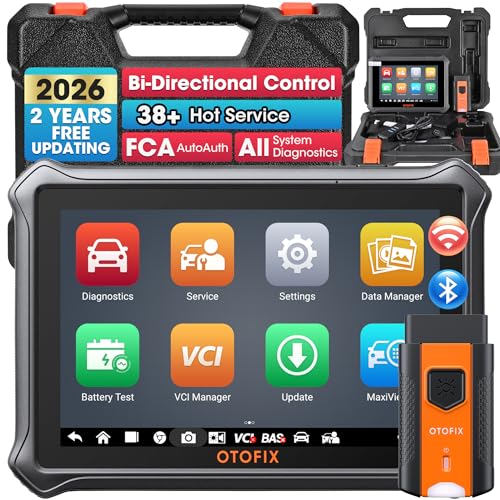
- 🎉[OTOFIX D1 Lite, Perfect Cost-effective Diagnostic Tool]: OTOFIX D1 Lite, a newest bidirectional scan tool from OTOFIX company, is a great choice for DIYers and repair shops. 👉This obd2 scanner diagnostic tool packs all practical functions: OE level all systems diagnoses, Bi-Directional Control, 38+ reset services fixing 99% of common problems, support DoIP & CANDF protocols and FCA
 AutoAuth, high-end hardware configuration. Worldwide vehicles and 🔥2 Years Free Updating🔥 covered.
 - 🎉[Bi-Directional Scan Tool, Active Test]: OTOFIX D1 Lite bluetooth obd2 scanner can also command ECUs and monitor the operation of the actuators to track down the problems of certain parts, like windows, sunroof, wipers, fuel pumps, etc., saving repair time & trouble. This makes OTOFIX D1 Lite the most cost-effective bidirectional scan tool.
- 🎉[2026 Newest, 38+ Hot Reset Functions]: Equipped with 38+ reset functions in one, the OTOFIX D1 lite automotive scanner diagnostic tool allows you to troubleshoot 99% of common vehicle problems. You can use this car diagnostic scanner holding enough functions to easily repair common vehicle models in your repair shops. Including Oil Reset, Injector Coding, Throttle, DPF Reset, SCR Reset, Gear Learning, Clutch Learning, Suspension, etc. Note* Reset functions vary by model.
- 🎉[OE Level Full Systems Diagnostics]: Unlike the 2-system and 4-system diagnostic tools, the OTOFIX auto scan tool can complete comprehensive system diagnostics within 5 minutes. It accesses and scans all available onboard systems like for Engine /AT /ABS /EPB /BMS /TPMS /SRS /SAS /Audio System /BCM /Air Conditioning / etc., to read & clear codes, view live data, and check ECU information. Note: Active test is not involved.
- 🎉[Powerful Hardware Configuration]: Designed with a fashion appearance & a 7” touchscreen and a weight of 463g, this OTOFIX D1 Lite OBD2 diagnostic scanner scan tool is convenient for everywhere and easy to use & store. Android9.0 OS and 2+64GB memory enhance multi-task smoothness and diagnostic operation, no more wasting too much time. 5800mAh battery allows hours-lasting use. WiFi & VCI1 also bring faster communication for your diagnostics.
- 🏆【2026 TOP OBD2 Scanner Diagnostic Tool】OTOFIX D1 Lite wireless obd2 scanner has upgraded hardware configuration and car coverage. The newly upgraded D1 Lite with 🔥OS Android 9.0🔥1.5Ghz 4 core high efficiency processor🔥2GB RAM+64GB ROM large storage🔥5800mAh large battery, more stable and longer lasting diagnostics🔥 38+ Reset🔥action tests🔥full system diagnostic🔥Supports MV105 endoscope🔥21+ Language Supports🔥100000+ vehicle coverage to meet all your daily maintenance needs.
- 👍【Bi-Directional Control / Active Test】D1 Lite obd2 scanner has bidirectional control(worth $300+), which is the most beloved feature among mechanic. If your headlights or car windows are broken, going to a repair shop will cost a lot of money. You can use D1 Lite to send execution commands to the ECU module and identify the repair status. Such as ABS, car windows, doors, valves, wipers, headlights, etc., effectively shorten diagnostic time and reduce diagnostic costs.
- 🔥【All Systems Diagnostics, In-depth Checking】This advanced OBD2 Scanner D1 Lite can perform OE-level diagnosis of all systems including engine, transmission, airbag, ABS, ESP, TPMS, gateway, steering, radio, and air conditioning for more than 100 brands. This diagnostic scanner supports essential functions, such as reading ECU version info, reading and clearing fault codes, and reading data streams.With just a simple click, it provides you with accurate and in-depth diagnostics.
- 🏆【38+ Reset Hot Functions】For repair workshops, holding an OTOFIX D1 Lite Auto scanner is a strong advantage over others. Its 38+ maintenance functions provide various solutions for all module repairs, including Oil Reset, TPMS Reset, Injector Coding, Suspension, Throttle Matching, etc., which will usher your repair business to a new pinnacle. Continuously updating will never make the functionality & compatibility out-of-date.
- 🏆【150+ Models, 10000+ Car Coverage & 16 Languages】D1 Lite is a comprehensive car diagnostic scan tool, help you to troubleshoot car issues fast for 95% US, European, Asian auto makes. ✅ With frequent updates and optimizations allow D1 Lite to cover more vehicles to meet your needs. ✅ Multilingual menu allows auto mechanics around the world to use it without language barriers. 🚩Note: Kindly send us the S/N of the device to authorize new language updates before changing the menu language.
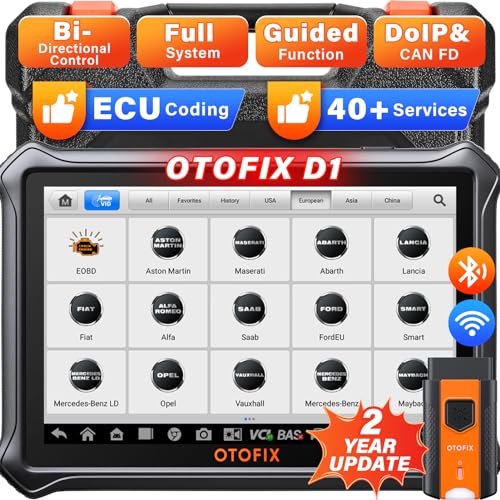
- 2026 Newest Wireless Bluetooth Scan Tool D1: OTOFIX D1 Diagnostic scanner is upgraded version with Enhanced Hardwares & Newest Functions, FASTER and SMARTER! ✅Alternative Bluetooth 5.0 +USB connect✅2G+64GB✅Android 9.0 OS✅5G & 2.4 GHz Dual WiFi✅5800mAh battery👍VAG Guided Function👍ECU Online Coding👍CANFD&DOIP👍40+ Services👍Bi-Directional Control👍Full Systems Diagnose👍2 Years Free Update👍150+ Vehicle Coverage🎁Contact to get gift: otofixaftersales-amz@ outlook.com
- ECU Coding to Unlock the Hidden Features: OTOFIX D1 obd2 scanner diagnostic tool newly adds ECU Coding which can Online Coding(ONLY for VW/Au.di/Sk0da), Variant Coding/Offline Programming, Flash Hidden Functions, Reset Adaptive Data, Match Replaced Components, Customize OE-Settings. Such as: halogen fog lamps retrofitted with xenon fog lamps, different capacity battery retrofit, disbale auto start-stop, sunroof initialization, injector calibration, etc. PS: Coding functions vary by model&year.
- Full Bidirectional Control for Active Car Tests: The D1 OTOFIX scanner also offers bi-directional control, allowing you to perform powerful active tests on car subsystems. This means that you can check the working status and functionality of open & close solenoids, energize injectors, turn cooling fan on & off, and more, all from the device itself.🚩The D1 bi-directional obd2 scanner can quickly help you to check if a system or component goes well,Improving 200% Efficiency.**Note that Active Tests available depend on the make/model/year of your car.
- 40+ Popular Maintenance Functions: OTOFIX D1 obd scanner for car performs 40+ hot services, including Oil Reset, EPB, TPMS, BMS, E.GR, G.PF, D.PF, SAS Calibration, ABS Bleeding, Injector Coding, Gearbox Match, Suspension, Crankshaft Relearn, Power Balance, etc., still growing. Great choice for DIYers, technician, repair shop. 🚩Get MORE special functions from "Car Brand>System>Service". Check compatibility before purchase via 📧 otofixaftersales-amz@ outlook.com.
- OE-Level All Systems Diagnostic + One-Click AutoVIN & AutoSCAN: OTOFIX D1 scanner automotriz gives you the ability to troubleshoot entire car systems including engion system,transmission system,body system,chassis,etc. 🚩One of the standout features of the D1 obd2 scanner diagnostic tool is the one-click AutoVIN & AutoScan function. This feature allows you to quickly and easily scan all diagnosable ECUs with just one click, and identify any problems hidden in your vehicle's systems.
Last update on 2026-06-23 / Affiliate links / Images from Amazon Product Advertising API
This product presentation was made with AAWP plugin.