
NHTSA ID Number: 11027535
Manufacturer Communication Number: KA-01634
TSB/Document Date: 2026-01-09
Summary
McLaren Artura Oil Leak Diagnosis Guide - Rear of Engine
This document is uncontrolled when printed. Before use, check the Knowledge Base within the McLaren
Retailer Portal to verify that this is the current version.
Document Information
Location: Powertrain
Topic: McLaren Artura Oil Leak Diagnosis Guide - Rear of Engine
Condition: Permanent
Diagnostic Trouble Codes: N/A
Measure
If an Artura is found to have oil traces on the underside of the powertrain at the rear, specifically the rear
interface between the engine, transmission and e – motor, please follow the steps below
1. Raise vehicle on ramp as per MSP instructions
2. Remove engine underfloor
3. Capture images prior to any cleaning (before and after removing transmission NVH cover), clearly showing
the leaking area. Label images: “Pre-Cleaning”
Care Point: Include images of both sides of the transmission NVH cover before cleaning
4. Take picture of engine number and label image “Engine Number”
5. Clean area thoroughly using degreaser/solvent
6. Add engine oil dye to the engine - Please refer to latest update of KA-01458
(https://retailerportal.mclaren.com/en-US/kbarticlellist/article/KA-01458) for correct dye and torch to use
Care Point: Do Not use leak detector spray / chalk spray
7. Start engine and run at increased idle speed (3,000 rpm) using engine oil check procedure until procedure is
complete (this will ensure that the engine oil temperature reaches 90°C)
8. Turn off engine and allow vehicle to stand for 20 minutes on the ramp in preparation for inspection
9. Inspect engine. Capture images and label images "Cycle 1", clean area again thoroughly, capture images
and label images "Post Cycle 1"
Care Point: If there is a clear and active leak after step 9, please stop the warm up cycles and submit a TR
with supporting images/video
10. Complete warm up/cool down cycle and inspection a further 4 times capturing images. Name image
foldersrespectively:
"Cycle 2" & "Post Cycle 2 (after cleaning)"
"Cycle 3" & "Post Cycle 3 (after cleaning)"
"Cycle 4" & "Post Cycle 4 (after cleaning)"
"Cycle 5" & "Post Cycle 5 (after cleaning)"
Care Point: In case of uncertainty on final assessment, please update TR with supporting images
correctly labelled
Care Point: If no further oil leak is observed, then the initial oil residue is potentially due to excessive oil
used in the build process
11. If there is obvious evidence of an oil leak from the rear of the engine after the 5 cycles please submit
aTechnical Request with clear pictures showing the leak. If no leak is present, carry out a road test (including
EV mode) and recheck for leaks. Capture images and label "Post Road Test" (before cleaning)
Care Point: If no further oil leak is observed, then the initial oil residue found previously is due to
excessive oil used in the build process - No further action required
12. Identify the location of the leak using a UV light Engine side = Engine oil identified by UV light
Transmission side = Transmission oil
E motor = Dielectric oil - this is different to engine oil and transmission oil, please take pictures and
label "Dielectric Oil"
13. If a leak is identified, please submit a TR for further instruction to remove the transmissionTransmission
Removed:
Complete a visual inspection of the area with the transmission removed identify the leak location
Capture images Label as “Transmission removed”
If engine oil leak is identified from the rear of the engine, drain the engine oil fully, follow
MSP instructions for oil drain procedure
Care Point - If a transmission leak is identified, please submit/update TR with images labeled as
"Transmission Leak"
Flywheel Removed:
Care Point: Carefully remove the flywheel to preserve the oil on any components, this will help with
identification. Do not clean any parts at this stage
Remove and inspect each flywheel bolt for signs of oil one at a time, starting from 12 O’clock position
labeling the bolts in the order of removal (clockwise) and lay down each bolt on a piece of white A4
paper with the bolt head down (threads pointing up). If oil present on bolts, capture images of the oily
bolts and their respective bolt holes on the crankshaft flange – label as “Oil Presence on Flywheel Bolt
and Crankshaft Flange threaded hole”
Capture images immediately of the flywheel, label as “Flywheel Inspection” and inspect. If oil is
centralized around the flywheel on the surface this indicates the flywheel bolts are potentially the cause
of the leak and new flywheel bolts with added Loctite 243 to the top threads will rectify this
Final inspection:
Care Point: Do not clean engine behind flywheel, capture images of leaking areas and label as “Rear
cover of engine”
Identify leaking area of the rear of the engine
a. Flywheel threaded bolt holes (crankshaft flange)
b. Rear crank seal OD
c. Rear crank seal ID
d. Rear cover (RTV Seal - identify exact location)
e. M14 Pins – Tensioner (escalate with images)
If the leak cannot be
obviously diagnosed follow pressure test procedure
(https://mclarenps.blob.core.windows.net/images/Knowledge%20Base%20Articles/KA01626/P16%20Engine%20Leak%20Test%20Procedure.pdf?sv=2021-10-04&st=2023-06-07T15%3A01%3A07Z&se=205001-08T16%3A01%3A00Z&sr=b&sp=r&sig=baFw70qOp362MMyYZVzNlDC2dZ3QfX09OovDxvPMGDE%3D)
Care Point: Inner diameter of rear crank seal will exhibit a leak. This seal is a dynamic seal, the object of
the leak test is to determine if another area at the rear of the engine is leaking also. If another area is
found to be leaking this will likely be the root cause of the failure and this issue should be addressed
Repair:
If it is determined that the outer diameter of the crank seal or the RTV joint of the rear cover is leaking
then replacement of the whole rear cover assembly with pre-fit rear seal is required
Care Point: Seal not to be pressed in on the engine
Check if the rear cover has a tab that clashes with the cylinder block part marking
If the Part Marking on the Cylinder Block is present and not machined down, check if the top surface of the
lettering is protruding the rear cover sealing surface on the cylinder block
If the Part Marking protrudes, proceed with the tab removal to resolve the potential hard clash of the rear cover
which would create a leak path
Use alignment pins referenced in MSP
used for fitment of the rear cover to remove the rear cover to avoid further damage to the rear seal
assembly. Do not remove rear crank seal from the rear cover to avoid any damage to the seal
Follow MSP instructions for correct cleaning, alignment and RTV application when fitting the new rear
cover assembly,
During replacement of the rear cover, it is essential the crankshaft rear seal expander cone PN
16FC663CP and the guide pins are used during this process to slide the seal onto the crank shaft when
fitting the new rear cover assembly
All other alignment, cleaning, and RTV processes in the MSP repair instructions are correct and should
be adhered to when fitting the cover
Flywheel Bolts:
When fitting the Flywheel, clean the bolt hole threads (crankshaft flange) from residual thread locker (from the
original bolt fitment) without pushing any debris into the engine (through holes)
Clean with standard automotive degreaser/solvent ensuring a thorough clean of the leak area
Capture Images: label “Clean Crankshaft-Flywheel Interface pre final assembly” Apply Loctite
243 radially to the first 4-6 threads as follows:
Follow MSP instructions to install the Flywheel using the bolts applied with Loctite 243
Care Point: Once the Flywheel is installed, allow the Loctite 243 activated by the mechanical interaction
of the threads to cure for min. 6 hours before filling the engine with oil
This step will prevent the oil from reaching the thread locker and interfering with the curing process and
potentially impacting the sealing performance of the thread locker
Once the min 6 hours (required for the thread locker curing process) have passed, follow the MSP
procedure to fill the system with oil and rebuild the Powertrain up to the point where you can start the
engine
Repair Validation:
With the floor panel removed, follow Steps 1 to 9 to validate that no leak is present anymore
Once this test has been successfully completed (no oil leaks), rebuild the vehicle as per MSP instructions After
performing the engine health checks, HYCU adaption and a road test, return the vehicle on the ramp and
inspect for any leakages
Remove the engine underfloor to check and confirm that the repaired area has remained dry
Parts Information
N/A
Attachments
N/A
This document is uncontrolled when printed. Before use, check the Knowledge Base within the McLaren
Retailer Portal to verify that this is the current version.

- 6X better wear protection on critical engine parts than...
- 1.3X better sludge protection than industry standards*
- 3X Stronger against viscosity breakdown than leading full...
- Protection for 10,000 miles between oil changes
- Meets or exceeds the following specifications: API SP/SN...

- Formulated for engines with 75,000 miles or more, Valvoline...
- Delivers 20% better wear protection and 15% better sludge...
- Extra detergents safeguard against friction, corrosion and...
- Advanced friction-fighting additives help maximize...
- Provides performance benefits for high mileage, new and...
Last update on 2026-06-23 / Affiliate links / Images from Amazon Product Advertising API
If the PDF is very large, it may not load in the preview below.
Some older TSBs had multiple PDFs — visit the NHTSA Website to view all PDFs.
If the TSB PDF does not show, download or view it on the NHTSA Website.
Click on the (+) Plus Sign
Then Click on Associated Document(s)
Search NHTSA Database for Recalls
Search NHTSA Database for Vehicle Investigations
View Latest Vehicle Investigations
Search NHTSA Database for Vehicle Complaints
View Latest Vehicle Complaints
TSB/Document ID: KA-01634
Replacement Service Bulletin Number:
MFR Communication Date: 2025-12-05
MFR Internal Campaign ID/Software Version:
Communication Type: Other
NHTSA Components: POWER TRAIN
MFR Component System:
MFR Component Subsystem:
Previous TSB | Next TSB |
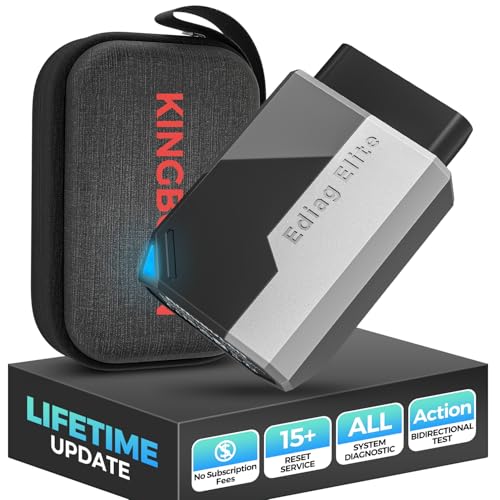
- Obd2 Bluetooth Scanner Lifetime Update: Ediag Elite offers revolutionary Advantage Lifetime Updates with unlimited access to the superior 15 reset service, bidirectional testing and full system diagnostics.The Ediag Elite is an excellent Bluetooth obd2 scanner diagnostic tool ideal for diy's and private car owners
- Bidirectional Control for Quickly Locating Problems: The Bidirectional Scan tool allows you to send commands directly from your smartphone to your vehicle for active testing. This feature helps to quickly narrow down problems such as air conditioning clutches, windows, doors, sunroofs, etc., reducing diagnostic time for mechanics and helping Diy users locate faults more easily. In addition, Ediag Elite provides fault analysis and repair guidance to help you solve problems efficiently.
- 15 Maintenance Resets: The current version introduces 15 popular special features: Oil Reset, Headlight Matching, Bleeding Reset, TPMS Reset, BMS Reset, Gear Box Relearn, Throttle Learning, Injector Coding, SAS Reset and more special functions in system diagnose menu. These functions make it easy for owners to carry out the necessary maintenance and servicing, ensuring that your vehicle stays in top condition, prolonging its service life and preventing common problems and breakdowns. Note: The Special function vary by model& year, Reach us check compatibility.
- Wide Compatibility CANFD & FCA
 Autoauth: Compatible with GM, Ford, Toyota, Chrysler, Honda, Mazda, Nissan, Mitsubishi, Hyundai, KIA with standard OBD2 port from 1996 to newer. More car brands and features will be released gradually. Newest Ediag Elite scanner supports CANFD Protocol and FCA cars. Note: Coverage may vary on different vehicle by model& year ,Please contact us to confirm compatibility before purchase.
 - Perfect for Monitoring The Health of Your Vehicle: Ediag Elite is designed to make vehicle maintenance simple and efficient. With intelligent AutoVIN quick recognition, it is easy to connect to your car without the need for manual input. Real-time data is visualized in a variety of formats, including graphs, numeric, meter displays and clear 4-in-1 data charts, allowing you to effortlessly monitor real-time data. Data logging/reporting is available for playback and further analysis.
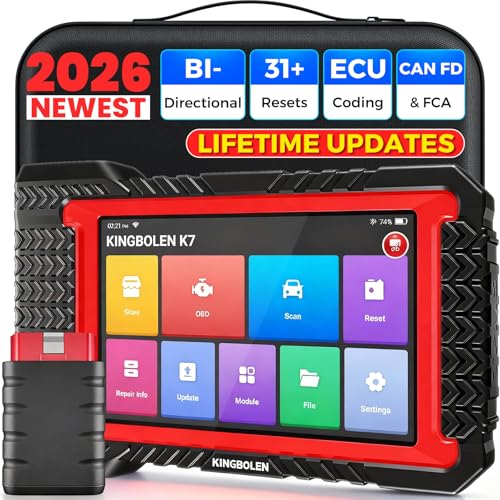
- No Annual Fees & 2026 Upgraded CAN FD: Why pay $199/year or more for updates? The 2026 newest Kingbolen K7 obd2 scanner features have been upgraded to Lifetime Updates without subscription fees, saving you significant costs in the long run. K7 scan tool also adds the CAN FD protocol for the latest GM models (2019+), enabling faster data transfer, reducing the risk of undetected errors
- 2026 Newest Top-tier Car Scanner: Kingbolen K7 diagnostic scan tool is equipped with most capabilities for daily repair/maintenance: Wireless diagnosis via Bluetooth, Bidirectional Test, ECU Online/Offline Code, 31+ Resets, PMI for Ford, Lincoln, Mazda, Global version for 100+ brand vehicles and 17 languages, no area limit, FCA AutoAuth
- OE-Level Full Systems Scan Tool: K7 professional diagnostic scanner with Auto Vin can do one-click to scan ECUs on most of vehicles, like pcm, ecm, eps, bcm, tpms, sas, a/c system... to read/clear code, view live data, freeze frame, read ecu info. 4-in-1 data stream graphics can make data viewing more intuitive. Detailed diagnostic reports will help you easily master the car situation as it can be shared by bluetooth or email! Adding workshop information can help your customers to know more
- Bidirectional Test/Active Test & ECU Code: Stop guessing and start fixing. Bidirectional scan tool Kingbolen K7 can perform real active test that can send commands to the vehicle's ECU to drive the actuators to work, like window, rear mirrors, sunroof, door, solenoids, wipers, headlamp, etc, helping you quickly find out bad parts and pinpoint faulty issues. K7 bidirectional scanner will be a good choice to save money and time on car repairs when performing complex maintenance and repair
- 31 Reset Functions: Avoid expensive dealership visits for simple services. Experience tells us that just a small repair service may cost a lot of money. Kingbolen K7 is a professional diagnostic scanner with 31 common maintenance services like Oil /SAS/EPB/TPMS Reset, Battery Matching, ABS Bleeding, Injector Code, etc. It effectively handles most of the car reset and relearning jobs, perfect for experienced DIYers and mechanics. Note: Functions in the menu vary across vehicles. Kindly check the compatibility before purchase
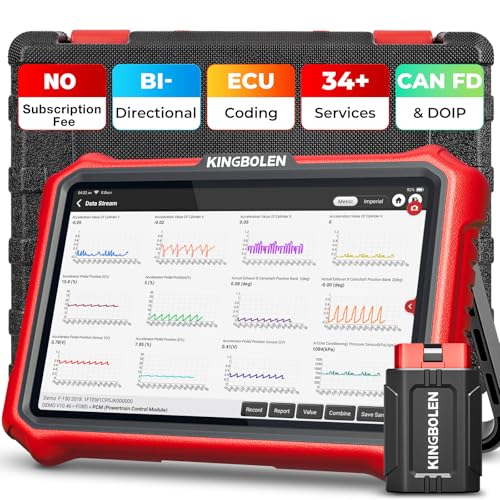
- 【Lifetime Database & Software Updates— No Subscription Fee, No Feature Lock, Save you $399/Y】KINGBOLEN K8 Pro's software can already be permanently upgraded and used for while software of other same price product still needs annual fee of almost $400. K8 pro scanner has packed all capabilities auto technicians would ever need for repair & maintenance services: Added CAN-FD & DOIP protocol, Bluetooth Wireless Diagnosis, Bidirectional Test, ECU Online/Offline Code & Guided Functions for VW, for Audi...34+ Restes, Autoauth for FCA SGW, Larger 4GB+64GB memory, 12600mAh battery, 8'' touch screen with 1280 * 800 Resolution. A Kickstand can allow the tablet to sit at a comfortable angle
- 【Newly Added CAN FD & DOIP Protocol】As Upgrade Version of Kingbolen K8, K8 Pro obd2 scanner supports CANFD and DOIP protocol, which will save you 200+ bucks as no need extra buy for special adapter. CANFD protocol suits for the latest GM(2019-), reducing the risk of undetected errors. The DoIP protocol (comes with DoIp cable) fits for 2017+ BMW(F&G chassis), for Jaguar & Land Rover after 2017, for Volvo after 2018. Plus, K8 Pro's Memory from 2G+32G expanded to 4G+64G, update period extended from 2 years to permanent
- 【34+ Hot Special Functions & V.A.G Guide】KINGBOLEN K8 pro bluetooth obd2 scanner covers almost all common services including Oil Reset, EPB, SAS, BMS Reset, ABS bleed, Throttle Reset, Suspension, Injector Code, Power Balance, Transmission Adaptation, Fuel Trim Learn, HVAC Control Module Calibrate, Language Change, A/F Settings, Stop/Start Reset, Crankshaft Sensor Relearn, TPMS, PMI function and etc. Imagine how much money and time you spend on car maintenance every year? K8 pro car scanner will be a good helper and saver for your car. V.A.G Guided function provides step-by-step guide to work for Volkswagen/Audi/Skoda. Note: Please send us model/year/vin to check compatibility before order
- 【Powerful Bidirectional Test/Active Test & ECU Code】As a bidirectional scan tool, KINGBOLEN K8 pro allows you to request information from a vehicle's ECU or send commands to the vehicle's modules to perform specific tests and functions, such as EVAP Tests, Turn on/off radiator fan, Window/Mirror/Door Lock Test, Pump and Value Tests, Sound horn Test, et. Without using the vehicle control system and dismantling car’s parts, it can quickly and accurately pinpoint the fault causes, simple operation saves time and money
- 【Wireless OE-Level All Systems Diagnostics】Equipped with Bluetooth VCI, you can do car diagnostics out of the car (up to 33F/10M) without being confined to a small space inside the car. Provides the convenience of Auto VIN, K8 pro allowing for easy access and diagnosis of all available modules on a wide range of vehicles, like PCM, ECM, BCM, TPMS, SAS, Fuel System, etc, to perform read/clear codes, view live data, freeze frame, perform active tests, and read ECU info... 12-In-1 Data Stream Graphics make data viewing more intuitive.Diagnostic reports can be shared via QR Code, Bluetooth or email.Built-in Browser and Fault Code Library allows you directly query the fault code when diagnosing
Last update on 2026-06-23 / Affiliate links / Images from Amazon Product Advertising API
This product presentation was made with AAWP plugin.