
NHTSA ID Number: 11021142
Manufacturer Communication Number: LI42.10-P-063502
TSB/Document Date: 2025-08-01
Summary
Complaint Noises/ squealing from the service brake in various driving situations and ambient conditions. Cause Frictional vibrations Remedy The intent of this document is to reduce or eliminate noise from high performance AMG brakes. AMG brakes are designed for performance under high load and in certain scenarios, can emit noise. Some of the scenarios are: • Driving style • Brake pressure and application style (stop-and-go traffic with consistent low brake pressure “riding brakes” where the brakes cannot cool sufficiently between applications). • Ambient temperatures 1. Beginning Diagnostics: a) Check whether the complaint can be reproduced and at which axle or side the noises occur (ideally together with the customer while driving). b) Check the affected system for component wear, mechanical damage or localized overheating damage. Replace damaged components as necessary. c) Assess condition of brake rotors and pads per WIS and visually (i.e. long periods of stagnation, etc...). d) Clean brake components free of brake dust and debris. d) Secure vehicle on a lift. 1. Start the engine and depress the brake pedal 3-4 times. 2. Check each wheel to see if they turn freely by hand. 3. If a wheel is not turning freely by hand, this needs to be addressed prior to re-assessing the noise concern. e) Check whether, apart from this document, an additional document exists for the specific model in question, and if so, work through it and then continue. 2. Specific Axle Work: NOTE: If the brake pad has a metal backing plate, there is no need to affix the adhesive film. Continue with applying chamfer and Molykote as instructed below. IMPORTANT: Be absolutely certain to not allow paste between friction surfaces of the pad and disc! a) If the noises are coming from the front axle. 1. Remove brake linings of front axle. 2. Clean all contact points on brake lining backing plate, including the brake lining guide pins and brake caliper/carrier. 3. Clean bonding surface (where pistons contact back of brake pad). Apply adhesive film to the backplate of the piston-side brake lining where the piston contacts the pad backing plate. See picture "Adhesive and Paste Application Area". 4. Be sure to remove both brown paper backing sides of the adhesive film, it is double sided adhesive film. 5. If adhesive is already installed on backing plate where pistons contact the back of the pad, you may gently scrape off and re-apply a new adhesive or Molykote. Must not apply the Molykote on top of the adhesive. 6. Chamfer edges (gently round off sharp leading edges) on brake pads. Some pads have vertical grooves, these can be gently chamfered with a triangular file as well. See picture "Chamfering Technique". 7. Apply Molykote to the sides of the backing plate. See picture "Adhesive and Paste Application Area". 8. After installing the brake linings, actuate the brake for 30 seconds. b) If the noises are coming from the rear axle. 1. Remove brake pads of rear axle. 2. Clean all contact points on brake lining backing plate and brake caliper/carrier. 3. Clean bonding surface (where pistons contact back of brake pad). Apply adhesive film to the backplate of the piston-side brake lining. 4. Chamfer edges (round off sharp leading edges) on brake pads. See picture "Chamfering Technique". 5. Grease contact points (red areas on attachment "Rear Pad Grease Area") between brake lining and guide of brake caliper with Molykote. 3. Brake Bedding Process: a) Before trip, the mileage incurred must be clarified with the customer (approx. 30 miles). b) Select a suitable route so speeds of approximately 65 MPH can be achieved. c) If the vehicle is an AMG P3 Hybrid, switch off recouperation prior to bedding in brakes. d) Brake the vehicle 15 times with a brake pressure of approx. 30 bar (have the passenger read it out using XENTRY) from 62 MPH to 30 MPH (no emergency stops and no braking in the ESP control range). Maintain a cooling distance of approx. 1 mile between brake application
Brake noise on AMG vehicles
Topic number
LI42.10-P-063502
Version
14
Function group
42.10 - Service brake
Date
7/31/25
Validity
All AMG model designations with steel or ceramic brakes
(code B07)
Reason for change
Added notes on proper adhesive and copper paste application.
Complaint
Noises/ squealing from the service brake in various driving situations and ambient conditions.
WIS-References
Document number
Title
Note
SI 00.00-P-0086A
Guidelines for queries relating to tech- Guidelines for queries relating to technical complaints
nical complaints
Cause
Frictional vibrations
Remedy
The intent of this document is to reduce or eliminate noise from high performance AMG brakes.
AMG brakes are designed for performance under high load and in certain scenarios, can emit noise. Some of the scenarios are:
•
Driving style
•
Brake pressure and application style (stop-and-go traffic with consistent low brake pressure “riding brakes” where the brakes cannot cool sufficiently between applications).
•
Ambient temperatures
1. Beginning Diagnostics:
a) Check whether the complaint can be reproduced and at which axle or side the noises occur (ideally together with
the customer while driving).
b) Check the affected system for component wear, mechanical damage or localized overheating damage. Replace
damaged components as necessary.
c) Assess condition of brake rotors and pads per WIS and visually (i.e. long periods of stagnation, etc...).
d) Clean brake components free of brake dust and debris.
d) Secure vehicle on a lift.
1.
Start the engine and depress the brake pedal 3-4 times.
2.
Check each wheel to see if they turn freely by hand.
3.
If a wheel is not turning freely by hand, this needs to be addressed prior to re-assessing the noise concern.
e) Check whether, apart from this document, an additional document exists for the specific model in question, and if
so, work through it and then continue.
2. Specific Axle Work:
31.07.2025 20:16
© Copyright Mercedes-Benz AG
CCUSHWA
Page 1 / 4
NOTE: If the brake pad has a metal backing plate, there is no need to affix the adhesive film. Continue with applying
chamfer and Molykote as instructed below.
IMPORTANT: Be absolutely certain to not allow paste between friction surfaces of the pad and disc!
a) If the noises are coming from the front axle.
1.
Remove brake linings of front axle.
2.
Clean all contact points on brake lining backing plate, including the brake lining guide pins and brake caliper/carrier.
3.
Clean bonding surface (where pistons contact back of brake pad). Apply adhesive film to the backplate of the
piston-side brake lining where the piston contacts the pad backing plate. See picture "Adhesive and Paste Application Area".
4.
Be sure to remove both brown paper backing sides of the adhesive film, it is double sided adhesive film.
5.
If adhesive is already installed on backing plate where pistons contact the back of the pad, you may gently scrape off and re-apply a new adhesive or Molykote. Must not apply the Molykote on top of the adhesive.
6.
Chamfer edges (gently round off sharp leading edges) on brake pads. Some pads have vertical grooves, these
can be gently chamfered with a triangular file as well. See picture "Chamfering Technique".
7.
Apply Molykote to the sides of the backing plate. See picture "Adhesive and Paste Application Area".
8.
After installing the brake linings, actuate the brake for 30 seconds.
b) If the noises are coming from the rear axle.
1.
Remove brake pads of rear axle.
2.
Clean all contact points on brake lining backing plate and brake caliper/carrier.
3.
Clean bonding surface (where pistons contact back of brake pad). Apply adhesive film to the backplate of the
piston-side brake lining.
4.
Chamfer edges (round off sharp leading edges) on brake pads. See picture "Chamfering Technique".
5.
Grease contact points (red areas on attachment "Rear Pad Grease Area") between brake lining and guide of
brake caliper with Molykote.
3. Brake Bedding Process:
a) Before trip, the mileage incurred must be clarified with the customer (approx. 30 miles).
b) Select a suitable route so speeds of approximately 65 MPH can be achieved.
c) If the vehicle is an AMG P3 Hybrid, switch off recouperation prior to bedding in brakes.
d) Brake the vehicle 15 times with a brake pressure of approx. 30 bar (have the passenger read it out using XENTRY)
from 62 MPH to 30 MPH (no emergency stops and no braking in the ESP control range). Maintain a cooling distance
of approx. 1 mile between brake applications.
e) Finally drive approx. 3 miles to allow the system to cool.
f) Reassess noise.
Attachments
File
Description
Rear Pad Grease Area.png
Rear Pad Grease Area
Chamfering Technique.png
Chamfering Technique
31.07.2025 20:16
© Copyright Mercedes-Benz AG
CCUSHWA
Page 2 / 4
Adhesive and Paste Application Area.jpg
31.07.2025 20:16
© Copyright Mercedes-Benz AG
Adhesive and Paste Application Area
CCUSHWA
Page 3 / 4
Disclaimer
NOTE: The information contained in this document is intended for use by trained, professional technicians with the
knowledge to properly and safely perform diagnosis and repairs on Mercedes-Benz vehicles, using Mercedes-Benz
approved tools and equipment. It informs service technicians about conditions that could occur in certain vehicles and
provides information that could assist in proper vehicle diagnosis, service, or repair. It does not indicate that a defect
is present in any vehicle referenced in this document nor does it imply warranty coverage. DO NOT assume that a
symptom or condition, or a described cause of a symptom or condition, affects any particular vehicle or groups of vehicles, or that a described repair applies to any particular vehicle or groups of vehicles. There can be multiple causes
resulting in the same or similar symptoms or conditions described in this document, and trained professional service
technicians must use their diagnostic skills to make evaluations on a case-by-case basis. The information contained
in this document does not guarantee warranty coverage nor does it extend the vehicle’s warranty in any way.
Symptoms
Chassis/suspension > Brake system > Service brake > Noises > General
Chassis/suspension > Brake system > Service brake > Noises > Squeals
Chassis/suspension > Brake system > Service brake > Noises > Whirring/howling
Chassis/suspension > Brake system > Service brake > Noises > Makes noise
Parts
Part number
ES1 ES2 Designation
Quantity Note
3M F9469PC
Alternate Adhesive Transfer
Tape
1
A 001 989 87 51
09
Molykote

- Mixes well with conventional fluids
- Low-moisture formula provides excellent vapor lock...
- Ideal for hydraulic and disc brakes


- Provides an extra margin of safety in extreme braking...
- Mix of polyglycol ethers ensures hot brake-system operation...
- Excellent for ABS, disc and drum brake systems
- Delivers braking power when needed by avoiding a spongy...
- Both wet and dry boiling points exceed the minimum...
Last update on 2026-06-12 / Affiliate links / Images from Amazon Product Advertising API
If the PDF is very large, it may not load in the preview below.
Some older TSBs had multiple PDFs — visit the NHTSA Website to view all PDFs.
If the TSB PDF does not show, download or view it on the NHTSA Website.
Click on the (+) Plus Sign
Then Click on Associated Document(s)
Search NHTSA Database for Recalls
Search NHTSA Database for Vehicle Investigations
View Latest Vehicle Investigations
Search NHTSA Database for Vehicle Complaints
View Latest Vehicle Complaints
TSB/Document ID: LI42.10-P-063502
Replacement Service Bulletin Number:
MFR Communication Date: 2025-08-01
MFR Internal Campaign ID/Software Version:
Communication Type: Service Bulletin/Repair Instructions
NHTSA Components: SERVICE BRAKES
MFR Component System:
MFR Component Subsystem:
Previous TSB | Next TSB |

- [2026 Top-Tier Hardware and Software Upgrade]: Topdon ArtiDiag900 Lite scanner has enhanced hardware and latest features, including Android 11.0, 5x faster CPU, 10000mAh battery for 12 hours of continuous operation, stable wireless diagnosis with Bluetooth 5.0, 8-inch touchscreen. Added bi-directional control, wireless diagnosis, battery testing (optional), and DTC repair guide
- [TOPDON Bidirectional Scan Tool]: This bidirectional obd2 scanner sends commands to the vehicle's ECU for active testing, enabling users to accurately and quickly locate faulty components such as injectors, coolant pumps, windows, wipers, headlights, mirrors, etc. The bidirectional control scanner is the ideal choice for workshops/automotive repair shops as it significantly reduces mechanic's diagnostic time.
- [Wireless Bluetooth Diagnostic Experience]: The AD900 Lite scan tool comes with a Bluetooth 5.0 VCI, supporting a wireless diagnostic range of up to 33 feet (10 meters), allowing you to diagnose without being confined to cables or tight spaces. Stable and fast wireless diagnosis provides a comfortable repair environment. It also offers VCI cables to increase connectivity options.
- [DTC Repair Guide Function]: Easily diagnose issues with your vehicle and receive guidance on repairs with the topdon scan tool's fault code definitions for all systems,maximize your diagnostic capabilities. This function is compatible with Chrysler
 /Dodge/Jeep/Fiat 2010-2014 and expanding with continual updates,the AritDiag 900 Lite car diagnostic scanner is the must-have tool for any technician or DIY enthusiast.
 - [OE-Level Full System Diagnostics]:AritDiag900 Lite full system diagnostic scanner can scan ALL available modules(Engine, Transmission, Airbag, ABS, ESP, TPMS, Gateway, Steering, Radio, Air conditioning, ect.) to✔read ECU info, ✔read/clear codes, ✔view live data stream, ✔retrieves freeze-frame, ✔perform active tests, and more. With just a simple click, it provides you with accurate and in-depth diagnostics.

- Bi-Directional Control, Quickly Locate Problems: Turn your phone into a professional diagnostic tool. You can send commands from your phone to the ECU to test injectors, cooling fans, headlights, A/C clutch, windows, wipers, and more. See which one doesn't respond. Helps you quickly locate the problem and save time. No need to tear things apart, avoid blind disassembly.
- Flexible Subscription, Choose Advanced Features as Needed: TopScan Lite provides free-for-life access to core diagnostics, including full system scan, code reading, performance tests, and repair information. After purchase, advanced features (bi-directional control, service operations, live data, code clearing, and AI functions) are free-for-the-first-year. After the first year, if you want to use advanced features, you need to subscribe on a monthly, quarterly, or yearly basis. As new models and reset functions are updated, the tool will also be continuously upgraded.
- Full System Diagnostics, No Fault Hides: Unlike basic diagnostic tools that only cover 4 systems, TopScan can scan all systems. Read and clear trouble codes, view live data streams, and generate a complete vehicle health report – all issues are clear at a glance. Covers 10,000+ vehicle models and is compatible with 99.99% of vehicles.
- AI Assistant - TopFix: Think of TopFix as your personal AI mechanic. It leverages a repair database and OEM data to deliver clear, step-by-step repair solutions. Features include AI Q&A, one-click translation, and a full repair log, making your diagnostic process simpler and more efficient.
- 8+ Hot Resets, Keep Your Car in Top Shape: One-tap resets for oil, throttle, EPB, steering angle, DPF, ABS, BMS, and airbag. It enables car owners to easily perform essential maintenance, ensuring the vehicle stays in optimal condition and extends its service life.
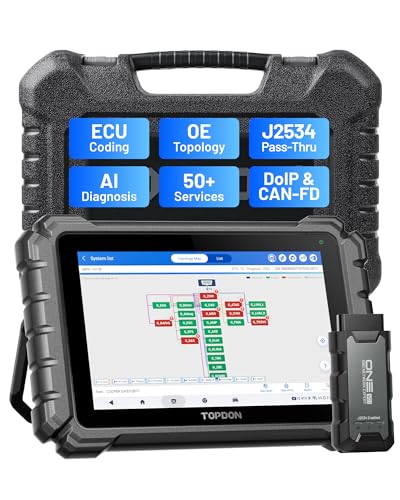
- Dual WiFi & 10.1" Touchscreen: Provides a stable, high-speed wireless link 3x faster than bluetooth, and a responsive, professional interface. Topdon ONE obd2 scanner diagnostic tool ensures smooth, non-lagging diagnostic scan, boosting mechanic efficiency
- J2534 Pass-Thru Support: The included ONE VCI supports the J2534 standard, allowing it to function as a pass-thru device when paired with OEM diagnostic software.Through TOPDON’s RLink platform, technicians can perform dealer-level coding, expanding in-house capabilities without investing in multiple factory automotive scan tools
- OE Topology Mapping: Visualize the vehicle’s ECU network exactly as it’s built.Zoom, pan, and highlight specific modules to pinpoint component issues with precision.Topology mapping displays real-time communication between modules
- 50 Plus Service Functions: Covers high-demand services like ADAS calibration, DPF regen, TPMS reset, ABS bleed, and throttle adaptation.Expands your service menu, allows you to charge premium rates, and turns away zero jobs due to lack of tooling. Vehicle-specific functionality may vary
- Advaned ECU Coding: 10 of the most serviced brands in North America, including full ECU coding and flash hidden support for BMW, VW, Au-di, Benz, Porsche, Toyota, Ni ssan and more. Enables module replacement, feature customization, and personal settings with automatic backup or restore.Lets your shop safely offer high-margin customization services, attracting more customers and boosting profit
Last update on 2026-06-12 / Affiliate links / Images from Amazon Product Advertising API
This product presentation was made with AAWP plugin.