
NHTSA ID Number: 11019326
Manufacturer Communication Number: 23-NA-115
TSB/Document Date: 2025-06-06
Summary
This service bulletin provides a procedure to verify the noise and align the camshaft caps to correct customer concerns of a Ticking, Tapping or Snapping Noise from Engine.
Bulletin No.: 23-NA-115
Service Bulletin
Date: April, 2025
TECHNICAL
Subject:
Ticking, Tapping or Snapping Noise from Engine - 5.5L RPO LT6 Realign
Camshaft Caps as Required
This Service Bulletin replaces PIP5920. Please discard PIP5920.
Brand:
Model:
Corvette
Model Year:
VIN:
from
to
from
to
2023
2024
—
—
Engine:
5.5L (RPO
LT6)
—
Note: AUS/NZ technicians must contact Technical Assistance Centre (TAC) prior to utilizing this Service
Bulletin.
Involved Region or Country
North America, Europe, Middle East, Australia/New Zealand
Condition
Some customers may comment on a ticking, tapping, or snapping noise from the engine.
Note: It is important to note that this engine incorporates a mechanical valve train design
to enable maximum engine performance and does not use traditional hydraulic lifters and
as a result there will be some mechanical tick noise from the valvetrain, which is normal. However, if the noise is excessive and not periodic, as described in this bulletin, this
procedure can be used to reduce the noise. For reference, this ticking disturbance noise
can be heard while the engine is idling and more noticeable with the hatch open and in
tour mode. It may also be found that the noise slightly increases as the engine gets towards operating temperature.
Cause
This condition may be caused by the misalignment of the camshaft caps.
Correction
The verify you have this concern; it will be necessary to follow the steps below. Do not
proceed with this bulletin if the customer has not commented about this concern.
Important: Please read entire bulletin prior to performing any repair.
Important: You MUST use the PicoScope to verify if you have this noise concern. Failure
to use the PicoScope may result in incorrect diagnosis and the need for further or unnecessary repairs.
Important: You need to take PicoScope measurements before and after the repair to
share with customer. Before performing any repair on the left or right side of the engine
please review the realignment procedure with the customer and ask them if they want to
proceed with the repair.
Important: Not all engines will see the same level of noise reduction after performing the
realignment procedure. Some engines may see a marginal improvement in noise reduction.
Important: Service agents must comply with all International , Federal, State, Provincial, and/or Local laws
applicable to the activities it performs under this bulletin, including but not limited to handling, deploying,
preparing, classifying, packaging, marking, labeling, and shipping dangerous goods. In the event of a
conflict between the procedures set forth in this bulletin and the laws that apply to your dealership, you
must follow those applicable laws.
Service Procedure
Step 1:
Follow the directions below to setup the PicoScope to obtain the sound file needed for review.
Copyright 2025 General Motors. All Rights Reserved.
Page 2
April, 2025
Bulletin No.: 23-NA-115
If you need to download or update the PicoScope, follow the steps below:
1. Log into GM GlobalConnect.
2. Click on the "Departments" drop down menu and select "Service.”
3. Under "Applications" on the service page, select "Special Tools and Software updates.” (in Canada, "GM
Special Tools & Equipment - Software Updates")
4. You will now be re-directed to www.gmtoolsandequipment.com (do not access this site directly as it requires the
use of GlobalConnect to allow downloads).
5. Click the link under "Software Downloads" for the latest PicoScope software version and a new page will open.
6374688
6. Click the setup links and follow instructions to update the tool.
Step 2:
⇒ Start up the vehicle/engine. Ensure engine is at operating temperature. Stand on the driver's side and then
passenger side of the engine to listen to the suspected tick. Subjectively determine which bank (LH vs RH) has
a more prominent tick and proceed with instrumenting on that bank.
Determine which side of the engine the noise is coming from.
Step 3:
Place the accelerometer on the suspect bank.
Bulletin No.: 23-NA-115
April, 2025
Page 3
6374742
⇒
With the suspect bank determined, prep/position the accelerometer so the X, Y, Z coordinate system (that’s
laser etched) is facing upwards before securing to the bolt head. After accelerometer is placed on bolt head,
double check to ensure its centered and did not rotate on the bolt head. Doing so will ensure the best results.
Note: Ensure to keep the cable routed away from the exhaust if working in the engine compartment or moving parts
if working under the vehicle.
6374737
Important: Ensure accelerometer coordinates are facing up towards the intake.
Page 4
April, 2025
Bulletin No.: 23-NA-115
Step 4:
Hook up the accelerometer to the oscilloscope.
⇒
Screw the accelerometer connector into the sensor interface. The red LED will start to blink when it senses the
connection. Attach a blue, red, and green BNC cable to X, Y, and Z ports, respectively. Then attach the blue,
red, and green cables to channels A, B, and C, respectively.
Step 5:
Setup the software to collect data.
1. Open the GM NVH software and click on the NVH button.
6374911
2. Start a new test with the setup wizard:
⇒
1) Under RPM Signal – Ensure Static RPM is set to 800 RPM.
⇒
2) Under Vibration Signal – Select three-axis mode then ensure all 3 channels are checked and the location
is set to Engine Compartment.
⇒
3) Under Signal Options – Set the Maximum Signal History Size to 500 seconds.
3. Go to the setup screen to finalize the wizard setup.
Bulletin No.: 23-NA-115
April, 2025
Page 5
6374914
4. Go to options at the top then to advanced options and change the maximum frequency of interest to 2000.
Update the SPL Weighting to dB(A) and check that the accelerometer units are (m/s^2). Under the FFT tab,
change the responsiveness marker to the position shown above. Finally, under the filter tab, add a bandpass
filter from 1300 to 2000 Hz.
Step 6:
Collect data.
1. Startup the vehicle/engine, leave at idle. Make sure the HVAC is off and the vehicle is put into weather mode so
that the vehicle idles at 800 rpm. Let the engine settle and wait for the suspected tick to start.
2. When the suspected tick starts, click on the “start recording” button. Let the recording go for 60 seconds, then
click “stop recording.” Do not adjust the accelerometer throughout the recording.
Note: If the instrumentation needs to be moved, restart the data collection.
4. After finishing the recording, click file then save. Click OK on the details box as this input is optional and save as
a .pddata. Change the file name to “[last 8 of vin]_[LH or RH bank]_[pre or post service fix]_[date].”
Step 7:
Analyze the data.
1. Right click in the time domain display and change the display mode to single.
2. If scales on the left end for each channel are not ranging from -4 m/s^2 to 4 m/s^2, right click in the time domain
display and select “reset scale.”
3. Pull the yellow window cursors on the bottom in as close together as they will go.
4. Look at the channel lines in the time domain window for ticks with a .15s gap between them.
⇒
Compare to the examples below for an engine with a tick and an engine without a tick:
Examples of Tick:
Page 6
April, 2025
Bulletin No.: 23-NA-115
6374921
Bulletin No.: 23-NA-115
April, 2025
Page 7
6374923
Page 8
April, 2025
Bulletin No.: 23-NA-115
6374935
Examples of No Tick:
Bulletin No.: 23-NA-115
April, 2025
Page 9
6375022
Page 10
April, 2025
Bulletin No.: 23-NA-115
6375036
Important: Once you have captured your Pico results before and after performing the service procedure, please
reset the settings menu to default for the next user by clicking on the reset buttons at the bottom of the advance
PICO set up screens.
Once it is determined which bank the noise is coming from, it will be necessary to follow the service procedure below
to adjust the camshaft cap torque.
Important: If the noise is heard from the left bank, the camshaft cap adjustment procedure can be done with powertrain in vehicle. If the noise is heard coming from the right bank, it will be necessary to drop the engine and transmission assembly to gain access and remove the camshaft cover for the adjustment procedure.
Important: Please review the PICO results with the customer and give them the option if they want their powertrain
removed and reinstalled for repair on the passenger side.
Important: Ensure you batteries in the interface module are good.
Camshaft Cap Re-Alignment Procedure:
Important: During the camshaft cap adjustment procedure, you may notice a dull area on the camshaft lobes. This
is considered normal and does not require any further service.
Please use the following procedure to execute a complete bank camshaft re-alignment procedure:
1. If the tick noise is on the Driver’s side bank 1, the repair can be done in the vehicle. If the tick is on the
passenger side bank 2, the rear cradle and powertrain assembly must be lowered to be able to remove the
camshaft cover on that bank.
− Refer to Camshaft Cover Replacement – Bank 1 or Camshaft Cover Replacement – Bank 2 in SI to get the
camshaft cover removed to perform the next steps.
Bulletin No.: 23-NA-115
April, 2025
Page 11
2. Remove the camshaft cover (w/solenoids installed in cover if LH bank, remove solenoids from cover first if RH
bank).
3. With aid of helper, rotate the engine from below by the crankshaft damper bolt until the Intake Cyl #1 (LH) or
Intake Cyl #2 (RH) cam lobes are pointed straight up to the top of the cap (on base circle).
− This is the first cam cap that will be adjusted per the steps 4-8 below.
− Note that the larger front camshaft caps behind the actuators will NOT be adjusted with this procedure.
Important: Always remember to work from front to rear when performing the re-alignment procedure.
Note: For the Bank 1 adjustment procedure, the cam lobes can be monitored through the wheel well opening to
properly position.
4. Loosen the camshaft cap bolts 2-3 full turns. It is not necessary to remove the bolts or camshaft cap.
6704748
5. Before torquing the camshaft cap bolts to spec, it will be necessary to push on the cap (Bias) towards the
direction shown in the graphic above and hold it in that direction while torquing to spec.
• LH Bank (1) - Bias caps inboard towards intake
• RH Bank (2) - Bias caps outboard toward exhaust side
Important: Use a suitable device such as a wooden or plastic handle to push on the cap to ensure we do not cause
any damage to the cap surface.
6. Tighten the inner camshaft cap bolt first to 15 N.m (11 lb ft).
Note: The inner camshaft cap bolt is the one closest to the spark plug tube.
7. Tighten the outer camshaft cap bolt next to 15 N.m (11 lb ft).
Note: The outer camshaft cap bolt is the one farthest away from the spark plug tube.
8. Make a second pass on both camshaft cap bolts to confirm each is torqued to 15 N.m (11 lb ft).
9. Place a black sharpie mark on the cam cap adjusted to note that it has been completed.
Page 12
April, 2025
Bulletin No.: 23-NA-115
Important: During each camshaft cap adjustment step, ensure the camshaft lobes are at base circle.
10. Move to the next valve position working from front to rear on the intake camshaft. Rotate the engine until the
lobes are pointing straight up to the top of the cap for that next position. Repeat steps 4-8 on that
position. Repeat this step for the rest of the valve positions on that cam working front to rear.
11. Repeat the steps 4-8 above on the exhaust camshaft caps on the same engine bank (LH, RH) depending on the
side on which you are working on.
Important: Always remember to work from front to rear when performing the re-alignment procedure.
12. Reinstall the cam cover and solenoids (if removed) and reconnect electrical.
13. Once the exhaust and intake camshaft cap bolts have been re-torqued, the engine can be reassembled.
Important: If the work was done with the engine still in vehicle (LH bank) and the cam phasing solenoids were left
installed in the cam cover, it is critical to make sure that the solenoid plungers are fully recessed before lowering the
cover onto the engine. The plungers can loosely move inward and outward. Tip the cam cover front (solenoids) end
down to make sure plungers are in/down. Carefully move cover with the front (solenoid) end tilted slightly down while
positioning onto the engine to prevent plungers from extending. If the solenoid plungers are extended out, they will
catch on the phaser OCV center bolt plunger and be bent – phasing will not work and both the solenoid and OCV will
need to be replaced.
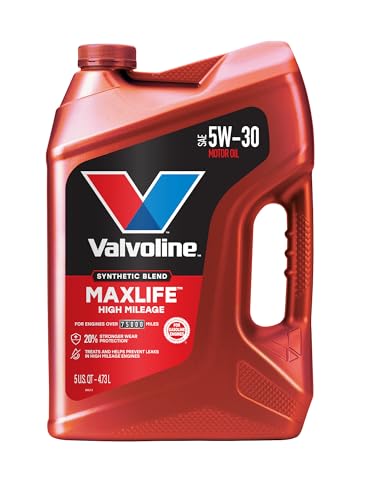
- Formulated for engines with 75,000 miles or more, Valvoline...
- Delivers 20% better wear protection and 15% better sludge...
- Extra detergents safeguard against friction, corrosion and...
- Advanced friction-fighting additives help maximize...
- Provides performance benefits for high mileage, new and...

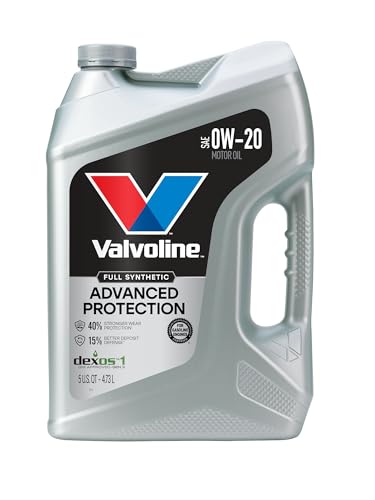
- Advanced protection against the four main causes of engine...
- Delivers 40% stronger wear protection than industry...
- Provides 15% better deposit defense vs. industry standards...
- Up to 2.5X better heat protection vs. industry standards to...
- Engineered for excellent low-temperature flow, reducing...
This product presentation was made with AAWP plugin.
If the PDF is very large, it may not load in the preview below.
Some older TSBs had multiple PDFs — visit the NHTSA Website to view all PDFs.
If the TSB PDF does not show, download or view it on the NHTSA Website.
Click on the (+) Plus Sign
Then Click on Associated Document(s)
Search NHTSA Database for Recalls
Search NHTSA Database for Vehicle Investigations
View Latest Vehicle Investigations
Search NHTSA Database for Vehicle Complaints
View Latest Vehicle Complaints
TSB/Document ID: 23-NA-115
Replacement Service Bulletin Number:
MFR Communication Date: 2025-04-16
MFR Internal Campaign ID/Software Version:
Communication Type: Service Bulletin/Repair Instructions
NHTSA Components: ENGINE
MFR Component System:
MFR Component Subsystem:
Previous TSB | Next TSB |

- Scanner POR V2.0 with all obd2 services
- Do the scanning for engine
- Support OBDII/EOBD Ten Modes of Operation

- 【Designed for Most Mercedes-Benz
 , Sprinter and Smart from 1996-2023】As every car model of Benz has its-owned specific car system and ECUs, not all models are equipped with a complete vehicle ECU, which may cause the scanner to be unable to perform all listed reset services on some models, or even completely incompatible. Like For Sprinter's newer models, it support diagnostic functions only, lacking support for specialized service functions.. So please tell us the car's VIN and required service before purchase for compatibility check. You may also refer to the instructions in the eighth image of the main product photos to perform your inquiry.
 - 【Up to 38 Reset Services】MB V3.0 2026 Version diagnostic tool performs Up to 38 maintenance services - Oil Rest , SAS, EPB, ETC, D-P-F, TPMS, ABS, Suspension, Air Conditioner, Head Lamp, Body Stability, Engine Control, Seat, Fuel Pump, Air-Filter, Engine Idle, Door, Im-mo-bilizer, Injector Coding, Transmission Control, Miscellaneous, Adblue, BMS, Cluth, Water Pump, NOxSensor, Rain/Light Sensor, Start/Stop, Radar/Camera, Cylinder Shutoff Test, Speed Limit Assist, Control Unit Reset, Oxygen Sensor, Seat Belt, Cruise Control System, Turbocharger, Crankshaft, Language Setting and etc. (Tips: Please update the software after receiving the product to obtain new service functions)
- 【OE-Level All System OBD2 Scanner】iCarsoft MB V3.0 (2026 Version) diagnostic scanner offers comprehensive OBDII services, allowing you to quickly scan all systems, including the Engine, ABS, SAS, SRS, TPMS, TCM, Fuel Pump System, ESP, EPB, EPS, Suspension, SCM, Adaptive Systems, and more. It supports functions such as reading and erasing codes, checking I/M readiness, viewing freeze frame data, performing O2 sensor tests, conducting on-board monitoring, testing the evap system, auto VIN retrieval, and reading both generic and specific codes, as well as DTCs and battery tests.
- 【Bidirectional Scan Tool】iCarsoft MB V3.0 (2026 Version) Bidirectional scanner supports activate or control a vehicle system or component, allows commanding cars’ modules and receiving info from the ECU to perform active tests on individual components, including EVAP/ABS Motor Pump/Windows/Sunroof and more, to pinpoint fault causes & resolve issues,and allows you to re-learn certain components after making repairs or replacement.
- 【Real Time Record & Graph View】iCarsoft MB V3.0 (2026 Version) can automatically record vehicle text history and identify vehicle information. Preserve real-time data information. View & Graph Live Data. Support Data Review and Print. Multi-language: English, German, Dutch, Spanish, French and so on. We promise to offer Lifetime updates (Lifetime free Update via PC), and confidence in products. We also provide 1 year warranty + extra lifetime hardware free repair if you need it in the future. We prioritize user experience & strive to meet your expectations. Please do feel free to reach out to us if you have any question or problem about the usage, our tech team will service you in time.
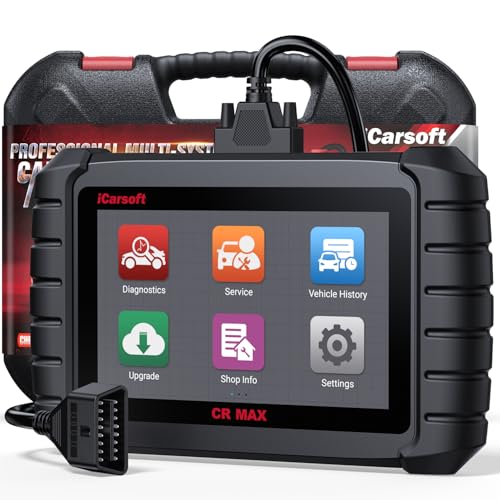
- WHY CHOOSE THE 2025 CR MAX -Upgrade the latest diagnostic capabilities for all vehicles after 1996: upgrade to 49+maintenance services; 46 extra specific functions; real all systems/all control modules diagnose; over 40K+ bidirectional actuation tests for diagnosing all control moduels of cars; Powerful full OBD2 Functions; built-in ECU Coding for BMW/ Audi/ VW/ RollsRoyce; Fr ee V.A.G Guide Function; Battery retistration for new battery adaptation and more. It covers all vehicle diagnostic services and some special professional vehicle maintenance servces, assists you to do home DIY vehicle maintenance or car repair as a pro technician.
- NEWEST IN INNOVATION FULL OBD2 SERVICES- iCarsoft auto car diagnostic scanner compatible with CAN-FD, CR MAX can do it all-reads and clears trouble codes, ALL SYSTEM DIAGNOSIS such as engine, transmission, ABS and airbag etc. CR MAX code reader for all cars can perform I/M Readiness, Live Data, Freeze Frame, Vehicle Information, Monitor Test, On-Board Monitor, E vap System Test,O2 Sensor Test,DTC Library Lookup,etc. (Warm Tips: If you car is after 2023,please contact us for compatibility; 3. It comes with 16PIN OBD2 diagnostic adapter, please check your car diagnostic socket if it is 16pin socket, if your car is 14pin diagnostic socket please contact us for the solution.)
- 49 RESET+ 46 SERVICES- Performs: Oil Reset, EPB,SAS,Throttle, D-P - F, Battery, ABS, Injector, TPMS, Suspension, AC, Head Lamp, Body Stablity, Engine, Tramsmission, Airbag, Seat, Door-Win-Roof, Fuel Pump, Door, E-G- R.+21 NEWEST SERVICES( Need update scanner)-AdBlue, Clutch, Crankshaft, High Voltage Battery, Cruise Control, NO xSensor, Rain Sensor, Stop And Start, Turbocharger, Head Up Display, Radar Camera, Vehicle Setup, Cyliner Misfire Check,Speedlimitassist, ControlUnitReset,OxygenSensor, Seatbelt. Extra 46+ extra services based on car brand.(Tips: Quantity of reset/ calibration fucitons are based on car system that your vehicle model has)
- REVOLUTIONARY 40000+BIDIRECTIONAL ACTIVE TESTS: Upgraded CR Max scanner equip with numberous of actuational test items for covering all available vehicle control modules, no longer only do simple light test or window test like other scanners, performs hardware modules test and software control modules test for checking car units or new updated control moduels work well or not after maintenance/ repair/ re-installation/ control system updated (Example for Benz- Roller Sun Blind test; Backup Camera test ;Self-test; EPB test; Transport Mode test;Boost Pressure Positioner test; Fuel Pump test; AND MORE!!).(Warm tip: The available test items are based on control modules your car has)
- ECU CODING+ BATTERY REGISTRATION- Powerful ECU Coding service for BMW/MINI/RollsRoyce / Audi/VW/Seat/Skoda/Bentley/Bugatti/Lamborghini, Improves Engine Power Performance and Optimizes Fuel Efficiency and Match New Hardware Unit to car and Customized a comfortable Driving Modes and Fixes & Updates Original Software Bug. The battery test function for checking car battery health, perform battery reset (BMS ) for replacing a damaged or aging car battery with a new one and register new battery to car ECU
This product presentation was made with AAWP plugin.
Last update on 2026-06-07 / Affiliate links / Images from Amazon Product Advertising API