
NHTSA ID Number: 10248651
Manufacturer Communication Number: NTB17-039Q
TSB/Document Date: 2024-01-09
Summary
CVT JUDDER AND DTC P17F0 OR P17F1 STORED This bulletin has been amended. See AMENDMENT HISTORY on the last page. Discard all previous versions of this bulletin.
Figure 131
105. Clean and then zero the Digital Depth Gauge (part #: J-50272). See pages 60-61.
Set Digital Depth Gauge to millimeters.
106. Clean Gauge Block J-50271.
107. Confirm that the CVT case and the dummy cover mating surfaces are clean.
62/118
NTB17-039Q
Gauge Block
108. Calculate the “average clutch
assembly bore depth” (D) shown in
Figure 132 as follows:
IMPORTANT: Measurements are
required from two opposite ends to
obtain the average.
Clutch drum of clutch assembly
Figure 132
Clutch assembly
bore
a. Position the Gauge Block over the
clutch assembly bore on the surface
where the dummy cover seats
(Figure 133).
IMPORTANT: This surface is lower
than the CVT case to torque
converter housing surface.
Gauge Block
Figure 133
b. Confirm the Gauge Block is not
sitting on the clutch assembly or
against the input shaft.
Dummy
cover seat
Dummy
cover seat
HINT:
o The clutch assembly should sit
1-3 mm lower than the dummy
cover seat (Figure 134).
o If the clutch assembly is sitting
higher than the dummy cover
surface, see
TROUBLESHOOTING The
Dummy Cover Will Not Sit
Flush on page 107.
63/118
Clutch assembly
Figure 134
NTB17-039Q
c. Position the Depth Gauge on the
Depth Gauge
Gauge Block (Figure 135).
Datum level
HINT: Make sure the Depth Gauge’s
datum level is flush with the top of
the Gauge Block.
d. Carefully slide the gauge down until it
bottoms out on the bottom of the
clutch assembly bore. Write this
measurement as D1 (use
millimeters).
Clutch assembly
bore
Gauge Block
HINT: Do not measure from the
clutch assembly bore shown in red
(Figure 136).
Figure 135
Do not measure
from this raised step
(highlighted in red).
Measure here; D2
Measure here; D1
Figure 136
e. Measure this same distance on the opposite side (180 degrees) of the clutch
assembly bore and write it as D2.
f.
Using the formula below, calculate the average and write down the calculated value
as D.
(D1 + D2)
D =
---------------------------
Write the measurement for “D” here _____ mm
2
64/118
NTB17-039Q
109. Measure the average (H) dummy
cover height (Figure 138) as follows:
Clean surfaces
Clean here
a. Clean the dummy cover surfaces
that contact the CVT case and
thrust bearing (Figure 137).
IMPORTANT: Use brake cleaner
(or equivalent) and a lint-free towel
only. Make sure the brake spray or
solvents used are compatible with
local regulations.
b. Place the dummy cover upside
Clean here
down on a work bench, and place
the Gauge Block onto the thrust
bearing surface (Figure 138).
Figure 137
c. Position the Depth Gauge on the Gauge Block over an outer end of the dummy
cover (Figure 138).
HINT: Make sure the Depth Gauge’s datum level is flush with the top of the
Gauge Block.
d. Carefully slide the Depth Gauge down until it contacts the dummy cover surface
that mates with the CVT case. Write this measurement as H1 (use millimeters).
e. Measure this same distance on the opposite side of the dummy cover and write as
H2 (Figure 138).
Gauge Block
Measure opposite sides
Figure 138
f. Using the formula below, calculate the average and then write down the calculated
value as H.
(H1 + H2)(H1 + H2)
H=
H = --------------Write the measurement for “H” here _____ mm
2
110. Choose the thrust bearing to adjust Clutch Total Endplay (A) as follows:
a. Calculate A (Total Endplay):
Total Endplay A = D – H (This will be the thrust bearing thickness).
o Fill in the measurements below for “D” and “H” from pages 64 and 65 to calculate
for “A”.
D measurement ______ mm
– H measurement ______ mm
= A - - - - - - - - - - - - - - - - ______ mm
65/118
Please print this page and
attach it to the repair order.
NTB17-039Q
b. Choose the appropriate bearing from Table A below, based on A (eight different
thicknesses of thrust bearings are available).
Example: If A = 4.3 mm, it falls between the lower and upper clearances for
bearing thickness 3.93 mm.
o Refer to PARTS INFORMATION for Thrust Bearing part numbers by thickness.
c. Measure and confirm that the selected thrust bearing is the correct thickness
before installing (Figure 139).
Table A
PART #: 31407-
A=D-H
BEARING
CLEARANCE (A) THICKNESS
1XZ0B or X270A
1XZ0C or X270B
1XZ0D or X270C
1XZ0E or X270D
1XZ1A or X270E
1XZ1B or X271A
1XZ1C or X271B
1XZ1D or X271C
3.87 - 4.06 mm
4.07 - 4.22 mm
4.23 - 4.42 mm
4.43 - 4.57 mm
4.58 - 4.77 mm
4.78 - 4.93 mm
4.94 - 5.08 mm
5.09 - 5.29 mm
3.57 mm
3.75 mm
3.93 mm
4.1 mm
4.28 mm
4.46 mm
4.61 mm
4.79 mm
Figure 139
111. Install the thrust bearing flush to the clutch assembly bore as shown in Figure 140.
Install thrust bearing in area shown in green so that it is centered by the four tabs.
HINT: The thrust bearing has two sides. See image below for appropriate
orientation.
Four Alignment
tabs.
(One not shown).
Silver surface
faces UP
Black surface
faces DOWN
Thrust bearing
This gap should
face down
Correct installation
Incorrect installation
Figure 140
66/118
NTB17-039Q
Pages 67-74 are for Type 2 Thrust Bearing (with bearing race) ONLY. Proceed to
page 62 if working with Type 1 Thrust Bearing.
Type 2 CVT: Clutch Total Endplay Adjustment – Bearing Race Selection
IMPORTANT: The clutch total endplay (Figure 131) must always be adjusted when a new
sub-assembly is installed.
The Type 2 CVT uses the thrust bearing race thickness between the clutch drum
of clutch assembly and the oil pump cover (dummy cover) to adjust the total
endplay.
Thrust Bearing Race Selection
There are seven (7) thicknesses of thrust bearing races available for total endplay
adjustment.
CVT
case
Bearing
race
Dummy
cover
Thrust
bearing
Clutch
drum
Figure 141
112. Clean and then zero the Digital Depth Gauge (part #: J-50272). See pages 60-61.
Set Digital Depth Gauge to millimeters.
113. Clean Gauge Block J-50271.
114. Confirm that the CVT case and the dummy cover mating surfaces are clean.
Do NOT use sanding discs or similar abrasive tools.
o Use brake spray or equivalent solvent and lint-free towels only.
o Make sure the brake spray or solvents used are compatible with local
regulations.
67/118
NTB17-039Q
115. Calculate the “average clutch
assembly surface depth” (D) as
follows:
IMPORTANT: Measurements are
required from two opposite ends to
obtain the average.
Figure 142
Gauge Block
a. Position the Gauge Block over the
clutch assembly on the surface
that the dummy cover seats.
IMPORTANT: This surface is lower
than the CVT case to torque
converter housing.
Figure 143
b. Confirm the Gauge Block is not
sitting on the clutch assembly or
against the input shaft.
Input shaft
HINT:
The top surface of the clutch
assembly must be 1-3 mm
below the CVT case surface,
where the dummy cover seats.
If the clutch assembly is sitting
higher than the dummy cover
surface, see
TROUBLESHOOTING The
Dummy Cover Will Not Sit
Flush on page 107.
68/118
Clutch assembly
Figure 144
NTB17-039Q
c. Position the Depth Gauge on the Gauge Block.
HINT: Make sure the depth gauge’s datum level is flush on top of the Gauge Block.
d. Carefully slide the gauge down until it bottoms out on the upper surface of the clutch
drum where thrust bearing seats, where shown in Figure 145. Write this
measurement as D1 (use millimeters).
Measure 180
degrees apart
Figure 145
e. Measure this same distance on the opposite side (180 degrees) of the clutch
assembly surface and write it as D2.
f. Using the formula below, calculate the average and write down the calculated value
as D.
(D1 + D2)
D =
---------------------------
Write the measurement for “D” here _____ mm
2
69/118
NTB17-039Q
Clean here
116. Measure the average (H) dummy
cover height where case seats as
follows;
Clean surfaces
a. Clean the dummy cover surface
that contact the CVT case and
depth gauge.
IMPORTANT: Use brake spray (or
equivalent) and lint-free towel only.
Make sure the brake spry or
solvents used are compatible with
local regulations.
b. Place the dummy cover upside
down on a workbench, and place
the Gauge Block onto the top
surface.
Clean here
Figure 146
c. Position the Depth Gauge on the Gauge Block over an outer end of the dummy
cover.
HINT: Make sure the Depth Gauge’s datum level is flush with the top of the
Gauge Block.
d. Carefully slide the Depth Gauge down until it contacts the dummy cover surface
that mates with the CVT case. Write this measurement as H1 (use millimeters).
e. Measure this same distance on the opposite side of the dummy cover and write it
as H2.
Measure opposite sides
Figure 147
f. Using the formula below, calculate the average and then write down the calculated
value as H.
(H1 + H2)
H = --------------2
Write the measurement for “H” here _____ mm
70/118
NTB17-039Q
117. Measure the average (J) dummy cover height where thrust race seats as follows:
a. Carefully slide the Depth Gauge down until it contacts the dummy cover surface
that mates with the thrust race. Write this measurement as J1 (use millimeters).
b. Measure this same distance on the opposite side (180 degrees) of the dummy
cover and then write as J2.
Measure 180
degrees apart
Figure 148
c. Using the formula below, calculate the average and then write down the calculated
value as J.
(J1 + J2)
J = --------------2
Write the measurement for “J” here _____ mm
118. Calculate gap G.
Gap G = J – H
o Fill in the measurements below for “J” and “H” to calculate for “G”.
J measurement ______ mm
– H measurement ______ mm
= G ------------------- ______ mm
71/118
NTB17-039Q
119. Measure the thickness of the thrust bearing ONLY (without original race) as follows:
a. Place the thrust bearing roller side down on the Gauge Block (Figure 149).
IMPORTANT: Roller side of thrust bearing must face down and be flat on the
Gauge Block to accurately measure thickness.
b. Measure at two different positions of the thrust bearing that are 180 degrees apart.
c. Add the two measurements, and then divide by two. Write down the calculated
value as E.
(E1 + E2)
E = --------------2
Write the measurement for “E” here _____ mm
Roller side
Gauge
Block
Thrust
bearing
Figure 149
120. Choose the thrust bearing race to adjust Clutch Total Endplay (C) as follows:
a. Calculate C (clearance).
Total Clearance C = D – T + G – E
HINT: “T “ is the Thickness of the Gauge Block (J-50271: 20mm).
o Fill in the measurements below for “D”, “G” and “E” from pages 69-72 to calculate
for “C”.
D measurement
– T measurement
+ G measurement
– E measurement
= C----------------
______ mm
_ 20 __ mm
______ mm
______ mm
______ mm
Please print this page and
attach it to the repair order.
EXAMPLE: If D = 23.81, G = 0.41, E = 2.57
C = D – 20 + G – E = 23.81 - 20 + 0.41 - 2.57
C = 1.65
72/118
NTB17-039Q
b. Choose an appropriate thrust bearing race from Table B below based on C
(seven different thrust bearing “race thicknesses” are available).
Example: If C = 1.65 mm, it falls between the lower and upper clearances for race
thickness 1.2 mm.
c. Measure and confirm that the selected thrust bearing race is the correct thickness
before installing (Figure 150).
IMPORTANT: Do not measure from the thrust bearing race lip (Figure 151).
Table B
3WX0A
CLEARANCE (C)
C=D–T+G–E
0.90 – 1.08 mm
RACE
THICKNESS
0.6 mm
3WX0B
3WX0C
3WX0D
1.09 – 1.29 mm
1.30 – 1.50 mm
1.51 – 1.70 mm
0.8 mm
1.0 mm
1.2 mm
3WX1A
3WX1B
3WX1C
1.71 – 1.90 mm
1.91 – 2.10 mm
2.11 – 2.30 mm
1.4 mm
1.6 mm
1.8 mm
PART #: 31435-
Incorrect
Correct
Thrust bearing
race lip
Do not measure
from thrust
bearing race lip
Thrust bearing
race
Figure 150
Figure 151
73/118
NTB17-039Q
121. Install the thrust bearing onto the
clutch drum.
IMPORTANT: The thrust bearing has
two sides.
o The needle bearing side is the
upper side.
o The race side mates with the
clutch drum surface.

- 💯【Conta.ct us for Support Directly】If you met any...
- 🔥🔥🔥【2026 AUTEL FLAGSHIP MK900BT MK900-BT, NEW...
- 🚗【3000+ ACTIVE TESTS (50➡3000+), SAME AS MS...
- 🚗【40+ HOT SERVICES FOR 150 MAKES (28+➡40+)】Full...
- 🚗【OE ALL SYSTEM DIAGNOSE, AUTO SCAN 2.0: SCAN LICENSE...

- 【TURN OFF CEL】 This AL319 car scanner diagnostic tool...
- 【EXTENSIVE APPLICATION】 Autel AL319 Compatible with...
- 【FOR END USER & DIYERS】 This error code reader AL319 is...
- 【USER-FRIENDLY DESIGN】 This OBD2 scanner and check...
- 【HIGH-QUALITY SERVICES】 12 months war.ranty from the...
Last update on 2026-06-23 / Affiliate links / Images from Amazon Product Advertising API
If the PDF is very large, it may not load in the preview below.
Some older TSBs had multiple PDFs — visit the NHTSA Website to view all PDFs.
If the TSB PDF does not show, download or view it on the NHTSA Website.
Click on the (+) Plus Sign
Then Click on Associated Document(s)
Search NHTSA Database for Recalls
Search NHTSA Database for Vehicle Investigations
View Latest Vehicle Investigations
Search NHTSA Database for Vehicle Complaints
View Latest Vehicle Complaints
TSB/Document ID: NTB17-039Q
Replacement Service Bulletin Number:
MFR Communication Date: 2023-12-15
MFR Internal Campaign ID/Software Version:
Communication Type: Service Bulletin/Repair Instructions
NHTSA Components: POWER TRAIN
MFR Component System:
MFR Component Subsystem:
Previous TSB | Next TSB |
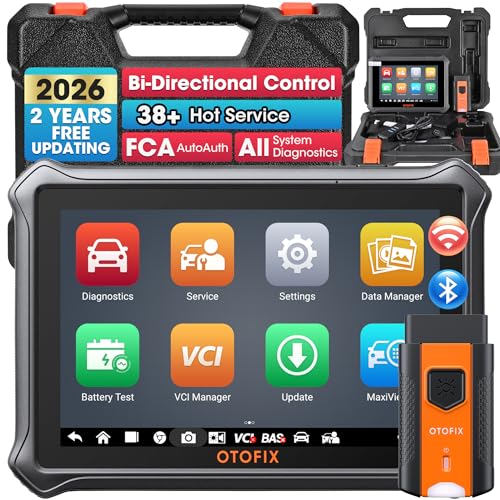
- 🎉[OTOFIX D1 Lite, Perfect Cost-effective Diagnostic Tool]: OTOFIX D1 Lite, a newest bidirectional scan tool from OTOFIX company, is a great choice for DIYers and repair shops. 👉This obd2 scanner diagnostic tool packs all practical functions: OE level all systems diagnoses, Bi-Directional Control, 38+ reset services fixing 99% of common problems, support DoIP & CANDF protocols and FCA
 AutoAuth, high-end hardware configuration. Worldwide vehicles and 🔥2 Years Free Updating🔥 covered.
 - 🎉[Bi-Directional Scan Tool, Active Test]: OTOFIX D1 Lite bluetooth obd2 scanner can also command ECUs and monitor the operation of the actuators to track down the problems of certain parts, like windows, sunroof, wipers, fuel pumps, etc., saving repair time & trouble. This makes OTOFIX D1 Lite the most cost-effective bidirectional scan tool.
- 🎉[2026 Newest, 38+ Hot Reset Functions]: Equipped with 38+ reset functions in one, the OTOFIX D1 lite automotive scanner diagnostic tool allows you to troubleshoot 99% of common vehicle problems. You can use this car diagnostic scanner holding enough functions to easily repair common vehicle models in your repair shops. Including Oil Reset, Injector Coding, Throttle, DPF Reset, SCR Reset, Gear Learning, Clutch Learning, Suspension, etc. Note* Reset functions vary by model.
- 🎉[OE Level Full Systems Diagnostics]: Unlike the 2-system and 4-system diagnostic tools, the OTOFIX auto scan tool can complete comprehensive system diagnostics within 5 minutes. It accesses and scans all available onboard systems like for Engine /AT /ABS /EPB /BMS /TPMS /SRS /SAS /Audio System /BCM /Air Conditioning / etc., to read & clear codes, view live data, and check ECU information. Note: Active test is not involved.
- 🎉[Powerful Hardware Configuration]: Designed with a fashion appearance & a 7” touchscreen and a weight of 463g, this OTOFIX D1 Lite OBD2 diagnostic scanner scan tool is convenient for everywhere and easy to use & store. Android9.0 OS and 2+64GB memory enhance multi-task smoothness and diagnostic operation, no more wasting too much time. 5800mAh battery allows hours-lasting use. WiFi & VCI1 also bring faster communication for your diagnostics.
 AutoAuth, high-end hardware configuration. Worldwide vehicles and 🔥2 Years Free Updating🔥 covered.
- 🏆【2026 TOP OBD2 Scanner Diagnostic Tool】OTOFIX D1 Lite wireless obd2 scanner has upgraded hardware configuration and car coverage. The newly upgraded D1 Lite with 🔥OS Android 9.0🔥1.5Ghz 4 core high efficiency processor🔥2GB RAM+64GB ROM large storage🔥5800mAh large battery, more stable and longer lasting diagnostics🔥 38+ Reset🔥action tests🔥full system diagnostic🔥Supports MV105 endoscope🔥21+ Language Supports🔥100000+ vehicle coverage to meet all your daily maintenance needs.
- 👍【Bi-Directional Control / Active Test】D1 Lite obd2 scanner has bidirectional control(worth $300+), which is the most beloved feature among mechanic. If your headlights or car windows are broken, going to a repair shop will cost a lot of money. You can use D1 Lite to send execution commands to the ECU module and identify the repair status. Such as ABS, car windows, doors, valves, wipers, headlights, etc., effectively shorten diagnostic time and reduce diagnostic costs.
- 🔥【All Systems Diagnostics, In-depth Checking】This advanced OBD2 Scanner D1 Lite can perform OE-level diagnosis of all systems including engine, transmission, airbag, ABS, ESP, TPMS, gateway, steering, radio, and air conditioning for more than 100 brands. This diagnostic scanner supports essential functions, such as reading ECU version info, reading and clearing fault codes, and reading data streams.With just a simple click, it provides you with accurate and in-depth diagnostics.
- 🏆【38+ Reset Hot Functions】For repair workshops, holding an OTOFIX D1 Lite Auto scanner is a strong advantage over others. Its 38+ maintenance functions provide various solutions for all module repairs, including Oil Reset, TPMS Reset, Injector Coding, Suspension, Throttle Matching, etc., which will usher your repair business to a new pinnacle. Continuously updating will never make the functionality & compatibility out-of-date.
- 🏆【150+ Models, 10000+ Car Coverage & 16 Languages】D1 Lite is a comprehensive car diagnostic scan tool, help you to troubleshoot car issues fast for 95% US, European, Asian auto makes. ✅ With frequent updates and optimizations allow D1 Lite to cover more vehicles to meet your needs. ✅ Multilingual menu allows auto mechanics around the world to use it without language barriers. 🚩Note: Kindly send us the S/N of the device to authorize new language updates before changing the menu language.
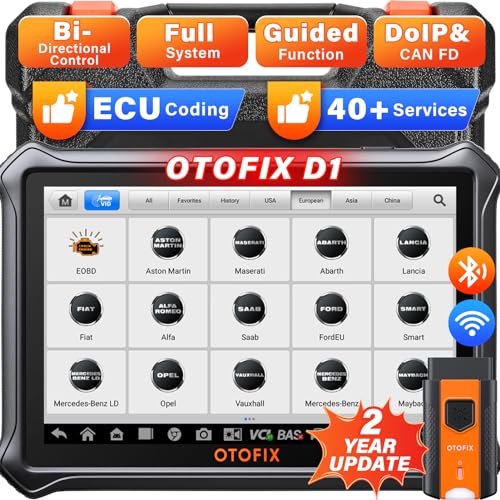
- 2026 Newest Wireless Bluetooth Scan Tool D1: OTOFIX D1 Diagnostic scanner is upgraded version with Enhanced Hardwares & Newest Functions, FASTER and SMARTER! ✅Alternative Bluetooth 5.0 +USB connect✅2G+64GB✅Android 9.0 OS✅5G & 2.4 GHz Dual WiFi✅5800mAh battery👍VAG Guided Function👍ECU Online Coding👍CANFD&DOIP👍40+ Services👍Bi-Directional Control👍Full Systems Diagnose👍2 Years Free Update👍150+ Vehicle Coverage🎁Contact to get gift: otofixaftersales-amz@ outlook.com
- ECU Coding to Unlock the Hidden Features: OTOFIX D1 obd2 scanner diagnostic tool newly adds ECU Coding which can Online Coding(ONLY for VW/Au.di/Sk0da), Variant Coding/Offline Programming, Flash Hidden Functions, Reset Adaptive Data, Match Replaced Components, Customize OE-Settings. Such as: halogen fog lamps retrofitted with xenon fog lamps, different capacity battery retrofit, disbale auto start-stop, sunroof initialization, injector calibration, etc. PS: Coding functions vary by model&year.
- Full Bidirectional Control for Active Car Tests: The D1 OTOFIX scanner also offers bi-directional control, allowing you to perform powerful active tests on car subsystems. This means that you can check the working status and functionality of open & close solenoids, energize injectors, turn cooling fan on & off, and more, all from the device itself.🚩The D1 bi-directional obd2 scanner can quickly help you to check if a system or component goes well,Improving 200% Efficiency.**Note that Active Tests available depend on the make/model/year of your car.
- 40+ Popular Maintenance Functions: OTOFIX D1 obd scanner for car performs 40+ hot services, including Oil Reset, EPB, TPMS, BMS, E.GR, G.PF, D.PF, SAS Calibration, ABS Bleeding, Injector Coding, Gearbox Match, Suspension, Crankshaft Relearn, Power Balance, etc., still growing. Great choice for DIYers, technician, repair shop. 🚩Get MORE special functions from "Car Brand>System>Service". Check compatibility before purchase via 📧 otofixaftersales-amz@ outlook.com.
- OE-Level All Systems Diagnostic + One-Click AutoVIN & AutoSCAN: OTOFIX D1 scanner automotriz gives you the ability to troubleshoot entire car systems including engion system,transmission system,body system,chassis,etc. 🚩One of the standout features of the D1 obd2 scanner diagnostic tool is the one-click AutoVIN & AutoScan function. This feature allows you to quickly and easily scan all diagnosable ECUs with just one click, and identify any problems hidden in your vehicle's systems.
Last update on 2026-06-23 / Affiliate links / Images from Amazon Product Advertising API
This product presentation was made with AAWP plugin.