
NHTSA ID Number: 10214475
Manufacturer Communication Number: A462232203418121
TSB/Document Date: 2022-07-01
Summary
This technical service bulletin provides troubleshooting for brake noise.
Technical Service Bulletin
46 Brake noise analysis and handling
46 22 32 2034181/21 June 3, 2022. Supersedes Technical Service Bulletin Group 46 number 22-30 dated April 7,
2022, for reasons listed below.
Model(s)
Year
VIN Range
Vehicle-Specific Equipment
All Audi Models
2012 – 2023
All
Not Applicable
Condition
REVISION HISTORY
Revision
Date
Purpose
21
-
Revised Service (Updated Procedure)
20
04/07/2022
Revised Warranty (Updated Claim Type)
19
01/31/2022
Revised header (Added model year)
Customer states:
• They hear a brake noise from the front or rear brakes. The customer may describe these noises as squealing,
squeaking, grinding, groaning, thumping, or creaking.
Note:
DO NOT use this TSB if there is another brake noise TSB applicable to the VIN.
For additional information, refer to the Audi Brake systems brochure.
Technical Background
Brake noise can be attributed to many causes. The most common causes are:
© 2021 Audi of America, Inc.
Page 1 of 11
All rights reserved. Information contained in this document is based on the latest information available at the time of printing and is subject to the copyright and other intellectual property rights
of Audi of America, Inc., its affiliated companies and its licensors. All rights are reserved to make changes at any time without notice. No part of this document may be reproduced, stored in a
retrieval system, or transmitted in any form or by any means, electronic, mechanical, photocopying, recording, or otherwise, nor may these materials be modified or reposted to other sites, without
the prior expressed written permission of the publisher.
Technical Service Bulletin
1. Brake discs or brake pads are close to or below their wear limit.
2. New brake pads and/or discs have not been properly embedded after installation.
3. Aftermarket pads or discs are installed.
4. There is debris (such as small stones, grit, road salt, or sand) between the brake disc and brake pad.
5. Discs are covered with rust. Rust can form
when the vehicle has not been driven for a
long period of time (Figure 1).
Figure 1. Disc covered with rust.
© 2021 Audi of America, Inc.
Page 2 of 11
All rights reserved. Information contained in this document is based on the latest information available at the time of printing and is subject to the copyright and other intellectual property rights
of Audi of America, Inc., its affiliated companies and its licensors. All rights are reserved to make changes at any time without notice. No part of this document may be reproduced, stored in a
retrieval system, or transmitted in any form or by any means, electronic, mechanical, photocopying, recording, or otherwise, nor may these materials be modified or reposted to other sites, without
the prior expressed written permission of the publisher.
Technical Service Bulletin
6. Discs are grooved (Figure 2).
Figure 2. Grooved disc.
7. There is chemical contamination on the braking
surface of the brake disc due to wheel or tire
cleaner being sprayed directly onto the brake
disc (Figure 3 and Figure 4).
© 2021 Audi of America, Inc.
Page 3 of 11
All rights reserved. Information contained in this document is based on the latest information available at the time of printing and is subject to the copyright and other intellectual property rights
of Audi of America, Inc., its affiliated companies and its licensors. All rights are reserved to make changes at any time without notice. No part of this document may be reproduced, stored in a
retrieval system, or transmitted in any form or by any means, electronic, mechanical, photocopying, recording, or otherwise, nor may these materials be modified or reposted to other sites, without
the prior expressed written permission of the publisher.
Technical Service Bulletin
Figure 3. Discoloration on the brake disc due to chemical
contamination from the cleaner that was sprayed directly
onto the disc.
Figure 4. Small spots and discoloration due to chemical
contamination from the cleaner that was sprayed directly
onto the disc.
© 2021 Audi of America, Inc.
Page 4 of 11
All rights reserved. Information contained in this document is based on the latest information available at the time of printing and is subject to the copyright and other intellectual property rights
of Audi of America, Inc., its affiliated companies and its licensors. All rights are reserved to make changes at any time without notice. No part of this document may be reproduced, stored in a
retrieval system, or transmitted in any form or by any means, electronic, mechanical, photocopying, recording, or otherwise, nor may these materials be modified or reposted to other sites, without
the prior expressed written permission of the publisher.
Technical Service Bulletin
8. There are “pad marks” on the brake disc as a
result of brake pad material transferring to the
discs (Figure 5). Pad marks can occur when a
vehicle has been parked for long periods of
time in a wet or snowy environment.
Figure 5. Brake pad material has transferred to the discs.
Note:
For specific pulsation concerns, refer to TSB 2022584: 46 Brake pulsation diagnostic guidelines.
For specific frequency analysis, refer to TSB 2051095: 46 Audi frequency analysis.
Production Solution
Not Applicable.
Service
Proceed as follows:
© 2021 Audi of America, Inc.
Page 5 of 11
All rights reserved. Information contained in this document is based on the latest information available at the time of printing and is subject to the copyright and other intellectual property rights
of Audi of America, Inc., its affiliated companies and its licensors. All rights are reserved to make changes at any time without notice. No part of this document may be reproduced, stored in a
retrieval system, or transmitted in any form or by any means, electronic, mechanical, photocopying, recording, or otherwise, nor may these materials be modified or reposted to other sites, without
the prior expressed written permission of the publisher.
Technical Service Bulletin
1. Check the overall condition of the brakes to determine if the brake noise is caused by one of the causes listed
in the Technical Background section of this bulletin. If the noise is not a result of one of these causes, proceed
with the following steps 2-4.
2. Determine the location of the brake noise (e.g., left front, front axle, rear axle, etc.):
• Knowing the location of the noise on the vehicle is critical to properly addressing the concern.
• It may be necessary to have an assistant listening from inside or outside of the vehicle to accurately
determine the location.
3. Obtain a sound or video recording and fill out the questionnaire:
• The sound recording should be from a cell phone using the Audi analysis app (TSB 2051095: 46 Audi
frequency analysis) and the noise should be clearly identified.
• Recordings submitted by customers are also acceptable.
• In order to minimize file size, only sound recordings are necessary. Videos should only be sent if it is critical
to understanding the conditions under which the noise occurs.
• Fill out as much information as possible in the questionnaire. Some fields are mandatory.
4. Clean the brake pads and discs:
© 2021 Audi of America, Inc.
Page 6 of 11
All rights reserved. Information contained in this document is based on the latest information available at the time of printing and is subject to the copyright and other intellectual property rights
of Audi of America, Inc., its affiliated companies and its licensors. All rights are reserved to make changes at any time without notice. No part of this document may be reproduced, stored in a
retrieval system, or transmitted in any form or by any means, electronic, mechanical, photocopying, recording, or otherwise, nor may these materials be modified or reposted to other sites, without
the prior expressed written permission of the publisher.
Technical Service Bulletin
A) With careful consideration of the traffic
situation, perform up to 5 ABS stops from speeds
above 50 mph. Between each ABS stop, allow the
brake components to cool by driving the vehicle
for more than one minute at speeds greater than
50 mph.
B) Let the vehicle sit for two hours to cool down.
C) Manually clean all the brake components.
Remove all brake dust from components (springs,
retaining clips, pistons, caliper, pins, etc.).
Clean all contact points between pads/clips/caliper
and add the correct lubrication paste to the
contact areas (review ELSA for the correct paste for
each application).
D) Test drive again.
If the noise was not eliminated after completing
steps A, B and C, open a Technical Assistance
Center (TAC) ticket and include the following
information with the TAC ticket:
Figure 6. Example of a frequency analysis screenshot.
• Completed Brakes Acoustic Questionnaire.
• Sound or video recording (sound recording
preferred from Audi frequency app, see TSB
2051095: Audi frequency analysis).
• Frequency analysis (screenshot preferred
showing peak frequency, see figure 6).
© 2021 Audi of America, Inc.
Page 7 of 11
All rights reserved. Information contained in this document is based on the latest information available at the time of printing and is subject to the copyright and other intellectual property rights
of Audi of America, Inc., its affiliated companies and its licensors. All rights are reserved to make changes at any time without notice. No part of this document may be reproduced, stored in a
retrieval system, or transmitted in any form or by any means, electronic, mechanical, photocopying, recording, or otherwise, nor may these materials be modified or reposted to other sites, without
the prior expressed written permission of the publisher.
Technical Service Bulletin
• Photos of the affected brake discs and pads
that clearly show the condition of the braking
surface (see Figures 7 through 11).
•
Note: Do not alter the brake pads when
performing the cleaning procedure.
Figure 7. Example of the whole disc.
Figure 8. Example of brake system equipped guide pins
(showing all 4 guide pins).
© 2021 Audi of America, Inc.
Page 8 of 11
All rights reserved. Information contained in this document is based on the latest information available at the time of printing and is subject to the copyright and other intellectual property rights
of Audi of America, Inc., its affiliated companies and its licensors. All rights are reserved to make changes at any time without notice. No part of this document may be reproduced, stored in a
retrieval system, or transmitted in any form or by any means, electronic, mechanical, photocopying, recording, or otherwise, nor may these materials be modified or reposted to other sites, without
the prior expressed written permission of the publisher.
Technical Service Bulletin
Figure 9 and 10. Example of Inner and outer with an adhesive pad.
Figure 11. Example of pads without adhesive (mark position for reinstallation if not replaced).
5. Known brake noise frequency and repair suggestions:
Note:
The information below is only a reference for vehicles with a similar brake system, always review the specific
VIN for applicable TSBs. Review ELSA Repair Manual for specific brake system repair information.
Brake system ATE-TEVES with PR codes: 1LF/1LG/1LL/1ZK/1LJ/1LP:
A) 1.6 KHz from front brakes. Inspect front pads.
B) 3.2 KHz/11 KHz from front brakes. Inspect front discs and pads.
Brake system TRW with PR codes : 1LA/1LB/1LD/1LT/1ZT/1LJ:
A) 1.6 KHz to 1.7 KHz from front brakes. Inspect front discs.
B) 3.2 KHz from front brakes. Inspect and if needed, suggest to clean and lube the guide pins in the caliper
carrier using anti-seize paste G052560A2.
C) 7.8 KHz from front brakes. Inspect front pads.
Warranty
Claim Type:
© 2021 Audi of America, Inc.
• 110 up to 12 Months/12,000 Miles.
Page 9 of 11
All rights reserved. Information contained in this document is based on the latest information available at the time of printing and is subject to the copyright and other intellectual property rights
of Audi of America, Inc., its affiliated companies and its licensors. All rights are reserved to make changes at any time without notice. No part of this document may be reproduced, stored in a
retrieval system, or transmitted in any form or by any means, electronic, mechanical, photocopying, recording, or otherwise, nor may these materials be modified or reposted to other sites, without
the prior expressed written permission of the publisher.
Technical Service Bulletin
• If the vehicle is outside any warranty, this Technical Service Bulletin is informational
only.
Service Number:
4617
Damage Code:
0020
Labor Operations:
Clean brake pads and discs
4617 8099
70 TU
GFF
No allowance
0 TU
Road test prior to the service procedure
No allowance
0 TU
Road test after the service procedure
No allowance
0 TU
Includes: Road tests, submission of an audio file,
and questionnaire
Diagnostic Time:
Claim Comment:
As per TSB 2034181/21
All warranty claims submitted for payment must be in accordance with the Audi Warranty Policies and Procedures
Manual. Claims are subject to review or audit by Audi Warranty.
Additional Information
The following Technical Service Bulletin(s) may be necessary to complete this procedure:
• TSB 2022584: 46 Brake pulsation diagnostic guidelines.
• TSB 2051095: 46 Audi frequency analysis.
All parts and service references provided in this TSB (2034181) are subject to change and/or removal. Always check
with your Parts Department and/or ETKA for the latest information and parts bulletins. Please check the Repair
Manual for fasteners, bolts, nuts, and screws that require replacement during the repair.
©2022 Audi of America, Inc. All rights reserved. The information contained in this document is based on the latest
information available at the time of printing and is subject to the copyright and other intellectual property rights of
Audi of America, Inc., its affiliated companies and its licensors. All rights are reserved to make changes at any time
without notice. No part of this document may be reproduced, stored in a retrieval system, or transmitted in any
© 2021 Audi of America, Inc.
Page 10 of 11
All rights reserved. Information contained in this document is based on the latest information available at the time of printing and is subject to the copyright and other intellectual property rights
of Audi of America, Inc., its affiliated companies and its licensors. All rights are reserved to make changes at any time without notice. No part of this document may be reproduced, stored in a
retrieval system, or transmitted in any form or by any means, electronic, mechanical, photocopying, recording, or otherwise, nor may these materials be modified or reposted to other sites, without
the prior expressed written permission of the publisher.
Technical Service Bulletin
form or by any means, electronic, mechanical, photocopying, recording, or otherwise, nor may these materials be
modified or reposted to other sites without the prior expressed written permission of the publisher.
© 2021 Audi of America, Inc.
Page 11 of 11
All rights reserved. Information contained in this document is based on the latest information available at the time of printing and is subject to the copyright and other intellectual property rights
of Audi of America, Inc., its affiliated companies and its licensors. All rights are reserved to make changes at any time without notice. No part of this document may be reproduced, stored in a
retrieval system, or transmitted in any form or by any means, electronic, mechanical, photocopying, recording, or otherwise, nor may these materials be modified or reposted to other sites, without
the prior expressed written permission of the publisher.

- Mixes well with conventional fluids
- Low-moisture formula provides excellent vapor lock...
- Ideal for hydraulic and disc brakes


- Provides an extra margin of safety in extreme braking...
- Mix of polyglycol ethers ensures hot brake-system operation...
- Excellent for ABS, disc and drum brake systems
- Delivers braking power when needed by avoiding a spongy...
- Both wet and dry boiling points exceed the minimum...
If the PDF is very large, it may not load in the preview below.
Some older TSBs had multiple PDFs — visit the NHTSA Website to view all PDFs.
If the TSB PDF does not show, download or view it on the NHTSA Website.
Click on the (+) Plus Sign
Then Click on Associated Document(s)
Search NHTSA Database for Recalls
Search NHTSA Database for Vehicle Investigations
View Latest Vehicle Investigations
Search NHTSA Database for Vehicle Complaints
View Latest Vehicle Complaints
TSB/Document ID: A462232203418121
Replacement Service Bulletin Number:
MFR Communication Date: 2022-06-03
MFR Internal Campaign ID/Software Version:
Communication Type: Service Bulletin/Repair Instructions
NHTSA Components: SERVICE BRAKES
MFR Component System:
MFR Component Subsystem:
Previous TSB | Next TSB |
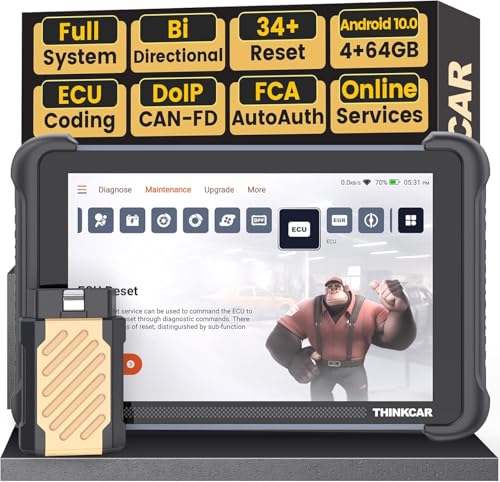
- [Notice] When you receive a used device, it may be a customer return resold by Amazon without inspection. You can exchange it for a new one through Amazon. As this situation is unavoidable, we sincerely apologize. For any issues, contacting us via Amazon's "Messages" is the best way. THINKSCAN 689BT Bidirectional Scan Tool Can Be Used Immediately After It is Turned On, Without Complicated Registration Process, Which is More Convenient & Quick.
- Full Bi-Directional Control & 3000+ Active Tests: Take control and test components like actuators, fuel injectors, relays, and cooling fans in real time. You’ll quickly see if the problem is in the part itself or the control module — saving you hours of guesswork and frustrating trial-and-error.
- Advanced ECU Coding Capabilities: Handle module matching and hidden feature activation with confidence. When you replace an ECU or want to customize settings, this obd2 scanner diagnostic bi directional tool gives you the professional-level capabilities you need without the dealership price tag.
- 34+ Useful Reset and Maintenance Functions: Complete everyday service tasks smoothly with a wide range of helpful reset and maintenance functions. Whether you’re keeping up with regular upkeep or tackling a specific job, this scanner makes maintenance simpler and less stressful for both DIYers and pros.
- Comprehensive Full System Diagnostics: Diagnose every major system — Engine, Transmission, ABS, SRS, TPMS, and more — all in one place. Finally stop wondering if you’re missing something important; get the full picture and clear codes with ease.
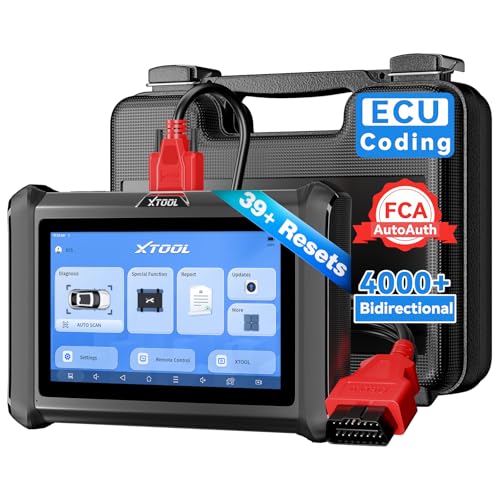
- Top Reasons to Choose the D7S OBD2 Scanner: XTOOL D7S car scan tool, an upgrade of XTOOL D7, offers comprehensive features for automotive technicians, workshops, and DIY enthusiasts 1. Upgraded Hardware: 2+64GB memory, rear camera, intuitive interface, foldable bracket 2. Complete Diagnostics: FCA
 Autoauth, OE-level all system scan, 39+ maintenance services, 4K+ bidirectional, CANFD/DoIP protocol 3. Advanced Capabilities: ECU c0ding, PMI functions 4. Wide Compatibility: Support 10,000+ models, covering 99% vehicle brands 5. Multi-language: Available in 22+ languages, No IP Restrictions 6. 3-Year Updates: Save 300 bucks on software updates for the latest features and optimizations
 - 2026 Upgraded D7S Car Scanner Features: The newly 2026 D7S V2.0 scanner for car brings exciting features for advanced vehicle diagnostics and enhanced user experience 1. FCA AutoAuth: Now supports FCA SGW module for Chrysler, for Jeep, for Dodge (2018+), for Fiat (2017+), enabling faster vehicle communication without gateway restrictions 2. PMI (Offline ECU Pr0gramming): Allows for Ford, for Lincoln, and for Mazda ECU pr0gramming for new modules 3. Optimized Diagnostic Report 2.0: Personalized reports with logos and customer info for auto shops. Note: Compatibility varies by cars, please check before order
- 39+ Services/Resets/Adaptations/Relearns/Calibrations: XTOOL D7S full system car scanner diagnostic tool tackles 99% of common car issues through its 36+ special functions, including Oil Reset, EPB, SAS, BMS, Throttle Reset, Injector C0ding, ABS Bleed, TPMS Reset, Power Balance, etc and also covers specific-vehicle functions like Crank Sensor Relearn, ABS Initialization, Cylinder Power Balance, Fuel Trim Reset, Idle Relearn etc. This car diagnostic scanner enhances efficiency, making repairs and maintenance hassle-free. Tip: DO NOT for All vehicles, please check compatibility first
- Cost-effective ECU C0ding Scan Tool for Specific Brands: Enhance your vehicle's performance with XTOOL D7S! This obd2 scanner all systems bidirectional offers advanced capabilities at an affordable price, supports online for BMW, for Benz and offline for BENZ, for MIT, along with PMI functions for Ford, for Mazda, and for Lincoln. Ideal for technicians and DIY enthusiasts, this automotive scanner diagnostic tool optimizes vehicle performance and enhances the driving experience. Note: Not for all cars and modules, please send car VIN to check the compatibility before purchase
- OE All System Diagnostic & 8 Pids Graphing: XTOOL D7S is a comprehensive all system bi directional obd2 scanner that delivers dealer-level diagnostics, completely controlling over your vehicle’s performance and health. This automotive scan tool can read and clear DTCs, view live data and ECU information, retrieve freeze frames, and perform active tests and full obd2 functions. This bi-directional scan tool can can identify your vehicle's make, model, and year information with just one click and show up to 8 PIDs live data with options for CSV viewing, playback, and recording for in-depth analysis. It is easy-to-use for both professionals and beginners, helping pinpoint issues efficiently
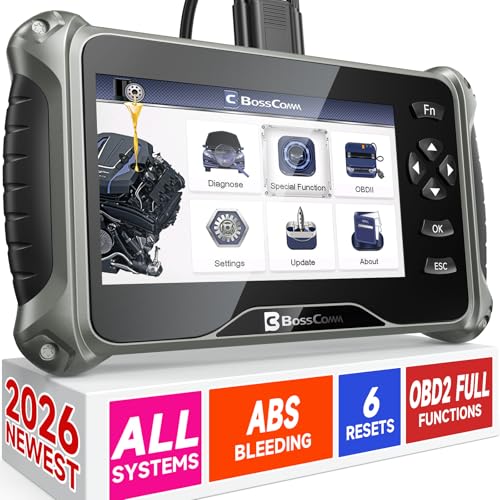
- 【✅Compared to BOSSCOMM IF742, IF745 Offers Full-System Diagnostics】The BOSSCOMM IF745 car diagnostic scanner is an upgraded model of IF742. In addition to supporting all OBD2 Code Reader functions and 6 reset options (ABS/EPB/SAS/BMS/Oil/Throttle), it expands diagnostics from 4 systems (Check Engine/ABS/SRS/Transmission) to vehicle All systems, including Steering, Suspension, and Body Electronics. This provides deeper, more comprehensive diagnostic capabilities.
- 【✨10 OBD2 Functions】The BOSSCOMM IF745 scan tool’s DTC Lookup instantly translates fault codes into user-friendly explanations, its I/M Readiness feature streamlines emissions testing with a single tap, and Freeze Frame lets you pinpoint the exact moment of a fault for in-depth root-cause diagnosis. Combined with a live data dashboard and advanced diagnostics (O2S, OBMon, EVAP), it delivers comprehensive insights for confident troubleshooting.
- 【✨Deep Diagnostics for All Vehicle System Modules】Beyond code reading/clearing and ECU information retrieval, our all-in-one data stream feature lets you inspect all current fault codes and their locations across the vehicle’s systems. This vehicle code reader helps you turn off dashboard warning lights and perform a comprehensive self-check of your car at home—no more back-and-forth trips to the repair shop or hefty inspection fees.
- 【✨6 Essential Resets: ABS Bleeding, Oil, EPB, SAS, Throttle, BMS】The BOSSCOMM IF745 obd2 scanner diagnostic tool swiftly purges air from brake lines to restore braking sensitivity, fine-tunes maintenance cycles to eliminate false alerts, resolves parking brake issues with one-click control, recalibrates steering sensors for stability, optimizes engine idling/acceleration for smoother performance, and deeply resets battery systems to extend lifespan and range via precise parameter adjustments.❗NOTE: Does NOT support bidirectional control, coding, or programming.
- 【✨10,000+ Car Models, AutoVIN, 13 Languages】The BOSSCOMM IF745 vehicle scanner diagnostic tool covers 73+ global car brands and offers support in 13 languages, making it perfect for DIYers, auto mechanics, or as a thoughtful gift. With a single-click AutoVIN feature, it instantly retrieves vehicle serial numbers, streamlining diagnostics for users globally. This adaptable tool balances user-friendliness with precision, catering to both personal and professional requirements.✅Unsure about compatibility? Compatibility will vary on vehicles' model and year, pls reach us via 📧 [email protected] 📧 before purchase.
This product presentation was made with AAWP plugin.