
NHTSA ID Number: 10213645
Manufacturer Communication Number: KC-628
TSB/Document Date: 2022-06-07
Summary
V-MAC III - Severe Engine Stumble
If the PDF is very large, it may not load in the preview below.
Some older TSBs had multiple PDFs — visit the NHTSA Website to view all PDFs.
If the TSB PDF does not show, download or view it on the NHTSA Website.
Click on the (+) Plus Sign
Then Click on Associated Document(s)
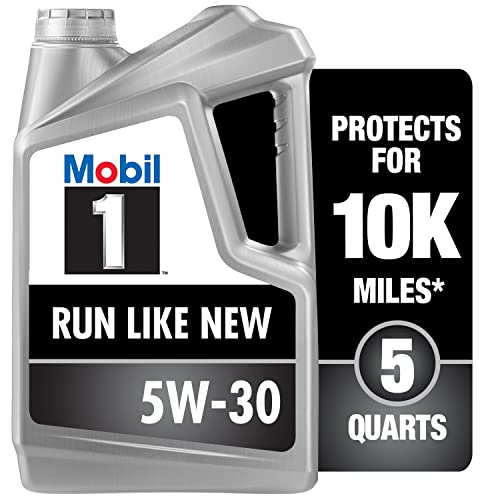
 advanced full-synthetic
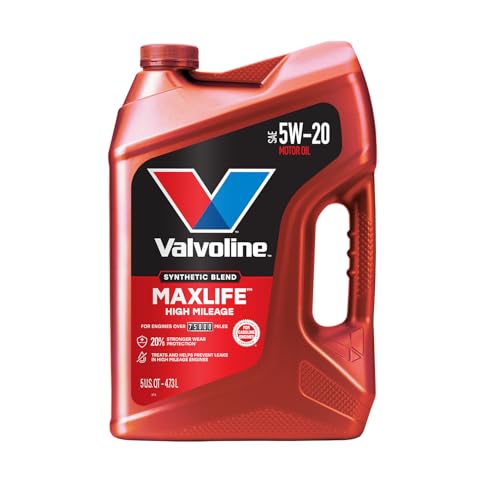
- MaxLife Technology prevents engine breakdown with 40% better...
- Includes seal conditioners to reduce oil consumption and oil...
- Added detergents reduce sludge, corrosion, rust and deposits...
- Advanced friction-fighting additives help maximize...
- Meets or exceeds all requirements of ILSAC GF-6A, API SP...
This product presentation was made with AAWP plugin.
Search NHTSA Database for Recalls
Search NHTSA Database for Vehicle Investigations
View Latest Vehicle Investigations
Search NHTSA Database for Vehicle Complaints
View Latest Vehicle Complaints
TSB/Document ID: KC-628
Replacement Service Bulletin Number:
MFR Communication Date: 2022-05-09
MFR Internal Campaign ID/Software Version:
Communication Type: Service Bulletin/Repair Instructions
NHTSA Components: ENGINE AND ENGINE COOLING
MFR Component System:
MFR Component Subsystem:
Previous TSB | Next TSB |
5/31/22, 9:12 AM
Article
V-MAC III - Severe Engine Stumble
Internal Content
1. INTRODUCTION
Recently, Service Engineering has seen a V-MAC III intermittent stumble
due to a severe power failure condition that does not register any fault
codes. This condition may result if any of the following clean (battery)
power components are intermittently shorted low:
When this condition occurs, momentarily the tachometer will drop 200
RPM, the torque will go to zero, the engine stumbles and then the
tachometer and torque are restored. The electrical transient is very fast
and can not be easily detected. A digital voltmeter will not be able to see
this very fast electrical disturbance. This engine or torque cutout is
violent and the vehicle will jerk excessively when under a load with the
engine speed between 1400 to 1600 rpms. It is even possible for this
condition to cause the V-MAC to go into limp mode. When a step 4 VMAC III system goes into limp mode, the engine power will be limited to
approximately 45% after recovering. When a step 5 V-MAC system goes
into limp mode, the engine power will be limited to approximately 85%.
Also, for step 5, it is possible for a PID S151 MID 128 FMI 4 or 3 (8-9) fault
code to be logged on the EECU. This condition has been experienced
both at idle no load and at 1400 to 1600 rpms in 9th or 10th gear with a
load present.
2. PRELIMINARY DIAGNOSTICS
It is possible to observe a jumping tachometer and a surging engine if
the EUPS are unable to control the fuel delivery. Before proceeding with
the following diagnostic procedures, verify that the symptoms are not
the result of a mechanical or an ECU output failure by doing the
following:
1. Battery Cables (linking battery to starter solenoid, starter solenoid
to alternator and starter relay)
2. Battery (internally or externally)
3. Starter Solenoid Battery Terminal (internally or externally)
4. Alternator Output Terminal (internally or externally)
5. Starter Relay Battery Terminal (internally or externally)
6. VECU (internally or externally)
7. EECU (internally or externally)
8. Electrical Equipment Panel (internally or externally)
9. Cab Harness (battery and switched power wiring)
; Live UI
10. Engine Power Distribution Module (internally or externally)
11 Engine Power Distribution Module Harness (switched power
1/9
5/31/22, 9:12 AM
Article
11. Engine Power Distribution Module Harness (switched power
wiring)
12. Engine Harness (switched power wiring)
Check all positive and negative battery cables for corrosion or
looseness. If necessary clean and tighten terminals.
Check each of the Power relays and fuses on the electrical
equipment panel. Remove each one and look for deep score marks
on each terminal and check that the electrical terminals in the
electrical equipment panel are securely locked in place. Deep score
marks indicate a tight electrical connection is being made between
the relay and fuse terminals and the electrical equipment panel
terminals. Intermittent or poor contact between the relay and fuse
terminals will result in evident arching on the terminal.
Check all V-MAC connections (EJ1, EJ2, VJ1, VJ2, VJ3, Engine/Trans
interface [transition], EPDM interface, Bulkhead interface) for
corrosion. Check the grip of each female terminal by inserting the
correct male terminal and evaluate the amount of “drag” the
female terminal applies as the male terminal is withdrawn.
Insufficient drag will allow intermittent contact to occur. Replace
any terminal that has loose drag or has corrosion.
Check if the EUP wiring stud terminals are painted black. If
necessary, detach the terminals, then remove the black paint from
the terminals and attach and re-tighten terminals 9 lb-in (1 N-m).
Check the fuel pressure at the secondary fuel filter outlet. This test
should be performed during the road test. The fuel pressure
should maintain approximately 100 psi.
Re-enter the EUP calibration codes.
Remove the alternator from the engine and shake, listening for any
rattling sound. Any loose metal objects in the alternator can create
momentary shorts to ground.
If a 42MT starter motor is fitted to the engine, remove the solenoid
from the starter motor (do not remove complete starter motor).
Remove the end cover of the solenoid. Look for burn marks on the
circumference of the contact disk that align with a similar burn
mark on the solenoid cover mounting pin.
2/9
5/31/22, 9:12 AM
Article
3. DIAGNOSTICS
To diagnose this severe and fast electrical power failure, each clean
battery power electrical component must be isolated (excluded) from
clean battery power circuitry. Then, the vehicle should be road tested to
see if the conditions has been eliminated. One component assembly
should be tested per road test and the components close to the batteries
should be tested first. See Figure 1, for a typical battery power circuit
arrangement.
3/9
5/31/22, 9:12 AM
Article
3.1 Isolating The Batteries
To exclude the batteries do the following:
If a sister truck (that is performing with no problems) is available, switch
batteries with the sister truck and road test to see if the cutout condition
follows the batteries.
Otherwise, load test each battery as follows:
Inspect each battery for visual damage.
With the battery fully charged, apply a 300 amp load (with a carbon
pile) to the battery for 15 seconds. Then, turn the load off. This will
stabilize the battery.
With the battery fully charged (open circuit voltage above 12.4
Volts), apply a test load (with a carbon pile) of 1/2 the CCA rating @
0 degrees F in amps.
After 15 seconds with the load on, measure and record the battery
terminal voltage. Turn the load off.
Check the recorded voltage against the following load test voltage
to electrolyte temperature table (estimate the temperature
[ambient]).
UI
; Live
Minimum
Voltage
96
Temperature Degrees Fahrenheit
70
4/9
5/31/22, 9:12 AM
9.6
9.5
70
60
9.4
9.3
9.1
8.9
8.7
8.5
50
40
30
20
10
0
Article
If the recorded voltage does not meet or exceed the value in the
table, replace the battery. Otherwise the battery is okay.
3.2 Isolating The Starter
To exclude the starter from the clean battery power circuitry, do the
following:
Disconnect the negative battery cable from the negative terminal
on the battery;
Disconnect the negative (BK-A-19.0) wire between the starter and
the ground circuit breaker;
Attach a 4 AWG jumper wire between an unused negative battery
terminal and the ground circuit breaker;
Disconnect the positive (RD-A-19.0) wire between the starter
solenoid and the starter relay;
Disconnect the positive (RD-A-19.0) wire between the starter
solenoid and the alternator (both ring terminals);
Connect a 4 AWG jumper wire between the starter relay battery
post and an unused positive battery terminal;
Connect a 4 AWG jumper wire between the starter relay battery
post and alternator output terminal;
Connect the negative battery cable to the negative terminal on the
battery;
Start the vehicle and disconnect both battery cables at the battery
terminals;
The starter is now isolated from the clean power circuitry;
Road test the vehicle to see if the condition is still present;
Also isolate the RD-C-8.0 wire from between the starter solenoid
and the starter relay and road test vehicle to see if condition is still
present.
See Figure 2, for the isolated starter wiring.
5/9
5/31/22, 9:12 AM
Article
3.3 Isolating The Alternator
To exclude the alternator from the clean battery power circuitry, do the
following:
Check that the batteries are fully charged. The vehicle must not be
operated if the batteries are below 60 percent state of charge (11
volts open circuit voltage). While performing the test, if the voltage
falls below 11 volts, stop the vehicle and reconnect the alternator
output jumper. This test can be conducted for approximately 30
minutes (engine running without lighting) before the fully charged
battery needs to be recharged;
With the engine running, and with the isolated started wiring
arrangement intact, disconnect the alternator output terminal
jumper;
Road test the vehicle to see if the condition is still present.
See Figure 3, for the isolated alternator wiring.
6/9
5/31/22, 9:12 AM
Article
3.4 Isolating The Starter Relay
To exclude the starter relay from the clean battery power circuitry, do
the following:
Restore all the wiring to the original arrangement. See Figure 1;
Disconnect the negative battery cable from the battery terminal;
Disconnect the two RD-A-19.0 and RD-B-19.0 ring terminals from
the starter relay battery stud;
Attach the two RD-A-19.0 and RD-B-19.0 ring terminals to one end
of a jumper wire, then attach the other end of the jumper wire to
the starter relay battery stud;
Start the vehicle;
Disconnect the jumper wire from the starter relay battery stud.
Make sure this jumper will not short low during the road test;
The starter relay is now isolated from the clean power circuitry;
Road test the vehicle to see if the condition is still present.
See Figure 4, for the isolated starter relay wiring.
7/9
5/31/22, 9:12 AM
Article
3.5 Isolating The VECU & EECU
To isolate the ECUs, switch each ECU with a known good ECU and road
test the vehicle to see if the cutout (stumble) is still present.
3.6 Isolating The Cab (Electrical Equipment Panel), EPDM, and Engine
Harness
If isolating the battery, starter solenoid, alternator, starter relay, EECU,
and VECU does not cause the severe clean electrical power failure
condition to disappear, then a conductor in one of the harnesses must
be shorting low. Service Engineering has developed a diagnostic jumper
harness that can isolate the cab, EPDM, and engine harnesses. To get
more information concerning the jumper harness, contact Marc Murray
at 610 709-2448. The harness and instructions will be shipped upon
request.
NOTE: The diagnostic jumper will only test intermittent shorts in the
wiring (the harness component). If the other clean power components
have not been isolated correctly as dictated above, the diagnostic jumper
harness will be of no assistance.
4. REPAIR
Once the circuit component assembly has been identified as the cause of
;
Live
UI
the cutout
(stumble), disassemble the component assembly if possible.
Then, look for any signs of extreme heat, bluing, and or metal transfer to
https://volvo-trkna-prod1.pegacloud.net/prweb/PRAuth/app/VolvoKM_/iNPUIKpeinqPJi2G0hH930k43USdE1gb*/!TABTHREAD10?pyActivity=%40base…
8/9
5/31/22, 9:12 AM
Article
validate that this is the failed component. Replace the failed component.
Tags
k10355880
Related links and attachments
No links or attachments available
Feedback
Give feedback
to help improve the content of this article
9/9

- [2026 Top-Tier Hardware and Software Upgrade]: Topdon ArtiDiag900 Lite scanner has enhanced hardware and latest features, including Android 11.0, 5x faster CPU, 10000mAh battery for 12 hours of continuous operation, stable wireless diagnosis with Bluetooth 5.0, 8-inch touchscreen. Added bi-directional control, wireless diagnosis, battery testing (optional), and DTC repair guide
- [TOPDON Bidirectional Scan Tool]: This bidirectional obd2 scanner sends commands to the vehicle's ECU for active testing, enabling users to accurately and quickly locate faulty components such as injectors, coolant pumps, windows, wipers, headlights, mirrors, etc. The bidirectional control scanner is the ideal choice for workshops/automotive repair shops as it significantly reduces mechanic's diagnostic time.
- [Wireless Bluetooth Diagnostic Experience]: The AD900 Lite scan tool comes with a Bluetooth 5.0 VCI, supporting a wireless diagnostic range of up to 33 feet (10 meters), allowing you to diagnose without being confined to cables or tight spaces. Stable and fast wireless diagnosis provides a comfortable repair environment. It also offers VCI cables to increase connectivity options.
- [DTC Repair Guide Function]: Easily diagnose issues with your vehicle and receive guidance on repairs with the topdon scan tool's fault code definitions for all systems,maximize your diagnostic capabilities. This function is compatible with Chrysler
 /Dodge/Jeep/Fiat 2010-2014 and expanding with continual updates,the AritDiag 900 Lite car diagnostic scanner is the must-have tool for any technician or DIY enthusiast.
 - [OE-Level Full System Diagnostics]:AritDiag900 Lite full system diagnostic scanner can scan ALL available modules(Engine, Transmission, Airbag, ABS, ESP, TPMS, Gateway, Steering, Radio, Air conditioning, ect.) to✔read ECU info, ✔read/clear codes, ✔view live data stream, ✔retrieves freeze-frame, ✔perform active tests, and more. With just a simple click, it provides you with accurate and in-depth diagnostics.
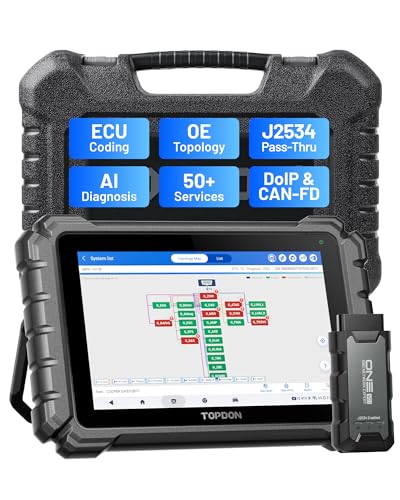
- Dual WiFi & 10.1" Touchscreen: Provides a stable, high-speed wireless link 3x faster than bluetooth, and a responsive, professional interface. Topdon ONE obd2 scanner diagnostic tool ensures smooth, non-lagging diagnostic scan, boosting mechanic efficiency
- J2534 Pass-Thru Support: The included ONE VCI supports the J2534 standard, allowing it to function as a pass-thru device when paired with OEM diagnostic software.Through TOPDON’s RLink platform, technicians can perform dealer-level coding, expanding in-house capabilities without investing in multiple factory automotive scan tools
- OE Topology Mapping: Visualize the vehicle’s ECU network exactly as it’s built.Zoom, pan, and highlight specific modules to pinpoint component issues with precision.Topology mapping displays real-time communication between modules
- Topfix AI Assistant: Covers 5 million plus fault codes and delivers instant causes, symptoms, and repair guidance with professional wiring diagrams for each code.Slashes diagnostic time, boosts first-time fix accuracy, and increases shop revenue
- 50 Plus Service Functions: Covers high-demand services like ADAS calibration, DPF regen, TPMS reset, ABS bleed, and throttle adaptation.Expands your service menu, allows you to charge premium rates, and turns away zero jobs due to lack of tooling. Vehicle-specific functionality may vary.

- Bi-Directional Control, Quickly Locate Problems: Turn your phone into a professional diagnostic tool. You can send commands from your phone to the ECU to test injectors, cooling fans, headlights, A/C clutch, windows, wipers, and more. See which one doesn't respond. Helps you quickly locate the problem and save time. No need to tear things apart, avoid blind disassembly.
- Full System Diagnostics, No Fault Hides: Unlike basic diagnostic tools that only cover 4 systems, TopScan can scan all systems. Read and clear trouble codes, view live data streams, and generate a complete vehicle health report – all issues are clear at a glance. Covers 10,000+ vehicle models and is compatible with 99.99% of vehicles.
- Flexible Subscription, Choose Advanced Features as Needed: TopScan Lite provides free-for-life access to core diagnostics, including full system scan, code reading, performance tests, and repair information. After purchase, advanced features (bi-directional control, service operations, live data, code clearing, and AI functions) are free-for-the-first-year. After the first year, if you want to use advanced features, you need to subscribe on a monthly, quarterly, or yearly basis. As new models and reset functions are updated, the tool will also be continuously upgraded.
- AI Assistant - TopFix: Think of TopFix as your personal AI mechanic. It leverages a repair database and OEM data to deliver clear, step-by-step repair solutions. Features include AI Q&A, one-click translation, and a full repair log, making your diagnostic process simpler and more efficient.
- 8+ Hot Resets, Keep Your Car in Top Shape: One-tap resets for oil, throttle, EPB, steering angle, DPF, ABS, BMS, and airbag. It enables car owners to easily perform essential maintenance, ensuring the vehicle stays in optimal condition and extends its service life.
This product presentation was made with AAWP plugin.
Last update on 2026-05-12 / Affiliate links / Images from Amazon Product Advertising API