
NHTSA ID Number: 10192639
Manufacturer Communication Number: ITB13039A
TSB/Document Date: 2021-05-10
Summary
SERVICE INFORMATION This bulletin has compiled Tire Pressure Monitor System (TPMS) and Low Tire Pressure Warning System (LTPWS) information for: - Basic diagnosing of TPMS/LTPWS systems - Radio frequency interference causing a "No Data" (C1708, C1709, C1710, C1711) condition - Sensor leaks - Moving TPMS/LTPWS wheel assemblies from one vehicle to another and TPMS/LTPWS sensor registration - Air pressure changes with altitude and ambient temperatures - Aftermarket tire sealers - Aftermarket wheels - Inflating/deflating tires with TPMS/LTPWS sensors See this bulletin for further detail.
Classification:
Reference:
Date:
WT13-006a
ITB13-039a
September 15, 2015
LOW TIRE PRESSURE WARNING SYSTEM
BULLETINS SUMMARY
This bulletin has been amended. Changes were made to several sections.
Please discard previous versions of this bulletin.
APPLIED VEHICLES:
All vehicles equipped with:
Tire Pressure Monitor System (TPMS)
or
Low Tire Pressure Warning System (LTPWS)
SERVICE INFORMATION
This bulletin has compiled Tire Pressure Monitor System (TPMS) and Low Tire Pressure Warning System
(LTPWS) information for:
Basic diagnosing of TPMS/LTPWS systems
Radio frequency interference causing a “No Data” (C1708, C1709, C1710, C1711) condition
Sensor leaks
Moving TPMS/LTPWS wheel assemblies from one vehicle to another and TPMS/LTPWS sensor
registration
Air pressure changes with altitude and ambient temperatures
Aftermarket tire sealers
Aftermarket wheels
Inflating/deflating tires with TPMS/LTPWS sensors
Infiniti Bulletins are intended for use by qualified technicians, not 'do-it-yourselfers'. Qualified technicians are properly trained
individuals who have the equipment, tools, safety instruction, and know-how to do a job properly and safely. NOTE: If you believe
that a described condition may apply to a particular vehicle, DO NOT assume that it does. See your Infiniti dealer to determine if this
applies to your vehicle.
1/11
BASIC DIAGNOSING OF TPMS/LTPWS SYSTEMS
The TPMS/LTPWS system can be diagnosed by turning the ignition to the “OFF” and then to the ”ON” position
(engine is not required to be running).
If the TPMS/LTPWS warning light is illuminated (continuously or flashing)
Normal Operation
If the TPMS/LTPWS warning light is continuously illuminated (not flashing),
the TPMS/LTPWS is operating normally and has detected low tire pressure
in one of the tires.
Leave the ignition in the “ON” position* (engine is not required to be
running) and set the tire pressure to the recommended pressure
shown on the vehicle’s tire pressure placard.
NORMAL
Continuosly illuminated
(not flashing)
Leaving the ignition in the ON position may allow the TPMS/LTPWS
to detect the corrected tire pressure more quickly on 2009 and
newer models (WITHOUT having to drive the vehicle).
NOTE:
Normal tire pressure maintenance is not covered under warranty.
Some 2011 and newer models will display an alert in the Vehicle information
display near the speedometer. The alert will read "Check Tire Pressure", or
similar, and will accompany the illuminated TPMS/LTPWS light.
CHECK TIRE
PRESSURE
Malfunction Present
If the TPMS/LTPWS warning light is flashing for approximately one
minute, there is a TPMS/LTPWS system malfunction. Some models will
also display a message in the meter indicating a malfunction. Check the
DTC and refer to the Service Manual for repair instructions.
MALFUNCTION
Flashing for approximately
one minute
2/11
ITB13-039a
RADIO FREQUENCY INTERFERENCE CAUSING A “NO DATA” (C1708, C1709, C1710, C1711)
CONDITION
Radio Frequency (RF) interference can cause a No Data condition and may be caused by any device that is
transmitting RF on the same or similar frequency that the TPMS/LTPWS sensors are on and is not covered
under warranty.
Cell phone chargers (Figure 1), aftermarket DVD players, etc. should be removed from the vehicle first and
then the vehicle retested before further diagnostic is performed.
Figure 1
3/11
ITB13-039a
SENSOR LEAKS
Sensor leaks can be caused by irregularities of the
wheel TPMS/LTPWS sensor sealing surface or damaged
TPMS/LTPWS sensor seals.
Valve stem sprayed with
soapy water to detect leak
Always confirm suspected leaks with a soapy water
solution.
Figure 2
Irregularities of TPMS/LTPWS Sensor Sealing Surface
Irregular sealing surfaces, contamination oil, etc., may allow an air leak to form between the wheel and
TPMS/LTPWS sensors.
Irregular surfaces
Figures 3-5
TPMS/LTPWS Seals
TPMS / LTPWS
seal
Do Not replace the TPMS/LTPWS sensor
assembly for a leak. Replace the seal or repair
the wheel as needed.
NOTE: Figure 6 is for reference only and may
appear to be different depending on the model
and year that is being serviced.
Figure 6
4/11
ITB13-039a
MOVING TPMS/LTPWS WHEEL ASSEMBLIES FROM ONE VEHICLE TO ANOTHER AND TPMS/LTPWS
SENSOR REGISTRATION
Moving TPMS/LTPWS Wheel Assemblies
TPMS/LTPWS sensors can have different part
numbers from model to model and
may not operate correctly or operate at all.
CAUTION:
New style and old style TPMS components
are not compatible and cannot be
interchanged.
Swapping of new style and old style
components will cause the TPMS to stop
operating correctly.
Figure 7
If further confirmation of the TPMS sensor part number is required, review the part number of the
originally installed equipment before replacement.
Figure 8
Compare part
numbers
Figure 9
To confirm the latest part numbers, always consult the appropriate parts catalog when replacing or
exchanging TPMS sensors, receivers, or control modules.
5/11
ITB13-039a
TPMS/LTPWS Sensors Must Be Registered To Each Vehicle Every Time the Wheels Are Swapped
TPMS/LTPWS wheel sensors must be registered each time the wheels are rotated, swapped or replaced so
that the sensors operate correctly and send the correct tire pressure from the new wheel location.
If tires are rotated or service is required on a vehicle’s Tire Pressure Monitor System/Low Tire Pressure
Warning System (TPMS/LTPWS), the Signal Tech II (special tool J-50190), Tire Pressure Sensor Activation
Tool J-45295, or Transmitter Activation tool (J-45295-A) can be used to register TPMS/LTPWS sensors.
NOTE: Failure to update Signal Tech II may lead to misdiagnosis of vehicles.
The latest software is available on the CONSULT III PC at: ASIST > Specialty Tools > Signal Tech II.
If you should encounter problems with updating, contact Techmate at 1-800-662-2001.
Future updates will be released as needed. Check ASIST frequently for this information.
NOTE:
Refer to the appropriate chapter and section of the Electronic Service Manual (ESM) for the model
specific procedure to register and diagnose TPMS/LTPWS systems.
Tire Pressure Sensor Activation Tool J-45295 will not work on some vehicles.
Instead use:
Transmitter Activation tool (J-45295-A) with C-III plus
or
Signal Tech II (J-50190) with C-III plus
6/11
ITB13-039a
AIR PRESSURE CHANGES WITH ALTITUDE AND AMBIENT TEMPERATURES
The air pressure inside a tire can change due to several factors, such as:
Seasonal temperature change
Tire temperature change due to driving
Natural pressure loss over time
Compensate for the above temperature factors when adjusting and setting tire pressure.
Each vehicle is equipped from the factory with a TIRE AND LOADING INFORMATION label.
Example
Figure 10
This label lists the COLD tire pressure setting for the original tires on the specific vehicle.
NOTE: Tires are considered COLD after the vehicle has been parked for 3 or more hours, or driven less than 1
mile at moderate speeds.
7/11
ITB13-039a
When setting / adjusting tire pressure, make sure to use an accurate tire pressure gauge.
Use the following information for reference:
Temperature
Tire pressure changes approximately 0.8 psi for
every 10°F of temperature change. As temperature
decreases, pressure decreases.
Tire pressure may change 3 - 5 psi between a Cold
reading and a reading taken just after the vehicle has
been driven for several miles.
Seasonal temperature change can result in tire pressure
that is low enough to turn on the Low Tire Pressure
Warning Light.
Tire Pressure Versus Temperature
36
35
34
33
32
31
30
PSI
80
60
40
Temperature (F)
20
0
Graph 1 - Example
Example 1 – Seasonal Temperature Change
The temperature of the vehicle is 70°F after sitting in the shop.
Ambient temperature outside the shop is 30°F or will soon fall to 30°F due to seasonal change.
Recommended pressure on the TIRE AND LOADING INFORMATION label is 35 psi.
The tire pressure should be compensated an additional +3 psi and adjusted to 38 psi to avoid dropping
below the label value when the vehicle experiences cooler ambient air temperature.
Compensation should also be used in the PDI process as needed.
Example 2 – WARM Tires
A vehicle arrives to the dealer after being driven across town.
The WARM tire pressure reading is 32 psi.
Recommended COLD tire pressure on the TIRE AND LOADING INFORMATION label is 35 psi.
The tire pressure should be compensated an additional +3 psi and adjusted to 38 psi to avoid dropping
below the label value when the tires cool.
8/11
ITB13-039a
Natural Tire Pressure Loss Over Time
Pressure Versus Time
Vehicle tire pressure can naturally decrease by
approximately 1.0 - 1.5 psi per month. This will vary
due to seasonal temperature change.
After 6 to 8 months tire pressure may be low enough
to turn ON the Low Tire Pressure Warning Light.
PSI
39
38
37
36
35
34
33
28
0
2
4
6
8
10
months
High Altitude
Graph 2 – Example
At high altitude locations, a standard tire pressure
gauge may show the tire pressure higher than the
TPMS system. If the gauge reading is not accounted
for, this could result in turning ON the Low Tire
Pressure Warning Light.
Standard tire pressure gauge readings increase about
1.0 psi for every 2,200 ft of altitude increase above sea
level (up to 10,000 ft). See Graph 3.
For example, if the TIRE AND LOADING
INFORMATION label reads 33 psi, then at an elevation
of 5,280 ft, the cold inflation pressure using a gauge
should be increased 2.5 psi to 35.5 psi."
NOTE: In Graph 3, C-III, Signal Tech II, or the vehicle
information display (if equipped) would show a tire
pressure of 33 psi. If needed, use C-III or Signal Tech-II
to confirm tire pressure.
Gauge
Pressure Versus Altitude
39
38
37
36
35
34
33
PSI
0
2
4
6
8
10
Altitude (Ft x 1000)
Graph 3 - Example
NOTE:
After correcting the tire pressure, the vehicle may need to be driven at speeds above 16 mph to
activate the TPMS and turn off the low tire pressure warning light.
If pressure compensation for temperature is used, the pressure should be re-checked and adjusted at a
later time when the tires are cold.
9/11
ITB13-039a
AFTERMARKET TIRE SEALERS
We do not recommend use of aftermarket tire sealants and/or aerosol repair kits (refer to the vehicle’s Owner’s
Manual).
Some aftermarket tire sealers and/or aerosol repair kits may contain chemicals and propellants that
can cause damage to TPMS/LTPWS sensors.
NOTE: Damage caused by use of aftermarket tire sealants contrary to recommendations in the vehicle Owner’s
Manual is not covered under the Infiniti New Vehicle Limited Warranty.
Examples of damage caused
by an aftermarket tire sealer
Residue
Exposed
Circuit
Cracks
Figure 11
AFTERMARKET WHEELS
Aftermarket accessory wheels may also have
the sensor stem in the incorrect orientation
(Figure 12). This may cause the sensor to not
transmit “data” when the wheel starts to rotate
or may prevent the transmitted data from
reaching the TPMS/LTPWS antenna.
Figure 12
10/11
ITB13-039a
INFLATING/DEFLATING TIRES WITH TPMS/LTPWS SENSORS
Filling Tires with Nitrogen
The TPMS/LTPWS sensors can be damaged if the sensors are at the 6 O’clock position (closest to the ground)
when the tires are deflated.
When filling the tires with nitrogen, the vehicle should either be raised off the ground on a lift, or the
wheels individually removed from the vehicle to prevent damaging the TPMS/LTPWS wheel sensors.
IMPORTANT: The vehicle should be raised or individual wheels
removed to prevent the rims from contacting the ground when
deflated.
Improper use of tire inflator tools can break the stem of a Tire
Pressure Monitor System (TPMS) sensor.
The type of stem breakage shown in Figure 13 is not considered a
warrantable repair.
Please refer to the examples of recommended and not recommended tire
pressure filling tools, below.
Figure 13
Recommended Tire Inflating Tools
Shallow well air chucks
Air chucks with flexible hose (no extensions)
Not Recommended Tire Inflating Tools
Long heavy hose with Lock-on air chuck or
wheel at 6 O’clock position
Deep well or dual
head air chucks
11/11
Air chucks with
handles or extensions
ITB13-039a

- Seamless Bluetooth Connectivity: Car stereo with Bluetooth...
- Powerful, Clear Audio Performance: Equipped with a built-in...
- High-Quality Music Playback via USB: Enjoy clear, detailed...
- Compact 1-DIN Design: Single din radio is designed with a...
- Simple Sound Customization: Dedicated Direct EQ Keys let you...

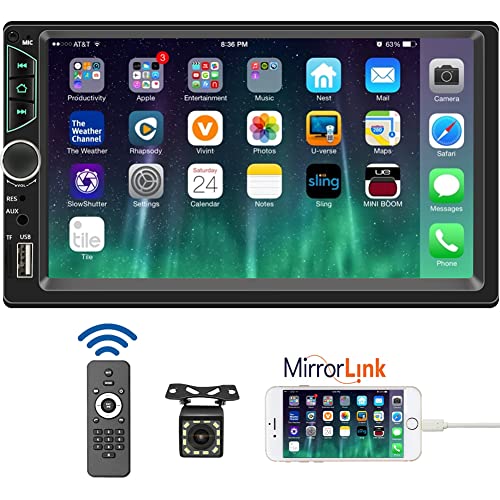
- 【High Quality Car Stereo Player】- Our double din car...
- 【Double Din Car Stereo Phone Mirror Link】- Support...
- 【7 inch Double Din Car Radio With Bluetooth 5.0 and FM...
- 【Car Stereo Double Din Inputs】- USB /SD/AUX input. car...
- 【Standard Double Din Stereo with Backup Camera】- Parking...
Last update on 2026-06-23 / Affiliate links / Images from Amazon Product Advertising API
If the PDF is very large, it may not load in the preview below.
Some older TSBs had multiple PDFs — visit the NHTSA Website to view all PDFs.
If the TSB PDF does not show, download or view it on the NHTSA Website.
Click on the (+) Plus Sign
Then Click on Associated Document(s)
Search NHTSA Database for Recalls
Search NHTSA Database for Vehicle Investigations
View Latest Vehicle Investigations
Search NHTSA Database for Vehicle Complaints
View Latest Vehicle Complaints
TSB/Document ID: ITB13039A
Replacement Service Bulletin Number:
MFR Communication Date: 2015-09-15
MFR Internal Campaign ID/Software Version:
Communication Type: Service Bulletin/Repair Instructions
NHTSA Components: LANE DEPARTURE
MFR Component System:
MFR Component Subsystem:
Previous TSB | Next TSB |
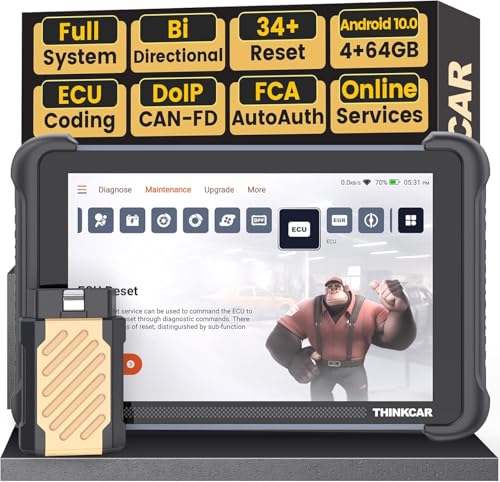
- [Notice] When you receive a used device, it may be a customer return resold by Amazon without inspection. You can exchange it for a new one through Amazon. As this situation is unavoidable, we sincerely apologize. For any issues, contacting us via Amazon's "Messages" is the best way. THINKSCAN 689BT Bidirectional Scan Tool Can Be Used Immediately After It is Turned On, Without Complicated Registration Process, Which is More Convenient & Quick.
- Full Bi-Directional Control & 3000+ Active Tests: Take control and test components like actuators, fuel injectors, relays, and cooling fans in real time. You’ll quickly see if the problem is in the part itself or the control module — saving you hours of guesswork and frustrating trial-and-error.
- Advanced ECU Coding Capabilities: Handle module matching and hidden feature activation with confidence. When you replace an ECU or want to customize settings, this obd2 scanner diagnostic bi directional tool gives you the professional-level capabilities you need without the dealership price tag.
- 34+ Useful Reset and Maintenance Functions: Complete everyday service tasks smoothly with a wide range of helpful reset and maintenance functions. Whether you’re keeping up with regular upkeep or tackling a specific job, this scanner makes maintenance simpler and less stressful for both DIYers and pros.
- Comprehensive Full System Diagnostics: Diagnose every major system — Engine, Transmission, ABS, SRS, TPMS, and more — all in one place. Finally stop wondering if you’re missing something important; get the full picture and clear codes with ease.
Last update on 2026-07-02 / Affiliate links / Images from Amazon Product Advertising API
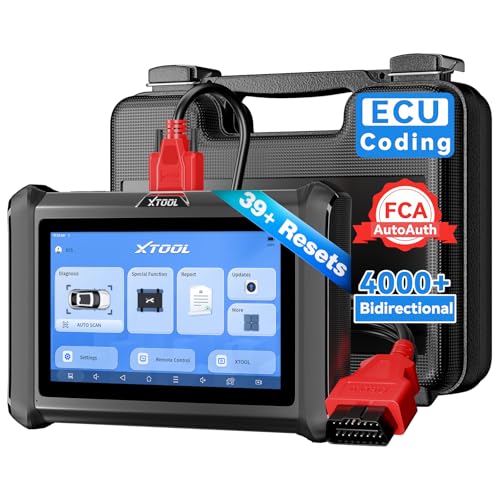
- Top Reasons to Choose the D7S OBD2 Scanner: XTOOL D7S car scan tool, an upgrade of XTOOL D7, offers comprehensive features for automotive technicians, workshops, and DIY enthusiasts 1. Upgraded Hardware: 2+64GB memory, rear camera, intuitive interface, foldable bracket 2. Complete Diagnostics: FCA
 Autoauth, OE-level all system scan, 39+ maintenance services, 4K+ bidirectional, CANFD/DoIP protocol 3. Advanced Capabilities: ECU c0ding, PMI functions 4. Wide Compatibility: Support 10,000+ models, covering 99% vehicle brands 5. Multi-language: Available in 22+ languages, No IP Restrictions 6. 3-Year Updates: Save 300 bucks on software updates for the latest features and optimizations
 - 2026 Upgraded D7S Car Scanner Features: The newly 2026 D7S V2.0 scanner for car brings exciting features for advanced vehicle diagnostics and enhanced user experience 1. FCA AutoAuth: Now supports FCA SGW module for Chrysler, for Jeep, for Dodge (2018+), for Fiat (2017+), enabling faster vehicle communication without gateway restrictions 2. PMI (Offline ECU Pr0gramming): Allows for Ford, for Lincoln, and for Mazda ECU pr0gramming for new modules 3. Optimized Diagnostic Report 2.0: Personalized reports with logos and customer info for auto shops. Note: Compatibility varies by cars, please check before order
- 39+ Services/Resets/Adaptations/Relearns/Calibrations: XTOOL D7S full system car scanner diagnostic tool tackles 99% of common car issues through its 36+ special functions, including Oil Reset, EPB, SAS, BMS, Throttle Reset, Injector C0ding, ABS Bleed, TPMS Reset, Power Balance, etc and also covers specific-vehicle functions like Crank Sensor Relearn, ABS Initialization, Cylinder Power Balance, Fuel Trim Reset, Idle Relearn etc. This car diagnostic scanner enhances efficiency, making repairs and maintenance hassle-free. Tip: DO NOT for All vehicles, please check compatibility first
- Cost-effective ECU C0ding Scan Tool for Specific Brands: Enhance your vehicle's performance with XTOOL D7S! This obd2 scanner all systems bidirectional offers advanced capabilities at an affordable price, supports online for BMW, for Benz and offline for BENZ, for MIT, along with PMI functions for Ford, for Mazda, and for Lincoln. Ideal for technicians and DIY enthusiasts, this automotive scanner diagnostic tool optimizes vehicle performance and enhances the driving experience. Note: Not for all cars and modules, please send car VIN to check the compatibility before purchase
- OE All System Diagnostic & 8 Pids Graphing: XTOOL D7S is a comprehensive all system bi directional obd2 scanner that delivers dealer-level diagnostics, completely controlling over your vehicle’s performance and health. This automotive scan tool can read and clear DTCs, view live data and ECU information, retrieve freeze frames, and perform active tests and full obd2 functions. This bi-directional scan tool can can identify your vehicle's make, model, and year information with just one click and show up to 8 PIDs live data with options for CSV viewing, playback, and recording for in-depth analysis. It is easy-to-use for both professionals and beginners, helping pinpoint issues efficiently
Last update on 2026-07-08 / Affiliate links / Images from Amazon Product Advertising API
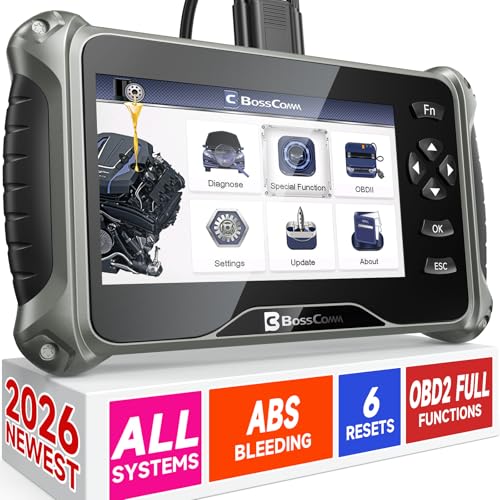
- 【✅Compared to BOSSCOMM IF742, IF745 Offers Full-System Diagnostics】The BOSSCOMM IF745 car diagnostic scanner is an upgraded model of IF742. In addition to supporting all OBD2 Code Reader functions and 6 reset options (ABS/EPB/SAS/BMS/Oil/Throttle), it expands diagnostics from 4 systems (Check Engine/ABS/SRS/Transmission) to vehicle All systems, including Steering, Suspension, and Body Electronics. This provides deeper, more comprehensive diagnostic capabilities.
- 【✨10 OBD2 Functions】The BOSSCOMM IF745 scan tool’s DTC Lookup instantly translates fault codes into user-friendly explanations, its I/M Readiness feature streamlines emissions testing with a single tap, and Freeze Frame lets you pinpoint the exact moment of a fault for in-depth root-cause diagnosis. Combined with a live data dashboard and advanced diagnostics (O2S, OBMon, EVAP), it delivers comprehensive insights for confident troubleshooting.
- 【✨Deep Diagnostics for All Vehicle System Modules】Beyond code reading/clearing and ECU information retrieval, our all-in-one data stream feature lets you inspect all current fault codes and their locations across the vehicle’s systems. This vehicle code reader helps you turn off dashboard warning lights and perform a comprehensive self-check of your car at home—no more back-and-forth trips to the repair shop or hefty inspection fees.
- 【✨6 Essential Resets: ABS Bleeding, Oil, EPB, SAS, Throttle, BMS】The BOSSCOMM IF745 obd2 scanner diagnostic tool swiftly purges air from brake lines to restore braking sensitivity, fine-tunes maintenance cycles to eliminate false alerts, resolves parking brake issues with one-click control, recalibrates steering sensors for stability, optimizes engine idling/acceleration for smoother performance, and deeply resets battery systems to extend lifespan and range via precise parameter adjustments.❗NOTE: Does NOT support bidirectional control, coding, or programming.
- 【✨10,000+ Car Models, AutoVIN, 13 Languages】The BOSSCOMM IF745 vehicle scanner diagnostic tool covers 73+ global car brands and offers support in 13 languages, making it perfect for DIYers, auto mechanics, or as a thoughtful gift. With a single-click AutoVIN feature, it instantly retrieves vehicle serial numbers, streamlining diagnostics for users globally. This adaptable tool balances user-friendliness with precision, catering to both personal and professional requirements.✅Unsure about compatibility? Compatibility will vary on vehicles' model and year, pls reach us via 📧 [email protected] 📧 before purchase.
Last update on 2026-07-02 / Affiliate links / Images from Amazon Product Advertising API
This product presentation was made with AAWP plugin.