
NHTSA ID Number: 10189711
Manufacturer Communication Number: SSP 861213
TSB/Document Date: 2021-04-06
Summary
Self Study Program 861213
Self Study Program 861213
The ID.4 Electromechanical Brake Servo (eBKV)
Tablet Format
Volkswagen Group of America, LLC
Volkswagen Academy
Published in U.S.A.
2/2021
SSP 861213
©2021 Volkswagen Group of America, LLC.
All rights reserved. All information contained in this manual is based on the latest information available at the time of publishing and is subject to the
copyright and other intellectual property rights of Volkswagen Group of America, LLC., its affiliated companies and its licensors. All rights are reserved to make
changes at any time without notice. No part of this document may be reproduced, stored in a retrieval system, or transmitted in any form or by any means,
electronic, mechanical, photocopying, recording or otherwise, nor may these materials be modified or reposted to other sites without the prior expressed
written permission of the publisher.
All requests for permission to copy and redistribute information should be referred to Volkswagen Group of America, LLC.
Always check Technical Bulletins and the latest electronic repair information for information that may supersede any information included in this booklet.
Trademarks: All brand names and product names used in this manual are trade names, service marks, trademarks, or registered trademarks; and are the
property of their respective owners.
Table of Contents
Introduction. . . . . . . . . . . . . . . . . . . . . . . . . . . . . . . . . . . . . . . . . . . . . . . . . . . . . . . . . . . . . . . . . . 1
Design of the Electromechanical Brake Servo Module. . . . . . . . . . . . . . . . . . . . . . . . . . . . . . 9
How the Electromechanical Brake Servo Works. . . . . . . . . . . . . . . . . . . . . . . . . . . . . . . . . . 17
Brake Management . . . . . . . . . . . . . . . . . . . . . . . . . . . . . . . . . . . . . . . . . . . . . . . . . . . . . . . . . . 19
Service. . . . . . . . . . . . . . . . . . . . . . . . . . . . . . . . . . . . . . . . . . . . . . . . . . . . . . . . . . . . . . . . . . . . . 25
Introduction
Due to the increasing number of electric vehicles and the low vacuum produced in the intake manifolds on modern combustion engines, a method to enhance
braking force is needed. The Electromechanical Brake Servo (eBKV) provides a solution to these concerns.
In addition to enhancing braking force, this system also reduces the total weight of the brake system, allowing further CO2 emission reduction for vehicles with
combustion engines.
1
Introduction
Technical features of the Electromechanical Brake Servo (eBKV):
• Parallel axis electric drive
• Weight-saving gear unit
• Weight saving control unit housing
• Vacuum-free brake force boosting
• No additional pressure accumulator
• Up to 5.3 kN power assistance
• Weight of approx. 9.7 lb (4.4 kg)
• Motor output 370 W
• Voltage range 9.8–16 V
• Maximum torque of 2.4 lb/ft (3.3 Nm)
Advantages of the eBKV
• Particularly fast brake pressure build-up for driver assist functions
• High safety advancement
• Reduced wheel brake drag torque
• Comfortable pedal feel
• CO2 savings due to weight reduction and omission of vacuum pump
• Long service life
• Redundant brake system for Electronic Stability Control (ESC)
2
Introduction
Safety Increases due to the eBKV
The eBKV increases the effectiveness of driver assist systems, such as Front Assist, in potential accident conditions that require extremely high pressure braking
increases. This cannot be performed using conventional vacuum-based systems.
This results in a shorter stopping distances than conventional systems:
• A reduced emergency braking distance of up to 4.2 ft (1.3 m) with deceleration from 18.5 mph (30 km/h) to a stop
• Collision speeds can be reduced by approximately 1.8 mph (3 km/h) due to the shorter stopping distance
This also allows pedestrian accident avoidance to be improved by 10%.
Reducing collision speed decreases the energy that the body has to absorb during the impact, improving occupant protection.
Vehicle Speed 18.5 mph (30.0 km/h)
Emergency Braking Distance with ESC
Emergency Braking Distance with eBKV
3
4.2 ft (1.3 m)
Introduction
What is Reduced Brake Drag Torque?
Brake drag torque occurs with disc brakes after a braking event. Brake drag
torque leads to higher fuel consumption and increased CO2 emissions.
After a braking event, the brake pads retract to their starting position as brake
pressure decreases. Due to slight wobbling of the brake disc in relation to
the brake caliper, combined with tight clearance, the whole brake pad does
not immediately lose contact with the brake disc. There is still transitional
frictional contact between the brake disc and the brake pad. By using a clip in
the brake caliper, the pads can be mechanically retracted faster.
4
Introduction
Conventional, Vacuum-based Brake Systems
Vacuum-based brake systems create vacuum using multiple methods:
Brake Servo
• Intake manifold evacuation while the combustion engine is running
• A mechanical vacuum pump
• An electric vacuum pump
These methods have some partial disadvantages:
Brake Fluid Reservoir
Tandem Brake
Master Cylinder
• Poor CO2 figures
• Heavy weight
• High production costs
ESC Unit
5
Introduction
Current Brake Systems for Electric Vehicles
This is the 1st Generation eBKV. It is used in high-voltage vehicles.
Electromechanical Brake
Servo Generation 1
Its distinguishing feature is a special pressure accumulator for the brake
system. It stores brake fluid during recuperation, reducing the brake pressure
in the system.
The disadvantages are:
• The space required
Brake Fluid
Reservoir
• The separate drive for the active accumulator
• Its weight
Tandem Brake
Master Cylinder
ESC Unit
Brake System
Pressure Accumulator
Brake Caliper
6
Introduction
Electronic Brake Servo
Electromechanical Brake Servo
The eBKV has an accumulator integrated into the ESC unit that holds brake
fluid during recuperation, instead of an external brake system pressure
accumulator.
The advantages of this system are:
• No additional space required for additional components
• Weight reduction
Brake Fluid
Reservoir
• Lower CO2 emissions
• Reduced costs
Tandem Brake
Master Cylinder
ESC Unit
7
Design of the eBKV
Exterior Design
The eBKV has the following components:
• The housing
• The push rod with boot
J539
• The motor/gear unit
• J539 Brake Booster Control Module
Housing
• The brake fluid reservoir
• The tandem brake master cylinder
Push Rod with Boot
Motor/Gear Unit
8
Design of the eBKV
Function
When the driver presses on the brake pedal, the push rod introduces this movement into the assembly. This movement is sensed by the transferred by the
Brake Pedal Position Sensor G100, which is part of the Brake Booster Control Module J539.
The G840 Brake Booster Motor Position Sensor is also intgral to the J539, and relays the current motor position.
The J539 uses the information about the driver’s brake request and the motor position to calculate the brake servo movement required.
To initiate movement, the reinforcing sleeve is
moved to the left by the pinion shafts, located
on either side of the reinforcing sleeve.
G840
As the reinforcing sleeve moves, the push
rod also moves. The braking force is
increased by seven to eight times when the
electromechanical brake servo is used.
G100
Reinforcing Sleeve
When the braking request is removed, the
spring located between the master cylinder and
the reinforcing sleeve pushes the reinforcing
sleeve/push rod back to its original position.
Tandem Brake
Master Cylinder
Push Rod
Spring
Push Rod
Gear Mechanism
9
Pinion Shaft
Design of the eBKV
Spring
Released and Engaged Positions
Released Position
These overhead images illustrate the released and engaged
positions as described on the previous page.
Released position:
• The spring is relaxed
• The parallel pinion shafts are on the left side of the
reinforcing sleeve
Engaged position
• The reinforcing sleeve has moved the left
• The spring is compressed
Engaged Position
10
Pinion Shafts
Reinforcing Sleeve
Design of the eBKV
Design in Detail - Pressure Accumulator in the ESC Unit
When compared to the 1st Generation eBKV, the active pressure accumulator has been removed. The pressure accumulator function is now integrated into the
ESC unit. The ESC unit has a larger volume to accommodate this function.
ESC Unit
J104 ABS Control Module
Accumulator
11
Design of the eBKV
G100 Brake Pedal Position Sensor - Design and Failure Effects
Design
The brake pedal position sensor has two Hall sensor
elements on the boost body and a slide with four Hall
magnets. The magnets are connected to the input push rod.
When the driver presses the brake pedal, the Hall magnets
move over the Hall sensors. This movement is interpreted
as a braking request by the brake servo system
Failure Effects
If the G100 fails, the brake function is taken over by the ESC
unit. If the electromechanical brake servo and ESC fail at
the same time, purely mechanical braking is still possible.
12
Brake Management
Network System
The eBKV is connected to the engine and transmission control modules using CAN-Bus.
Key
G85
J104 ABS Control Module
J285 Instrument Cluster Control Module
J428 Control Module for Adaptive Cruise Control
J500 Power Steering Control Module
J519 Vehicle Electrical System Control Module
J533 Data Bus On Board Diagnostic Interface
J539 Brake Booster Control Module
J623 Engine/Motor Control Module
J775 Drivetrain Control Module
R242 Driver Assistance Systems Front Camera
U31
13
Diagnostic Connection
Powertrain CAN-bus
Running Gear CAN-bus
Drivers Assist System CAN-bus
Convenience CAN-bus
Diagnostic CAN-bus
Analogue Connection
Brake Management
What is Brake Blending?
The term “brake blending” comes from high-voltage vehicles. The three phase current drive of a high-voltage vehicle can be used in regenerative mode to
brake (decelerate) the vehicle speed. Part of the vehicle’s kinetic energy is converted into electrical energy and thermal energy during the process and the
vehicle speed decreases.
Depending on the battery charge level and the temperature of the high-voltage battery, it is not always possible to use the high-voltage system for
deceleration. Any fluctuations in deceleration are covered by the hydraulic brake system.
Since the eBKV responds much faster than vacuum-based systems, this collaboration between hydraulic braking and high-voltage braking is very efficient.
Three-phase
Current Drive
Driver's Braking
Demand
14
Situation-based interaction between braking effect
from three-phase current drive and braking effort
from eBKV
eBKV
Brake Management
Brake Blending Process - Deceleration Requirement
When brake pedal actuation occurs, which is detected by the J539 Brake Booster Control Module, the eBKV will build up pressure.
Three-phase
Current Drive
Driver's Braking
Demand
eBKV
15
Brake Management
Brake Blending Process - Frictional Deceleration
The brake pressure built up in the hydraulic brake system presses the brake pads against the brake disc. Due to the resulting friction, part of the vehicle’s
kinetic energy is converted into thermal energy and radiated. This energy is lost.
Required Brake Pressure is
Built Up
ESC Unit
Braking Intervention
Driver's Braking
Demand
Braking Support from eBKV
16
Brake Management
Brake Blending Process - Recuperative Deceleration
If the charge level of the high-voltage battery and its temperature are suitable, a large part of the frictional deceleration can happen using the regenerative
mode of the three-phase current drive.
The vehicle’s kinetic energy is converted into electrical energy, stored in the high-voltage battery and can be used for acceleration. In this process, which is
known as recuperation, a small amount is lost as thermal energy due to bearing friction and the heat occurring during induction.
Since the braking effect happens using the high-voltage drive, brake pressure in the hydraulic system and the electrical brake force boosting are reduced.
Electrical energy is saved by the not using the hydraulic brake system.
Low Brake Pressure is Built Up
ESC Unit
Braking Intervention
Main Braking Effect
Through Three-phase
Current Drive
Driver's Braking
Demand
Braking Support from eBKV
17
Brake Management
Brake Blending Process - Supporting Deceleration
If the charge level of the high-voltage battery and its temperature do not allow recuperative deceleration to be used, hydraulic braking must be used to slow
the vehicle. The eBKV and the hydraulic brake system intervenes and supplies the required braking force using the wheel brake cylinders.
The driver does not notice any of this interaction since the eBKV acts autonomously and will automatically build up the brake pressure without driver
intervention.
High Brake Pressure is Built Up
ESC Unit
Braking Intervention
Small Braking Effect
Through Three-phase
Current Drive
Driver's Braking
Demand
Braking Support from eBKV
18
Service
Service - Work After the Electromechanical Brake Servo is Replaced
If defective, eBKV must be replaced as a complete unit. Once the new eBKV has been installed, the brake system needs to be checked for free movement and
also bled by means of a pressure test:
• A free movement test is performed first. This involves testing the mechanical functions of the brake servo
• The pressure test is then performed with the vehicle diagnostic tester using “Guided Functions”
The individual steps for changing a new electromechanical brake servo vary according to model.
19
Volkswagen Group of America
2200 Ferdinand Porsche Drive
Herndon, VA 20171
February 2021
If the PDF is very large, it may not load in the preview below.
Some older TSBs had multiple PDFs — visit the NHTSA Website to view all PDFs.
If the TSB PDF does not show, download or view it on the NHTSA Website.
Click on the (+) Plus Sign
Then Click on Associated Document(s)
Search NHTSA Database for Recalls
Search NHTSA Database for Vehicle Investigations
View Latest Vehicle Investigations
Search NHTSA Database for Vehicle Complaints
View Latest Vehicle Complaints
TSB/Document ID: SSP 861213
Replacement Service Bulletin Number:
MFR Communication Date: 2021-03-12
MFR Internal Campaign ID/Software Version:
Communication Type: Service Bulletin/Repair Instructions
NHTSA Components: EQUIPMENT
MFR Component System:
MFR Component Subsystem:
Previous TSB | Next TSB |
- [Notice] When you receive a used device, it may be a customer return resold by Amazon without inspection. You can exchange it for a new one through Amazon. As this situation is unavoidable, we sincerely apologize. For any issues, contacting us via Amazon's "Messages" is the best way. THINKSCAN 689BT Bidirectional Scan Tool Can Be Used Immediately After It is Turned On, Without Complicated Registration Process, Which is More Convenient & Quick.
- Full Bi-Directional Control & 3000+ Active Tests: Take control and test components like actuators, fuel injectors, relays, and cooling fans in real time. You’ll quickly see if the problem is in the part itself or the control module — saving you hours of guesswork and frustrating trial-and-error.
- Advanced ECU Coding Capabilities: Handle module matching and hidden feature activation with confidence. When you replace an ECU or want to customize settings, this obd2 scanner diagnostic bi directional tool gives you the professional-level capabilities you need without the dealership price tag.
- 34+ Useful Reset and Maintenance Functions: Complete everyday service tasks smoothly with a wide range of helpful reset and maintenance functions. Whether you’re keeping up with regular upkeep or tackling a specific job, this scanner makes maintenance simpler and less stressful for both DIYers and pros.
- Comprehensive Full System Diagnostics: Diagnose every major system — Engine, Transmission, ABS, SRS, TPMS, and more — all in one place. Finally stop wondering if you’re missing something important; get the full picture and clear codes with ease.
- Top Reasons to Choose the D7S OBD2 Scanner: XTOOL D7S car scan tool, an upgrade of XTOOL D7, offers comprehensive features for automotive technicians, workshops, and DIY enthusiasts 1. Upgraded Hardware: 2+64GB memory, rear camera, intuitive interface, foldable bracket 2. Complete Diagnostics: FCA
 Autoauth, OE-level all system scan, 39+ maintenance services, 4K+ bidirectional, CANFD/DoIP protocol 3. Advanced Capabilities: ECU c0ding, PMI functions 4. Wide Compatibility: Support 10,000+ models, covering 99% vehicle brands 5. Multi-language: Available in 22+ languages, No IP Restrictions 6. 3-Year Updates: Save 300 bucks on software updates for the latest features and optimizations
 - 2026 Upgraded D7S Car Scanner Features: The newly 2026 D7S V2.0 scanner for car brings exciting features for advanced vehicle diagnostics and enhanced user experience 1. FCA AutoAuth: Now supports FCA SGW module for Chrysler, for Jeep, for Dodge (2018+), for Fiat (2017+), enabling faster vehicle communication without gateway restrictions 2. PMI (Offline ECU Pr0gramming): Allows for Ford, for Lincoln, and for Mazda ECU pr0gramming for new modules 3. Optimized Diagnostic Report 2.0: Personalized reports with logos and customer info for auto shops. Note: Compatibility varies by cars, please check before order
- 39+ Services/Resets/Adaptations/Relearns/Calibrations: XTOOL D7S full system car scanner diagnostic tool tackles 99% of common car issues through its 36+ special functions, including Oil Reset, EPB, SAS, BMS, Throttle Reset, Injector C0ding, ABS Bleed, TPMS Reset, Power Balance, etc and also covers specific-vehicle functions like Crank Sensor Relearn, ABS Initialization, Cylinder Power Balance, Fuel Trim Reset, Idle Relearn etc. This car diagnostic scanner enhances efficiency, making repairs and maintenance hassle-free. Tip: DO NOT for All vehicles, please check compatibility first
- Cost-effective ECU C0ding Scan Tool for Specific Brands: Enhance your vehicle's performance with XTOOL D7S! This obd2 scanner all systems bidirectional offers advanced capabilities at an affordable price, supports online for BMW, for Benz and offline for BENZ, for MIT, along with PMI functions for Ford, for Mazda, and for Lincoln. Ideal for technicians and DIY enthusiasts, this automotive scanner diagnostic tool optimizes vehicle performance and enhances the driving experience. Note: Not for all cars and modules, please send car VIN to check the compatibility before purchase
- OE All System Diagnostic & 8 Pids Graphing: XTOOL D7S is a comprehensive all system bi directional obd2 scanner that delivers dealer-level diagnostics, completely controlling over your vehicle’s performance and health. This automotive scan tool can read and clear DTCs, view live data and ECU information, retrieve freeze frames, and perform active tests and full obd2 functions. This bi-directional scan tool can can identify your vehicle's make, model, and year information with just one click and show up to 8 PIDs live data with options for CSV viewing, playback, and recording for in-depth analysis. It is easy-to-use for both professionals and beginners, helping pinpoint issues efficiently
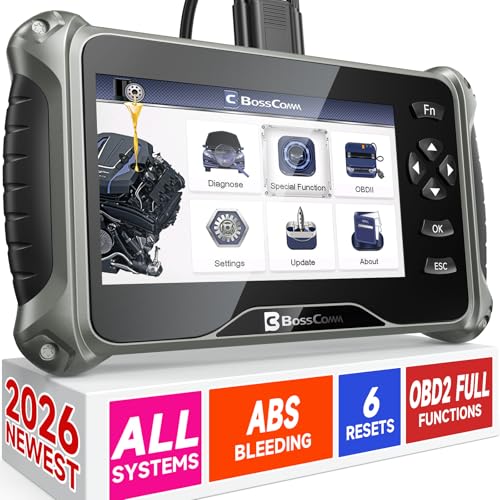
- 【✅Compared to BOSSCOMM IF742, IF745 Offers Full-System Diagnostics】The BOSSCOMM IF745 car diagnostic scanner is an upgraded model of IF742. In addition to supporting all OBD2 Code Reader functions and 6 reset options (ABS/EPB/SAS/BMS/Oil/Throttle), it expands diagnostics from 4 systems (Check Engine/ABS/SRS/Transmission) to vehicle All systems, including Steering, Suspension, and Body Electronics. This provides deeper, more comprehensive diagnostic capabilities.
- 【✨10 OBD2 Functions】The BOSSCOMM IF745 scan tool’s DTC Lookup instantly translates fault codes into user-friendly explanations, its I/M Readiness feature streamlines emissions testing with a single tap, and Freeze Frame lets you pinpoint the exact moment of a fault for in-depth root-cause diagnosis. Combined with a live data dashboard and advanced diagnostics (O2S, OBMon, EVAP), it delivers comprehensive insights for confident troubleshooting.
- 【✨Deep Diagnostics for All Vehicle System Modules】Beyond code reading/clearing and ECU information retrieval, our all-in-one data stream feature lets you inspect all current fault codes and their locations across the vehicle’s systems. This vehicle code reader helps you turn off dashboard warning lights and perform a comprehensive self-check of your car at home—no more back-and-forth trips to the repair shop or hefty inspection fees.
- 【✨6 Essential Resets: ABS Bleeding, Oil, EPB, SAS, Throttle, BMS】The BOSSCOMM IF745 obd2 scanner diagnostic tool swiftly purges air from brake lines to restore braking sensitivity, fine-tunes maintenance cycles to eliminate false alerts, resolves parking brake issues with one-click control, recalibrates steering sensors for stability, optimizes engine idling/acceleration for smoother performance, and deeply resets battery systems to extend lifespan and range via precise parameter adjustments.❗NOTE: Does NOT support bidirectional control, coding, or programming.
- 【✨10,000+ Car Models, AutoVIN, 13 Languages】The BOSSCOMM IF745 vehicle scanner diagnostic tool covers 73+ global car brands and offers support in 13 languages, making it perfect for DIYers, auto mechanics, or as a thoughtful gift. With a single-click AutoVIN feature, it instantly retrieves vehicle serial numbers, streamlining diagnostics for users globally. This adaptable tool balances user-friendliness with precision, catering to both personal and professional requirements.✅Unsure about compatibility? Compatibility will vary on vehicles' model and year, pls reach us via 📧 [email protected] 📧 before purchase.

This product presentation was made with AAWP plugin.