
NHTSA ID Number: 10178116
Manufacturer Communication Number: 2048616/8
TSB/Document Date: 2020-08-07
Summary
Creaking noise from the front suspension when manoeuvring. Customer statement / workshop findings: Creaking noise from the front suspension when manoeuvring Technical background: Verify that the customer complaint matches the sound file within the Bentley Hub Reference TPI Transaction number 2048616 TIP: When listening to the sound file the noise can be heard from between 0 and 3 seconds The noise present in the sound file is caused by defective Lower suspension lever - Rear - Hydraulic mounts. In order to reproduce the noise this bush must be twisted, therefore the noise can appear in the following circumstances When performing parking manoeuvers with the brake applied When steering from lock to lock with the vehicle in motion and the brake applied When the vehicle is moved with steering input over uneven surfaces (for e.g. a ramp or speed bump) If the customer complaint occurs in any of the above circumstances and the noise can be clearly assigned to the noise within the sound file Refer to the instructions within the Measure section of this TPI
Using Ball joint puller -T10444-, "break" the taper
pin of the ball joint.
Remove the Ball joint puller -T10444- , remove and
DISCARD the nut -arrow-.
Remove and DISCARD the fixings -2 and 3- (70
Nm + 180°.
Manoeuvre the lower lever -1- out from the sub
frame and wheel bearing housing.
Installation
Installation is the reverse of removal procedure, noting
the following.
Note
The lower lever -1- MUST be fitted into the wheel
bearing housing first.
Secure the outer section of the lower lever -1- to the
–
wheel bearing housing with a NEW fixing -arrowbut do NOT yet torque tighten.
Secure the inner section of the lower lever -1- to the
–
sub frame with NEW fixings -2 and 3- but do NOT
yet torque tighten.
Caution
There is a requirement that any suspension
component with bonded rubber bushes, all levers
and the bearing housing MUST be set at standard
ride height before tightening the fixings.
Bonded rubber bushes can only be turned to a
limited extent. The suspension mountings must
therefore only be tightened when the suspension is
in the unladen position or normal level.
Failure to comply will result in the lever bushes
undertaking excessive torsional twist, resulting in
rupture and complete failure of the rubber inserts.
The suspension must be set to a specific angle prior to
torque tightening the fixings.
Position the Hydraulic support stand ASE40611000000 or VAG 1383-A- beneath the
–
wheel bearing housing and jack until the
suspension levers are at the correct ride height
level. Refer to "Raising the wheel bearing housing To tighten bolts".→ Rep.-Gr.40
With the wheel bearing housing in the raised
–
position, torque tighten the fixing -3- to 70 Nm + 180
° using a suitable "crow ring" spanner.
–
Remove the Hydraulic support -ASE40611000000
or VAG 1383-A-.
Using 21 mm Ring insert -VAG 1332/7- , torque
–
tighten the nut -arrow- securing the ball joint on the
outer section of the lower lever -1- to the wheel
bearing housing to 140 Nm.
–
–
Take the car out of "Jack" mode.→ Rep.-Gr.99
Charge the air suspension. Refer to "Air suspension
system - To discharge and charge".→ Rep.-Gr.43
Lower suspension lever (W12) - Rear - To remove and fit
General Information
The following procedure is for the LH lower rear lever. The procedure for the RH lever is the same except where
stated.
Access is only possible after the removal of the front subframe.
Special tools and workshop equipment required
Ball joint puller -T10444-
Vehicle tester
21 mm Ring insert -VAG 1332/7-
Torque tightening values
Unless otherwise shown, standard torque values apply.
→ Rep.-Gr.00
Single use items
Within this procedure there are single use items which
must be replaced and not reused. Ensure that new
replacements are available prior to starting this
procedure.
Removal
–
Remove the front subframe. Refer to "Front
subframe - To remove and fit". → Rep.-Gr.40
–
Remove the two fixings -arrows- and the heatshield
-1-.
On the outer section of the lower lever and using 21
–
mm Ring insert -VAG 1332/7-, release the nut arrow- (140 Nm) until it is flush with the end of the
thread of the ball joint.
–
–
Using Ball joint puller -T10444-, "break" the taper
pin of the ball joint.
Remove the Ball joint puller -T10444- , remove and
DISCARD the nut -arrow-.
–
–
Remove and DISCARD the fixings -2 and 3- (70
Nm + 180°.
Manoeuvre the lower lever -1- out from the sub
frame.
Installation
Installation is the reverse of removal procedure, noting
the following.
Secure the outer section of the lower lever -1- to the
–
wheel bearing housing with a NEW fixing -arrowbut do NOT yet torque tighten.
Secure the inner section of the lower lever -1- to the
–
sub frame with NEW fixings -2 and 3- but do NOT
yet torque tighten.
Caution
There is a requirement that any suspension
component with bonded rubber bushes, all levers
and the bearing housing MUST be set at standard
ride height before tightening the fixings.
Bonded rubber bushes can only be turned to a
limited extent. The suspension mountings must
therefore only be tightened when the suspension is
in the unladen position or normal level.
Failure to comply will result in the lever bushes
undertaking excessive torsional twist, resulting in
rupture and complete failure of the rubber inserts.
The suspension must be set to a specific angle prior
to torque tightening the fixings and after the
subframe has been refitted.
–
Refit the front subframe. Refer to "Front subframe To remove and fit". → Rep.-Gr.40
Position the Hydraulic support stand ASE40611000000 or VAG 1383-A- beneath the
–
wheel bearing housing and jack until the
suspension levers are at the correct ride height
level. Refer to "Raising the wheel bearing housing To tighten bolts".→ Rep.-Gr.40
With the wheel bearing housing in the raised
–
position, torque tighten the inner fixings -2 and 3- to
70 Nm + 180°.
–
Remove the Hydraulic support -ASE40611000000
or VAG 1383-A-.
Using 21 mm Ring insert -VAG 1332/7- , torque
–
tighten the nut -arrow- securing the ball joint on the
outer section of the lower lever -1- to the wheel
bearing housing to 140 Nm.
–
–
Take the car out of "Jack" mode.→ Rep.-Gr.99
Charge the air suspension. Refer to "Air suspension
system - To discharge and charge".→ Rep.-Gr.43
Automatic transmission mounts - Front - To remove and fit
General Information
This procedure is for removing the front transmission mounts Gearbox mounting valve 1 -N262- and Gearbox
mounting valve 2 -N263-.
The procedure for the LH side is different to the RH side. Refer to the appropriate section below.
Special tools and workshop equipment required
None
Torque tightening values
Unless otherwise shown, standard torque values apply.→ Rep.-Gr.00
Single use items
Within this procedure there are single use items which must be replaced and not reused. Ensure that new
replacements are available prior to starting this procedure.
Removal — LH side
–
Remove the front road wheels. Refer to "Road wheel - To remove and fit".→ Rep.-Gr.44
–
Remove the front undersheets -2 & 3-.
Remove the front subframe brace. Refer to
–
"Brace front subframe - To remove and fit". →
Rep.-Gr.40
–
–
Disconnect the electrical connection -arrow- to the
transmission mount assembly.
Remove the three fixings -1- (10 Nm) and the
upper heatshield -2-.
Carefully bend the lower heatshield -1- downwards
–
and remove the three fixings -2- (10 Nm) and the
heatshield -3- from the mounting bracket.
–
–
Detach the coolant hose at the clipping point arrow-.
Remove the M12 "Multispline" fixing -arrow- (55
Nm) from the mount.
Remove the three fixings -arrows- (20 Nm) and
–
detach the inner transmission mount bracket -1and remove from the vehicle.
Caution
Prior to removing ANY of the fixings -arrows-, mark
the position of the transmission mounting bracket -1against the automatic transmission housing in order
to retain the correct height settings of the bracket -1. Failure to do so will result in premature mount
failure!
Carefully bend the heatshield -1- back into the
–
upright position and remove the outermost mount
fixing -2- (55 Nm).
–
Manoeuvre the mount and outer bracket assembly
out from the vehicle.
Replacement of the transmission mount
–
Using a soft-faced mallet, carefully tap the lower
bracket -1- from the transmission mount -2-.
Installation – LH side
Installation is the reverse of removal procedure, noting
the following.
Caution
When refitting the transmission mounting bracket -1, the mounting bracket MUST be positioned to the
corresponding markings previously made prior to
tightening the fixings -arrows-.
–
Refit all previously removed components.
–
Torque tighten all remaining fixings.→ Rep.-Gr.00
Removal — RH side
Remove the front road wheels. Refer to
–
"Road wheel - To remove and fit".
→ Rep.-Gr.44
–
Remove the front undersheets -2 & 3-.
Remove the front subframe brace. Refer to
–
"Brace front subframe - To remove and fit".→
Rep.-Gr.40
For vehicles equipped with "EAWS", remove the
–
two fixings -arrows- (10 Nm), detach the 48 volt
steering connector block -1- from the body and
move to one side.
–
Remove the three fixings -arrows- (10 Nm) and the
upper heatshield -1-.
–
Remove the fixing -1- from lower
steering coupling (20 + 90).
Detach the steering column -2-
–
from the rack -3- and push
upwards to gain access to the
transmission mount fixings.
Detach the electrical connection arrow- to the transmission mount.
Caution
Prior to removing ANY of the fixings -arrows-, mark the position
of the transmission mounting bracket -1- against the automatic
transmission housing in order to retain the correct height settings
of the bracket -1-. Failure to do so will result in premature mount
failure!
From the underside of the vehicle, remove the
–
rearmost fixing -arrow- (20 Nm) from the
transmission mount -1-.
–
–
–
Remove the two fixings -1- (20 Nm) securing the
transmission mount -2-.
Remove the outer fixing -3- (55 Nm) securing the
transmission mount -2- to the body.
Carefully manoeuvre the transmission mount assembly out
from beneath vehicle.
Note
Access is tight.
Replacement of the transmission mount
–
Remove the three fixings -arrows- (10 Nm) and the
heatshield -1-.
–
–
Remove the "Multispline" fixing -arrow- (55 Nm)
and detach the top bracket.
Using a soft-faced mallet, carefully tap the lower
bracket from the transmission mount.
Installation – RH side
Installation is the reverse of removal procedure, noting the
following.
Caution
When refitting the transmission mounting bracket, the mounting
bracket MUST be positioned to the corresponding markings
previously made prior to tightening the fixings -arrows-.
–
Refit all previously removed components.
–
Torque tighten all remaining fixings.→ Rep.-Gr.00

- Mixes well with conventional fluids
- Low-moisture formula provides excellent vapor lock...
- Ideal for hydraulic and disc brakes


- Provides an extra margin of safety in extreme braking...
- Mix of polyglycol ethers ensures hot brake-system operation...
- Excellent for ABS, disc and drum brake systems
- Delivers braking power when needed by avoiding a spongy...
- Both wet and dry boiling points exceed the minimum...
Last update on 2026-06-12 / Affiliate links / Images from Amazon Product Advertising API
If the PDF is very large, it may not load in the preview below.
Some older TSBs had multiple PDFs — visit the NHTSA Website to view all PDFs.
If the TSB PDF does not show, download or view it on the NHTSA Website.
Click on the (+) Plus Sign
Then Click on Associated Document(s)
Search NHTSA Database for Recalls
Search NHTSA Database for Vehicle Investigations
View Latest Vehicle Investigations
Search NHTSA Database for Vehicle Complaints
View Latest Vehicle Complaints
TSB/Document ID: 2048616/8
Replacement Service Bulletin Number:
MFR Communication Date: 2020-07-03
MFR Internal Campaign ID/Software Version:
Communication Type: Service Bulletin/Repair Instructions
NHTSA Components: SUSPENSION
MFR Component System:
MFR Component Subsystem:
Previous TSB | Next TSB |
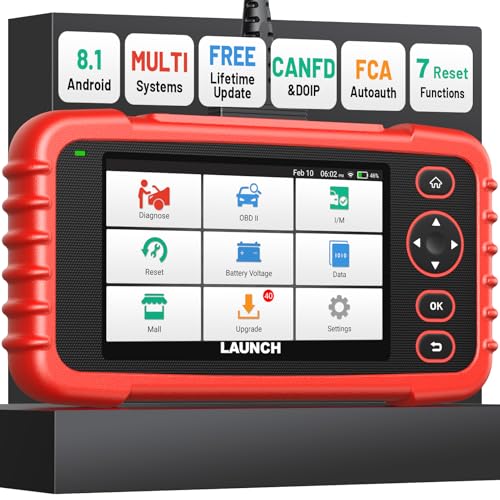
- [Newly Added in 2026: 7 Reset Functions] The 2026 new version of the OBD2 scanner diagnostic tool CRP123X V3.0 Elite has new special functions for F.REE: Throttle Ad.aptation, Oil/SAS/BMS/Brake Reset, D-P.F Re.generation and ABS Service. Before you visit a mechanic, launch obd2 Scanner CRP123X Elite can perform a more in-depth diagnosis of the car system and provide accurate data within minutes. What's more, the list of compatible models has been expanded. Upgrading frequency is regular, occurring monthly even weekly.
- 🔥[FCA AutoAuth + CAN FD & DoIP] As an upgraded version of the LAUNCH CRP123X/CRP129X, FOXWELL NT614, and ANCEL FX2000, The Newest LAUNCH CRP123X V3.0 auto diagnostic scanner supports the following new protocols: CAN-FD for 2020 and newer G.M and Chrysler
 models, as well as DoIP for V.olvo, Land Rover/Jaguar, and B.MW F/G chassis. With integrated AutoAuth, you can diagnose 2018 and newer FCA cars equipped with S.GW. Note: CAN-FD and DoIP protocols require an additional obd2 cable. *Menus vary by make, model, and year of gasoline or diesel engine vehicle. Email us your VIN data.
 - 🔥[No extra software fee. Works on 90 vehicle brands.] Most OBD2 scanners work with vehicles manufactured after 2001. However, the LUNCH OBD2 scanner is compatible with OBDII-equipped vehicles built after 1996 and works with more than 90 vehicle brands. One-click lifetime updates over WIFI 2.4&5.0Ghz keep the car software current and ensure constant coverage additions, diagnose vehicles from 1996 to 2026 with a massive global database. Android 8.1 ensures lightning-fast boot-up and processing.
- [Accurate & Intuitive Multi System Diagnosis] Will you be confused about what happens when the warning light of transmission, ABS, and SRS Airbag check engine flashes? Launch obd2 scanner diagnostic tool CRP123X V3.0 to pinpoint the problem components for a faster diagnosis for your car instead of taking your car to the dealership. Generate vehicle health reports with one click and share them via email over Wi-Fi to help avoid blind maintenance. And will turn off the warning light for you after fixing the problem, make to know more about your cars and do your own repair.
- [Multiple Display of Live Data + DTC Code Definition Explanation] Launch car tools show real-time data of oil temp, pressure, transmission temp, engine speed, coolant temperature, you will know which car part is abnormal. Data can be shown in a single, multi- graph, and merge two graphs for analysis(or 4-in-1 merged waveform graph),you can save, share, print, or email the overall inspection report for easier analysis.🔥Code Search,DTC Library provide massive information. Inbuilt “Feedback” module provides customized repair suggestions from our certified professionals.
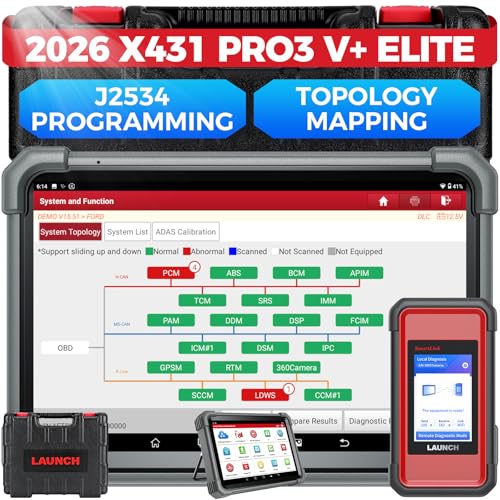
- [2026 X431 PRO3 V+ Elite] A great value for the X431 series that differs from similar diagnostic tools by adding: 1) J2534 protocol for over $800 in savings; 2) CANFD/DOIP support for enhanced communications; 3) Configuration of over $900 worth of HD(heavy truck) modules, needed purchase HD diagnostic software by HD vehicle model for use.; 4) A 10.1 inch Gorilla screen with 1280*800 resolution and 80% more touch screen sensitivity
- [J2534 Protocol Scan Tool] The J2534 Direct Access Device can be used as a factory scanning tool at no cost to you, saving you over $2,000. You can easily expand your ECU protocol capabilities for Toyota, Honda, VW, BMW, Ford, GM, Chrysler, Mercedes-Benz and more. The LAUNCH X431 PRO3 V+ ELITE Scan Tool is equipped with the newly upgraded smartlinkC V2.0. smartLinkC is a communication interface that supports the J2534 specification. It can also be used as a J2534 PassThru device to implement the J2534 protocol with a PC that has OEM diagnostic software installed.The J2534 protocol is the only way to solve problems ranging from drivability and power loss to poor fuel economy
- [Top Hardware Configuration, Upgraded Version of V+] LAUNCH Diagnostic Scanner adopts Android 10.0 OS; CPU is 4-core processor with 2.0 GHz, which greatly improves the speed of running multi-tasks. 2.4GHz/5GHz; 6300mAh/7.6V ultra-large capacity battery; 10.1 inch Gorilla screen, sunlight readable, 8MP camera; Auto VIN; 4GB+64GB storage; 20x transfer rate to save more vehicle files and customer data; New TYPE A interface to connect expansion tools such as oscilloscopes, sensors, etc.; Supports more than 25 software languages such as EN, DE, FR, SP and JP
- [60+ Reset 3000+ Active Test] Full Bi-Directional Scan Tool quickly detects problems and guides repairs based on the response of actuators such as air conditioning clutches, windows, doors, mirrors and more. With the touch of a finger, you can easily send command signals from the scanner to a variety of modular actuators, testing component integrity and functionality in minutes or even seconds to determine if a replacement or repair is needed. In addition, the machine enjoys 60+ special services such as oil reset, ABS brake bleed, EPB, SAS, BMS, suspension, injector reset and more, and undergoes rigorous field testing to ensure availability
- [Unrivaled Coverage, Over 200 Vehicle Brands] LAUNCH X431 PRO3 V+ Elite Automotive Scanner is suitable for over 200 vehicle brands, including commercial vehicles and new energy vehicles. This professional car scanner supports: 1) J2534/D-PDU protocol for HD trucks; DoIP/CANFD for Land Rover/Jaguar, BMW F/G chassis, GM, etc.; 2) FCA Autoauth, covering 2018+ Chrysler/Dodge/Fiat, etc. New/old models, all covered. Includes frequently updated vehicle software and car coverage for faster support of other new models
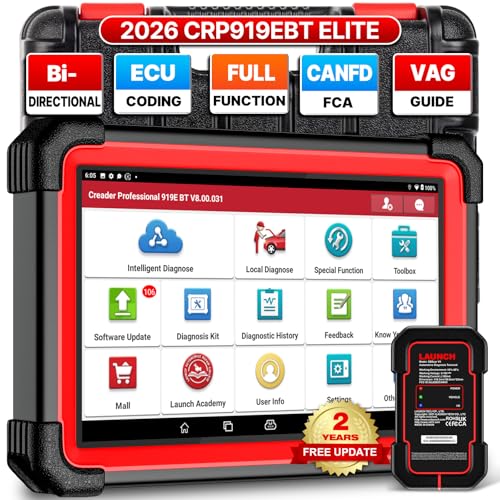
- 🔥【2026 TOP HARDWARE AND SOFTWARE UPGRADE,UPGRADED OF CRP919E】LAUNCH scanner CRP919EBT wireless obd2 scanner has upgraded TOP HARDWARE CONFIGURATION and ADD NEWEST FUNCTIONS. The more FASTER and SMARTER CRP919EBT with 🔥Bluetooths & USB 2-in-1 connect🔥Android 10.0 OS🔥2.0Ghz 4 core high efficiency processor 4GB RAM+64GB ROM large storage🔥6300mAh large battery, more stable and longer lasting diagnostics🔥VAG Guided🔥ECU Code🔥Bi-directional Control🔥35+ Resets🔥CANFD&DOIP🔥FCA AutoAuth🔥Full System Diagnostics🔥2 Yrs Update🔥Newly add BST360 battery tester & I-TPMS & VSP600 endoscope🔥23+ Languages. Provide an unparalleled diagnostic experience at an affordable price.
- 🚗【CAN FD & DOIP & FCA, SUPER PROTOCOL】LAUNCH X431 CRP919EBT is equipped with the DBSCAR VII Bluetooth connector supporting CANFD and DoIP. The CRP919EBT automotive diagnostic scanner supports CAN FD protocol (compatible with post-2020 GM vehicles). It also meets DoIP protocol requirements (adapter sold separately) for compatibility with BMW (E & F chassis) models from 2017 onward. Autoauth for FCA SGW supports FCA vehicles including Chrysler models from 2017 and later.
- ✔️【ADVANCED ECU CODE, ADAPTATION, CALIBRATION & INITIALIZATION】The LAUNCH X431 CRP919EBT automotive scanner delivers exceptional ECU code capabilities for customized vehicle setups. It provides dealer-level functionality to streamline maintenance and repairs, enabling ECU matching and learning for enhanced customization.
- 👍【BIDIRECTIONAL CONTROL, 4000+ ACTIVE TESTS】LAUNCH OBD2 scanner CRP919EBT features bi-directional control - the most demanded capability among mechanics. When headlights or windows malfunction, repairs can be costly. With CRP919EBT, execute ECU commands and assess repair status through systems including ABS, windows, valves, wipers, and headlights - streamlining diagnostics while slashing repair expenses.
- 🥇【35+ MOST POPULAR RESET SERVICE FOR 160 MAKES】Same as Snap-on scanners, CRP919EBT scan tool delivers 35+ reset functions for 160+ vehicle models, including: service oil reset, throttle adaptation, steering angle calibration, brake pad replacement code, tire pressure reset, ABS bleeding, battery registration, gear signal learning, and injector code, etc.
Last update on 2026-06-12 / Affiliate links / Images from Amazon Product Advertising API
This product presentation was made with AAWP plugin.