NHTSA ID Number: 10176391
Manufacturer Communication Number: ENP-164
TSB/Document Date: 2020-06-15
Summary
Agility Fuel Solutions LLC (?Agility®?) defueling procedure prepared for Gillig buses equipped with Type 3 fuel cylinders and electric solenoid cylinder valves. With compressed natural gas (CNG) With CNG cylinders equipped with electric solenoid cylinder valves, verification that cylinder pressure is fully exhausted is required before any removal, replacement, tightening or loosening is performed on any valve, pressure transducer, PRD, tubing or fitting connected to the cylinders. This verification is required to confirm the electric solenoid cylinder valves opened properly during the defueling process and allowed the cylinder to be depressurized and defueled. This procedure describes two methods to defuel the cylinders, lines and valves. Both methods include a procedure to verify the electric solenoid cylinder valves opened properly during defueling and that the cylinder pressures are fully exhausted. Either method can be used. 1. How to remove the solenoid valve components and then fully exhaust the pressure in the cylinder if the solenoid valve did not open properly when energized during defueling. 2. How to defuel the CNG system and cylinders if no battery power is available. ADDED: Metric values; ADDED: "Type 3" to title; REVISED: Warning message definitions.
(Printed and Downloaded Copies are Uncontrolled)
Type 3 CNG Cylinder Defueling with
Electric Solenoid Cylinder Valves
Procedure applies to systems equipped with the following Agility Fuel Solutions assemblies:
Fuel Management Module (FMM) p/ns
Roof Mount
(RM) p/ns
Description
20866000
20866500
20866600
25501000
Roof Mount, 144 DGE, 2036 L, 8 Tanks
20866700
20867000
20867500
25503000
Roof Mount, 162 DGE, 2415 L, 8 Tanks
20867600
20868000
20868500
25503000-002
Roof Mount, 162 DGE, 2415 L, 8 Tanks
20868600
20868700
20869000
25505000
Roof Mount, 126 DGE, 1657 L, 8 Tanks
20869500
20869600
20869700
25507000
Roof Mount, 144 DGE, 2036 L, 8 Tanks
20870000
20870500
20870600
25509000
Roof Mount, 162 DGE, 2415 L, 8 Tanks
20870700
20871000
20871500
25509000-002
Roof Mount, 162 DGE, 2415 L, 8 Tanks
20871600
20871700
20892000
25511000
Roof Mount, 126 DGE, 1657 L, 8 Tanks
20893000
20894000
20895000
25513000
Roof Mount, 144 DGE, 2036 L, 8 Tanks
20896000
20897000
25515000
Roof Mount, 162 DGE, 2415 L, 8 Tanks
25517000
Roof Mount, 126 DGE, 1657 L, 8 Tanks
ENP-164, Rev. H
May 4, 2020
Agility® Fuel Solutions. ©2020. All Rights Reserved.
1. Introduction
On Agility Fuel Solutions LLC (“Agility®”) compressed natural gas (CNG) cylinders equipped with
electric solenoid cylinder valves, verification that cylinder pressure is fully exhausted is required
before any removal, replacement, tightening or loosening is performed on any valve, pressure
transducer, PRD, tubing or fitting connected to the cylinders. This verification is required to
confirm the electric solenoid cylinder valves opened properly during the defueling process and
allowed the cylinder to be depressurized and defueled.
This procedure describes two methods to defuel the cylinders, lines and valves. Both methods
include a procedure to verify the electric solenoid cylinder valves opened properly during defueling
and that the cylinder pressures are fully exhausted. Either method can be used.
1. How to remove the solenoid valve components and then fully exhaust the pressure in the
cylinder if the solenoid valve did not open properly when energized during defueling.
2. How to defuel the CNG system and cylinders if no battery power is available.
1.1. Warning Messages and Symbols Used in this Bulletin
Will cause or death severe injuries if procedures are not followed.
Could cause or death severe injuries if procedures are not followed.
Could cause minor or moderate injuries if procedures are not followed.
Practices not related to physical injury. Includes procedures to prevent vehicle damage as well
as hints to help an operation or procedure go smoothly.
Critical Characteristic.
Procedure directly affects safety of vehicle users, people nearby and maintenance personnel; or
regulatory compliance.
ENP-164, REV H 5-4-2020
(Printed and Downloaded Copies are Uncontrolled)
2 of 19
2. Affected Units
Gillig buses equipped with Agility® roof mount CNG fuel systems including Type 3 CNG
cylinders and Emer™ Mark 100 Series electric solenoid valves as follows:
25501000
25503000
25503000-002
Agility® p/n
25505000
25509000-002
25507000
25511000
25509000
25513000
25515000
25517000
3. System Defuel Procedures
A. This procedure should be performed only by CNG qualified personnel.
B. This procedure involves venting gas to atmosphere: please consult local codes and
regulations to determine if this is legal in your area.
C. Full cylinder pressure [as much as 3600 psi (25MPa) or greater] is present at the
cylinder solenoid valve, PRDs and tubing. System components must not be under
pressure during servicing to prevent serious injury or death.
D. Defueling must be performed in a well ventilated area and must comply with any fire
or building code requirements, including use of electrical grounding and vent piping.
To fully defuel all the CNG lines and defuel the cylinders, choose the appropriate method from
the following procedures to perform prior to removing or disconnecting a cylinder valve, PRD,
tubing or fitting directly connected to the cylinder. These procedures will ensure the plumbing and
the cylinders are depressurized.
A. Use a slow flow when transferring fuel to reduce static electricity/electrostatic
discharge and to avoid freezing.
B. Atmospheric venting of natural gas to depressurize a cylinder must be done with
care. Improper equipment or procedures raise the risk of fire. Before depressurizing,
ground the venting orifice to an approved electrical ground system.
3.1. Basic Rules for Defueling
1. Only CNG qualified personnel should attempt these processes.
2. Consume as much fuel as possible prior to defueling.
3. Only use an approved storage container for the fuel removed from the vehicle.
4. Notify nearby personnel prior to defueling.
5. Always ground the vehicle and the fuel system.
6. Never defuel indoors.
7. Always wear personal protective equipment.
8. Be familiar with evacuation routes.
ENP-164, REV H 5-4-2020
(Printed and Downloaded Copies are Uncontrolled)
3 of 19
3.2. Defueling Requirements
Use an approved storage vessel to store natural gas fuel removed from the vehicle. There are
three common defueling options:
1. Vent to atmosphere
2. Compressor transfer
3. Return to supply
In all cases, both the vehicle and the fueling system must be grounded to prevent static
electricity build-up.
3.2.1. Vent to Atmosphere
First, verify whether this method is legal. Local air quality regulations may restrict the release of
methane into the atmosphere. If atmospheric venting is acceptable in your area, then a venting
facility compliant to regulations must be used.
3.2.2. Compressor Transfer
In this defueling method, a compressor at the fueling station extracts the gas from vehicle.
3.2.3. Return to Supply
The third method returns fuel to a distribution system. When using this process, pressure in the
vehicle cylinder and the supply system pressure will equalize, so some pressure may remain in
the vehicle fuel system.
3.2.4. Typical Venting Facility
The following information is provided in the absence of formalized procedures from local
authorities and governing bodies. Figure 1 is an example of a typical venting facility.
Vent stack/pipe
properly supported,
≥ 10-ft. (3.04m)
above ground
To rest of
fuel system
Defuel port
Defuel nozzle
Electrically conductive,
flexible hose
Earth grounding
rod/connection
Manual
valve
Ground cable (earths vent stack)
Ground cable
(earths rest of fuel system when
defuel nozzle is connected)
Figure 1. Typical atmospheric venting equipment.
ENP-164, REV H 5-4-2020
(Printed and Downloaded Copies are Uncontrolled)
4 of 19
A Venting Facility Should Include the Following Minimum Equipment
1. Onboard defueling connection installed on the vehicle. Consult vehicle original
equipment manufacturer (OEM) for further information.
2. Vent pipe typically a two-in. (51mm) diameter steel pipe attached to a support structure.
The pipe must extend a minimum of two ft. (0.6m) higher than the support structure and a
least 10 ft. (3m) above ground level. The vent pipe must be connected to an electrical
ground. There should be no ignition sources in proximity to the pipe. Figure 1
3. Electrical ground connection with a minimum 3 gauge or heavier stranded copper wire
attached at one end to a ground rod, or an equally suitable electrical ground. The other
end should be securely fastened to both the venting pipe and cylinder valve. Figure 1
4. High pressure electrically conductive flexible hose. Figure 1
5. Manual valve to control the flow of gas. Figure 1
Additional Equipment
1. Portable fire extinguisher in an easily accessible location at the defueling facility. The
extinguisher should have a rating no less than 20-B:C.
2. Large signage indicating “NO SMOKING” and “FLAMMABLE GAS.”
3. Flame arrestor downstream of the hand valve.
Freestanding cylinders must be restrained prior to venting. Cylinders will contract and
move if gas is released at a rapid rate.
3.3. Standard Defueling Procedure
This procedure applies to vehicles equipped with a NGV1-style defuel receptacle.
Refer to Figures 2, 3 and 4. The defuel receptacle is equipped with a one-way check valve, which
must be safely bypassed to perform the defuel process. The Agility transfer hose is equipped with
a matching defueling nozzle (Figure 2) that safely mates with the defueling receptacle. Use the
instructions provided with the defueling nozzle for the proper connection and use of the defueling
nozzle.
Figure 2. BDN defueling nozzle and ground connection.
ENP-164, REV H 5-4-2020
(Printed and Downloaded Copies are Uncontrolled)
5 of 19
1
2
3
4
5
6
8
Figure 3. Fuel Management Module (FMM) faceplate: (1) 1/4-turn shut off valve,
(2) transit (fast) fill receptacle, (3) high pressure (HP) gauge, (4) fill receptacle,
(5) defuel receptacle, (6) low pressure (LP) gauge, (8) bleed valve.
7
Figure 4. FMM panel, rear. (7) defuel valve.
ENP-164, REV H 5-4-2020
(Printed and Downloaded Copies are Uncontrolled)
6 of 19
3.3.1. Defuel Nozzle Connection
1. Connect vehicle ground wire to vent stack system. Figure 1
2. Attach defuel hose to vent stack system. Figure 1
3. Turn FMM 1/4-turn shut off valve (1) to the OFF/CLOSED position. Figure 3
4. Fully open the defuel valve (7) by turning fully counterclockwise. Figure 4
5. If possible: Run engine to use up fuel in the FMM and related lines.
6. Slowly open the bleed valve (8) in the FMM to bleed any remaining pressure in the fuel
manifold and defuel lines. Figure 4
7. Close the bleed valve (8) and close the defuel valve (7). Figures 3 and 4
8. Attach the defuel nozzle (Figure 2) to the defuel receptacle (4) on the FMM. Figure 3
9. Turn FMM 1/4-turn shut off valve (1) to the ON/OPEN position. Figure 4
3.3.2. Defueling Method 1: Defuel with Audible Test Method
An audible test verifies electric solenoid function and cylinder depressurization. This method
requires electric power to actuate the electric solenoid cylinder valves.
1. Complete all nine steps in Section 3.3.1. Defuel Nozzle Connection above.
2. Close all cylinder manual valves on all cylinders.
3. Energize all the electric solenoid cylinder valves. To energize the solenoid valves, verify
battery disconnect switch is in the ON position and use the defuel switch located inside
the rear run box (located in the engine compartment) to energize the solenoid valves.
Confirm all manual cylinder valves are closed.
4. Slowly open defuel valve (7), turning it fully counterclockwise to open. Figure 4. Use the
defuel nozzle to defuel the supply line system. Figure 2
5. Once the CNG supply lines have been defueled, verify FMM high pressure (HP) gauge
(3) reads zero (Figure 3), and open bleed valve (8) and leave the bleed valve open during
this procedure. Figure 4
6. If all cylinders are to be tested and defueled, start with cylinder #1 and work in order to
test all cylinders. If only some of the cylinders are to be defueled and tested leave the
manual valves closed on the cylinders which are not to be defueled. Cylinders where the
manual valves are not opened will NOT be defueled and will remain pressurized.
7. When performing this test confirm the following:
a. Electrical solenoid valves are energized.
b. Defuel nozzle is connected so the system can defuel.
c. Bleed valve (8) on the FMM is open to prevent pressure build up in the fuel supply
plumbing. Figure 4
d. HP gauge (3) on the FMM reads zero. Figure 3
ENP-164, REV H 5-4-2020
(Printed and Downloaded Copies are Uncontrolled)
7 of 19
8. Starting with cylinder #1 or the first cylinder to be tested, slowly open the manual valve.
Listen for the sounds of gas flowing out of the cylinder, as soon as the flow of gas is
detected, close the valve. Gas flow indicates the solenoid valve has opened properly and
is functioning properly.
a. If no gas flow is detected, continue to open the manual valve until fully opened. If gas
flow is not heard, the solenoid valve is not functioning properly.
b. Close the manual valve, record that this solenoid is not functioning and will require
disassembly to depressurize the cylinder.
c. Repeat this test of slowly opening the manual valve, listening for gas flow and closing
the valve on all cylinders requiring defueling.
d. Carefully note any cylinders where the solenoid valve is failed closed and not allowing
the cylinder to defuel. All cylinders where the solenoid valve fails to open properly will
require disassembly to depressurize the cylinder.
9. Once all electric solenoid cylinder valves have been tested, close the bleed valve (8) on
the FMM. Figure 4
10. Close manual cylinder valves on all cylinders with failed solenoid valves.
11. Open the manual cylinder valves on all cylinders to be defueled with functioning solenoid
valves.
12. Verify defuel nozzle (Figure 2) is properly connected and proceed to defuel the cylinders
with functioning solenoid valves. Slowly open the defuel valve and adjust for a slow and
steady flow to avoid freeze up. Figure 4. Refer to Section 3.3.1.
13. On all cylinders where no gas flow was heard (which means the solenoid valve is failed),
the solenoid valve must be disassembled and manually vented to depressurize the
cylinder. Refer to Section 4. Solenoid valve disassembly, and Section 5. for solenoid valve
function test and cylinder venting after valve disassembly.
14. Once the defueling procedure on the cylinders with functioning solenoid valves is
complete and cylinders with non-functioning solenoid valves have been dissembled and
vented manually, verify the HP gauge (3) reads zero (Figure 3) and open the bleed valve
(8). Figure 4. The fuel lines and cylinders with opened manual cylinder valves are now
depressurized.
15. It is now safe to remove, replace or adjust cylinder valves, PRDs or associated tubing on
all cylinders with opened manual cylinder valves.
Any cylinders on which manual valves were not opened remain pressurized.
16. When work on the CNG system is completed, close the bleed valve (8). Figure 4
Torque bleed valve nut to 4 ft-lbs to 5 ft-lbs (5.42Nm to 6.78Nm).
17. Close defuel valve (7). Figure 3
18. Remove defueling nozzle. Figure 2
ENP-164, REV H 5-4-2020
(Printed and Downloaded Copies are Uncontrolled)
8 of 19
3.3.3. Defueling, Method 2: Defuel Using Valve Disassembly
In this procedure, solenoid valves are disassembled to verify valve function and depressurization.
This method requires electrical power to actuate the electric solenoid cylinder valves.
1. Complete all steps in Section 3.3.1. Defuel Nozzle Connection.
2. Confirm all manual valves on all cylinders to be defueled are open to allow these cylinders
to defuel. Manual valves should remain closed on all cylinders which are not to be
defueled.
3. Verify FMM 1/4-turn manual shut off valve (1) is in the ON/OPEN position. Figure 3
4. Defuel the CNG supply plumbing and cylinders.
a. When defueling, all electric solenoid cylinder valves should be energized (open).
b. Verify battery disconnect switch is ON.
c. To energize the cylinder solenoid valves for defueling, use the defuel switch inside the
rear run box (located in the engine compartment).
5. Slowly open defuel valve (7) and adjust for a slow and steady flow to avoid freeze up.
Figure 3
6. Continue defueling until the HP gauge (3) on the FMM reads zero (Figure 3), then open
the bleed valve (8) on the FMM and leave it open during this procedure. Figure 4
7. If all cylinders are to be tested and defueled, start with cylinder #1 and work in order to
test all cylinders.
If only some of the cylinders are to be defueled and tested, leave the manual valves
closed on cylinders which are not to be defueled. Cylinders where the manual valve
is not opened will NOT be defueled and will remain pressurized.
8. Turn off the defuel switch in the rear run box to turn off power to the electric cylinder
solenoid valves.
9. Refer to Section 4, Solenoid Valve Disassembly, and Section 5, Solenoid Valve Function
Test and Cylinder Venting After Valve Disassembly.
10. Disassemble and test each solenoid valve. If the valve is functioning correctly, there will
be no gas pressure in the cylinder and no gas will flow out of the disassembled valve.
Carefully test each valve.
11. Any valves which exhaust gas in Step 9 have failed closed and must be replaced before
putting the bus back in service.
12. On all valves which exhaust gas in Step 6, leave the manual valve open to fully exhaust
all the pressure in the cylinder. Leave the manual valve in the fully open position.
13. Reassemble the valves which function properly after testing and replace any that are failed
closed. Reassemble solenoid valve.
ENP-164, REV H 5-4-2020
(Printed and Downloaded Copies are Uncontrolled)
9 of 19
14. Once all the valves on the cylinders to be defueled have been tested and all cylinders with
a failed closed valve have been manually vented, the cylinders have been depressurized
and work can be done on the cylinder valves, PRDs or associated plumbing.
15. Before putting the bus back in service complete a leak test and solenoid function test.
16. Perform a leak test with leak detection fluid. Repair any leaks.
17. Test for proper solenoid valve function:
a. Start engine and allow engine to idle for at least two minutes.
b. Operate cylinder solenoid test switch. This will de-energize the electric solenoid
- High density negative paste, improves performance and...
- Enhanced life alloy or Silver Calcium stamped alloy...
- Calcium lead positive grid, maximizes conductivity and...
- Robust envelope separator with puncture resistant back...
- Vent cap design that resists acid leakage

- High density negative paste, improves performance and...
- Enhanced life alloy or Silver Calcium stamped alloy...
- Calcium Lead positive grid, maximizes conductivity and...
- Robust Envelope Separator with puncture-resistant back...
- Vent cap design that resists acid leakage
Last update on 2026-05-30 / Affiliate links / Images from Amazon Product Advertising API
If the PDF is very large, it may not load in the preview below.
Some older TSBs had multiple PDFs — visit the NHTSA Website to view all PDFs.
If the TSB PDF does not show, download or view it on the NHTSA Website.
Click on the (+) Plus Sign
Then Click on Associated Document(s)
Search NHTSA Database for Recalls
Search NHTSA Database for Vehicle Investigations
View Latest Vehicle Investigations
Search NHTSA Database for Vehicle Complaints
View Latest Vehicle Complaints
TSB/Document ID: ENP-164
Replacement Service Bulletin Number:
MFR Communication Date: 2020-05-04
MFR Internal Campaign ID/Software Version:
Communication Type: Service Bulletin/Repair Instructions
NHTSA Components: EQUIPMENT
MFR Component System:
MFR Component Subsystem:
Previous TSB | Next TSB |
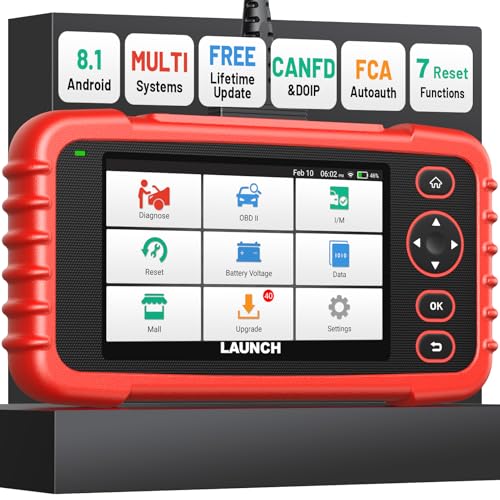
- [Newly Added in 2026: 7 Reset Functions] The 2026 new version of the OBD2 scanner diagnostic tool CRP123X V3.0 Elite has new special functions for F.REE: Throttle Ad.aptation, Oil/SAS/BMS/Brake Reset, D-P.F Re.generation and ABS Service. Before you visit a mechanic, launch obd2 Scanner CRP123X Elite can perform a more in-depth diagnosis of the car system and provide accurate data within minutes. What's more, the list of compatible models has been expanded. Upgrading frequency is regular, occurring monthly even weekly.
- 🔥[FCA AutoAuth + CAN FD & DoIP] As an upgraded version of the LAUNCH CRP123X/CRP129X, FOXWELL NT614, and ANCEL FX2000, The Newest LAUNCH CRP123X V3.0 auto diagnostic scanner supports the following new protocols: CAN-FD for 2020 and newer G.M and Chrysler
 models, as well as DoIP for V.olvo, Land Rover/Jaguar, and B.MW F/G chassis. With integrated AutoAuth, you can diagnose 2018 and newer FCA cars equipped with S.GW. Note: CAN-FD and DoIP protocols require an additional obd2 cable. *Menus vary by make, model, and year of gasoline or diesel engine vehicle. Email us your VIN data.
 - 🔥[No extra software fee. Works on 90 vehicle brands.] Most OBD2 scanners work with vehicles manufactured after 2001. However, the LUNCH OBD2 scanner is compatible with OBDII-equipped vehicles built after 1996 and works with more than 90 vehicle brands. One-click lifetime updates over WIFI 2.4&5.0Ghz keep the car software current and ensure constant coverage additions, diagnose vehicles from 1996 to 2026 with a massive global database. Android 8.1 ensures lightning-fast boot-up and processing.
- [Accurate & Intuitive Multi System Diagnosis] Will you be confused about what happens when the warning light of transmission, ABS, and SRS Airbag check engine flashes? Launch obd2 scanner diagnostic tool CRP123X V3.0 to pinpoint the problem components for a faster diagnosis for your car instead of taking your car to the dealership. Generate vehicle health reports with one click and share them via email over Wi-Fi to help avoid blind maintenance. And will turn off the warning light for you after fixing the problem, make to know more about your cars and do your own repair.
- [Multiple Display of Live Data + DTC Code Definition Explanation] Launch car tools show real-time data of oil temp, pressure, transmission temp, engine speed, coolant temperature, you will know which car part is abnormal. Data can be shown in a single, multi- graph, and merge two graphs for analysis(or 4-in-1 merged waveform graph),you can save, share, print, or email the overall inspection report for easier analysis.🔥Code Search,DTC Library provide massive information. Inbuilt “Feedback” module provides customized repair suggestions from our certified professionals.
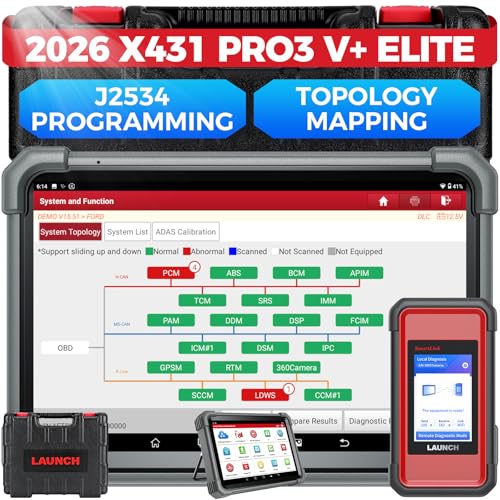
- [2026 X431 PRO3 V+ Elite] A great value for the X431 series that differs from similar diagnostic tools by adding: 1) J2534 protocol for over $800 in savings; 2) CANFD/DOIP support for enhanced communications; 3) Configuration of over $900 worth of HD(heavy truck) modules, needed purchase HD diagnostic software by HD vehicle model for use.; 4) A 10.1 inch Gorilla screen with 1280*800 resolution and 80% more touch screen sensitivity
- [J2534 Protocol Scan Tool] The J2534 Direct Access Device can be used as a factory scanning tool at no cost to you, saving you over $2,000. You can easily expand your ECU protocol capabilities for Toyota, Honda, VW, BMW, Ford, GM, Chrysler, Mercedes-Benz and more. The LAUNCH X431 PRO3 V+ ELITE Scan Tool is equipped with the newly upgraded smartlinkC V2.0. smartLinkC is a communication interface that supports the J2534 specification. It can also be used as a J2534 PassThru device to implement the J2534 protocol with a PC that has OEM diagnostic software installed.The J2534 protocol is the only way to solve problems ranging from drivability and power loss to poor fuel economy
- [Top Hardware Configuration, Upgraded Version of V+] LAUNCH Diagnostic Scanner adopts Android 10.0 OS; CPU is 4-core processor with 2.0 GHz, which greatly improves the speed of running multi-tasks. 2.4GHz/5GHz; 6300mAh/7.6V ultra-large capacity battery; 10.1 inch Gorilla screen, sunlight readable, 8MP camera; Auto VIN; 4GB+64GB storage; 20x transfer rate to save more vehicle files and customer data; New TYPE A interface to connect expansion tools such as oscilloscopes, sensors, etc.; Supports more than 25 software languages such as EN, DE, FR, SP and JP
- [60+ Reset 3000+ Active Test] Full Bi-Directional Scan Tool quickly detects problems and guides repairs based on the response of actuators such as air conditioning clutches, windows, doors, mirrors and more. With the touch of a finger, you can easily send command signals from the scanner to a variety of modular actuators, testing component integrity and functionality in minutes or even seconds to determine if a replacement or repair is needed. In addition, the machine enjoys 60+ special services such as oil reset, ABS brake bleed, EPB, SAS, BMS, suspension, injector reset and more, and undergoes rigorous field testing to ensure availability
- [Unrivaled Coverage, Over 200 Vehicle Brands] LAUNCH X431 PRO3 V+ Elite Automotive Scanner is suitable for over 200 vehicle brands, including commercial vehicles and new energy vehicles. This professional car scanner supports: 1) J2534/D-PDU protocol for HD trucks; DoIP/CANFD for Land Rover/Jaguar, BMW F/G chassis, GM, etc.; 2) FCA Autoauth, covering 2018+ Chrysler/Dodge/Fiat, etc. New/old models, all covered. Includes frequently updated vehicle software and car coverage for faster support of other new models
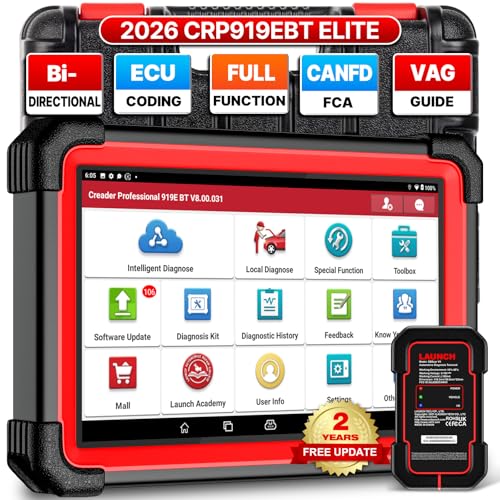
- 🔥【2026 TOP HARDWARE AND SOFTWARE UPGRADE,UPGRADED OF CRP919E】LAUNCH scanner CRP919EBT wireless obd2 scanner has upgraded TOP HARDWARE CONFIGURATION and ADD NEWEST FUNCTIONS. The more FASTER and SMARTER CRP919EBT with 🔥Bluetooths & USB 2-in-1 connect🔥Android 10.0 OS🔥2.0Ghz 4 core high efficiency processor 4GB RAM+64GB ROM large storage🔥6300mAh large battery, more stable and longer lasting diagnostics🔥VAG Guided🔥ECU Code🔥Bi-directional Control🔥35+ Resets🔥CANFD&DOIP🔥FCA AutoAuth🔥Full System Diagnostics🔥2 Yrs Update🔥Newly add BST360 battery tester & I-TPMS & VSP600 endoscope🔥23+ Languages. Provide an unparalleled diagnostic experience at an affordable price.
- 🚗【CAN FD & DOIP & FCA, SUPER PROTOCOL】LAUNCH X431 CRP919EBT is equipped with the DBSCAR VII Bluetooth connector supporting CANFD and DoIP. The CRP919EBT automotive diagnostic scanner supports CAN FD protocol (compatible with post-2020 GM vehicles). It also meets DoIP protocol requirements (adapter sold separately) for compatibility with BMW (E & F chassis) models from 2017 onward. Autoauth for FCA SGW supports FCA vehicles including Chrysler models from 2017 and later.
- ✔️【ADVANCED ECU CODE, ADAPTATION, CALIBRATION & INITIALIZATION】The LAUNCH X431 CRP919EBT automotive scanner delivers exceptional ECU code capabilities for customized vehicle setups. It provides dealer-level functionality to streamline maintenance and repairs, enabling ECU matching and learning for enhanced customization.
- 👍【BIDIRECTIONAL CONTROL, 4000+ ACTIVE TESTS】LAUNCH OBD2 scanner CRP919EBT features bi-directional control - the most demanded capability among mechanics. When headlights or windows malfunction, repairs can be costly. With CRP919EBT, execute ECU commands and assess repair status through systems including ABS, windows, valves, wipers, and headlights - streamlining diagnostics while slashing repair expenses.
- 🥇【35+ MOST POPULAR RESET SERVICE FOR 160 MAKES】Same as Snap-on scanners, CRP919EBT scan tool delivers 35+ reset functions for 160+ vehicle models, including: service oil reset, throttle adaptation, steering angle calibration, brake pad replacement code, tire pressure reset, ABS bleeding, battery registration, gear signal learning, and injector code, etc.
Last update on 2026-06-12 / Affiliate links / Images from Amazon Product Advertising API
This product presentation was made with AAWP plugin.