
NHTSA ID Number: 10176302
Manufacturer Communication Number: PIP5504D
TSB/Document Date: 2020-06-15
Summary
This Preliminary Information communication provides information and definitions to the technician about vehicles that have fishbite, chuggle, misfire, AFM disturbances or torque converter shudder/vibration concerns. Technician are advised to use PICO software to determine root cause of the concern. If torque converter shudder is confirmed technicians are referred to Torque Converter Diagnosis in SI.
If the PDF is very large, it may not load in the preview below.
Some older TSBs had multiple PDFs — visit the NHTSA Website to view all PDFs.
If the TSB PDF does not show, download or view it on the NHTSA Website.
Click on the (+) Plus Sign
Then Click on Associated Document(s)
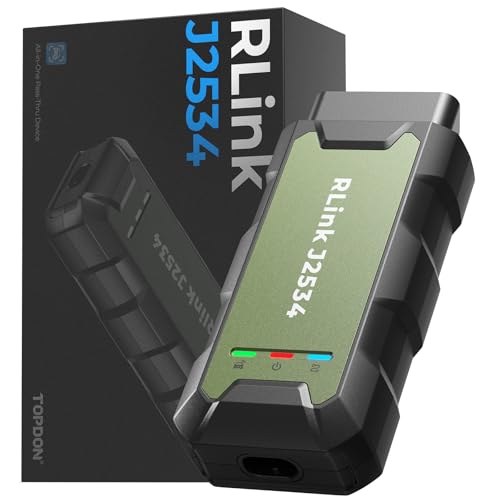

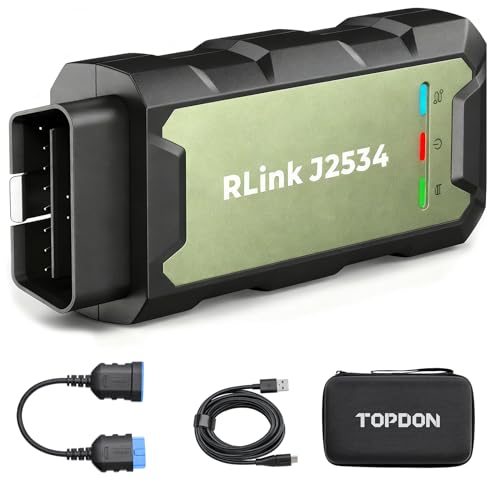
- Advanced VCI Box, Industry-leading J2534 Pass-Thru...
- High-Speed OEM-Level Diagnostics & Programming: Unlock true...
- Coverage for 17 Car Brands & Ultra Reliability: Works...
- User-Friendly RLink Platform & Expert Support: TOPDON’s...
- 6.6 ft USB-C Cable & Portable Storage Case: The RLink J...
This product presentation was made with AAWP plugin.
Search NHTSA Database for Recalls
Search NHTSA Database for Vehicle Investigations
View Latest Vehicle Investigations
Search NHTSA Database for Vehicle Complaints
View Latest Vehicle Complaints
TSB/Document ID: PIP5504D
Replacement Service Bulletin Number:
MFR Communication Date: 2020-05-06
MFR Internal Campaign ID/Software Version:
Communication Type: Service Bulletin/Repair Instructions
NHTSA Components: ENGINE AND ENGINE COOLING
MFR Component System:
MFR Component Subsystem:
Previous TSB | Next TSB |
Bulletin No.: PIP5504D
Published date: 05/6/2020
Preliminary Information
PIP5504D Diagnosing Fishbite Chuggle Mis re Feeling Or Shudder
Vibration, With A Light Tip In
Models
Brand:
Model:
Model Years:
VIN:
from
to
Engine:
Transmissions:
Silverado
2016 - 2018
All
All
L83
MYC
Silverado New Model
2019
All
All
L82 L84
MYC
Silverado 1500
2020
All
All
L82 L84
MYC
Suburban
2016 - 2020
All
All
L83
MYC
Tahoe
2016 - 2020
All
All
L83
MYC
Sierra Models
2016 - 2018
All
All
L83
MYC
Sierra New Model
2019
All
All
L82 L84
MYC
Sierra 1500 Models
2020
All
All
L82 L84
MYC
Yukon Models
2016 - 2020
All
All
L83
MYC
Involved Region
North America and N.A. Export Regions.
or Country
Some customers may comment on any of the following conditions.
A shake and/or shudder during light throttle acceleration between 48 and 104 km/h (30 and 65 mph)
steady state driving when transmission is not actively shifting gears.
Condition
A shudder feeling that may be described as driving over rumble strips or rough pavement.
A shudder feeling that is evident in both Drive and M5 mode.
Cause
Please refer to the following information to aid in addressing these types of conditions.
De nitions:
In general if there is insu cient engine ring pulse isolation or combustion instability, vibrations can be transmitted to
the driver typically through the steering wheel, seat track, or accelerator pedal.
1. Fishbite: (also called Surge, nudge, jerk and bump) is a jerk or bump which may be transmitted through the Torque
Converter Clutch due to insu cient damping or TCC locking and releasing.
2. Chuggle: (often called boom) is induced from engine combustion exciting the driveline due to insu cient isolation.
Frequency of the boom is a ected by driveline mass, sti ness, damping, and gear.
3. Mis re: or knock is the engine having an irregular combustion event.
4. AFM Disturbances can be mislabeled as any of the de nitions above as well as shudder below, but in fact has to do
with the imbalance caused by less cylinders ring.
5. Torque Converter Shudder/Vibration: Any vibration induced by the torque converter clutch in normal driving mode
(with an expected TCC slip amount). (Most often due to TCC friction material/ATF degradation)
Important – DEXRON 6 is the only approved ATF to be used with 6L (MYA, MYB, MYC, MYD) transmissions at this time.
Diagnosis/Test Instructions:
Verify and correct any DTC’s prior to proceeding with next steps.
The use of the PICO scope and NVH software should be used to con rm the Disturbance Frequency and allow
the user to see if the disturbance tracks to engine speed (Chuggle, Mis re), road speed (Tire Vibrations), or
remains constant across various inputs (TCC Shudder). Place the PICO Scope pick up on a metallic component
where vibration can be felt the most (seat track, steering wheel column, accelerator pedal, etc).
a. - Evaluate within customer complaint range (note if concern occurs in V4 or V8 mode).
b. - Evaluate at Idle (Warm & Cold Start).
c. - Evaluate in multiple gears.
A smooth road is desirable for evaluations to isolate concerns without introducing road inputs/noise.
Minimize extraneous vibration input by testing on a smooth road and correct any other known vehicle vibration
issues (tires, brakes, etc.) before conducting test.
1. Fishbite – Condition can be best isolated by placing the transmission in manual range 5th gear to turn o V4
mode and monitoring TCC Slip in GDS2. With engine speed between 1,000 – 1,600 rpm and engine load up to
320 Nm the calibration target is 20 rpm of TCC slip in V8 mode. Under these conditions, slip should not be less
than 5 rpm with steady throttle input. (Note: At 400Nm engine load, the calibration target is 5 rpm of TCC slip.)
2. Chuggle – Condition can be best isolated in Manual 5th gear while in V8 mode, greater than 320 Nm of engine
torque, and engine speeds between 1,200–1,300 rpm when tipping into throttle to load the engine. Can be
con rmed by using GDS2 to Command TCC on - condition should be the same with TCC locked. This can be
Engine 1st Order Vibration on the PICO Scope as well.
3. Mis re – Can be viewed in GDS2 under engine control module and then selecting mis re data. This will prompt
a screen that will show mis re by each cylinder if the tab Diagnostic Data Display is clicked. This can be Engine
1st Order Vibration on the PICO Scope as well.
4. AFM Disturbances – While monitoring the Driver Information Center to display V4 or V8 mode, determine if the
disturbance only occurs in V4 mode or during the transition between V8 and V4 mode.
5. Torque Converter Shudder/Vibration – Condition can be best isolated with transmission temperature between
40°C (104°F) - 89°C (192°F). Drive the vehicle in 6th gear, V8 mode, with a transmission input speed of 1,000–
1,500 rpms (approximately 64-89 km/h (40–55 mph)), constant throttle input, and engine torque 250-375 Nm.
Important: For some road conditions, it may be required to apply the brake pedal and throttle simultaneously
to stay within desired engine torque range.
Press and hold the tow-haul mode button for 5 seconds to disable grade braking to prevent downshifts during
test.
Run the test in 3 operational modes:
- Normal Operation (TEHCM commanding TCC apply. Use GDS2 for viewing only).
- GDS2 Commanding TCC in Disabled Operation. (No TCC Apply).
- GDS2 Commanding TCC in Enabled Operation. (TCC Locked).
To con rm TCC Shudder, the vibration concern must be present in normal operation (Mode A), but not present
with the torque converter clutch disabled (Mode B) or with the torque converter clutch locked (Mode C).
If the concern is not present in Mode A, then the vibration concern is NOT TCC Shudder.
If the concern is still present with the torque converter clutch disabled (Mode B) or with the torque converter
clutch locked (Mode C), the root cause of vibration is NOT TCC shudder.
Perform TCC slip control test within this procedure.
If TCC Shudder is present, a vibration peak will appear at approximately 43Hz +/-3Hz as shown in the picture
above. If the vibration frequency follows engine, tire, or driveshaft speed, then it is NOT TCC Shudder.
TCC Shudder vibration frequency should stay constant per gear while vehicle and engine speeds change.
Vibrations not identi ed as shudder should be further investigated using the “Vehicle Vibration Diagnosis” in SI
as a starting point.
Use of the PICO scope and NVH software can be used to con rm TCC Shudder, Engine, Tire or Driveline
component related conditions.
Vibrations identi ed as shudder should be further investigated using the "Torque Converter Diagnosis" in SI as
a starting point.
An alternative diagnostic for TCC shudder is to road test the vehicle and monitor commanded and actual TCC
slip speeds.
Road test the vehicle under light throttle acceleration between 88 and 104 km/h (55 and 65 MPH) steady state
driving when the transmission is not actively shifting gears and monitor the following GDS2 parameters.
Callout 1
GDS2 data showing TCC slip peak to peak below 20 RPM is an example of normal TCC operation.
Callout 2
GDS2 data showing TCC slip peak to peak erratic near 0 RPM to over 100 RPM in a short time is an example of
a damaged torque converter clutch.
Callout 3
GDS2 data showing TCC slip peak to peak repeating near 60 RPM or less is an example of degraded uid.
Perform TCC slip control test within this procedure. Compare service tool collected data results to normal, damaged
and degraded operation.
TCC SLIP CONTROL
TEST RESULT
TCC rpm slip peak to peak
ACTION
Note
Normal (Callout 1)
Below 20 rpm.
Do nothing.
Damaged (Callout 2)
Near 0 to 100 rpm - erratic.
Inspect transmission further Inspect transmission pan magnet
for excessive metal accumulation.
Degraded (Callout 3)
Near 60 rpm - repeating.
Flush transmission uid.
(at steady throttle)
Shudder, surge, sh bite likely.
Version History
Version
5
Modi ed
06/19/2017 - Created on.
01/17/2018 Updated Model Years
10/03/2019 - Added the 2019 model year and removed the repair
recommendation if TCC shudder is confirmed. Added to refer
to Torque Converter Diagnosis in SI if TCC shudder is confirmed.
01/17/2020 - Added the 2020 model year.
05/06/2020 - Added engine RPOs L82 and L84 and more diagnostic
information.
© 2020 General Motors . All Rights Reserved.

- [2026 Top-Tier Hardware and Software Upgrade]: Topdon ArtiDiag900 Lite scanner has enhanced hardware and latest features, including Android 11.0, 5x faster CPU, 10000mAh battery for 12 hours of continuous operation, stable wireless diagnosis with Bluetooth 5.0, 8-inch touchscreen. Added bi-directional control, wireless diagnosis, battery testing (optional), and DTC repair guide
- [TOPDON Bidirectional Scan Tool]: This bidirectional obd2 scanner sends commands to the vehicle's ECU for active testing, enabling users to accurately and quickly locate faulty components such as injectors, coolant pumps, windows, wipers, headlights, mirrors, etc. The bidirectional control scanner is the ideal choice for workshops/automotive repair shops as it significantly reduces mechanic's diagnostic time.
- [Wireless Bluetooth Diagnostic Experience]: The AD900 Lite scan tool comes with a Bluetooth 5.0 VCI, supporting a wireless diagnostic range of up to 33 feet (10 meters), allowing you to diagnose without being confined to cables or tight spaces. Stable and fast wireless diagnosis provides a comfortable repair environment. It also offers VCI cables to increase connectivity options.
- [DTC Repair Guide Function]: Easily diagnose issues with your vehicle and receive guidance on repairs with the topdon scan tool's fault code definitions for all systems,maximize your diagnostic capabilities. This function is compatible with Chrysler
 /Dodge/Jeep/Fiat 2010-2014 and expanding with continual updates,the AritDiag 900 Lite car diagnostic scanner is the must-have tool for any technician or DIY enthusiast.
 - [OE-Level Full System Diagnostics]:AritDiag900 Lite full system diagnostic scanner can scan ALL available modules(Engine, Transmission, Airbag, ABS, ESP, TPMS, Gateway, Steering, Radio, Air conditioning, ect.) to✔read ECU info, ✔read/clear codes, ✔view live data stream, ✔retrieves freeze-frame, ✔perform active tests, and more. With just a simple click, it provides you with accurate and in-depth diagnostics.
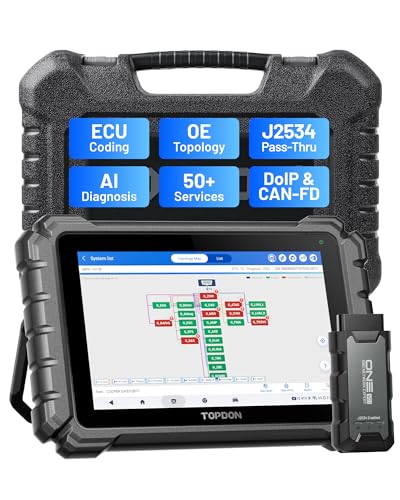
- Dual WiFi & 10.1" Touchscreen: Provides a stable, high-speed wireless link 3x faster than bluetooth, and a responsive, professional interface. Topdon ONE obd2 scanner diagnostic tool ensures smooth, non-lagging diagnostic scan, boosting mechanic efficiency
- J2534 Pass-Thru Support: The included ONE VCI supports the J2534 standard, allowing it to function as a pass-thru device when paired with OEM diagnostic software.Through TOPDON’s RLink platform, technicians can perform dealer-level coding, expanding in-house capabilities without investing in multiple factory automotive scan tools
- OE Topology Mapping: Visualize the vehicle’s ECU network exactly as it’s built.Zoom, pan, and highlight specific modules to pinpoint component issues with precision.Topology mapping displays real-time communication between modules
- Topfix AI Assistant: Covers 5 million plus fault codes and delivers instant causes, symptoms, and repair guidance with professional wiring diagrams for each code.Slashes diagnostic time, boosts first-time fix accuracy, and increases shop revenue
- 50 Plus Service Functions: Covers high-demand services like ADAS calibration, DPF regen, TPMS reset, ABS bleed, and throttle adaptation.Expands your service menu, allows you to charge premium rates, and turns away zero jobs due to lack of tooling. Vehicle-specific functionality may vary.

- Bi-Directional Control, Quickly Locate Problems: Turn your phone into a professional diagnostic tool. You can send commands from your phone to the ECU to test injectors, cooling fans, headlights, A/C clutch, windows, wipers, and more. See which one doesn't respond. Helps you quickly locate the problem and save time. No need to tear things apart, avoid blind disassembly.
- Full System Diagnostics, No Fault Hides: Unlike basic diagnostic tools that only cover 4 systems, TopScan can scan all systems. Read and clear trouble codes, view live data streams, and generate a complete vehicle health report – all issues are clear at a glance. Covers 10,000+ vehicle models and is compatible with 99.99% of vehicles.
- Flexible Subscription, Choose Advanced Features as Needed: TopScan Lite provides free-for-life access to core diagnostics, including full system scan, code reading, performance tests, and repair information. After purchase, advanced features (bi-directional control, service operations, live data, code clearing, and AI functions) are free-for-the-first-year. After the first year, if you want to use advanced features, you need to subscribe on a monthly, quarterly, or yearly basis. As new models and reset functions are updated, the tool will also be continuously upgraded.
- AI Assistant - TopFix: Think of TopFix as your personal AI mechanic. It leverages a repair database and OEM data to deliver clear, step-by-step repair solutions. Features include AI Q&A, one-click translation, and a full repair log, making your diagnostic process simpler and more efficient.
- 8+ Hot Resets, Keep Your Car in Top Shape: One-tap resets for oil, throttle, EPB, steering angle, DPF, ABS, BMS, and airbag. It enables car owners to easily perform essential maintenance, ensuring the vehicle stays in optimal condition and extends its service life.
This product presentation was made with AAWP plugin.
Last update on 2026-05-12 / Affiliate links / Images from Amazon Product Advertising API