
NHTSA ID Number: 10175980
Manufacturer Communication Number: WTY-84R
TSB/Document Date: 2020-06-02
Summary
Subaru of America, Inc. (Subaru) is recalling certain 2013 model year BRZ and XV Crosstrek and 2012-2014 model year Impreza vehicles to replace the engine valve springs which may fracture. A total of 139,324 U.S. vehicles will be affected by this recall.
of the procedure will make the sealer removal job considerably
easier. There are other color blades available but different colors
have different stiffness characteristics. The WHITE color blades worked best during
development of these procedures. Steel razor blades are NOT recommended as they can
easily damage machined aluminum sealing surfaces.
10) Rotate the engine so the RH (cylinders #1 and #3) side face upward (crankcase seam horizontal).
Continued...
Bulletin Number: WTY-84R; Revised: 05/06/20
Page 9 of 42
11) CAREFULLY remove the camshaft caps, both camshafts, spark plug tube seals (discard, 1-time
use) and either the cylinder head plate (on M/T models) or the vacuum pump (on A/T models) as
shown below. Spray any remaining sealer with gasket remover and allow to soak.
VERY IMPORTANT:
A. Always record the positions of the cam caps, every rocker arm and valve shim as each is removed
to insure they get reinstalled back into their original locations and proper orientation. The
use of a closeable partitioned tray as shown below or an equivalent organizer is STRONGLY
recommended to keep valve train parts organized.
B. DO NOT remove the sprockets from the camshafts.
C. DO NOT remove the cam carriers or the rocker arm pivots from the cylinder heads.
D. IMPORTANT: Always
keep close watch for any
loose pieces of sealer, large
or small as components are
disassembled and remove
them right away. This will
help prevent them from
getting into oil passages,
restricting oil flow and
potentially causing damage
as shown here.
Continued...
Bulletin Number: WTY-84R; Revised: 05/06/20
Page 10 of 42
12) Air Piping and Regulator Assembly
Assemble the air pressure regulator assembly
as shown with the shop air supply inlet on the
left and the outlet fitting to connect the plastic
tubing to the right. The air pressure regulator
will be ineffective otherwise. Once the tool is
assembled, connect shop air, open the valve
and let air flow through to make sure it is
clean. Pull up on the adjustment knob, adjust
to 0.5 MPa then push the knob back down to
lock the setting.
Unlock
Lock
Adjusting
Knob
Shop Air Supply
Set Regulator to 0.5 MPa (72.5 PSI)
IMPORTANT NOTE: NEVER connect compressed air to any of the spark plug adapters until
instructed to do so in this procedure.
13) Valve Spring Replacement
VERY IMPORTANT:
Never replace valve springs on a cylinder not positioned at top dead center (TDC). If the
retainer was removed and the valve were to drop, the piston would keep it from falling into
the cylinder. If the piston were at bottom dead center (BDC), the valve could drop through the
guide and into the cylinder necessitating cylinder head removal.
The valve springs on Cylinder #1 will be replaced first in this procedure. Temporarily install the
crankshaft spacer, pulley and hand-tighten the retaining bolt (snug). Rotate the crankshaft clockwise
until the reference mark applied to the face of the crankshaft pulley is at 12:00 (perpendicular to the
crankcase seam). This will place the piston in cylinder #1 at TDC and cylinder #3 at BDC.
Install the 2 spark plug adapters into #1 and #3 spark plug holes.
Make them tight WITHOUT using any extra tightening tools.
Hand-tightening only will seal the adapters sufficiently. Connect
both air hoses to the spark plug adapters and SLOWLY (5 seconds
from closed to open), open the shut-off valve. A slight amount of air
leakage is normal. If the engine rotates, return the crankshaft to the
proper position and try again.
REMINDER: Hand-tightening only.
Continued...
Bulletin Number: WTY-84R; Revised: 05/06/20
Page 11 of 42
TIP: Although the remover and installer tools are “magnetized” to keep the related components in
position during use, it is STRONGLY recommended to have a stick / pocket magnet or equivalent
available to retrieve any small parts which may come loose when performing these procedures. Use
clean shop cloths to plug oil passages and prevent small parts (or loose sealer pieces) from entering
the crankcase
Using the removal tool, press down firmly on the top of the remover while keeping the tool aligned
with the valve stem then remove one of the valve springs on #1 cylinder. NOTE: NEVER HIT
ANY OF THESE TOOLS WITH A HAMMER! It is recommended to do the removal and
installation one spring at a time to keep the retainer, keepers together as a set in the organizer.
The cutaway illustration below provides extra detail on how the Remover tool operates. When the
tool is pushed down, the keepers disengage from both the retainer and the valve stem. Once they are
loose, all three pieces (2 keepers and the retainer) are attracted to the tool’s magnets for removal.
End View photo of
tool after removal
NOTE: Before installing the new valve springs, although engine oil usually keeps them in position,
always confirm the steel spring seats remain in place against the aluminum cylinder head.
Install the new valve spring with the blue painted end up (toward the retainer).
Continued...
Bulletin Number: WTY-84R; Revised: 05/06/20
Page 12 of 42
Assemble the keepers and retainer then install onto the Valve Spring Installer as shown below. The
tool is also equipped with magnets to keep the components in place during reassembly. OK and NG
photos are provided below for reference.
OK
NG
Keeper Displaced
Once the keepers and retainers are properly assembled on the Installer, press down firmly on
the top of the tool as shown while keeping the tool aligned with the valve stem.. Remove
the tool to confirm the retainer and keepers are in their proper positions on the spring and
the valve stem. Develop a “feel” for how far down the installer needs to be pressed to
achieve the proper result. Post-installation “OK” and “NG” photos are provided below
for reference. If the result is NG, remove the installer, disassemble (use the Remover if
necessary) then reassemble on the Installer. Confirm the retainers and keepers are in their proper
positions on the tool and try again.
This cutaway illustration provides additional detail on how the Installer tool operates.
Continued...
Bulletin Number: WTY-84R; Revised: 05/06/20
Page 13 of 42
NG
OK
SUCCESS!
NG- 1 Keeper
is upside-down.
NG
NG- 1 Keeper is not
seated in the valve
stem groove.
NG
NG- 1 Keeper is
missing.
EXTREMELY CRITICAL: A post-installation inspection to confirm success as shown above
MUST be performed as each spring is reassembled. Left undetected, a mis-placed or out of position
keeper WILL cause MAJOR engine damage when the engine is restarted.
Once successful reassembly is confirmed, proceed to replace the other three (3) valve springs on #1
cylinder following the same steps as outlined above.
After completing the remaining spring replacements on #1 cylinder, close the air shut-off valve and
remove the air hoses from the spark plug adapters.
Rotate the crankshaft 180 degrees clockwise to put the mark at
6:00. This will bring #3 piston to TDC.
Reconnect the air hoses to the spark plug adapters and
SLOWLY (5 seconds from closed to open), open the shut-off
valve. A slight amount of air leakage is normal. If the engine
rotates, return the crankshaft to the proper position and try
again.
Follow the procedure outlined above starting at Step 13 and replace the four (4) valve springs on #3
cylinder.
REMINDER: A post-installation inspection to confirm success as shown above MUST be performed
as each spring is reassembled. Left undetected, a mis-placed or out of position keeper WILL cause
MAJOR engine damage when the engine is restarted.
Before Reassembly:
When valve spring replacement and inspections are complete on cylinder #1 and #3, THOROUGHLY
clean any remaining sealer from the sealing surfaces of the cylinder head, cam caps, valve covers and
the front timing cover.
VERY IMPORTANT: It is critical to make sure all the original sealer is removed and the affected
sealing surfaces completely clean and dry before applying any new sealer. After cleaning, a thorough
inspection of the inside surfaces of the cylinder head area around the valve springs, inside the front
timing cover and inside all the cam caps for any small pieces / bits of removed sealant or any other
contamination is essential to providing a quality repair. Any contamination left behind can cause the
Check Engine light to illuminate and / or other issues to develop resulting in a comeback.
Continued...
Bulletin Number: WTY-84R; Revised: 05/06/20
Page 14 of 42
14) Cylinder #1 and #3 Valve Train Reassembly:
Apply a small amount of engine oil to all the valve shims and install them onto their respective valve
stems.
Apply a small amount of engine oil to all the rocker arms and install them onto their respective
pivots.
Apply engine oil to the camshaft journal areas and re-install the camshafts in the no-load (free)
position.
CAREFULLY apply ThreeBond 1217H or equivalent (see Recommended Materials TSB
01-167-08R) sealant to the front and rear cam caps as described in the applicable Service Manual.
Apply a small amount of engine oil to the camshaft journal surfaces of the cam caps then install them
while following the tightening and torqueing sequences outlined in the applicable Service Manual.
IMPORTANT: Before proceeding further and while the camshafts are in their no-load (free)
positions, recheck all valve clearances and compare to the original measurements. This will confirm
no changes have occurred during the repair and that all the shims and rocker arms have been
reinstalled to their original locations.
After removing any remaining original sealant, reinstall either the cylinder head plate (M/T) or the
vacuum pump (A/T). NOTE: Always use the new o-rings supplied in the parts kit where applicable
and torque the retaining bolts to specification.
Confirm any remaining original sealant has been removed from the valve cover and all sealing
surfaces are clean and dry. Install the new valve cover gasket to the valve cover and two of the new
spark plug tube seals included in the parts kit.
CAREFULLY apply ThreeBond 1217H or
equivalent sealant to the valve cover in the specific
areas as described in the applicable Service Manual.
Install the valve cover and retaining bolts. Follow the
tightening and torqueing sequences outlined in the
applicable Service Manual.
Reinstall the injector driver module retaining bracket.
Continued...
Bulletin Number: WTY-84R; Revised: 05/06/20
Page 15 of 42
15) Cylinder #2 and #4 Procedure:
Rotate the engine so the LH (cylinders #2 and #4) side face upward (crankcase seam horizontal).
Remove the fuel delivery pipe for the LH injectors, fuel delivery pipe #2 from the high-pressure
fuel pump and the high-pressure fuel pump assembly. Leave the black fuel line attached to pump.
Remove the pump drive case (mounts the fuel pump to the cylinder head) from the cylinder head.
Remove Fuel Delivery Pipe LH.
Replacement o-rings are
included in the Parts Kit.
Remove and discard Fuel Delivery
Pipe #2 (1-time use). A replacement
is included in the Parts Kit.
Leave attached to pump.
Rotate the crankshaft 180 degrees clockwise to put the mark (back) at 6:00. This will bring #2 piston
to TDC.
Following the same procedures as outlined above, replace the valve springs on #2 cylinder.
When complete. Rotate the crankshaft another 180 degrees clockwise to put the mark at 12:00. This
will bring #4 piston to TDC.
Following the same procedures as outlined above:
•
Replace the valve springs on #4 cylinder.
•
Reassemble the valve train.
•
Recheck and compare the valve clearances against the original measurements.
•
Reinstall the pump drive case, cam follower and high-pressure fuel pump. Always use
the new o-rings and the new steel fuel pipe #2 included in the parts kit. Follow applicable
Service Manual instructions for torqueing procedures.
TIP: A 3/8” drive 17mm crow-foot flare nut wrench is needed to properly torque the compression
nuts used on both ends of the new fuel pipe #2. REMINDER: NEVER attempt to re-use the
original fuel pipe #2.
•
Reinstall the fuel delivery pipe LH using all new o-rings supplied in the parts kit.
16) Rotate the engine back to horizontal position and reinstall the timing chains and related
components following the procedures in the applicable Service Manual.
17) ALWAYS install the new front crankshaft oil seal DRY (no oil on the inside or outside of the seal
or timing cover and always use the proper installer) along with the new o-ring for the crankshaft
extension included in the parts kit. See TSB 02-161-15R for more information on this important
step.
Continued...
Bulletin Number: WTY-84R; Revised: 05/06/20
Page 16 of 42
18) CAREFULLY apply sealant to the front cover closely following the applicable Service Manual
procedure. REMINDER: There are three (3) different length bolts used to secure the front
cover. Make sure the correct length bolts are used in each hole.
TIPS:
• BEFORE installing the front engine cover, always
make sure all the 6mm bolt holes, ESPECIALLY
“blind” holes are fully cleaned of any remaining
sealant. When tightening the bolts, any remaining
sealant can “hydrolock” in the bolt hole resulting in
damage to the threads and / or the casting. The photo
below shows a damaged front cam cap casting caused
by tightening a front cover bolt while sealant remained
in the blind hole coming from the front side.
•
Always make sure any places where collections of
residual oil have developed around the front of the cylinder heads and crankcase are wiped
clean. If oil drips onto any of the front cover sealing surfaces, the fresh sealant could be
compromised and a potential leak develop as a result.
•
When re-installing the front cover assembly, be very careful to not allow it to contact the
timing sprockets. If contact does occur, it is almost a guarantee the fresh sealant beads
applied to the cover will be disturbed. To minimize the possibility of this happening,
ALWAYS use the alignment pins shown below to “guide” the cover into its proper position
without disturbing the fresh sealer. The Subaru Special Tool Kit number is J-51972. Each kit
includes 2 alignment pins.
•
After mounting the cover to the engine, always make sure ALL the retaining bolts are fingertight BEFORE beginning the final tightening / torqueing sequence.
19) Reinstall the front crank pulley and torque the bolt following the procedure in the applicable
Service Manual. Finish reassembly of the remaining components in reverse order of removal.
REMINDER: ALWAYS use the new o-ring included in the Parts Kit when reinstalling the A/C line
onto the compressor.
Continued...
Bulletin Number: WTY-84R; Revised: 05/06/20
Page 17 of 42
Section 3: FB Engine Procedure:
TIPS:
• Road test the vehicle before disassembly to confirm the engine operates as designed with no
abnormalities (e.g. smoke from exhaust, engine noise, fluid leak(s), A/C system operation,
etc.).
•
Check for any DTC(s).
•
Check for any vehicle modifications and if found, document them using the existing process
outlined in the Claims Policies and Procedures section 8.4.45 “Procedures for Assessment,
Documentation, and Notification of Non-Warrantable Repairs” using the “Vehicle
Modification and Accident Damage Report” found on Subarunet under Service-Technical /
Forms / Downloads.
•
Note and review any items needing attention with the customer before proceeding. Having
the customer initial these item by item on the repair order is highly recommended.
•
Contact the SOA Techline immediately to review any concerns believed to be impeding or
preventing proper completion of this recall. There should be very few if any cases where this
would be necessary. A severe example of an impediment would be if the wrong specification
engine is found to be installed. Nearly all aftermarket modifications can be worked around or
removed to allow valve spring replacement to proceed.
•
Contact the SOA Claims Team should removal and / or reinstallation of these customer
modifications require significant additional time.
•
Open both door windows before disconnecting the battery.
•
Remove the fuel cap to release any vapor pressure inside the fuel tank and to prevent fuel
spray when disconnecting fuel lines.
•
Remove the fuel pump fuse, then start and run the vehicle until it stalls to relieve fuel
pressure.
•
Record the customer’s radio station presets (and Navigation System Favorites if applicable)
then disconnect the battery negative cable from the battery terminal.
•
Separate the exhaust manifold assembly from the front exhaust pipe and remove the manifold
from the vehicle. The manifold to cylinder head gaskets are included in the parts kit.
•
Evacuate the A/C system and leave the A/C compressor assembly bolted to the engine.
Remove both lines from the compressor. Be sure to protect any exposed connections from
contamination while the system is open. Always replace both o-rings at reinstallation with
the parts included in the Parts Kit.
•
Drain the engine oil and coolant.
•
VERY IMPORTANT: NEVER use a jack on the oil pan of the CVT assembly. A block of
wood between the front of the converter housing and front chassis crossmember can be used
to support the transmission while the engine assembly is removed.
•
Also on CVT models, ALWAYS install the
torque converter stopper tool to keep the
converter secured in the transmission when
separating the engine.
Continued...
Bulletin Number: WTY-84R; Revised: 05/06/20
Page 18 of 42
IMPORTANT NOTE: In a limited number of cases, some vehicles may have had prior repairs
which included valve spring replacement. Should you encounter a vehicle that appears to have had
valve springs installed of the type described in these procedures, whether through engine assembly,
cylinder head, or simply valve spring replacement as part of a prior repair, contact the SOA Claims
Team to review any findings or concerns BEFORE proceeding further with this WTY-84R spring
replacement campaign. The SOA Claims Team will work to provide guidance on how best to
proceed and claim for these limited cases.
1) Remove the engine assembly following the existing procedures in the applicable Service Manual.
2) Secure the engine assembly to the
engine stand using the four (4) bolt
locations as shown below. Before
tightening any of the bolts, position the
engine on the stand so the crankshaft
centerline is as close as possible to
being aligned with the center pivot
point of the engine stand. This will
make the engine easier to rotate when
switching from side to side.
3) Remove both LH and RH intake manifold protectors.
4) Remove all the ignition coils and spark plugs. Leave the coils
connected to the engine wiring harness.
5) Remove both LH and RH valve covers. Apply Silicone Gasket
Remover spray and allow it to “soak” while performing other
steps of the procedure. This will make removing the original
sealer considerably easier.
6) Measure and record the cam clearances following the
procedure in the applicable Service Manual.
IMPORTANT NOTES: The purpose for performing these cam clearance measurements is to
compare the “before” and “after” values and confirm there was no change.
•
If the clearances are out of specification, obtain the required shims for installation at
reassembly.
•
If the clearances are all within specification at this point but after reassembly, some are found
to be out of specification, there is a possibility the shims in question may have been mixed
up while removed. Re adjust as necessary to insure all clearances are within the following
specifications:
Standard values (cold engine):
○ INTAKE: 0.13 mm + .02 to - .03 mm (0.005” +.0008 to -.0012”)
○ EXHAUST: 0.22 mm +/- .02 mm (0.0087” +/- .0008”)
7) Rotate the engine so the RH (cylinders #1
and #3) side face upward (crankcase seam
horizontal).
Continued...
Bulletin Number: WTY-84R; Revised: 05/06/20
Page 19 of 42
REMINDER: When performing this valve spring replacement on a FB engine, removal of the
timing cover (and related components) is NOT required.
The valve spring replacement tools consist of a set of four different spring compressor tools, two
retainer / keeper re-installation tools and a “bridge” framework to properly position each tool for use.
•
Bridge Base and Bracket Set, p.n. 99850AA020 (for use on FB engines ONLY)
RH Bridge Base
LH Bridge Base
Bridge Brackets
IMPORTANT REMINDER: NEVER attempt to use any of these valve spring replacement
tools on a 2015MY or later 2.5L FB engine. Although the Bridge Base and Bracket set bolts to
the cylinder heads normally, the spacing between the valve stems is different. Attempting to
use any of the compressor tools or spring installers on a 2015MY or later 2.5L FB engine WILL
damage them.
•
Valve Spring Compressor and Installation Tool Set, p.n. 99850AA070 (for use on
pre-2015MY FB engines ONLY).
REMINDER: The tools for servicing the INTAKE valves have WHITE paint markings whereas
the tools for servicing the EXHAUST valves have GREEN paint markings.
IMPORTANT: See “APPENDIX C” starting on pg. 36 for new information regarding servicing the
“C” Spring Installer tools.
Continued...

- 6X better wear protection on critical engine parts than...
- 1.3X better sludge protection than industry standards*
- 3X Stronger against viscosity breakdown than leading full...
- Protection for 10,000 miles between oil changes
- Meets or exceeds the following specifications: API SP/SN...

- Formulated for engines with 75,000 miles or more, Valvoline...
- Delivers 20% better wear protection and 15% better sludge...
- Extra detergents safeguard against friction, corrosion and...
- Advanced friction-fighting additives help maximize...
- Provides performance benefits for high mileage, new and...
Last update on 2026-06-23 / Affiliate links / Images from Amazon Product Advertising API
If the PDF is very large, it may not load in the preview below.
Some older TSBs had multiple PDFs — visit the NHTSA Website to view all PDFs.
If the TSB PDF does not show, download or view it on the NHTSA Website.
Click on the (+) Plus Sign
Then Click on Associated Document(s)
Search NHTSA Database for Recalls
Search NHTSA Database for Vehicle Investigations
View Latest Vehicle Investigations
Search NHTSA Database for Vehicle Complaints
View Latest Vehicle Complaints
TSB/Document ID: WTY-84R
Replacement Service Bulletin Number:
MFR Communication Date: 2020-05-06
MFR Internal Campaign ID/Software Version:
Communication Type: Service Bulletin/Repair Instructions
NHTSA Components: ENGINE AND ENGINE COOLING
MFR Component System:
MFR Component Subsystem:
Previous TSB | Next TSB |

- 【OE-Level Full System Diagnostics-Lifetime F*REE Software Updates】The VDIAGTOOL D200 OBD2 Scanner for cars is a all system bidirectional scan tool that enjoy lifetime f*ree software updates, delivers complete system coverage. reading/clearing codes across engine, transmission, ABS, SAS, EPB, TPMS plus full access to body, chassis, powertrain and all control modules. This D200 Bidirectional car scanner works with most 1996+ OBD2 gasoline and hybrid
 cars and light trucks. It does NOT support pure electric and heavy-duty trucks. PLEASE CHECK COMPATIBILITY BEFORE ORDERING or Contact us with VIN to confirm compatibility.
 - 【Supports OBD2 Full Functions-ZERO Subscription Fees】D200 Bidirectional OBD2 Scanner is a upgarde of universal car code reader. It supports OBD2 full functions to help you turn off the annoying instrument fault indicator, such as read/clear codes, O2 sensor test, I/M readiness, on-board monitor test, datastream, freeze frame, E-VAP system test, and retrieve vehicle information. This professional obd2 scanner diagnostic tool can full access to diagnostics, reset tools and maintenance features with a single payment. NOTE: The fault code can only be cleared after the vehicle's malfunction has been repaired; please ensure the vehicle issue is fixed before clearing the code.
- 【D200 Hidden 2 Advantages: 1. $169 Expandable 49+ Advanced Resets. 2. $199 Get J2534 P*a*s*s-Thru Programming】Your core car diagnostics and 26 reset remain lifetime f*ree for everyday maintenance. When you need deeper repair capability, upgrade with 3-year access for $169 in Store on VDIAGTOOL App, gaining 49+ advanced resets. D200 configured with J2534 hardware, upgrade only when you need without replacing the entire device. You also can Lifetime Unlock for $199 in Store one-time, perform module programming, software re~flashing and ECU data updates directly. Supports 17+ major brands, including for BMW, for Audi, for GM, for Ford and more. Note:D200 does‘t provide any OE software.
- 【Full Bidirectional Control / Active Tests】The D200 car scanner diagnostic tool is a true bidirectional scan tool that lets you send commands directly to the vehicle’s ECU for active tests. Quickly test fuel pumps, relays, solenoids, injectors, cooling fans, windows, sunroofs and more to verify operation instantly. Get dealership-level diagnostic control at a fraction of the cost (ofter $100-200$ per diagnostic visit), reduce guessworkand confirm repairs faster, avoid unnecessary parts replacement, towing fees and wait times.
- 【26 F*ree Essential Reset & Relearn Functions – Everyday Maintenance Made Easy】Handle common maintenance and repair jobs without visiting the shop. The D200 code readers & scan tools includes 26 f*ree high-demand reset functions, including Oil Reset, EPB Service, SAS Calibration, ABS Brake Bleeding, Throttle Relearn, Injector Coding, Headlight Adjustment, Tire Size Reset and more. Perfect for home car owners, mechanics and DIYers – just plug and diagnose anytime, anywhere! Note: Service functions vary by vehicle model—please confirm compatibility.

- 【A MUST-HAVE TOOL FOR DIYERS】 - VDIAGTOOL VD10 car code reader is an incredibly useful obd scanner for each car owner or hobbyist, even for those with little to no experience when it comes to vehicle mechanics! Similar to a fixd car diagnostic tool, using this car diagnostic scanner is extremely easy. All you have to do is attach it to your car OBDII port and you can diagnose car problems in seconds! Read Codes (DTCs); Clear Codes; Live Data; View Freeze Frame; I/M Readiness; Vehicle Information.
- 【KEEP ENGINE IN GOOD STATUS】 - VDIAGTOOL check engine code reader brings a fast access to scan, read the car fault code, show its definition on the screen instantly, troubleshooting to find the root causes of problems, erase the engine fault code and turn off the MIL (Malfunction Indicator Light). Similar to a fixd car diagnostic tool, this car code reader helps ensure your engine stays in top condition.
- 【READ/CLEAR CODES & DTC LOOKUP】- No search online & saving your time, this vehicle car code reader retrieves generic (P0, P2, P3, and U0), manufacturer specific (P1, P3, and U1) codes, pending codes and displays DTC definitions based on the built-in database(more than 3000 codes) on the TFT screen, find out the root causes and clear the codes after fixed.
- 【LIVE DATA & RETRIEVE FREEZE FRAME】 - This diagnostic scan tool for accurate diagnosis enables you to retrieve data from vehicle sensors, such as Engine RPM, Intake air temperature, Short/Long term fuel, Misfire data and etc. The freeze frame is stored in the PCM together with the diagnostic trouble code (DTC) related to the fault. Comparable to a fixd car diagnostic tool, the VD10 car code reader car scanner can be a valuable & practical diagnostic aid and also greatly help when diagnosing intermittent problems.
- 【I/M READINESS for THE S-nn-0-g CHECK】- OBDII vehicle may not pass the annual inspection unless the required monitors since reset are complete. So you should at least read the readiness monitors and make sure they are ready. This car obd2 scanner diagnostic tool is equipped with I/M readiness function to check the operations of the e-m-issi0n system on OBD2 compliant vehicles, run I/M monitor readiness test, checking if the pass vehicle s-m-0-g inspection.
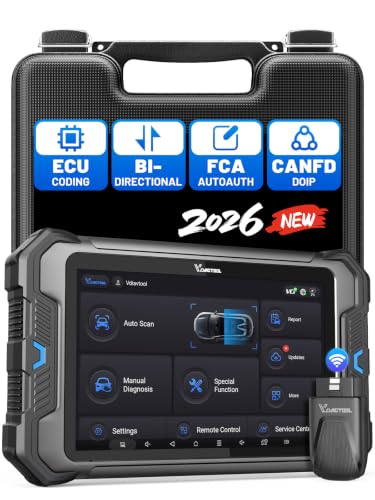
- 【Professional Diagnostics】 The VD80 BT Lite bidirectional obd2 scanner is a professional OBD2 scanner diagnostic tool, delivering vehicle diagnostics right in your own garage. It supports 4,000+ active diagnostic tests, 28+ maintenance service functions, ECU coding, PMI calibration, brake service reset, and OEM-grade full-system vehicle scanning—perfect for DIYers and pros looking for powerful automotive tools. The available function tests vary by model—please to confirm compatibility.
- 【ADVANCED ECU CODE, CUSTOMIZE OE-SETTINGS】As a complete car code reader and reset tool, the VD80 BT Lite bidirectional obd2 scanner supports ECU coding for VW, for Audi, for BMW, for Benz, for Mitsubishi and more. PMI function for Ford/for Lincoln/for Mazda, supports copy data into new module. Step-by-step Guided Diagnostics makes complex jobs easier—making this one of the most reliable code readers & scan tools on the market.
- 【100000+ Vehicles Compatibility – CAN FD/DOIP】 VD80 BT Lite Auto Scanner Compatible with 100,000+ vehicles worldwide, this bidirectiona car scanner works with all OBD2-compliant vehicles manufactured after 1996, covering more than 100 brands worldwide. It also supports CAN FD, DOIP and FCA Secure Gateway protocols, boost 2X faster data transfer, covers 99% of U.S., EU and Asian cars. With 22 languages and 2 years of f*ree updates—future-proofing your car reader diagnostic for all cars.
- 【28+ Maintenance Services & Calibration Functions】VD80 BT Lite scanner for car Supports 28 maintenance services, including resetting oil and service lights after routine maintenance, registering new batteries for proper system operation, and clear clogged filters and restore performance. Additionally, it calibrates TPMS sensors after tire rotations, resets brake systems after pad replacements, relearns steering angle sensors after alignments, and more. These functions help your vehicle quickly and accurately return to peak performance—without the costly dealer visits.
- 【True Bidirectional Control – Diagnose with Confidence】Standing out with full-system coverage and extensive active test capabilities, the VD80 BT Lite bidirectional scan tool retrieves data from electronic control units and performs a wide range of active tests. You can real-time control over modules like fuel pumps, windows, A/C clutches, and relays. Perform 100+ advanced functions including throttle adaptation, injector coding, VIN write, idle relearn, and ABS bleed—helping you fix it right the first time with this all-in-one car diagnostic scanner.
Last update on 2026-06-23 / Affiliate links / Images from Amazon Product Advertising API
This product presentation was made with AAWP plugin.