
NHTSA ID Number: 10173140
Manufacturer Communication Number: P021800
TSB/Document Date: 2020-04-02
Summary
Transmission Fluid Over Temperature Condition
DTC:
P0218 – 00
GDC18-058
Bulletin:
September 10, 2018
Date:
Description:
Applies to:
Transmission Fluid Over Temperature Condition
US13 - US17 Emissions
For Spanish click here: ESPAÑOL
General Information
These repair instructions are intended to address the following fault(s):
DTC
P0218 –
00
Description
Transmission
Fluid Over
Temperature
Condition
Possible Cause
x
x
x
x
Possible (Observable)
Symptoms
Low oil level, Transmission
Oil temperature sensor
Oil cooler
Transmission overloaded
Engine de-rated
Required Parts
Part Number
Description
Quantity
22807993
Oil Level Sensor
1
20579690
Oil Drain Plug Gasket
1
20541940
Oil Pan Gasket
1
20555696
1
*NOTE: Before proceeding with the repair below please check the following:
x
x
Check engine coolant level
Check transmission oil level
If the fluids are not at an acceptable level please check and diagnose for fluid leakage instead.
Repair Instructions
Oil Level Sensor Replacement
1. Secure the vehicle for service by parking it on a flat level surface, applying the parking brake, chocking the
rear wheel, and placing the transmission in neutral.
2. Disconnect all cables from the negative (ground) battery terminals to prevent personal injury from electrical
shock and prevent damage to electrical components.
3. Using a hydraulic jack, lift the front axle until the front wheels are off the ground. Position jack stands of a
suitable capacity under the frame in a position which will allow the front axle to hang free.
© 2016 Mack Trucks , Inc. Information is subject to change without notice.
Page 1/4
DTC:
P0218 – 00
Bulletin:
Date:
GDC18-058
September 10, 2018
4. Using a suitable container drain the oil. Discard of the oil drain plug gasket. Dispose of the use oil in
accordance with all state, local and/or federal regulations. Note: Use only hand tools when removing and
tightening the drain plug. Do not use air ratchet or similar air tool.
5. If required, remove the skid plate to allow access for oil pan removal.
6. Remove the oil fill and dip-stick tube.
7. Disconnect the engine oil level/temperature sensor (EOLT sensor) connector.
8. Move the transmission cooler hoses with the bracket attached to allow the oil pan to be removed.
9. Remove oil pan fasteners. Note: Note the fasteners orientation so they can be reinstalled in the correct
locations for the transmission cooler line brackets.
10. Carefully lower the oil pan. Note: Use caution so that the oil pick-up tube is not damaged during oil pan
removal.
© 2016 Mack Trucks, Inc. Information is subject to change without notice.
Page 2/4
DTC:
P0218 – 00
Bulletin:
Date:
GDC18-058
September 10, 2018
11. Replace the EOLT sensor.
12.
13.
14.
15.
20.
Clean the sealing surface on block and oil pan.
Install a new oil pan gasket on the oil pan.
Apply sealant at the corner joints on the sealing surface of the block.
Clean the oil pan gasket sealing surface on the cylinder block, flywheel housing and front seal cover. All
surfaces must be completely free of dirt and debris such as old sealant, and any grease or oil residue. Apply a
two mm (0.079 inch) bead of approved sealant to the seam between the flywheel housing and the timing gear
mounting plate and between the timing gear mounting plate and the engine block. Note: Make sure that the
block flange is flush with the flywheel housing to prevent leaking. If not flush, flywheel housing must be
realigned.
Reinstall oil pan.
Torque the oil pan fasteners to specifications. Note: For torque specifications refer to IMPACT FGRP 20 –
Specifications
Install a new O-ring on the oil fill tube and install the tube to the side of the oil pan. Install the oil fill tube
fasteners and tighten to secure.
Install the transmission cooler hose with the brackets attached, to the correct oil pan fasteners.
Tighten to specification.
Connect the EOLT sensor connector.
21.
22.
23.
24.
25.
26.
27.
Install the oil fill tube and dip-stick tube. Tighten fasteners securely.
Install skid plate if removed for access.
Remove the jack stands, lower the vehicle.
Fill the engine with the specified amount of approved engine oil. Do not overfill.
Install all the previously removed cables to the negative (ground) battery terminals.
Start engine, check for leaks.
Using Tech Tool, check and clear all codes.
16.
17.
18.
19.
© 2016 Mack Trucks, Inc. Information is subject to change without notice.
Page 3/4
DTC:
P0218 – 00
Bulletin:
Date:
GDC18-058
September 10, 2018
Additional Resources
These repairs are the most likely fix for the identified fault, if this does not fix the issue, Tech Tool will need to be
used for more detailed diagnostics. If filing a warranty claim, please include the ASIST case number.
Labor Code
3861-03-02-06
1.6 - 2.1 (Depending on model)
Causal Part
22807993
© 2016 Mack Trucks, Inc. Information is subject to change without notice.
Page 4/4
P0218 – 00
DTC:
Boletín:
Fecha:
GDC18-032
20 de febrero de 2020
Condición de temperatura excesiva del fluido de
transmisión
Descripción:
Emisiones de US13 - US17
Se aplica a:
Para inglés, haga clic aquí: ENGLISH
Información general
Estas instrucciones de reparación están destinadas a abordar las siguientes fallas:
DTC
P0218 – 00
Descripción
Condición de
temperatura
excesiva
del fluido de
transmisión
Posibles síntomas
(observados)
Causa posible
x
x
x
x
Bajo nivel de aceite, Transmisión
El sensor de temperatura de aceite
Enfriador de aceite
Sobrecarga de la transmisión
Reducción de potencia
del motor
Piezas necesarias
Número de pieza
Descripción
Cantidad
22807993
Sensor de nivel de aceite
1
20579690
Junta del tapón de drenaje de aceite
1
20541940
Junta del cárter de aceite
1
20555696
Aro sello del tubo de llenado de aceite
1
Instrucciones de reparación
Reemplazo del sensor de nivel de aceite
1. Asegure el vehículo al estacionarlo en una superficie plana, aplicar el freno de estacionamiento, bloquear
la rueda trasera y poner la transmisión en neutro.
2. Desconecte todos los cables de los terminales negativos (tierra) de la batería para evitar lesiones por
descargas eléctricas y daños en los componentes eléctricos.
3. Utilizando un gato hidráulico, levante el eje delantero hasta que las ruedas delanteras no toquen el suelo.
Coloque soportes de gato de una capacidad adecuada debajo el bastidor, en una posición que permita
que el eje delantero cuelgue libremente.
4. Con un contenedor adecuado, drene el aceite. Elimine la junta del tapón de drenaje de aceite. Elimine el
aceite usado según las regulaciones estatales, locales y/o federales. Nota: Utilice solo herramientas
manuales cuando retire y ajuste el tapón de drenaje. No use trinquete de aire ni herramientas de aire
similares.
5. Si es necesario, retire la placa de deslizamiento para permitir el acceso para retirar el depósito de aceite.
6. Retire el llenado de aceite y tubo de la varilla.
© 2016 Mack Trucks, Inc. La información está sujeta a cambios sin aviso previo.
Página 1/4
DTC:
P0218 – 00
Boletín:
Fecha:
GDC18-032
20 de febrero de 2020
7. Desconecte el conector del sensor de nivel de aceite/sensor de temperatura (sensor EOLT).
8. Mueva las mangueras de enfriamiento de la transmisión con el soporte adjunto para permitir que el depósito
de aceite sea retirado.
9. Retire los sujetadores del cárter de aceite. Nota: Tenga en cuenta la orientación de elementos de fijación
para que puedan volver a instalarse en los lugares correctos para los soportes de línea de transmisión más
fríos.
10. Baje con cuidado el depósito de aceite. Nota: Tenga cuidado para que el tubo de recolección de aceite no se
dañe durante el retiro del depósito de aceite.
© 2016 Mack Trucks, Inc. La información está sujeta a cambios sin aviso previo.
Página 2/4
DTC:
P0218 – 00
Boletín:
Fecha:
GDC18-032
20 de febrero de 2020
11. Vuelva a colocar el sensor EOLT.
12.
13.
14.
15.
20.
Limpie la superficie de sellado en el bloque y la bandeja de aceite.
Instale una nueva junta del múltiple de aceite en el cárter de aceite.
Aplique sellador en las juntas de esquina en la superficie de sellado del bloque.
Limpie la superficie de sellado de la junta del cárter de aceite en el bloque de cilindros, carcasa del volante y
la tapa del sello frontal. Todas las superficies deben estar completamente libres de suciedad y desechos
como el sellador viejo, y/o cualquier residuo de grasa o aceite. Aplique una tira de 2 mm (0.079 pulg.) de
sellador aprobado para la unión entre la carcasa del volante y la placa de montaje del engranaje de
sincronización y entre la placa de montaje del engranaje de sincronización y el bloque del motor. Nota:
Asegúrese de que la brida del bloque esté nivelada con la carcasa del volante para evitar fugas. Si no está
nivelado, la carcasa
del volante debe ser realineada.
Vuelva a instalar la bandeja de aceite.
Aplique par de apriete a los elementos de fijación del cárter de aceite de acuerdo a las especificaciones.
Nota: Para ver las especificaciones del par de apriete consulte IMPACT FGRP 20 – Especificaciones
Instale un nuevo aro sello en el tubo de llenado de aceite e instale el tubo a un lado del cárter de aceite.
Instale los elementos de sujeción del tubo de llenado de aceite y apriete para asegurar.
Coloque las mangueras de enfriamiento de la transmisión con los soportes unidos, a los elementos de
fijación del cárter de aceite correctos. Apriete a la especificación.
Conecte el conector del sensor EOLT.
21.
22.
23.
24.
25.
26.
27.
Instale el tubo de llenado de aceite y tubo de la varilla. Apriete los sujetadores.
Instale la placa de deslizamiento, si fue retirada para mejorar el acceso.
Retire los soportes del gato, baje el vehículo.
Llene el motor con la cantidad especificada del aceite de motor aprobado. No sobre llene.
Instale todos los cables que había quitado anteriormente a los terminales negativos (tierra) de la batería.
Arranque el motor, compruebe si hay fugas.
Con TechTool, revise y borre todos los códigos.
16.
17.
18.
19.
© 2016 Mack Trucks, Inc. La información está sujeta a cambios sin aviso previo.
Página 3/4
DTC:
P0218 – 00
Boletín:
Fecha:
GDC18-032
20 de febrero de 2020
**NOTA** FSB 284-047, Empalme de cable de arnés del sensor de nivel de aceite (octubre de 2013)
Algunos vehículos VOLVO construidos entre enero de 2004 y el 19 de septiembre de 2013 pueden experimentar
una falla en el sensor de nivel de aceite que genera contaminación de aceite en el arnés de cableado del motor. Un
nuevo kit de antipercolación de empalme pigtail, número de pieza 85137983, está disponible ahora. Siga el
siguiente procedimiento si se observa percolación. Chasis con fecha de fabricación de 20 de septiembre de 2013 y
posterior tienen el nuevo conector de clavijas sólidas y no se requiere ninguna acción. El sensor de nivel de aceite,
número
de pieza 21521353, con conector de clavijas huecas ahora fue reemplazado por el nuevo sensor de nivel de aceite
con conector con clavijas sólidas, número de pieza 22022794. El nuevo conector con clavijas sólidas no permite
que el aceite ingrese en el arnés del motor.
Recursos adicionales
Es muy probable que estas reparaciones solucionen la falla identificada; si esto no soluciona el problema, se
requerirá el uso de Tech Tool para diagnósticos más detallados. Si presenta una reclamación de garantía, incluya
el número de caso ASIST.
Código de trabajo
3861-03-02-06
1.6 – 2.1 (según la configuración)
Pieza causal
22807993
© 2016 Mack Trucks, Inc. La información está sujeta a cambios sin aviso previo.
Página 4/4

- REDUCED - oxidation and lower volatility at high temperature
- ALLOWS - high-temp operation without varnishing valves and...
- IMPROVED THERMAL STABILITY - maintains viscosity levels, and...
- POPULAR TRANSMISSION FLUID FOR - Dexron-VI, MerconSP...
- WHY RED LINE - Established in 1979, Red Line Products...

- CUTTING EDGE TECHNOLOGY - Shockproof technology designed to...
- QUIET SMOOTH SHIFTING - V-Twin Transmission oil dampens...
- IMPROVES PERFORMANCE - Transmission fluid that dramatically...
- POPULAR POWESPORTS OIL FOR - UTVs & Side by Sides, ATVs...
- WHY RED LINE - Established in 1979, Red Line Products...
Last update on 2026-06-12 / Affiliate links / Images from Amazon Product Advertising API
If the PDF is very large, it may not load in the preview below.
Some older TSBs had multiple PDFs — visit the NHTSA Website to view all PDFs.
If the TSB PDF does not show, download or view it on the NHTSA Website.
Click on the (+) Plus Sign
Then Click on Associated Document(s)
Search NHTSA Database for Recalls
Search NHTSA Database for Vehicle Investigations
View Latest Vehicle Investigations
Search NHTSA Database for Vehicle Complaints
View Latest Vehicle Complaints
TSB/Document ID: P021800
Replacement Service Bulletin Number:
MFR Communication Date: 2020-03-10
MFR Internal Campaign ID/Software Version:
Communication Type: Service Bulletin/Repair Instructions
NHTSA Components: POWER TRAIN
MFR Component System:
MFR Component Subsystem:
Previous TSB | Next TSB |
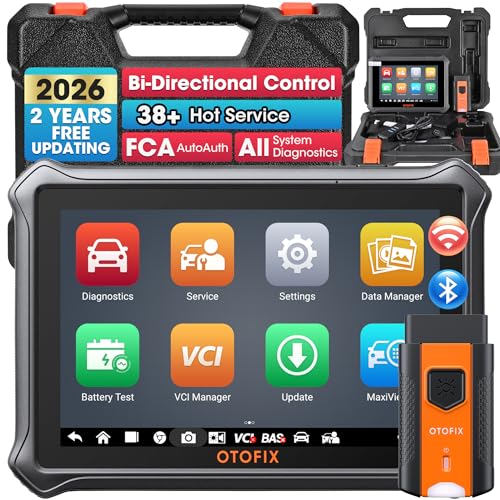
- 🎉[OTOFIX D1 Lite, Perfect Cost-effective Diagnostic Tool]: OTOFIX D1 Lite, a newest bidirectional scan tool from OTOFIX company, is a great choice for DIYers and repair shops. 👉This obd2 scanner diagnostic tool packs all practical functions: OE level all systems diagnoses, Bi-Directional Control, 38+ reset services fixing 99% of common problems, support DoIP & CANDF protocols and FCA
 AutoAuth, high-end hardware configuration. Worldwide vehicles and 🔥2 Years Free Updating🔥 covered.
 - 🎉[Bi-Directional Scan Tool, Active Test]: OTOFIX D1 Lite bluetooth obd2 scanner can also command ECUs and monitor the operation of the actuators to track down the problems of certain parts, like windows, sunroof, wipers, fuel pumps, etc., saving repair time & trouble. This makes OTOFIX D1 Lite the most cost-effective bidirectional scan tool.
- 🎉[2026 Newest, 38+ Hot Reset Functions]: Equipped with 38+ reset functions in one, the OTOFIX D1 lite automotive scanner diagnostic tool allows you to troubleshoot 99% of common vehicle problems. You can use this car diagnostic scanner holding enough functions to easily repair common vehicle models in your repair shops. Including Oil Reset, Injector Coding, Throttle, DPF Reset, SCR Reset, Gear Learning, Clutch Learning, Suspension, etc. Note* Reset functions vary by model.
- 🎉[OE Level Full Systems Diagnostics]: Unlike the 2-system and 4-system diagnostic tools, the OTOFIX auto scan tool can complete comprehensive system diagnostics within 5 minutes. It accesses and scans all available onboard systems like for Engine /AT /ABS /EPB /BMS /TPMS /SRS /SAS /Audio System /BCM /Air Conditioning / etc., to read & clear codes, view live data, and check ECU information. Note: Active test is not involved.
- 🎉[Powerful Hardware Configuration]: Designed with a fashion appearance & a 7” touchscreen and a weight of 463g, this OTOFIX D1 Lite OBD2 diagnostic scanner scan tool is convenient for everywhere and easy to use & store. Android9.0 OS and 2+64GB memory enhance multi-task smoothness and diagnostic operation, no more wasting too much time. 5800mAh battery allows hours-lasting use. WiFi & VCI1 also bring faster communication for your diagnostics.

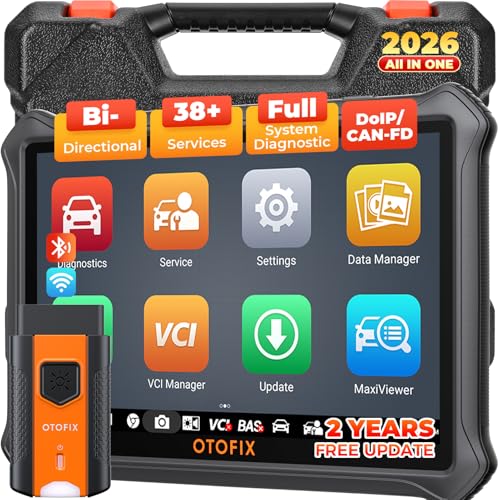
- 🏆【2026 TOP OBD2 Scanner Diagnostic Tool】OTOFIX D1 Lite wireless obd2 scanner has upgraded hardware configuration and car coverage. The newly upgraded D1 Lite with 🔥OS Android 9.0🔥1.5Ghz 4 core high efficiency processor🔥2GB RAM+64GB ROM large storage🔥5800mAh large battery, more stable and longer lasting diagnostics🔥 38+ Reset🔥action tests🔥full system diagnostic🔥Supports MV105 endoscope🔥21+ Language Supports🔥100000+ vehicle coverage to meet all your daily maintenance needs.
- 👍【Bi-Directional Control / Active Test】D1 Lite obd2 scanner has bidirectional control(worth $300+), which is the most beloved feature among mechanic. If your headlights or car windows are broken, going to a repair shop will cost a lot of money. You can use D1 Lite to send execution commands to the ECU module and identify the repair status. Such as ABS, car windows, doors, valves, wipers, headlights, etc., effectively shorten diagnostic time and reduce diagnostic costs.
- 🔥【All Systems Diagnostics, In-depth Checking】This advanced OBD2 Scanner D1 Lite can perform OE-level diagnosis of all systems including engine, transmission, airbag, ABS, ESP, TPMS, gateway, steering, radio, and air conditioning for more than 100 brands. This diagnostic scanner supports essential functions, such as reading ECU version info, reading and clearing fault codes, and reading data streams.With just a simple click, it provides you with accurate and in-depth diagnostics.
- 🏆【38+ Reset Hot Functions】For repair workshops, holding an OTOFIX D1 Lite Auto scanner is a strong advantage over others. Its 38+ maintenance functions provide various solutions for all module repairs, including Oil Reset, TPMS Reset, Injector Coding, Suspension, Throttle Matching, etc., which will usher your repair business to a new pinnacle. Continuously updating will never make the functionality & compatibility out-of-date.
- 🏆【150+ Models, 10000+ Car Coverage & 16 Languages】D1 Lite is a comprehensive car diagnostic scan tool, help you to troubleshoot car issues fast for 95% US, European, Asian auto makes. ✅ With frequent updates and optimizations allow D1 Lite to cover more vehicles to meet your needs. ✅ Multilingual menu allows auto mechanics around the world to use it without language barriers. 🚩Note: Kindly send us the S/N of the device to authorize new language updates before changing the menu language.
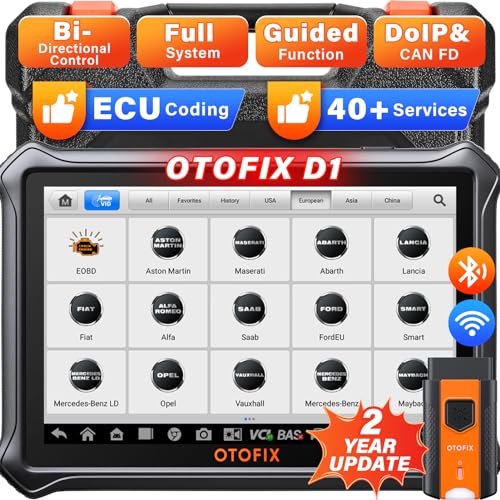
- 2026 Newest Wireless Bluetooth Scan Tool D1: OTOFIX D1 Diagnostic scanner is upgraded version with Enhanced Hardwares & Newest Functions, FASTER and SMARTER! ✅Alternative Bluetooth 5.0 +USB connect✅2G+64GB✅Android 9.0 OS✅5G & 2.4 GHz Dual WiFi✅5800mAh battery👍VAG Guided Function👍ECU Online Coding👍CANFD&DOIP👍40+ Services👍Bi-Directional Control👍Full Systems Diagnose👍2 Years Free Update👍150+ Vehicle Coverage🎁Contact to get gift: otofixaftersales-amz@ outlook.com
- ECU Coding to Unlock the Hidden Features: OTOFIX D1 obd2 scanner diagnostic tool newly adds ECU Coding which can Online Coding(ONLY for VW/Au.di/Sk0da), Variant Coding/Offline Programming, Flash Hidden Functions, Reset Adaptive Data, Match Replaced Components, Customize OE-Settings. Such as: halogen fog lamps retrofitted with xenon fog lamps, different capacity battery retrofit, disbale auto start-stop, sunroof initialization, injector calibration, etc. PS: Coding functions vary by model&year.
- Full Bidirectional Control for Active Car Tests: The D1 OTOFIX scanner also offers bi-directional control, allowing you to perform powerful active tests on car subsystems. This means that you can check the working status and functionality of open & close solenoids, energize injectors, turn cooling fan on & off, and more, all from the device itself.🚩The D1 bi-directional obd2 scanner can quickly help you to check if a system or component goes well,Improving 200% Efficiency.**Note that Active Tests available depend on the make/model/year of your car.
- 40+ Popular Maintenance Functions: OTOFIX D1 obd scanner for car performs 40+ hot services, including Oil Reset, EPB, TPMS, BMS, E.GR, G.PF, D.PF, SAS Calibration, ABS Bleeding, Injector Coding, Gearbox Match, Suspension, Crankshaft Relearn, Power Balance, etc., still growing. Great choice for DIYers, technician, repair shop. 🚩Get MORE special functions from "Car Brand>System>Service". Check compatibility before purchase via 📧 otofixaftersales-amz@ outlook.com.
- OE-Level All Systems Diagnostic + One-Click AutoVIN & AutoSCAN: OTOFIX D1 scanner automotriz gives you the ability to troubleshoot entire car systems including engion system,transmission system,body system,chassis,etc. 🚩One of the standout features of the D1 obd2 scanner diagnostic tool is the one-click AutoVIN & AutoScan function. This feature allows you to quickly and easily scan all diagnosable ECUs with just one click, and identify any problems hidden in your vehicle's systems.
Last update on 2026-06-12 / Affiliate links / Images from Amazon Product Advertising API
This product presentation was made with AAWP plugin.