
NHTSA ID Number: 10165111
Manufacturer Communication Number: 19NA180
TSB/Document Date: 2019-09-23
Summary
This New Engine Features Bulletin provides General Information to help the Service Personnel become familiar with the Duramax Diesel 3.0L - RPO LM2.
Bulletin No.:
Service Bulletin
Date:
19-NA-180
September, 2019
INFORMATION
Subject:
Brand:
Duramax® Diesel 3.0L New Engine Features
Model:
Model Year:
From:
Silverado
1500
To:
2020
Sierra 1500
Involved Countries
From:
To:
—
Engine:
Duramax®
Diesel, 3.0L,
Inline
6-Cylinder, CRI,
DOHC,
Turbocharged,
VGT,
Aluminum,
CSS50V —
RPO LM2
10L80,
10-Speed
Automatic,
ATSS, CPA,
GEN 2 —
RPO MQB
United States, Canada, Mexico, South America and Middle East
Overview
Bulletin Purpose
The purpose of this bulletin is to introduce the
Duramax® diesel 3.0L turbocharged engine. This
bulletin will help the Service Department Personnel
become familiar with the engine, components, fuel
system, engine oil requirements, exhaust
aftertreatment system and transmission.
Duramax® Diesel 3.0L L6 Turbocharged
Engine — RPO LM2
Overview
The Duramax® Diesel 3.0L will be paired with GM’s
10-speed automatic transmission — RPO MQB and will
produce approximately 282 horsepower (210.28 kW)
and 450 lb ft (610.11 Nm) of torque.
Copyright 2019 General Motors LLC. All Rights Reserved.
VIN:
Page 2
September, 2019
Bulletin No.: 19-NA-180
5336795
Left Front
Bulletin No.: 19-NA-180
September, 2019
Page 3
5336810
Right Front
Engine Specifications
•
•
•
•
•
•
•
Bore: 3.307-inches (84.0 mm)
Compression: 261 PSI (1800 kPa)
Compression Ratio: 15:1
Displacement: 3.0L
Firing Order: 1–5–3–6–2–4
Glow Plug Voltage: 5.4 V
Stroke: 3.543-inches (90.0 mm)
•
•
Engine Component Description
•
•
•
•
Camshaft: Two camshafts are used, one for all
intake valves, the other for all exhaust valves. The
camshafts are driven by two camshaft sprockets
which in turn are driven by the secondary timing
chain.
Compressor Air Intake Turbocharger: The
turbocharger is a variable nozzle design with an
electric vane actuator attached to the exhaust
manifold. The turbocharger supplies compressed
air from the turbine/impeller to the engine to
increase power. It also results in higher fuel
efficiency and lower CO2 emissions.
Crankshaft: The crankshaft is forged steel with
4 counterweights. It is supported by 7 main
journals with main bearings which have oil
clearance for lubricating. The thrust bearing is
•
•
located at the 6th main journal. A crankshaft pulley
is used to control torsional vibration. The sprocket
for the primary drive chain is machined directly on
the crankshaft. An oil pump sprocket is integrated
on to the crankshaft along with a timing
reluctor ring.
Cylinder Head: The cylinder head is dual
over-head camshaft (DOHC) with 4 valves per
cylinder. The cylinder head is made of cast
aluminum.
Engine Block: The engine block is cast
aluminum with 6 pressed in iron sleeves. The
block has 7 crankshaft main bearings with one
thrust bearing set.
Exhaust Manifold: The exhaust manifold is
located on the cylinder head. It is designed to
endure high pressure and high temperature. The
turbocharger is mounted on the exhaust manifold.
High Pressure Diesel Fuel Injection System:
The high pressure fuel pump supplies pressurized
fuel through the high pressure fuel lines to the fuel
rail and then through the fuel injector lines to the
fuel injectors. Excess fuel returns to the fuel tank
through the fuel return pipes.
Hydraulic Valve Lash Adjuster: The valve train
uses a valve rocker arm acted on by a hydraulic
valve lash adjuster which reduces friction and
noise.
Page 4
•
•
•
•
•
September, 2019
Intake Manifold: Intake air flow from the throttle
body passes through the intake manifold to the
cylinder combustion chambers. The intake
manifold is made of a composite material.
Lower Crankcase Extension: The lower
crankcase extension bolts to the engine block and
contains the oil pump. The oil pump is fastened
directly to the lower crankcase extension. The oil
pump is a variable vane pump driven by a wet
timing belt, which is driven by the oil pump
sprocket.
Lower Oil Pan: The lower oil pan is made of
dual-layer stamped aluminum and is attached at
the lower crankcase extension.
Positive Crankcase Ventilation System: The
positive crankcase ventilation (PCV) valve carries
blow-by gas to the turbocharger inlet of the intake
system. The amount of blow-by gas varies
according to engine conditions, driving conditions
and the pressure of the turbocharger. The PCV
valve is designed to control the amount of
blow-by gas.
Valves: There are 2 intake and 2 exhaust valves
per cylinder.
Bulletin No.: 19-NA-180
Cooling System
Overview
The Duramax® 3.0L utilizes GM’s advanced cooling
system strategy known as Active Thermal Management
(ATM). ATM distributes coolant through the engine in a
targeted manner, sending heat where it’s needed to
warm up the engine, thereby reducing friction. It
promotes quicker heating of the passenger
compartment as needed and engine cooling when
needed during high power operation. The system uses
a conventional engine-driven coolant pump. The ECM
controls the complete ATM system using feedback from
various sensors.
The engine has numerous engine coolant temperature
(ECT) sensors placed at specific locations throughout
the cooling system as follows:
– Engine Block Coolant Temperature Sensor
– Engine Cylinder Head Coolant Temperature Sensor
– Engine Inlet Coolant Temperature Sensor
– Engine Outlet Coolant Temperature Sensor
– Radiator Outlet Coolant Temperature Sensor
– Heater Core Inlet Coolant Temperature Sensor
– Heater Core Outlet Coolant Temperature Sensor
Additional sensors used by the ECM to control the ATM
system are:
– Engine Oil Temperature Sensor 1 and Sensor 2
– Transmission Oil Temperature Sensor
– Control Valve Sensors
Bulletin No.: 19-NA-180
September, 2019
Page 5
Engine Coolant Flow Control Valve
5340159
The Engine Coolant Flow Control Valve assembly is
attached to the engine under the intake manifold. The
engine coolant flow control valve is comprised of two
actuators, the Block Rotary Valve (BRV) (1) and the
Main Rotary Valve (MRV) (2). The engine coolant flow
control valve consists of two chambers. The first
chamber controls the coolant flow rate across the
radiator and bypass. The second chamber controls the
flow to the transmission and engine oil cooler, providing
heated coolant from the EGR/Turbocharger return
circuit or cold coolant directly from the pump outlet, as
required based on feedback from the various coolant
temperature sensors. The engine coolant flow control
valve also has an integrated Flow Control Valve (FCV)
(3) that limits engine coolant flow from the mechanical
water pump when full output is not needed. The
Exhaust Gas Recirculation (EGR) feed port is
always open.
Engine Coolant Flow Control Valve Reverse View
5354588
1. Block Port
2. Head Port
Page 6
September, 2019
Bulletin No.: 19-NA-180
Exhaust Aftertreatment System
Auxiliary Electric Engine Coolant Pump
Overview
The exhaust aftertreatment system is designed to
reduce the levels of hydrocarbons (HC), carbon
monoxide (CO), oxides of nitrogen (NOx), and
particulate matter (PM) pollutants remaining in the
engines’s exhaust gases before they exit via the
vehicle’s exhaust tailpipe.
Typically NOx and PM are controlled by separate
aftertreatment components. NOx is controlled by a
Selective Catalytic Reduction (SCR) converter
combined with precise injections of Diesel Exhaust
Fluid (DEF), while PM is controlled by a diesel
particulate filter (DPF). Combining aftertreatment
system components can reduce packaging volume and
manufacturing cost. One way of doing this is to coat the
SCR catalyst on the DPF to form an SCR coated DPF
also known as a Selective Catalytic Reduction on Filter
(SCRoF).
5340434
When the Stop/Start System has shut down the engine,
and the ambient temperature is colder than 59°F
(15°C), the ECM will activate the Stop/Start relay for the
auxiliary electric engine coolant pump motor (1) to turn
it ON. This will continually circulate engine coolant
through the heater core while the engine is OFF. This is
to ensure the passenger compartment temperature is
maintained while the engine is OFF. Once the Stop/
Start System has restarted the engine, the ECM will
deactivate the relay to turn OFF the auxiliary electric
coolant pump motor, allowing the engine driven coolant
pump to circulate the engine coolant.
Bulletin No.: 19-NA-180
September, 2019
Page 7
Component Location and Description
5336000
Tip: A exhaust mounting boss is an internally threaded
protruding feature on a work piece or component,
typically used to mount various exhaust sensors. In the
diagrams the boss is used to identify certain
component mounting locations.
1. Nitrogen Oxides (NOx) Sensor - Position 1 (Boss).
2. Emission Reduction Fluid/Diesel Exhaust Fluid
(DEF) Injector Mounting Flange.
Note: This catalyst is located in the close coupled
position.
3. Nitrogen Oxides Catalytic Converter (LM2 With
Filter) assembly. The arrow points to the Diesel
Particulate Filter (DPF) section of the assembly
(rear gray section), that contains the SCR on Filter
(SCRoF).
4. Exhaust Back Pressure Valve. The valve disc is
internal to the assembly and the valve actuator is
mounted on the exterior cover.
5. Nitrogen Oxides (NOx) Sensor - Position 3 (Boss).
Note: This catalyst is located in the underfloor
position.
6. Nitrogen Oxides Catalytic Converter (LM2 Without
Filter) assembly. The front section of the assembly
is an SCR. The rear section of the assembly is an
Ammonia Oxidation Catalyst.
7. Nitrogen Oxides (NOx) Sensor - Position 2 (Boss).
8. Diesel Oxidation Catalyst (DOC), part of the
Nitrogen Oxides Catalytic Converter (LM2 With
Filter) assembly. The arrow points to the Diesel
Oxidation Catalyst section of the assembly (front
green section).
Page 8
September, 2019
Bulletin No.: 19-NA-180
Component Location and Description
(Reverse View)
5336140
1. Exhaust Temperature Sensor - Position 1 (Boss).
2. Emission Reduction Fluid/Diesel Exhaust Fluid
(DEF) Injector Mounting Flange.
3. Exhaust Pressure Differential Sensor Pipe.
4. Exhaust Pressure Differential Sensor Pipe.
5. Exhaust Gas Recirculation (EGR) Flange.
Note: This catalyst is located in the underfloor
position.
6. Nitrogen Oxides Catalytic Converter (LM2 Without
Filter) assembly. The front section of the assembly
is an SCR. The rear section of the assembly is an
Ammonia Oxidation Catalyst. The arrow points to
the SCR section of the assembly.
7. Particulate Matter (PM) (Boss).
8. Exhaust Back Pressure Valve. The valve disc is
internal to the assembly and the valve actuator is
mounted on the exterior cover.
Diesel Oxidation Catalyst (DOC) Operation
The DOC is the front section of the Nitrogen Oxides
Catalytic Converter (LM2 With Filter) assembly. The
close coupled DOC removes exhaust HC and CO
through an oxidation process. The DOC functions much
like the catalytic converter used with gasoline fueled
engines. As with all catalytic converters, the DOC must
be hot in order to effectively convert the exhaust HC
and CO into CO2 and H2O. On cold starts, the exhaust
gases are not hot enough to create temperatures within
the DOC that are hot enough to support full HC and CO
conversion. Proper DOC function requires the use of
ultra-low sulfur diesel (ULSD) fuel containing less than
15 parts-per-million (ppm) sulfur. Levels above 15 ppm
will reduce catalyst efficiency and eventually result in
poor driveability and one or more DTCs may be set.
Selective Catalyst Reduction (SCR) — SCR on Filter
(SCRoF)
The close coupled DOC along with the SCR on Filter
(SCRoF) are integrated into one assembly. The
combined SCR and DPF make up the second section
of the Nitrogen Oxides Catalytic Converter (LM2 With
Filter) assembly. In the DPF, particulate matter
consisting of extremely small particles of carbon
remaining after combustion are removed from the
exhaust gas by the large surface area of the DPF. DEF
is injected into the exhaust gases prior to entering the
SCRoF stage. Within the SCRoF, NOx is converted to
nitrogen (N2), carbon dioxide (CO2) , and water
vapor (H20) through a catalytic reduction fueled by the
injected DEF.
Bulletin No.: 19-NA-180
September, 2019
Emission Reduction Fluid — Diesel Exhaust
Fluid (DEF)
Note: Depending on the Service Information or
Parts Information that is being referenced,
Emission Reduction Fluid is also identified as
Diesel Exhaust Fluid (DEF) and/or Reductant.
Diesel Exhaust Fluid (DEF) is a mixture of a carefully
blended aqueous urea solution of 32.5% high purity
urea (Pharmaceutical Grade Urea) and 67.5%
deionized water. The ECM energizes the DEF injector
to dispense a precise amount of reductant upstream of
the SCRoF in response to changes in exhaust NOx
levels. Within the SCRoF, exhaust heat converts the
urea into ammonia (NH3) that reacts with NOx to form
nitrogen, CO2, and water vapor. Optimum NOx
reduction occurs at SCRoF temperatures of more than
480°F (250°C). At lower temperatures, NH3 and NOx
may react to form Ammonium Nitrate (NH4NO3) which
can lead to temporary deactivation of the SCRoF
catalyst. To prevent this, the ECM will suspend DEF
injection when the exhaust temperature is less than a
calibrated minimum.
A 32.5% solution of urea with 67.5% deionized water
will begin to crystallize and freeze at 12°F (−11°C). At
this ratio, both the urea and water will freeze at the
same rate, ensuring that as it thaws, the fluid does not
become diluted, or over concentrated. The freezing and
thawing of DEF will not cause degradation of the
product. DEF should be stored in a cool, dry,
well-ventilated area, out of direct sunlight.
Exhaust Gas Temperature (EGT) Sensor
The engine uses exhaust gas temperature (EGT)
management to maintain the SCRoF catalyst within
the optimum NOx conversion temperature range of
390–750°F (200–400°C). The ECM monitors the EGT
sensors located upstream and downstream of the
SCRoF in order to determine if the SCRoF catalyst is
within the temperature range where maximum NOx
conversion occurs.
Exhaust Pressure Differential Sensor
Pressure connections, provided by pipes/hoses at the
DPF inlet and outlet allow the sensor to measure the
pressure drop across the DPF. This pressure drop
increases as trapped soot (Particulate Matter) collects
in the cells of the DPF during vehicle operation. The
rate at which soot collects varies with the power
demands placed on the engine. If left unchecked, the
increasing back pressure will eventually result in a
driveability problem. There are two sensing elements in
the sensor; one for the upstream side of the DPF, and
the other for the downstream side. Pressure from each
side of the DPF is applied to the bottom side of a silicon
diaphragm in each sensing element while atmospheric
pressure is applied to the top side of each diaphragm.
Relative pressure differences in each sensing element
is converted to a voltage (V1 & V2). The difference in
these voltages is monitored by the ECM. As the DPF
becomes restricted, the pressure on the upstream side
increases because of back pressure due to the
restriction of the exhaust gas flow exiting the DPF.
Page 9
Nitrogen Oxides (NOx) Sensor
The ECM uses three smart NOx sensors to control
exhaust NOx levels. The first NOx sensor is located in
the inlet pipe of the close coupled catalyst, near the
turbocharger outlet and monitors the engine out NOx.
The second NOx sensor is located in the exhaust pipe
downstream of the SCRoF and monitors NOx levels
exiting the close coupled SCRoF. The third NOx sensor
is located on the Nitrogen Oxides Catalytic Converter
(LM2 Without Filter) assembly and monitors NOx levels
exiting the aftertreatment system.
The smart NOx sensors consist of two components, the
NOx module and the NOx sensor element that are
serviced as a unit. The NOx sensors incorporate an
electric heater that is controlled by the NOx module to
quickly bring the sensors to operating temperature. As
moisture remaining in the exhaust pipe could interfere
with sensor operation, there is a delay turning ON the
heaters until the exhaust temperature exceeds a
calibrated value. This allows any moisture remaining in
the exhaust pipe to boil off before it can effect NOx
sensor operation.
Particulate Matter (PM) Sensor
The PM sensor monitors the amount of particulates
(soot) in the exhaust gas exiting the tailpipe. The PM
sensor is similar to a heated oxygen sensor with a
ceramic element but also includes an individually
calibrated control unit. The PM sensor sensing element
includes two comb-shaped inter-digital electrodes, a
heater and a positive temperature coefficient (PTC)
resistor used for temperature measurement.
The operation of the PM sensor is based on the
electrical conductivity characteristic of the soot. As the
exhaust gas flows over the sensing element, soot is
absorbed in the combs between the electrodes,
eventually creating a conductive path. When the path is
formed, it generates a current based on the voltage
being applied to the element. The measurement
process continues until a preset current value is
reached. To avoid misleading readings, the sensor
operates on a “regenerative” principle, where the soot
is cleaned off by heating up the element to burn off the
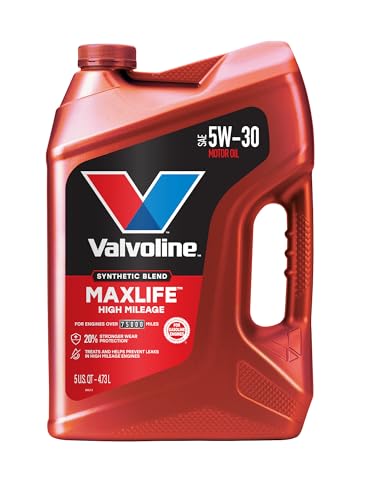
- Formulated for engines with 75,000 miles or more, Valvoline...
- Delivers 20% better wear protection and 15% better sludge...
- Extra detergents safeguard against friction, corrosion and...
- Advanced friction-fighting additives help maximize...
- Provides performance benefits for high mileage, new and...

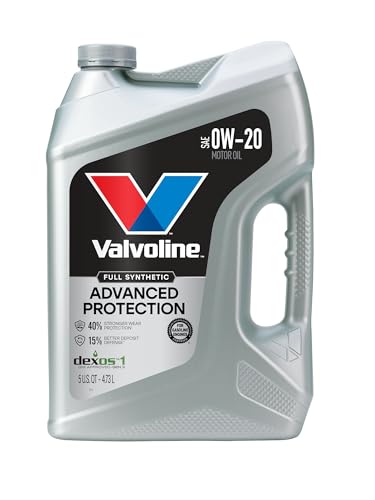
- Advanced protection against the four main causes of engine...
- Delivers 40% stronger wear protection than industry...
- Provides 15% better deposit defense vs. industry standards...
- Up to 2.5X better heat protection vs. industry standards to...
- Engineered for excellent low-temperature flow, reducing...
Last update on 2026-06-12 / Affiliate links / Images from Amazon Product Advertising API
If the PDF is very large, it may not load in the preview below.
Some older TSBs had multiple PDFs — visit the NHTSA Website to view all PDFs.
If the TSB PDF does not show, download or view it on the NHTSA Website.
Click on the (+) Plus Sign
Then Click on Associated Document(s)
Search NHTSA Database for Recalls
Search NHTSA Database for Vehicle Investigations
View Latest Vehicle Investigations
Search NHTSA Database for Vehicle Complaints
View Latest Vehicle Complaints
TSB/Document ID: 19NA180
Replacement Service Bulletin Number:
MFR Communication Date: 2019-08-28
MFR Internal Campaign ID/Software Version:
Communication Type: Service Bulletin/Repair Instructions
NHTSA Components: ENGINE AND ENGINE COOLING:ENGINE:DIESEL
MFR Component System:
MFR Component Subsystem:
Previous TSB | Next TSB |

- Stay Updated with Lifetime Access: This obd2 scanner includes lifetime free software updates for all app service functions. With a single payment, enjoy full access to diagnostics, reset tools, and maintenance features — zero subscription fees. A budget-friendly choice for weekend mechanics, home car owners, and DIYers, supporting vehicles from 1996 onward. Come to us with your VIN to check compatibility.
- Full Bidirectional Control/Active Tests & Stable Wireless Connectivity: This car code reader features full bidirectional control, allowing you to send commands to the vehicle's ECU for active tests on components such as fuel pumps, injectors, A/C clutches, windows, sunroofs, and more. This car scanner diagnostic tool helps DIYers quickly diagnose and test vehicle parts, cutting down troubleshooting and repair time. With BT 4.0 wireless connectivity, you can enjoy cable-free diagnostics up to 33 feet. Stand in your garage and test windows, wipers, or even engine components—all without needing to move around your car.
- Portable Car Scanner with 26 Special Functions: Scheduled vehicle maintenance with the A30M car diagnostic scanner can keep your vehicle in peak condition and save you big on dealership trips. The XTOOL A30M obd2 scanner diagnostic tool features essential reset and relearn functions, such as Oil Reset, EPB Reset (Electronic Parking Brake Release), SAS, ABS Brake Bleeding, Throttle Body Relearn, Injector Coding, Crank Sensor Relearn, Headlight Adjustment, and Tire Size Reset. Note: Service functions may vary by vehicle model – check compatibility beforehand!
- Wide Compatibility CAN FD & FCA
 Autoauth: This obd2 scanner diagnostic tool is compatible with over 85+ car brands from the U.S., Europe, and Asia, providing extensive coverage through a BT connection with your smartphone or iPad. Now upgraded to support the latest protocols, it includes FCA AutoAuth access for Chrysler, Jeep, Dodge, and Fiat (2018+), and supports CAN FD for GM (2020+) models, giving you greater access to newer vehicles and systems. Note: The FCA AutoAuth account is not included with the device. Users must register and pay separately through the official FCA AutoAuth website to access diagnostic functions for vehicles that require it.
 - Up to 8 Live Data Streams Graphing – Real-Time Graphing for Deeper Insight: This car scanner supports up to 8 live data streams simultaneously with intuitive, real-time graphing. Gain comprehensive insights into your vehicle’s performance, making it easier to spot issues, detect trends, and make informed diagnostic decisions with confidence.
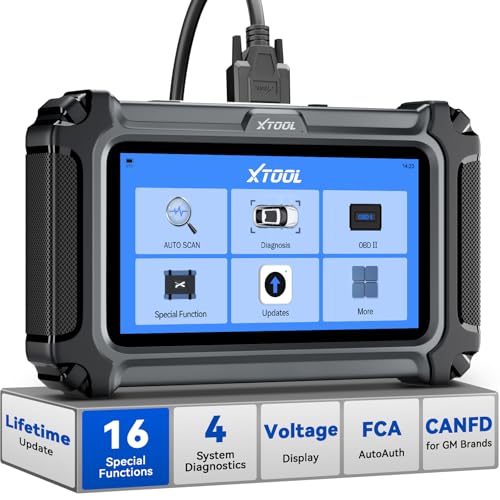
- Comprehensive OBD2 Scanner with 16 Resets: The XTOOL D5S car code reader and vehicle reset tool provides an advanced diagnostic solution with 16 commonly needed reset functions, including Electronic Parking Brake Reset (EPB Reset), SAS, BMS Reset (Battery Test), Throttle Body Relearn, TPMS Reset, ABS Bleeding, Injector Coding, Gearbox Match, Suspension Adjustment, Headlight, Window Initialization, Crank Sensor Relearn and more. Equipped with CAN FD Protocol and FAC AutoAuth, the D5S obd2 scanner diagnostic tool ensures compatibility with a broad range of modern vehicles, allowing users to address common maintenance needs quickly. NOTE: Please Check the Compatibility before ordering.
- 4 Main System Car Scanner & Full OBD2 Diagnostics: The XTOOL D5S car code reader is ideal for home mechanics, DIYers, and professionals, providing access to Transmission/Engine/ABS/SRS systems to read DTCs, Live data can be displayed in text or up to 4 PID data graphs, along with full OBD2 diagnostics to check the engine light on, other obd2 issues and routine maintenance. This car diagnostic scanner ensures you can keep your vehicles in top condition, avoiding costly repairs or unexpected breakdowns. NOTE: Some vehicles display three systems after connection because the transmission and engine of some vehicles are integrated into one.
- Check Engine Code Reader & Real-Time Engine Monitoring: Whether you're a car owner, a DIYer, or run a repair shop, the XTOOL D5S obd2 scanner diagnostic tool makes engine diagnostics fast and frustration-free, reading and explaining trouble codes in seconds—no confusion. Check live data like fuel trim, 02 sensor voltage, RPM, and coolant temp to pinpoint mis~fires, rough idle, or sensor issues. After repairs, simply use the D5S check engine code reader and reset tool to turn off the check engine light and confirm the problem’s fixed—saving time, money, and unnecessary shop visits. - Note: If the check engine light comes back on, it indicates the original problem still exists.
- Portable Car Scanner for ABS and SRS: XTOOL D5S gives you peace of mind when ABS or airbag warning lights come on. It reads and clears ABS codes to help you fix brake sensor, traction control, or wheel speed issues, and supports ABS bleeding after repairs like caliper or master cylinder replacement. For airbag systems, it scans and clears SRS codes related to airbags, seatbelt tensioners, and crash sensors. Whether you're doing repairs at home or running a small shop, the D5S is a cost-effective solution for safety diagnostics. Note: If a fault code returns after clearing, it usually means the issue hasn’t been fully resolved. Please check the compatibility before ordering.
- Transmission Warning Light ON? Here’s the Transmission Diagnostic and Reset Tool You Need: The XTOOL D5S is more than just a basic car scanner—it’s an easy-to-use transmission diagnostic tool. From rough shifts to slipping gears, the D5S lets you read and clear transmission trouble codes, monitor real-time TCM data, and perform transmission resets after fluid changes or repairs. Whether you’re a hands-on car owner or a pro running a busy shop, this OBD2 scanner with transmission functions helps you catch problems early—saving you time, money, and future headaches.. Note: Clearing fault codes is equivalent to a reset on some vehicles, but not all. For help, contact XTOOL Tech Support.
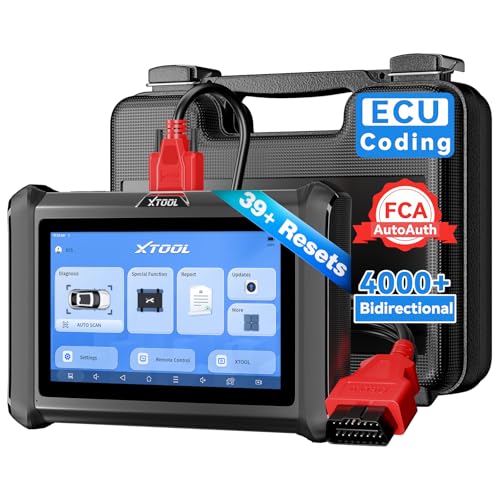
- Top Reasons to Choose the D7S OBD2 Scanner: XTOOL D7S car scan tool, an upgrade of XTOOL D7, offers comprehensive features for automotive technicians, workshops, and DIY enthusiasts 1. Upgraded Hardware: 2+64GB memory, rear camera, intuitive interface, foldable bracket 2. Complete Diagnostics: FCA Autoauth, OE-level all system scan, 39+ maintenance services, 4K+ bidirectional, CANFD/DoIP protocol 3. Advanced Capabilities: ECU c0ding, PMI functions 4. Wide Compatibility: Support 10,000+ models, covering 99% vehicle brands 5. Multi-language: Available in 22+ languages, No IP Restrictions 6. 3-Year Updates: Save 300 bucks on software updates for the latest features and optimizations
- 2026 Upgraded D7S Car Scanner Features: The newly 2026 D7S V2.0 scanner for car brings exciting features for advanced vehicle diagnostics and enhanced user experience 1. FCA AutoAuth: Now supports FCA SGW module for Chrysler, for Jeep, for Dodge (2018+), for Fiat (2017+), enabling faster vehicle communication without gateway restrictions 2. PMI (Offline ECU Pr0gramming): Allows for Ford, for Lincoln, and for Mazda ECU pr0gramming for new modules 3. Optimized Diagnostic Report 2.0: Personalized reports with logos and customer info for auto shops. Note: Compatibility varies by cars, please check before order
- 39+ Services/Resets/Adaptations/Relearns/Calibrations: XTOOL D7S full system car scanner diagnostic tool tackles 99% of common car issues through its 36+ special functions, including Oil Reset, EPB, SAS, BMS, Throttle Reset, Injector C0ding, ABS Bleed, TPMS Reset, Power Balance, etc and also covers specific-vehicle functions like Crank Sensor Relearn, ABS Initialization, Cylinder Power Balance, Fuel Trim Reset, Idle Relearn etc. This car diagnostic scanner enhances efficiency, making repairs and maintenance hassle-free. Tip: DO NOT for All vehicles, please check compatibility first
- Cost-effective ECU C0ding Scan Tool for Specific Brands: Enhance your vehicle's performance with XTOOL D7S! This obd2 scanner all systems bidirectional offers advanced capabilities at an affordable price, supports online for BMW, for Benz and offline for BENZ, for MIT, along with PMI functions for Ford, for Mazda, and for Lincoln. Ideal for technicians and DIY enthusiasts, this automotive scanner diagnostic tool optimizes vehicle performance and enhances the driving experience. Note: Not for all cars and modules, please send car VIN to check the compatibility before purchase
- OE All System Diagnostic & 8 Pids Graphing: XTOOL D7S is a comprehensive all system bi directional obd2 scanner that delivers dealer-level diagnostics, completely controlling over your vehicle’s performance and health. This automotive scan tool can read and clear DTCs, view live data and ECU information, retrieve freeze frames, and perform active tests and full obd2 functions. This bi-directional scan tool can can identify your vehicle's make, model, and year information with just one click and show up to 8 PIDs live data with options for CSV viewing, playback, and recording for in-depth analysis. It is easy-to-use for both professionals and beginners, helping pinpoint issues efficiently
Last update on 2026-06-12 / Affiliate links / Images from Amazon Product Advertising API
This product presentation was made with AAWP plugin.