
NHTSA ID Number: 10160826
Manufacturer Communication Number: A4619122022584_9
TSB/Document Date: 2019-06-06
Summary
This informational bulletin provides diagnostic information for brake conditions. This bulletin applies to every Audi 2006-2020 model.
46 Brake pulsation diagnostic guidelines
46 19 12 2022584/9 May 31, 2019. Supersedes Technical Service Bulletin Group 46 number 17-68 dated March
15, 2017 for reasons listed below.
Model(s)
Year
VIN Range
Vehicle-Specific Equipment
All
2006 - 2020
All
Not Applicable
Condition
REVISION HISTORY
Revision
Date
Purpose
9
-
Revised header data (Added model years)
8
03/15/2017
Revised attachments (Brake Steel Measurement Form)
7
01/12/2017
Revised header data (Added model years)
Revised attachments (Added Steel Brake Measurement form)
Note:
DO NOT use this TSB if there is another TSB for same concern applicable to the VIN. This TSB is only
intended for diagnostic purposes and does not serve as a guideline for determining warrantable
conditions.
Customer states:
The steering wheel vibrates or pulsates when the brakes are applied.
Technical Background
Brake-related vibrations and pulsations can have multiple root causes, which include—but are not limited to:
driving style, environmental conditions, and the service history of the vehicle. Additionally, as brake pads and
discs wear, their dampening ability is reduced.
Disc thickness variation (DTV) is a common condition that contributes to brake
pulsation (Figure 1). DTV occurs when the two braking surfaces of the brake
disc are no longer parallel to each other. This condition cannot be accurately
measured with normal workshop tools. Most common conditions that create
DTV include:
Page 1 of 8
© 2019 Audi of America, Inc.
All rights reserved. Information contained in this document is based on the latest information available at the time of printing and is subject to the copyright and other intellectual property rights of Audi of
America, Inc., its affiliated companies and its licensors. All rights are reserved to make changes at any time without notice. No part of this document may be reproduced, stored in a retrieval system, or transmitted
in any form or by any means, electronic, mechanical, photocopying, recording, or otherwise, nor may these materials be modified or reposted to other sites, without the prior expressed written permission of the
publisher.
Corrosion/rust build-up.
Pad material transfer.
Prolonged use of a disc with the high run-out condition.
Figure 1. Example of DTV.
Production Solution
Not applicable.
Service
Brake pulsation may be noticeable only with specific vehicle speed, brake pedal pressure, and temperature of the
brake components. In order to accurately diagnose the vehicle, it is critical to test drive the vehicle under the
same conditions as the customers would (e.g., speed, braking pressure, etc.). The following are examples of
other conditions that can cause brake pulsation.
Overheated brake components
Overheated brake components can cause permanent damage to the brake discs and brake pads.
Condition: Brake pad material smeared on the brake disc
(Figure 2). This condition can create DTV.
Common cause: An overly-aggressive driving style, which
results in frequent sharp braking without proper cooling off
periods.
Service: Replace the brake discs and pads.
Figure 2. Deposits on the brake disc.
Page 2 of 8
© 2019 Audi of America, Inc.
All rights reserved. Information contained in this document is based on the latest information available at the time of printing and is subject to the copyright and other intellectual property rights of Audi of
America, Inc., its affiliated companies and its licensors. All rights are reserved to make changes at any time without notice. No part of this document may be reproduced, stored in a retrieval system, or transmitted
in any form or by any means, electronic, mechanical, photocopying, recording, or otherwise, nor may these materials be modified or reposted to other sites, without the prior expressed written permission of the
publisher.
Condition: Blue-tempered or overheated brake discs (Figure 3).
Common cause: Failed component(s) causing constant brake
application. This can also be caused by an overly-aggressive
driving style, which results in frequent sharp braking without
proper cooling off periods.
Service: Replace the brake disc and pads.
Figure 3. Brake disc with heat marks.
Corrosion/rust build-up
The ability to remove any build-up on a brake disc is impacted by the severity of the build-up. If left unattended,
the build-up can permanently damage brake discs and pads.
Condition: Corrosion/rust build-up on the brake discs
(Figure 4). This condition can create DTV.
Common causes:
Exposure to road salt during winter months, high
humidity, or moisture.
Vehicle not being driven for prolonged periods of time.
A gentle driving style with very light brake application
may not be enough to remove build-up (such as rust or
corrosion) on the brake discs and pads.
Service: With careful consideration of the traffic situation,
perform 2-3 ABS stops from speeds above 50mph. Between Figure 4. Corrosion/rust build-up.
each stop, allow the brake components to cool by driving the
vehicle for more than one minute at speeds greater than
50mph. Do not perform ABS stops if brand new pads and/or
discs are installed. Replace brake disc and pads if the
condition is not eliminated.
Page 3 of 8
© 2019 Audi of America, Inc.
All rights reserved. Information contained in this document is based on the latest information available at the time of printing and is subject to the copyright and other intellectual property rights of Audi of
America, Inc., its affiliated companies and its licensors. All rights are reserved to make changes at any time without notice. No part of this document may be reproduced, stored in a retrieval system, or transmitted
in any form or by any means, electronic, mechanical, photocopying, recording, or otherwise, nor may these materials be modified or reposted to other sites, without the prior expressed written permission of the
publisher.
Condition: Pad material transfer or corrosion marks from
brake pads on the brake disc, also known as “pad marks”
(Figure 5). This condition can create DTV.
Common cause: These marks can appear if the vehicle has
not been driven for a prolonged period of time or if the
brakes are exposed to high humidity or moisture.
Service: With careful consideration of the traffic situation,
perform 2-3 ABS-stops from speeds above 50mph. Between
each stop, allow the brake components to cool by driving the Figure 5. Pad marks on the brake disc.
vehicle for more than one minute at speeds greater than
50mph. Do not perform ABS stops if brand new pads and/or
discs are installed. Replace brake disc and pads if the
condition is not eliminated.
Condition: Excessive brake disc or wheel hub run-out
(Figure 6). Measure according to the Run-out Measurement
Instructions listed below.
Common causes:
Over-torqued or improperly-torqued wheels (torque
sticks, impact gun, etc.) can distort the brake disc and
hub, causing a run-out condition. Refer to Elsa for proper
torque values and procedures for the VIN.
Wheels that are not Audi-approved may not have the
same contact surface on the back of the wheel and may
not have the correct center bore dimension, which can
distort the brake disc and hub, causing a run-out
condition.
External impact or rust build-up between brake disc
and hub.
Service: Replace brake disc(s) and/or hub(s) if
measurements exceed the maximum value listed in the Runout Measurement Instructions.
Figure 6. True disc rotation (a) and disc lateral
run-out (b).
Page 4 of 8
© 2019 Audi of America, Inc.
All rights reserved. Information contained in this document is based on the latest information available at the time of printing and is subject to the copyright and other intellectual property rights of Audi of
America, Inc., its affiliated companies and its licensors. All rights are reserved to make changes at any time without notice. No part of this document may be reproduced, stored in a retrieval system, or transmitted
in any form or by any means, electronic, mechanical, photocopying, recording, or otherwise, nor may these materials be modified or reposted to other sites, without the prior expressed written permission of the
publisher.
Condition: Worn brake pads (Figure 7).
Common cause: As brake pads and discs reach their wear
limit, their dampening characteristics are reduced.
Service: Replace worn brake pads and discs.
Figure 7. Worn brake pad.
Other common causes
The following factors can impact the condition of the brake and suspension components, which can lead to
pulsation during braking. Always check the repair history and the overall condition of the vehicle.
Page 5 of 8
© 2019 Audi of America, Inc.
All rights reserved. Information contained in this document is based on the latest information available at the time of printing and is subject to the copyright and other intellectual property rights of Audi of
America, Inc., its affiliated companies and its licensors. All rights are reserved to make changes at any time without notice. No part of this document may be reproduced, stored in a retrieval system, or transmitted
in any form or by any means, electronic, mechanical, photocopying, recording, or otherwise, nor may these materials be modified or reposted to other sites, without the prior expressed written permission of the
publisher.
Condition: Faulty, damaged, or aftermarket suspension
components (ball joints, links, tie rods, bushing, etc.) can
significantly amplify vibration/pulsation or lead to body vibrations
which only become noticeable when braking (Figure 8 and
Figure 9).
Service: Diagnose these components accordingly.
Figure 8. Damaged suspension bushing.
Figure 9. Damaged suspension link.
Page 6 of 8
© 2019 Audi of America, Inc.
All rights reserved. Information contained in this document is based on the latest information available at the time of printing and is subject to the copyright and other intellectual property rights of Audi of
America, Inc., its affiliated companies and its licensors. All rights are reserved to make changes at any time without notice. No part of this document may be reproduced, stored in a retrieval system, or transmitted
in any form or by any means, electronic, mechanical, photocopying, recording, or otherwise, nor may these materials be modified or reposted to other sites, without the prior expressed written permission of the
publisher.
Condition: Wheel/tire imbalance (Figure 10) or radial run-out
can significantly amplify the vibration/pulsation or lead to body
vibrations which only become noticeable when braking.
Service: Inspect the condition of these components and
diagnose accordingly.
Figure 10. Wheel/ tire imbalance.
Run-out Measurement Instructions
To obtain accurate run-out measurements, the following conditions must apply:
All surfaces that will be measured must be free of
rust/corrosion build-up or pad material transfer.
VAS6079/1 (or similar measurement tool) is securely
attached to the vehicle (Figure 11).
The brake disc is secured to the hub with 5 bolts.
Axle bolt/nut is installed and properly torqued.
Run-out measurements should be taken with all parts
installed on the vehicle.
Figure 11. Example of the run-out
measurement tool VAS6079/1 properly secured
to a solid suspension component.
Page 7 of 8
© 2019 Audi of America, Inc.
All rights reserved. Information contained in this document is based on the latest information available at the time of printing and is subject to the copyright and other intellectual property rights of Audi of
America, Inc., its affiliated companies and its licensors. All rights are reserved to make changes at any time without notice. No part of this document may be reproduced, stored in a retrieval system, or transmitted
in any form or by any means, electronic, mechanical, photocopying, recording, or otherwise, nor may these materials be modified or reposted to other sites, without the prior expressed written permission of the
publisher.
Use the following values to determine the severity of the runout:
Disc braking surface (Figure 12, point 1):
Disc hub and wheel hub run-out impact this value.
Maximum run-out: 0.06 mm / 0.002”.
Disc hub (center of the brake disc) (Figure 12, point 2):
Wheel hub run-out impacts this value.
Disc hub run-out impacts the disc braking surface run-out.
Maximum run-out: 0.03 mm / 0.0012”.
Wheel hub (without the disc installed) (Figure 12, point 3):
This value impacts the disc hub and disc braking surface
run-out. High run-out can distort the brake disc.
Figure 12. Run-out measurement locations:
disc braking surface (1), disc hub (2), wheel
hub (3).
Maximum run-out: 0.02 mm / 0.0008”.
Warranty
This TSB is informational only and not applicable to any Audi Warranty.
Additional Information
All parts and service references provided in this TSB (2022584) are subject to change and/or removal. Always
check with your Parts Department and/or ETKA for the latest information and parts bulletins. Please check the
Repair Manual for fasteners, bolts, nuts, and screws that require replacement during the repair.
©2019 Audi of America, Inc. All rights reserved. The information contained in this document is based on the
latest information available at the time of printing and is subject to the copyright and other intellectual property
rights of Audi of America, Inc., its affiliated companies and its licensors. All rights are reserved to make changes
at any time without notice. No part of this document may be reproduced, stored in a retrieval system, or
transmitted in any form or by any means, electronic, mechanical, photocopying, recording, or otherwise, nor may
these materials be modified or reposted to other sites without the prior expressed written permission of the
publisher.
Page 8 of 8
© 2019 Audi of America, Inc.
All rights reserved. Information contained in this document is based on the latest information available at the time of printing and is subject to the copyright and other intellectual property rights of Audi of
America, Inc., its affiliated companies and its licensors. All rights are reserved to make changes at any time without notice. No part of this document may be reproduced, stored in a retrieval system, or transmitted
in any form or by any means, electronic, mechanical, photocopying, recording, or otherwise, nor may these materials be modified or reposted to other sites, without the prior expressed written permission of the
publisher.

- Mixes well with conventional fluids
- Low-moisture formula provides excellent vapor lock...
- Ideal for hydraulic and disc brakes


- Provides an extra margin of safety in extreme braking...
- Mix of polyglycol ethers ensures hot brake-system operation...
- Excellent for ABS, disc and drum brake systems
- Delivers braking power when needed by avoiding a spongy...
- Both wet and dry boiling points exceed the minimum...
If the PDF is very large, it may not load in the preview below.
Some older TSBs had multiple PDFs — visit the NHTSA Website to view all PDFs.
If the TSB PDF does not show, download or view it on the NHTSA Website.
Click on the (+) Plus Sign
Then Click on Associated Document(s)
Search NHTSA Database for Recalls
Search NHTSA Database for Vehicle Investigations
View Latest Vehicle Investigations
Search NHTSA Database for Vehicle Complaints
View Latest Vehicle Complaints
TSB/Document ID: A4619122022584_9
Replacement Service Bulletin Number:
MFR Communication Date: 2019-05-31
MFR Internal Campaign ID/Software Version:
Communication Type: Service Bulletin/Repair Instructions
NHTSA Components: SERVICE BRAKES
MFR Component System:
MFR Component Subsystem:
Previous TSB | Next TSB |

- [Notice] When you receive a used escaner automotriz device, it may be a customer return resold by Amazon without inspection. You can exchange it for a new one through Amazon. As this situation is unavoidable, we sincerely apologize. For any issues, contacting us via Amazon's "Messages" is the best way, and we’ll provide a solution within 24 hours. THINKSCAN 689BT Can Be Used Immediately After It is Turned On, Without Complicated Registration Process, Which is More Convenient & Quick.
- [Good News] THINKSCAN 689BT is the most competitive automotive scan tool to date, offering wireless updates with no subscription fees(valued 500Buc.ks) . With all the features of THINKTOOL PD8,PRO, built on Android 10 platform with 4-core CPU, 4GB RAM
 and 64GB ROM, serving up to 5X faster than older MAX/MINI/PLUS vehicle scanners escaner automotriz, no more slow and delayed feedbacks, it's time to update your garage tool.
 - [Big Money Saver] Premium THINKSCAN 689BT Wireless Diagnostic Scanner Escaner Automotriz, save up to 400USD per year, includes all useful features: Full bi-directional controls, ECU coding, 34+ services, OEM all system diagnostics, Worldwide vehicles coverage, CAN FD & DoIP, FCA AutoAuth(The 689BT only provides a login and purchase portal, and users are required to register for an FCA account and pay a membership fee in order to perform the relevant automotive diagnostics)
- [3000+ Active Tests]Active testing is one of the most useful features in automotive maintenance and greatly improves mechanic efficiency. THINKCAR 689BT bidirectional scanner can send action commends to vehicle sub-systems or components for active test without using vehicle controls. It can perform various tests such as: EVAP Test, Fuel Trim Reset, Injector Buzz Test, Window/ Mirror/ Door Lock Test, Pump and Value Tests, etc. Get functions from "Diagnose>Car Model>System>Active Test".
- [Hot Advanced Features] 689BT bidirectional tool newly adds ECU Coding, Power Balance, Flash Hidden Functions, Reset Adaptive Data, Match Replaced Components, Customize OE-Settings. Such as: 1. changing the color of interior lights 2. switching on/off the auto hold, 3. customizing dash kits 4. activating the auto side mirror folding function 5. disables auto start-stop. Note: Coding functions vary by model&year.
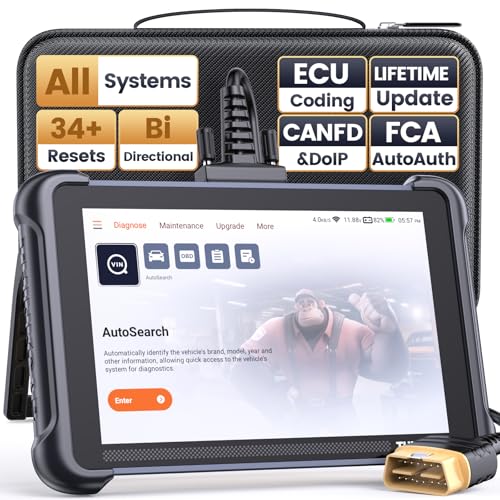
- 【Warm Tips】Wired THINKSCAN 689 is connected through a detachable OBDII cable, and we also have added OBD2 Extension Cable (about 60 cm/2 feet) as g ift, enabling customers handling vehicle repairs with ease. Just click "Bundles Item" above to get it. Note: FCA AutoAuth is a third-party service, additional cost may be required.
- 【Professional Car Diagnostic Tool】Tired of renew fees? Thinkscan 689 scanner provides dealer-level advanced functions without annual fees for auto mechanics and repair shops. 34+ Services, 3000+ Active Test, ECU Coding, 140+ Brands Coverage, FCA AutoAuth, CANFD&DOIP Protocol, Component Matching, Power Balance, V.A.G Guided, Compatible with Google Chrome integration, etc. With strong hardware backing, 64G Memory, Android 10, 4-core processors, and 4150mAh battery. Thinkscan 689 brings you the best as your daily business helper and never lets you drop the ball!
- 【Over 34 Reset Service, Adaptation + Relearn + Calibration + Initialization + Matching】Made for workshops, Thinkscan 689 scanner provides 34+ services for worldwide vehicles: such as Gear/SAS/EPB/TPMS/D.P.F/I.M.M.O/BMS/ETS/Oil/Brake/AFS/GEARBOX/SUNROOF/SUS Reset, ABS Bleed, Injector coding, etc. Warm tips: Compatibility may vary on vehicles' model and year, please contact seller before purchase to make sure it works well on your cars.
- 【Real Active Test】Thinkscan 689 scan tool features over 3000+ full bi-directional control ability, to send commands to vehicle’s systems/components, to verify system input/output without using the vehicle's controls, e.g. turn on the radiator fan, modulate the throttle, open/close windows, operate mirrors, Injector Buz Test, turn on interior&exterior lights, sound horn, test door lock actuators, turn on/off front/rear side ACM Solenoid, Vehicle level position calibration, Wheel Speed Sensor Supply.
- 【Comprehensive Solutions with Advanced Features】Take your vehicle customization to the next level with the Thinkscan 689's advanced ECU coding capabilities. This scan tool provides power balance, PMI, unlock more new features and enhance performance by activating dormant functions, customizing OE settings, matching replaced components, and reprogramming adaptive data to elevate your driving experience. Note: Compatibility varies by car models, please check before order.
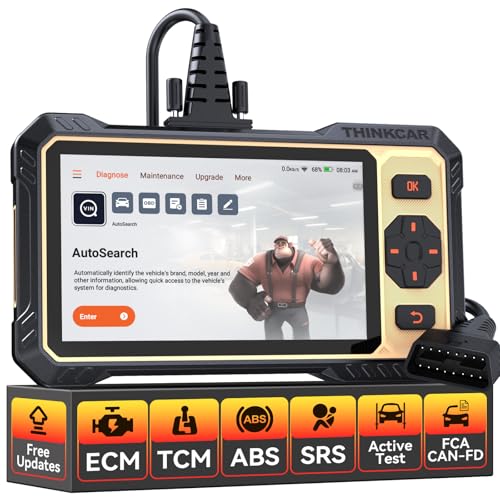
- 【Powerful Bidirectional Control -- Active Test】Good News! The THINKSCAN 662 obd2 scanner has bidirectional control function,which is the most popular feature among mechanics.This function is mainly used to test whether the executing components in the electronic control system can work normally,By requesting information from the vehicle's ECU or sending commands to the ECU module to execute commands and identify maintenance status,quickly locate the cause of the fault.Such as ABS,Fuel Injectors,Adjusting Throttle,Coolant Fans,Radiator Fans,Coolant Pumps,EV.AP Test, Fuel Trim Reset,Injector Buzz Test,Pump/ Value Test,etc. Effectively shorten diagnosis time and reduce diagnosis costs.
- 【Unlock Pro-Level Diagnostics With Half Costs】 THINKSCAN 662 obd2 scanner diagnostic tool Delivers Premium Scanning Power for Half the Price! The OBD2 scanner can handle common issues with ECM,TCM,ABS,SRS. It can easily read and clear fault codes, analyze data streams, and ensure quick identification of problems. THINKSCAN 662 bidirectional scan tool has 12 practical reset functions, including Airbag Reset,ABS Bleeding,BMS,Brake Reset, D.P.F,Throttle Adaptation,Injector Coding,OIL Reset,steering angle Reset,Gearbox,TPMS,and more. The car scanner diagnostic tool very suitable for DIY enthusiasts, car repair technicians, and small and medium-sized repair shops.
- 【Multi Functional Intelligent Car Scanner Diagnostic Tool】 Automatic VIN + Real-time Data + DTC Lookup + Historical Diagnostic Records: This OBD2 scanner features auto serch technology, allowing for car recognition without the need for manual input. The real-time data of the car ECU is read and displayed in the form of text or a 4-in-1 merged waveform chart. You can save, share, print or send the entire inspection report via email for analysis. Historical diagnostic reports help you quickly identify vehicle issues and understand the condition of the vehicle. The built-in 'feedback' module provides customized repair Operation recommendations from our certified professionals.
- 【Upgraded Hardware + Ergonomically Engineered】 THINKSCAN 662 OBD2 scanner has a friendly combination of touch screen and physical buttons with an ergonomic appearance for comfortable use.Experience 2x faster scans and 50% longer lifespan vs standard models.This scanner para autos boast a 4-core 1.8GHz CPU,6.2-inch HD touch screen,2GB RAM + 32GB ROM storage capacity,a long-lasting 4150mAh battery,Android 8 ensures lightning-fast bootup and processing.The scanner is robust with rubberized protection that you can store and use in the trunk or garage.Whether you are engaged in Home car maintenance or road rescue car repair,this car scanner can help you perfectly solve car problems.
- 【Effortless Setup & Scanning - Intuitive for All Skill Levels】No More Complicated Scanners! The User Interface is as User-Friendly as THINKCAR 689BT! Truly Plug-and-Play,The downward sliding setup shortcut portal and drawer function shortcut portal make you use this scan tool as easy as using your own cell phone.The car scanner supports setup screenshot,screen recording,volume adjustment,this scan tool includes product e-manuals,instructional videos,and fault code libraries,users can check the usage guide,perfect for DIY car owners,Maintenance technician.If your father,husband,brother,boyfriend enjoys car repairs,THINKSCAN 662 is a great gift choice, and it has amazing family value.
Last update on 2026-06-10 / Affiliate links / Images from Amazon Product Advertising API
This product presentation was made with AAWP plugin.