
NHTSA ID Number: 10159521
Manufacturer Communication Number: SIL 06-EP-19EN
TSB/Document Date: 2019-05-13
Summary
Troubleshooting tips for DC-to-DC converter for high voltage DC power from the ESS to non-Allison components
If the PDF is very large, it may not load in the preview below.
Some older TSBs had multiple PDFs — visit the NHTSA Website to view all PDFs.
If the TSB PDF does not show, download or view it on the NHTSA Website.
Click on the (+) Plus Sign
Then Click on Associated Document(s)
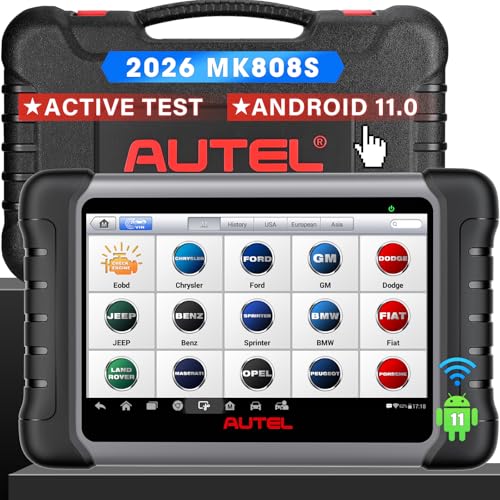
- 💝【Questions? We’re Here Anytime】MK808S is a...
- 🔥🔥🔥【2026 NEWLY RELEASED BI-DIRECTIONAL...
- 【28+ MOST POPULAR RESET SERVICE FOR 150 MAKES】Autel...
- 【ALL SYSTEM DIAGNOSTICS, FACTORY-LEVEL SCANNER】The...
- 【AUT0 SCAN & AUT0V1N, 10X FASTER】How much have you spent...

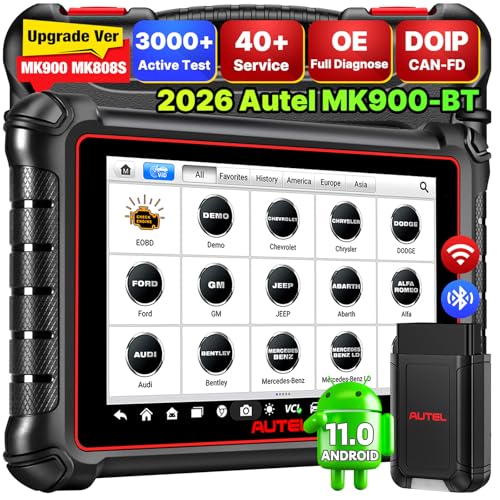
- 💯【Conta.ct us for Support Directly】If you met any...
- 🔥🔥🔥【2026 AUTEL FLAGSHIP MK900BT MK900-BT, NEW...
- 🚗【3000+ ACTIVE TESTS (50➡3000+), SAME AS MS...
- 🚗【40+ HOT SERVICES FOR 150 MAKES (28+➡40+)】Full...
- 🚗【OE ALL SYSTEM DIAGNOSE, AUTO SCAN 2.0: SCAN LICENSE...
This product presentation was made with AAWP plugin.
Search NHTSA Database for Recalls
Search NHTSA Database for Vehicle Investigations
View Latest Vehicle Investigations
Search NHTSA Database for Vehicle Complaints
View Latest Vehicle Complaints
TSB/Document ID: SIL 06-EP-19EN
Replacement Service Bulletin Number:
MFR Communication Date: 2019-04-07
MFR Internal Campaign ID/Software Version:
Communication Type: Service Bulletin/Repair Instructions
NHTSA Components: ELECTRICAL SYSTEM
MFR Component System:
MFR Component Subsystem:
Previous TSB | Next TSB |
SIL 06-EP-19
April, 2019
Page 1 of 17
SUBJECT:
Troubleshooting Hybrid Vehicles Equipped with High Voltage Accessories
MODELS AFFECTED:
H 40/50 EPTM System
Introduction:
The primary function of the Energy Storage System (ESS) in the H 40/50 EPTM System is to store and provide DC
electrical power to the Dual Power Inverter Module (DPIM). The DPIM converts the DC electrical power into AC
electrical power for the three-phase AC electric motors in the Drive Unit.
In 2011, Allison Transmission announced the availability of an optional DC-to-DC converter that may be
incorporated into the H 40/50 EPTM System (refer to SIL 8-EP-11). In 2013, and later in 2014, Increased Accessory
Power (IAP1) and IAP2 were released (see SIL 4-EP-13), supporting a wider array of optional high-voltage (HV)
accessory products. Currently, all optional DC-to-DC converters and HV accessory products that may be integrated
in the H 40/50 EPTM System are manufactured by Vanner, Inc.
The incorporation of various Vanner HV accessories into the H 40/50 EPTM System adds additional demand to the
ESS beyond powering the DPIM; it now also provides DC electrical power to the Vanner components and any
OEM-installed equipment connected to Vanner’s HV accessories.
It is important to note that this extension of the HV DC power from the ESS to non-Allison components can affect
how the H 40/50 EPTM System operates and, depending on certain faults, effect which diagnostic trouble codes
(DTCs) set and how to troubleshoot the H 40/50 EPTM System.
Recommended Practices and Contacts:
Depending on the complaint or what DTCs may be set, knowing whether the HV system is constrained to only
the DPIM and Drive Unit or shared with other HV accessories can greatly reduce the time spent troubleshooting.
Below are recommendations to help reduce time spent troubleshooting.
• Check to see if the vehicle is equipped with any HV accessories. If you are unsure, look for a splice in the HV
DC cables between the ESS and DPIM that splits off to other components.
• If a DPIM or motor check sheet are to be completed, it is recommended to also check any Vanner equipment
at the same time per Vanner’s troubleshooting and testing documentation.
• Read, understand, and be familiar with Allison Transmission publications regarding HV accessories,
including SILs, WATCH letters, and Tech Data.
• Keep up-to-date copies of Vanner publications on components you may encounter incorporated in the
H 40/50 EPTM System.
ML / SL8483EN
4558627
Copyright © 2019 Allison Transmission, Inc. All Rights Reserved.
SIL 06-EP-19
April, 2019
Page 2 of 17
• Download and install the latest version of Vanner’s Dashboard diagnostic software. Review any
documentation included with the software.
• Perform basic component tests per Vanner publications when necessary during the troubleshooting process.
If during the troubleshooting process you discover an issue with a Vanner component or need assistance with
testing Vanner components, please contact Vanner, Inc. Contact information is provided below.
Also provided below are two examples that highlight how the extension of HV DC power to non-Allison components
can affect the H 40/50 EPTM System.
H 40/50 EPTM System Troubleshooting with HV Accessories:
Case 1: Vanner HBA (DC-to-DC Converter) Failure
A customer’s 2013 bus will not start and the stop system light is set. Connecting with Allison DOC® Premium
(H 40/50 EPTM) shows active DTCs 73-90, 74-90, 73-91, and 74-91. All four DTCs are associated with HV
isolation faults that stop the system and prevent the ESS from closing relays. The Electrical Disconnect
Verification Procedure is performed and a DPIM and motor check sheet are completed. The DPIM check
sheet does not reveal any isolation issues nor were any signs of moisture or liquid water observed in
the DPIM lug boxes. The motor check sheet shows adequate isolation resistance in both the HV AC
cables and the motor stator windings. Motor stator winding resistances are also within specification. More
troubleshooting is required as no breakdown in HV isolation has been found.
Next, the HV DC cables are disconnected from the DPIM DC lug box and the Vanner HBA. The HV DC
cables are checked with adequate isolation resistance measured between DC+ and DC- and from each
conductor to vehicle chassis. Left to test are the ESS and the Vanner HBA. Following directions from
Vanner’s HBA Owner’s Manual, the HBA is measured and resistance values are significantly lower than
those specified. After replacing the HBA, the H 40/50 EPTM System is reassembled, cleared of any DTCs,
started, road tested, and returned to service.
In this example it is important to note that the HBA, powered directly from the ESS via HV DC cables
specifically installed for this application, is sharing the same DC bus that the DPIM uses. The low isolation
resistance in the HBA was detected by the TCM which then set DTCs disabling the H 40/50 EPTM System.
Case 2: Air Compressor Motor Failure
A customer’s 2018 bus is out of service for complaints of active DTCs and possible open ESS fuses.
Connecting with Allison DOC® Premium (H 40/50 EPTM) and reviewing ESS data indicates all three ESS
fuses are open and multiple DTCs are logged, including 77-30 Battery Pre-Charge, 76-51 Battery Subpack
SOC Deviation High, and 79-41 Battery Subpack Under Voltage. The Electrical Disconnect Verification
Procedure is performed and a DPIM check sheet is completed. The DPIM check sheet indicates an issue
internal to the DPIM as the first row of resistance measurements are returning “OL” on the meter. The main
cover is removed from the DPIM to reveal a burned resistor on the HVIL card and arcing damage on the DC
busbar. The burnt resistor on the HVIL card is an indicator of a short in an AC electrical component, typically a
shorted AC motor stator winding in the Drive Unit. The motor check sheet is completed but does not indicate
an issue with either Drive Unit motor or the HV AC cables. An on-site Vanner representative discovers an
open channel 2 fuse in the Vanner High Voltage Distribution Module (HVDM). More troubleshooting is
needed as there is no clear reason why the HVIL card resistor burned, damaging the DC busbar, and there is
an open channel 2 fuse in the HVDM.
Next, Vanner personnel check the Vanner Exportable Power Inverter (VEPI) connected to channel 2 of the
HVDM suspecting a fault in the VEPI may have caused the issue. No issues with the VEPI were found.
Vanner personnel proceed to inspect the OEM-installed electric accessories powered by the VEPI. A short in
the three-phase AC electric motor driving the vehicle’s onboard air compressor is identified and the AC circuit
Copyright © 2019 Allison Transmission, Inc. All Rights Reserved.
SIL 06-EP-19
April, 2019
Page 3 of 17
breakers are found to be open. The air compressor motor is replaced and fuses in the ESS and HVDM are
replaced. The DPIM is repaired and a DPIM check sheet completed with no issues found. The H 40/50 EPTM
System is reassembled, cleared of any DTCs, started, test driven, and returned to the customer for service.
In this example it is important to note that the three-phase AC electric motor for the onboard air compressor
is attached to the VEPI, an inverter powered by channel 2 of the HVDM, sharing the same DC bus that the
DPIM uses. The short in the OEM-installed electric AC motor caused fuses in multiple components to open
and damaged components internal to the DPIM.
Provided below is technical information authored and maintained by Vanner, Inc. The copies below are accurate
as of March 4th, 2019. Please contact Vanner, Inc. for the latest copies or visit their publications website at
http://www.vanner.com/products/product-manuals/.
Vanner, Inc.
Service and Repair Department
4282 Reynolds Drive
Hilliard, OH 43026
TOLL FREE: 1-800-AC-POWER
(227-6937) http://www.vanner.com/
4282 Reynolds Drive
Hilliard, OH 43026
TOLL FREE: 1-800-227-6937 x3512
614-771-3512
[email protected]
www.vanner.com/contact-vanner/
For technical support please contact: Doug Dean, Jeff Carey, Pete Duffy, or Craig Bushman.
To return a field unit for service or a replacement unit if required contact: James Finley, Craig Bushman, or
Jeff Carey.
Doug Dean
Jeff Carey
Customer Technical Support
O: 614-771-3509 M:
740-360-8128
[email protected]
Customer Technical
Support O: 614-771-3503
M: 614-329-1589
[email protected]
James Finley
Craig Bushman
Service Manager
O: 614-771-2718 x203
[email protected]
Service Technician
O: 614-771-3520
[email protected]
Pete Duffy
Senior Electrification Engineer
M: 215-518-2040
[email protected]
Copyright © 2019 Allison Transmission, Inc. All Rights Reserved.
VANNER Incorporated
OWNER’S MANUAL
Testing and Troubleshooting
CAUTION
Servicing of electrical systems should only be performed by trained and qualified technical personnel.
Equipment Required
Required: A laptop provisioned with Vanner's Dashboard software, supporting hardware and
interface cables.
Note: There are kits available for purchase that include Vanner's Dashboard software, a USB to CAN
adapter module and a harness to connect to the vehicle's CAN network. Please contact Vanner's
inside sales department for the appropriate kit part number for your application.
Optional:
Volt Meter having 0.01 volt resolution. (Fluke Model 87 Multimeter recommended).
Clamp-on current meter (Fluke Model 36 Clamp-on Meter recommended).
Test Procedure for HBA
The HBA is working properly if:
1. The 24 volt DC loads are being operated continuously and are within the rated capacity of the HBA
and;
2. The power drawn from the hybrid drive train system is within its rated capacity.
HBA Test Procedure:
1. Field-test the HBA while fully connected to the vehicles high and low voltage batteries.
The 24V battery must measure between 16 and 32 volts. If the 24V battery is below 16 volts,
apply a 24 volt battery charger to the batteries.
The high voltage battery must measure between 500 and 780 volts for the HBA to start properly.
2. Start the vehicle normally while monitoring the HBA status with a laptop provisioned with Vanner’s
Dashboard software. The laptop must be connected to the vehicle CAN Bus utilizing a USB to CAN
adapter and harness.
The HBA will turn on automatically upon receiving the engine RPM signal or CAN On/Off
command via CAN bus and a +24V enable signal.
Upon normal system startup, the output voltage will increase to 28.5 volts and the output current
will increase indicating charging of the 24V batteries and providing power for the 24V auxiliary
loads.
3. The Vanner Dashboard software monitors the following data which can be observed on the laptop;
High Input Voltage
High Input Current
Engine RPM
Heartbeat
CAN On/Off Command Message Status
Vanner High Voltage DC-DC Converter
Low Output Voltage
Low Output Current
Power Stage Temps. Control Board Temp
Converter Status and Faults
15
OWNER’S MANUAL
VANNER Incorporated
OWNER’S MANUAL
Dashboard screenshot of a system under normal operating conditions
4. If the Vanner Dashboard software isn’t utilized or available, proper start up can be validated by
measuring the 24V output terminals with a Volt Meter. Upon start up, the voltage will increase from
the 24V battery nominal value up to ≈ 28.5 volts. Note: The measurement is dependent on the
voltage drop in the cables/bolted connections between the HBA output terminals and the 24V
battery terminals.
5. A clamp on style current meter can also be used to validate the output current of the HBA.
6. Important: The high voltage terminals are inaccessible for measurement. A high voltage interlock
circuit is implemented for safety purposes to prevent an accidental and potentially lethal shock to
personnel. The high voltage input to the HBA can only be read via the Dashboard software.
Vanner High Voltage DC-DC Converter
16
OWNER’S MANUAL
VANNER Incorporated
OWNER’S MANUAL
Trouble Shooting an HBA No-Start Situation
In the event the Vanner HBA does not start, the following need to be reviewed/validated;
1. Is the high voltage battery within the acceptable input range? 550 - 780VDC
2. Is the 24V battery within the acceptable range? 20 – 32VDC
3. Is 24V battery voltage present at the output terminals of the HBA upon closing the battery disconnect
switch?
4. If not, verify the fuse between the 24V battery and the HBA is installed and hasn’t cleared.
5. Upon startup of the engine, does the 24V battery remain within the acceptable range? If the health of
the 24V batteries is questionable, the voltage may collapse below 20 volts before the HBA starts.
There is an approximate 2 - 3 second delay from the time the engine starts to the start of the HBA.
6. Is the +24V enable signal present at the I/O connector?
7. If the +24V enable signal is present, is the wire in the proper location of the mating I/O connector?
8. For vehicles with pre MY2013 engines: Is the engine rpm data being transmitted properly via the
CAN Bus? PGN 61444 (0xF004)
9. If so, is the engine rpm greater than 400 rpm?
10. For vehicles with MY2013 engines or newer, is the "Converter Control" command message being
received? PGN 65498 (0xFFDA)
11. If the answers to 5 and 6 are yes, are the CAN signal wires (HI,LO and Shield) in the proper locations
of the mating connector?
HBA Status and Fault Indication Definitions
The HBA monitors several status and fault conditions. If any faults occur, they are reported via CAN
bus and can be observed with the Dashboard software. The HBA status and fault indications in the
lower left corner of the screenshot on page 16, are defined as follows;
DC/DC Converter ON: Green indication that HBA has turned on successfully
DC/DC Converter OFF: Red indication that HBA is off. If the reason is due to a fault, that condition
will be indicated by a red icon.
Engine RPM/ Low or CAN Data Loss: The HBA will perform a soft shutdown if the engine speed
drops below 350 RPM for four seconds or there is a loss of CAN communication. The HBA will
restart automatically when the engine speed exceeds 400 RPM for 0.1 seconds or CAN
communication is restored.
HVPS (High Voltage Power Stage) Imbalance Fault: Internal circuitry detects if the voltage
differential between the center point to negative and center point to positive is excessive, > 200V. If
an imbalance fault is detected, the HBA will "permanently" shut down. The unit will not restart
automatically if the imbalance condition clears, the ignition must be cycled off and on. See note
below.
Note: An imbalance fault can be caused by leakage current or a defective detection circuit within the
HBA. However, the HBA will also detect external leakage paths. The external leakage path could be
caused by water ingress in a high voltage cable assembly or junction box. It could also be caused by
damaged shielding on a high voltage cable assembly. If the high voltage imbalance fault does not
clear after cycling the ignition, Vanner recommends inspecting the high voltage cable assemblies for
leakage paths.
Over Temperature Fault: The HBA will perform a soft shutdown if any of the following conditions
exist: the temperature on the low voltage power stage reaches 82°C, or the temperature on the high
voltage power stage reaches 98°C, or temperature on the control board reaches 98°C. The HBA will
restart automatically if all of the following conditions exist: the temperature on the low voltage power
stage drops below 78°C, and the temperature on the high voltage power stage drops below 92°C,
and the temperature on the control board drops below 92°C.
Vanner High Voltage DC-DC Converter
17
OWNER’S MANUAL
VANNER Incorporated
OWNER’S MANUAL
HBA Status and Fault Indications Cont'd
Input Overvoltage Fault: The HBA will perform a soft shutdown if the input voltage is above 800V
and below 850V. It will restart automatically once the input voltage drops below 750V. If the input
voltage exceeds 850V, the converter will “permanently” shut down. The unit will not restart
automatically if the input voltage drops below 750V, the ignition switch must be cycled off and on.
Input Under Voltage Fault: The HBA will perform a soft shut down if the input voltage drops below
500V. Once the input voltage is equal to or greater than 550V, the converter will restart
automatically.
Output Overvoltage Fault: The HBA will perform a soft shutdown if the low voltage battery exceeds
32V. The HBA will restart automatically if the voltage returns to the normal operating range of 16 32V.
Output Under Voltage Fault: If the low voltage battery drops below 15V, the HBA will perform a soft
shutdown. The converter will restart automatically if the voltage returns to the normal operating range
of 16 – 32V.
Output Overload Fault: The HBA is current limited to 250A or 300A. If the load is above 250A or
300A, the unit will begin current limiting and gradually reduce the output voltage. Once the HBA
output voltage decreases to a value less than or equal to the battery voltage, the batteries will begin
to assist in supporting the load. If the load continues to increase and the output voltage drops to 20V,
the output current will begin to fold back. If the output or battery voltage is reduced to 16V, the HBA
will turn off. The HBA will restart automatically if the loads are reduced and the battery voltage
returns to the normal operating range of 16 - 32V.
Over Maximum Current Fault: The HBA will perform a soft shutdown if the current flowing through
an internal power stage current transformer exceeds 90A. The HBA will restart automatically if the
current returns to a value below 90A.
+12V Power Supply Failure Fault: The HBA will perform a permanent shutdown in the event of a
+12V power supply failure. The unit should be replaced and the failed unit returned to Vanner for
evaluation.
LV Gate Drive +12V Failure: The HBA will perform a permanent shutdown in the event of a LV Gate
Drive +12V power supply failure. The unit should be replaced and the failed unit returned to Vanner
for evaluation.
Vanner High Voltage DC-DC Converter
18
OWNER’S MANUAL
3-20-19
Purpose:
Testing the HBA when looking for the cause of an Allison Isolation Fault DTC.
Procedure: How to measure the isolation resistance of an HBA using a Megohmmeter.
Meters: Vanner recommends using an Amprobe AMB-45, Fluke 1507, or Fluke 1587 for this procedure.
WARNING! The Vanner HBA uses potentially lethal voltages for operation. DO NOT attempt to
replace the HBA unless you have been trained to work with the Allison H 40/50 EP system.
1. Before beginning, reference Allison Transmission's "Electrical Disconnect Verification Procedure" for the H 40/50
EP product family. It contains important steps that are not covered in these instructions.
2. High Voltage Personal Protective Equipment (PPE) must be worn for this procedure.
3. Assure that the vehicle ignition switch is in the OFF position.
4. Assure that the vehicle master battery disconnect switch is in the OFF position. Use lockout devices to assure
the switch cannot be moved to the ON position until the test procedure is complete.
5. Disconnect the high voltage positive and negative cables from the HBA input studs.
6. Insulate the ring terminals.
7. Do not disconnect the 24V positive and negative cables, 14 pin Deutsch connector, and chassis GND from the
HBA. Note: If bench testing, connect HBA 24v negative to HBA chassis.
8. Set Megohmmeter to the 250V scale.
9. Step 1: Connect Megohmmeter negative lead to the HBA chassis. Connect Megohmmeter positive lead to the
HBA high voltage negative stud. Press test button and record resistance.
10. Step 2: Leave Megohmmeter negative lead connected to the HBA chassis. Connect Megohmmeter positive lead
to the HBA high voltage positive stud. Press test button and record resistance.
11. Step 3: Relocate Megohmmeter negative lead from the HBA chassis to the HBA high voltage negative stud.
Leave the Megohmmeter positive lead connected to the HBA high voltage positive stud. Press the test button
and record resistance if using an AMB-45 and record voltage if using a Fluke 1507 or Fluke 1587.
12. See table below for proper readings.
13. If any readings are out of range, the HBA may be defective and should be returned to Vanner for repair.
HBA Serial
Number
Positive to
Chassis
Negative to
Chassis
Prior to 13246-250093
810kΩ +/- 10%
After 13246-250093
2.8MΩ +/- 10%
All “DUAL” Model Numbers
2.8MΩ +/- 10%
All Model Numbers

- [2026 Top-Tier Hardware and Software Upgrade]: Topdon ArtiDiag900 Lite scanner has enhanced hardware and latest features, including Android 11.0, 5x faster CPU, 10000mAh battery for 12 hours of continuous operation, stable wireless diagnosis with Bluetooth 5.0, 8-inch touchscreen. Added bi-directional control, wireless diagnosis, battery testing (optional), and DTC repair guide
- [TOPDON Bidirectional Scan Tool]: This bidirectional obd2 scanner sends commands to the vehicle's ECU for active testing, enabling users to accurately and quickly locate faulty components such as injectors, coolant pumps, windows, wipers, headlights, mirrors, etc. The bidirectional control scanner is the ideal choice for workshops/automotive repair shops as it significantly reduces mechanic's diagnostic time.
- [Wireless Bluetooth Diagnostic Experience]: The AD900 Lite scan tool comes with a Bluetooth 5.0 VCI, supporting a wireless diagnostic range of up to 33 feet (10 meters), allowing you to diagnose without being confined to cables or tight spaces. Stable and fast wireless diagnosis provides a comfortable repair environment. It also offers VCI cables to increase connectivity options.
- [DTC Repair Guide Function]: Easily diagnose issues with your vehicle and receive guidance on repairs with the topdon scan tool's fault code definitions for all systems,maximize your diagnostic capabilities. This function is compatible with Chrysler
 /Dodge/Jeep/Fiat 2010-2014 and expanding with continual updates,the AritDiag 900 Lite car diagnostic scanner is the must-have tool for any technician or DIY enthusiast.
 - [OE-Level Full System Diagnostics]:AritDiag900 Lite full system diagnostic scanner can scan ALL available modules(Engine, Transmission, Airbag, ABS, ESP, TPMS, Gateway, Steering, Radio, Air conditioning, ect.) to✔read ECU info, ✔read/clear codes, ✔view live data stream, ✔retrieves freeze-frame, ✔perform active tests, and more. With just a simple click, it provides you with accurate and in-depth diagnostics.
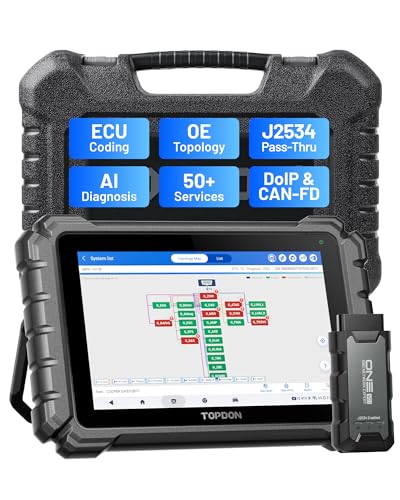
- Dual WiFi & 10.1" Touchscreen: Provides a stable, high-speed wireless link 3x faster than bluetooth, and a responsive, professional interface. Topdon ONE obd2 scanner diagnostic tool ensures smooth, non-lagging diagnostic scan, boosting mechanic efficiency
- J2534 Pass-Thru Support: The included ONE VCI supports the J2534 standard, allowing it to function as a pass-thru device when paired with OEM diagnostic software.Through TOPDON’s RLink platform, technicians can perform dealer-level coding, expanding in-house capabilities without investing in multiple factory automotive scan tools
- OE Topology Mapping: Visualize the vehicle’s ECU network exactly as it’s built.Zoom, pan, and highlight specific modules to pinpoint component issues with precision.Topology mapping displays real-time communication between modules
- Topfix AI Assistant: Covers 5 million plus fault codes and delivers instant causes, symptoms, and repair guidance with professional wiring diagrams for each code.Slashes diagnostic time, boosts first-time fix accuracy, and increases shop revenue
- 50 Plus Service Functions: Covers high-demand services like ADAS calibration, DPF regen, TPMS reset, ABS bleed, and throttle adaptation.Expands your service menu, allows you to charge premium rates, and turns away zero jobs due to lack of tooling. Vehicle-specific functionality may vary.

- Bi-Directional Control, Quickly Locate Problems: Turn your phone into a professional diagnostic tool. You can send commands from your phone to the ECU to test injectors, cooling fans, headlights, A/C clutch, windows, wipers, and more. See which one doesn't respond. Helps you quickly locate the problem and save time. No need to tear things apart, avoid blind disassembly.
- Full System Diagnostics, No Fault Hides: Unlike basic diagnostic tools that only cover 4 systems, TopScan can scan all systems. Read and clear trouble codes, view live data streams, and generate a complete vehicle health report – all issues are clear at a glance. Covers 10,000+ vehicle models and is compatible with 99.99% of vehicles.
- Flexible Subscription, Choose Advanced Features as Needed: TopScan Lite provides free-for-life access to core diagnostics, including full system scan, code reading, performance tests, and repair information. After purchase, advanced features (bi-directional control, service operations, live data, code clearing, and AI functions) are free-for-the-first-year. After the first year, if you want to use advanced features, you need to subscribe on a monthly, quarterly, or yearly basis. As new models and reset functions are updated, the tool will also be continuously upgraded.
- AI Assistant - TopFix: Think of TopFix as your personal AI mechanic. It leverages a repair database and OEM data to deliver clear, step-by-step repair solutions. Features include AI Q&A, one-click translation, and a full repair log, making your diagnostic process simpler and more efficient.
- 8+ Hot Resets, Keep Your Car in Top Shape: One-tap resets for oil, throttle, EPB, steering angle, DPF, ABS, BMS, and airbag. It enables car owners to easily perform essential maintenance, ensuring the vehicle stays in optimal condition and extends its service life.
This product presentation was made with AAWP plugin.
Last update on 2026-05-12 / Affiliate links / Images from Amazon Product Advertising API