
NHTSA ID Number: 10154841
Manufacturer Communication Number: SB1596A
TSB/Document Date: 2019-03-18
Summary
Compressed-air brake system functional check. These tests are designed to identify the cause(s) of a sluggish performance and/or leaks in the system. The tests give you a general idea of the system condition. The procedures described in this service bulletin are applicable to CX35 vehicles.
If the PDF is very large, it may not load in the preview below.
Some older TSBs had multiple PDFs — visit the NHTSA Website to view all PDFs.
If the TSB PDF does not show, download or view it on the NHTSA Website.
Click on the (+) Plus Sign
Then Click on Associated Document(s)

- Mixes well with conventional fluids
- Low-moisture formula provides excellent vapor lock...
- Ideal for hydraulic and disc brakes


- Provides an extra margin of safety in extreme braking...
- Mix of polyglycol ethers ensures hot brake-system operation...
- Excellent for ABS, disc and drum brake systems
- Delivers braking power when needed by avoiding a spongy...
- Both wet and dry boiling points exceed the minimum...
This product presentation was made with AAWP plugin.
Search NHTSA Database for Recalls
Search NHTSA Database for Vehicle Investigations
View Latest Vehicle Investigations
Search NHTSA Database for Vehicle Complaints
View Latest Vehicle Complaints
TSB/Document ID: SB1596A
Replacement Service Bulletin Number:
MFR Communication Date: 2019-01-30
MFR Internal Campaign ID/Software Version:
Communication Type: Service Bulletin/Repair Instructions
NHTSA Components: SERVICE BRAKES, AIR
MFR Component System:
MFR Component Subsystem:
Previous TSB | Next TSB |
SERVICE BULLETIN
SB1596A
ADDRESSEES
: Owners and operators
ABC Customer Care and Parts Source
VEHICLE MODEL
: CX35
SYSTEM/SUBSYSTEM
: 05.10 Brakes – Compressed-air brakes
BULLETIN TYPE
: Service Information
DATE
: January 30th, 2019
SUBJECT
: Compressed-air brake system functional check
TERMS & CONDITIONS
: This service bulletin does not entitle to any reimbursement.
DESCRIPTION
These tests are designed to identify the cause(s) of a sluggish performance and/or leaks in the
system. The tests give you a general idea of the system condition. The procedures described in this
service bulletin are applicable to CX35 vehicles.
JOB QUALIFICATION:
The task has to be carried out by a technician trained in the operations at hand. If you are not
sure that you’re qualified, contact ABC Customer Care.
EQUIPMENT CONDITION:
•
•
•
•
Park the coach on a level-surfaced service pit.
Apply the parking brake and shut down the engine.
Put a “DO NOT OPERATE” tag on the instrument panel.
Read the entire procedure before starting to work.
WARNING!
Observe safe shop practices at all times.
SAFETY INFORMATION ABOUT SYSTEMS UNDER PRESSURE:
•
•
•
Do not tighten or loosen pipe or hose connections while the pipe or hose is under pressure.
Do not check pressurized lines for leaks with your hands.
Safely depressurize devices containing compressed air under pressure before opening
them.
Continued on next page.
SB1596A_USA_en_2019-01-30
Page 1 of 9
RETRIEVAL OF COMPRESSED-AIR TANK PRESSURES THROUGH DASHBOARD
DISPLAY
Step
1
Action
Press and hold the left button under the dashboard display for longer than 5 seconds.
The service menu appears on the display.
Figure 1: Left button under dashboard
display
2
Figure 2: Service menu
Press the button under the dial symbol. The garage feature menu appears on the
display.
Figure 3: Garage feature menu
3
Press the pressures retrieval button (P). The first screen appears on the display.
Browse through the screens with the buttons under the arrows until the required
compressed-air tank pressure screen appears.
Figure 4: Compressed-air tank
pressure screen (example shows
pressure in front axle brakes
tank)
(1) Front axle brakes tank
(2) Drive-axle service brakes
tank
(3) Trailing axle service brake
circuit (not applicable)
(4) ZF Astronic transmission
circuit (if applicable)
Continued on next page.
SB1596A_USA_en_2019-01-30
Page 2 of 9
BUS-STOP BRAKE OPERATION:
The bus-stop brake is an automatic brake and operates by adding compressed air to the service
part of the brake cylinders on the drive and trailing axles.
The bus-stop brake is applied when you:
•
•
•
open a passenger door;
unlock the wheelchair lift system (if applicable);
switch on the suspension kneeling system.
It is released again if you press the accelerator pedal provided that all entrance doors are
closed, the wheelchair lift system is locked and the vehicle is no longer kneeled.
Perform the following steps to be sure that the bus-stop brake is released:
Step
1
2
3
4
Action
Make sure that all entrance doors are closed.
Make sure that kneeling system is deactivated.
Make sure that the wheelchair lift system is locked.
Press the accelerator pedal.
The bus-stop brake symbol on the dashboard display disappears to indicate that the
bus-stop brake is released.
PROCEDURE:
Step
1
2
3
4
5
6
7
8
9
Action
Prior to performing any test, check condition of all air lines. Check pipes for kinks or
dents, hoses for signs of wear or overheating.
Put chocks in front of and behind the front-axle wheels.
Test the compressed-air supply system as explained in “STEP 3 IN DETAIL”.
Test the tank supply circuit for leakage as indicated in “STEP 4 IN DETAIL”.
Test the parking brake operation as indicated in “STEP 5 IN DETAIL”.
Test the service brake delivery circuits for leakage as indicated in “STEP 6 IN DETAIL”.
Test the bus-stop brake operation as indicated in “STEP 7 IN DETAIL”.
Test the one way check valves operation as indicated in “STEP 8 IN DETAIL”.
Test the operation of the dual air system as indicated in “STEP 9 IN DETAIL”.
Continued on next page.
SB1596A_USA_en_2019-01-30
Page 3 of 9
STEP 3 IN DETAIL: To test compressed-air supply system (pressure build-up, low
pressure warning, governor operation)
Step
3.1
3.2
Action
Connect an accurate pressure gauge to the test fitting (identified by two red adhesive
tapes) behind the front bumper.
WARNING!
Use appropriate hearing protection while draining the air tanks.
Completely drain the entire air system by using the drain cocks on the air tanks.
Refer to figure 9 at the end of this service bulletin for air tanks location.
Figure 5a:
Compressed-air tank
drain cock, previous
model
Figure 5b: Compressed-air tank drain
cock, current model
Left: closed
Right: open
1. Closed
2. Open
3.3
3.4
Close the air tanks cocks if the compressed-air system is drained.
Turn the vehicle ignition on.
Low air warning on dashboard should appear and low air buzzer should sound. If not
so, check installation.
Figure 6: Low air warning on dashboard
display (example shows a low pressure
condition in circuit 2)
(1) Front axle brakes tank
(2) Drive-axle service brakes tank
(3) Trailing-axle service brake circuit
(not applicable)
(4) ZF Astronic transmission circuit
(if applicable)
3.5
Start the engine and run at 1,600 rpm.
Low air warning should disappear and buzzer should stop when pressure reaches 80 psi.
If not so, check installation.
Continued on next page.
SB1596A_USA_en_2019-01-30
Page 4 of 9
3.6
3.7
Start timing as system pressure reaches 85 psi and stop at 100 psi.
Air build-up time should be 45 seconds or less. If the build-up time is excessive,
check:
• for excessive air system leakage;
• for restrictions in the air compressor inlet or discharge lines (carbon build-up);
• Air compressor condition (excessive wear on piston rings and/or cylinders);
• operation of air compressor inlet and discharge valves.
Idle the engine. Observe reading on the air pressure gauge when governor cuts out
the compressor. The reading should be as indicated in table 1.
Table 1: Governor setting
Cut-in pressure (psi)
Cut-out pressure (psi)
115 +0/-5 psi
135 ± 5 psi
3.8
With the engine still running, slowly reduce air pressure in the system by applying
and releasing the brakes. Observe reading on pressure gauge when governor cuts in
the compressor. The reading should be as indicated in table 1. If not so, check the
operation of the governor and the unloading mechanism on the compressor.
STEP 4 IN DETAIL: To test tank supply circuit for leakage
Step
4.1
4.2
4.3
4.4
Action
Connect an accurate pressure gauge to the test fitting (identified by two red adhesive
tapes) behind the front bumper.
Fully charge the air system and stop the engine.
Allow pressure to stabilize for at least 1 minute.
Observe the pressure gauge for 2 minutes, and note any pressure drop.
Pressure drop should not be more than 3 psi per minute. If not so, coat all air line
connections and pneumatic components with a water and soap solution. Bubbles will
indicate an air leak, and none should be permissible. Repair or replace defective parts.
STEP 5 IN DETAIL: To test parking brake operation
Step
5.1
5.2
5.3
Action
Connect an accurate pressure gauge to the test fitting in the air line leading to the
spring brake part of the brake cylinder of the left-hand drive wheel.
Fully charge the air system and stop the engine.
Pull the parking brake button to apply the parking brake. The pressure gauge should
indicate no pressure.
Figure 7: Parking brake button
SB1596A_USA_en_2019-01-30
Page 5 of 9
5.4
Push and hold the emergency parking brake release button to release the parking
brake. The pressure gauge should indicate pressure.
Figure 8: Emergency parking
brake release button
5.5
5.6
5.7
Release the emergency parking brake release button.
Push the parking brake button to release the parking brake. The pressure gauge
should indicate pressure.
Reduce air pressure in the system by applying and releasing the foot brake.
Low air warning on dashboard should appear and low air buzzer should sound when
pressure drops to 80 psi. Drive axle spring brakes should apply when pressure drops
to approximately 60 psi.
STEP 6 IN DETAIL: To test service brake delivery circuits for leakage
Step
6.1
6.2
6.3
6.4
Action
Connect accurate pressure gauges to:
• the test fitting in the air line leading to the brake cylinder of a front axle wheel;
• the test fitting in the air line leading to the service part of a brake cylinder of a
drive axle wheel.
Fully charge the air system and stop the engine.
Apply the foot brake pedal, allow pressure to stabilize for at least 1 minute.
Hold down the foot brake pedal for 2 minutes while observing the pressure gauge.
Pressure drop should not be more than 4 psi per minute. If not so, coat all brake air
line connections and pneumatic components with a water and soap solution. Bubbles
will indicate an air leak, and none should be permissible. Repair or replace defective
parts.
STEP 7 IN DETAIL: To test bus-stop brake operation
Step
7.1
7.2
7.3
7.4
7.5
Action
Connect accurate pressure gauges to:
• the test fitting in the air line leading to the service part of a brake cylinder of a
drive axle wheel;
• the test fitting in the air line leading to (the service part of) a brake cylinder of a
trailing axle wheel;
Fully charge the air system.
Operate the kneeling system. The pressure gauges should indicate pressure.
Return to normal ride height and press the accelerator pedal. The pressure gauges
should indicate no pressure.
Unlock the wheelchair lift system. The pressure gauges should indicate pressure.
Continued on next page
SB1596A_USA_en_2019-01-30
Page 6 of 9
7.6
7.7
7.8
7.9
Lock the wheelchair lift system and press the accelerator pedal. The pressure
gauges should indicate no pressure.
Open the front entrance door. The pressure gauges should indicate pressure.
Close the front entrance door and press the accelerator pedal. The pressure gauges
should indicate no pressure.
If applicable, repeat steps 7.7 and 7.8 by operating the rear entrance door
STEP 8 IN DETAIL: To test operation of one way check valves
WARNING!
Use appropriate hearing protection while draining the air tanks.
Step
8.1
8.2
Action
8.3
Fully charge the air system and stop the engine.
Retrieve the compressed-air tank pressures screen on the dashboard display
through the garage feature menu.
Drain the wet tank.
8.4
The compressed-air tank pressures screen on the dashboard display should not
indicate a loss of pressure.
Close the wet tank drain cock.
STEP 9 IN DETAIL: To test operation of dual air system
WARNING!
Use appropriate hearing protection while draining the air tanks.
Step
9.1
9.2
9.3
9.4
9.5
9.6
9.7
9.8
9.9
9.10
9.11
Action
Connect accurate pressure gauges to:
• the test fitting in the air line leading to the brake cylinder of a front axle wheel;
• the test fitting in the air line leading to the service part of a brake cylinder of a
drive axle wheel;
Fully charge the air system and stop the engine.
Make sure the bus-stop brake is released.
Drain the drive axle service brakes tank.
Make a service brake application and check whether the pressure gauge connected
to the front axle brakes indicate pressure.
Close the drain valve of the drive axle service brakes tank.
Start the engine and fully charge the air system again.
Stop the engine.
Make sure the bus-stop brake is released.
Drain the front axle brakes tank.
Make a service brake application and check whether the pressure gauge connected
to the drive axle brakes indicate pressure.
Continued on next page
SB1596A_USA_en_2019-01-30
Page 7 of 9
9.12
9.13
9.14
Close the drain valve of the front axle brakes tank.
Start the engine and fully charge the air system again.
Stop the engine.
LOCATION OF COMPRESSED-AIR TANKS
Figure 9: Location of compressed-air tank on CX35
1.
2.
3.
4.
5.
6.
7.
8.
9.
Kneeling system
Front axle brakes
Accessories
Rear raising
Parking brake emergency release
Drive axle service brakes
Air-dryer regeneration
Wet tank
ZF Astronic (vehicles with ZF Astronic transmission only)
HELP DESK:
Consult ABC Customer Care & Parts Source toll-free for guidance on 1-877-427-7278. Listen
for the prompts for warranty and select that option.
Continued on next page.
SB1596A_USA_en_2019-01-30
Page 8 of 9
DISCLAIMER:
The procedures contained herein are not exclusive. Van Hool cannot possibly know, evaluate,
or advise the transportation industry of all conceivable ways in which a procedure may be
undertaken or of the possible consequences of each such procedure. Other procedures may be
as good, or better, depending upon the particular circumstances involved. Each carrier who
who
uses the procedures herein must first satisfy itself thoroughly that neither the safety of its
employees or agents, nor the safety or usefulness of any products, will be jeopardized by any
procedure selected.
INFORMATION HANDLING:
Important supplements to and modifications of technical information not yet included
in the manual, are communicated by means of Service Bulletins.
VAN HOOL CUSTOMER PORTAL:
Consult the customer portal regularly for the latest service documentation. Beside the
maintenance manual, you will also find the operating manual and the spare parts catalogue of
your vehicle on the customer portal. The customer portal is accessible through
www.vanhool.be, and only with a code (password) from Van Hool. If you do not have a
password yet, request it by using the link on the Van Hool website.
SB1596A_USA_en_2019-01-30
Page 9 of 9
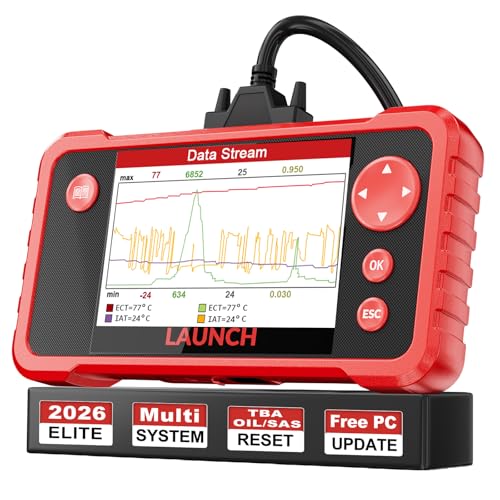
- 【Great Ideal For Every Car Owner】Prefect choice for your father, husband, brother or boyfriend. EVERY CAR OWNER WILL NEED IT! Also, the lifetime update is provided for more vehicle coverage, bug fixes. SAVE AT LEAST $1000+ PER YEAR!Get LAUNCH CRP123 V2.0 car diagnostic scanner and give your lover a surprise!*R each us to Get the Extra Gifts :Protective Case Storage Bag.
- 【Newly Added 3 Reset Functions】CRP123 V2.0 obd2 scanner with upgrades it offers Throttle Adaptation,Oil Reset and SAS Reset functions for FREE now!! Optimize your engine performance with Throttle Adaptation, reset your oil life system with ease to save time and money on maintenance, and enhance your vehicle's handling and safety with SAS Reset.Covering more daily repairs,become the most cost-effective product in its price range,save your time and money!
- 【 Read & Clear/Reset Engine/ABS/SRS/Transmission Diagnostic Scan Tool 】LAUNCH CRP123 V2.0 OBD2 Scanner can test Engine, Transmission, ABS and Airbag four systems, also reads and resets code, displays data stream graphic, stores and playbacks dynamic data stream,helps to quick analysis and diagnosis.
- 【 Error Fault Code Reader】Except the full 10 modes OBD2 diagnostic functions like, retrieving I/M readiness, Freeze Frame Data, Read Dynamic Data stream and Vehicle Information, O2 Sensor Test, EVAP Test of Fuel Tank System (Mode 8) and Advanced On-board Monitoring (Mode 6), launch crp123 v2.0 obd2 scanner can not only reveal what error codes your car is producing, but also erase your vehicle’s check engine light after problem fixed, the DTC help and explanation also tell you the exact problem.
- 【 Live Data Graphing + Read/Record/Playback Data stream + Print diagnostic data 】Live Data Graphing,more intuitive to know your vehicle’s problem.4 inches Screen Screen ;Print Function:Print the diagnose result easily; with user manual and register & update tutorial video uploaded in the link by us,you can Look up it anytime by ONE-CLICK.
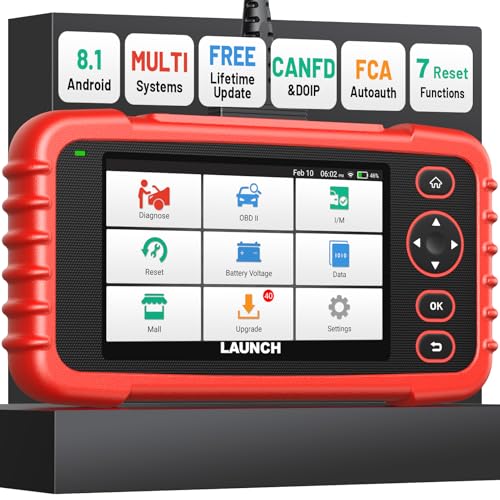
- [Newly Added in 2026: 7 Reset Functions] The 2026 new version of the OBD2 scanner diagnostic tool CRP123X V3.0 Elite has new special functions for F.REE: Throttle Ad.aptation, Oil/SAS/BMS/Brake Reset, D-P.F Re.generation and ABS Service. Before you visit a mechanic, launch obd2 Scanner CRP123X Elite can perform a more in-depth diagnosis of the car system and provide accurate data within minutes. What's more, the list of compatible models has been expanded. Upgrading frequency is regular, occurring monthly even weekly.
- 🔥[FCA AutoAuth + CAN FD & DoIP] As an upgraded version of the LAUNCH CRP123X/CRP129X, FOXWELL NT614, and ANCEL FX2000, The Newest LAUNCH CRP123X V3.0 auto diagnostic scanner supports the following new protocols: CAN-FD for 2020 and newer G.M and Chrysler
 models, as well as DoIP for V.olvo, Land Rover/Jaguar, and B.MW F/G chassis. With integrated AutoAuth, you can diagnose 2018 and newer FCA cars equipped with S.GW. Note: CAN-FD and DoIP protocols require an additional obd2 cable. *Menus vary by make, model, and year of gasoline or diesel engine vehicle. Email us your VIN data.
 - 🔥[No extra software fee. Works on 90 vehicle brands.] Most OBD2 scanners work with vehicles manufactured after 2001. However, the LUNCH OBD2 scanner is compatible with OBDII-equipped vehicles built after 1996 and works with more than 90 vehicle brands. One-click lifetime updates over WIFI 2.4&5.0Ghz keep the car software current and ensure constant coverage additions, diagnose vehicles from 1996 to 2026 with a massive global database. Android 8.1 ensures lightning-fast boot-up and processing.
- [Accurate & Intuitive Multi System Diagnosis] Will you be confused about what happens when the warning light of transmission, ABS, and SRS Airbag check engine flashes? Launch obd2 scanner diagnostic tool CRP123X V3.0 to pinpoint the problem components for a faster diagnosis for your car instead of taking your car to the dealership. Generate vehicle health reports with one click and share them via email over Wi-Fi to help avoid blind maintenance. And will turn off the warning light for you after fixing the problem, make to know more about your cars and do your own repair.
- [Multiple Display of Live Data + DTC Code Definition Explanation] Launch car tools show real-time data of oil temp, pressure, transmission temp, engine speed, coolant temperature, you will know which car part is abnormal. Data can be shown in a single, multi- graph, and merge two graphs for analysis(or 4-in-1 merged waveform graph),you can save, share, print, or email the overall inspection report for easier analysis.🔥Code Search,DTC Library provide massive information. Inbuilt “Feedback” module provides customized repair suggestions from our certified professionals.
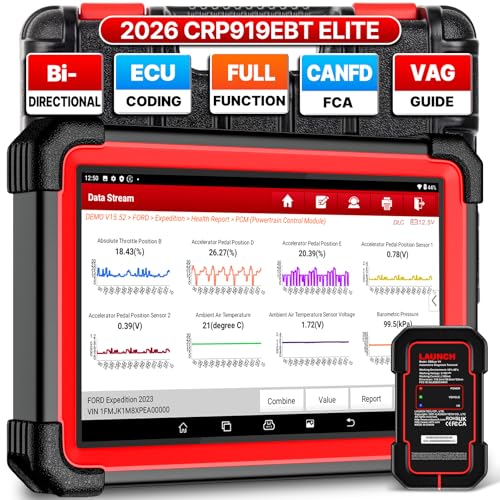
- 🔥【2026 TOP HARDWARE AND SOFTWARE UPGRADE,UPGRADED OF CRP919E】LAUNCH scanner CRP919EBT wireless obd2 scanner has upgraded TOP HARDWARE CONFIGURATION and ADD NEWEST FUNCTIONS. The more FASTER and SMARTER CRP919EBT with 🔥Bluetooths & USB 2-in-1 connect🔥Android 10.0 OS🔥2.0Ghz 4 core high efficiency processor 4GB RAM+64GB ROM large storage🔥6300mAh large battery, more stable and longer lasting diagnostics🔥VAG Guided🔥ECU Code🔥Bi-directional Control🔥35+ Resets🔥CANFD&DOIP🔥FCA AutoAuth🔥Full System Diagnostics🔥2 Yrs Update🔥Newly add BST360 battery tester & I-TPMS & VSP600 endoscope🔥23+ Languages. Provide an unparalleled diagnostic experience at an affordable price.
- 🚗【CAN FD & DOIP & FCA, SUPER PROTOCOL】LAUNCH X431 CRP919EBT is equipped with the DBSCAR VII Bluetooth connector supporting CANFD and DoIP. The CRP919EBT automotive diagnostic scanner supports CAN FD protocol (compatible with post-2020 GM vehicles). It also meets DoIP protocol requirements (adapter sold separately) for compatibility with BMW (E & F chassis) models from 2017 onward. Autoauth for FCA SGW supports FCA vehicles including Chrysler models from 2017 and later.
- ✔️【ADVANCED ECU CODE, ADAPTATION, CALIBRATION & INITIALIZATION】The LAUNCH X431 CRP919EBT automotive scanner delivers exceptional ECU code capabilities for customized vehicle setups. It provides dealer-level functionality to streamline maintenance and repairs, enabling ECU matching and learning for enhanced customization.
- 👍【BIDIRECTIONAL CONTROL, 4000+ ACTIVE TESTS】LAUNCH OBD2 scanner CRP919EBT features bi-directional control - the most demanded capability among mechanics. When headlights or windows malfunction, repairs can be costly. With CRP919EBT, execute ECU commands and assess repair status through systems including ABS, windows, valves, wipers, and headlights - streamlining diagnostics while slashing repair expenses.
- 🥇【35+ MOST POPULAR RESET SERVICE FOR 160 MAKES】Same as Snap-on scanners, CRP919EBT scan tool delivers 35+ reset functions for 160+ vehicle models, including: service oil reset, throttle adaptation, steering angle calibration, brake pad replacement code, tire pressure reset, ABS bleeding, battery registration, gear signal learning, and injector code, etc.
This product presentation was made with AAWP plugin.
Last update on 2026-05-12 / Affiliate links / Images from Amazon Product Advertising API