
NHTSA ID Number: 10144873
Manufacturer Communication Number: 02-157-14R
TSB/Document Date: 2018-10-01
Summary
As part of our dedication to customer satisfaction, Subaru of America, Inc. is initiating a program to extend the original New Car Powertrain Limited Warranty coverage for excessive engine oilconsumption on applicable vehicles to 8 years / 100,000 miles from the original warranty start date.This Warranty Extension will not cover any excessive engine oil consumption found to be a result ofany condition(s) other than those specifically described in this bulletin.This condition must be verified during an inspection and when determined necessary, an oil consumption test performed by an authorized Subaru retailer. SOA will inform vehicle owners this condition may exist via a customer letter.
806932030
3
21236AA050
Thermostat Gasket
1
806939060
O-Ring, Crank Extension
1
806750080
1
16608KA000
16698AA110
Legacy, Outback and Forester
Impreza and XV Crosstrek
w/ 2.0L
4
1
803916010
Gasket, Drain Plug
1
806933010
2
Oil Level Switch
11136AA160
14451AA050
Legacy & Outback
4
Injector O-Rings
15208AA15A
11136AA140
Impreza, Forester and
XV Crosstrek
4
11044AA790
10944AA080
APPLICABILITY
Filter (Cam Carrier Filter Screen)
1
All EXCEPT 2012MY Impreza 5MT &
2011-13MY Forester
1
2012MY Impreza 5MT ONLY
2 or 4
2- Engines with Only Intake AVCS
4- Engines with Intake and Exhaust AVCS
The table below shows the latest available part numbers. It is to be used when determining the proper
short block based on the transmission type.
Short Block Applicability Table
Transmission Type
Existing Part Number
10103AC390
MT
10103AC700
10103AC420
MT
10103AC690
CVT / MT
10103AC600
Latest Part Number
10103AC760**
10103AC750**
10103AC650**
NOTES:
** Whenever a remanufactured short block assembly is available, it should be used for
these repairs.
• Any remaining inventory of the Existing Part Number short blocks are OK to use as long as
they are matched with the listed transmission type.
• Short blocks are not interchangeable between transmission types.
Continued...
Bulletin Number: 02-157-14R; Revised: 08/22/18
Page 5
MISCELLANEOUS MATERIALS
SOA (ORDERABLE) PART NUMBER
WARRANTY PART NUMBER
DESCRIPTION
QUANTITY
SOA868V9610
SOA635305
ThreeBond 1217H
1
SOA868V9270
SOA635041
Super Coolant, (qt.)
8
SOA427V1310
SOA635045
Engine Oil (qt.) 0W-20
6
SOA345001*
SOA635071
Cooling System Conditioner
1
*Case of 12 bottles
SERVICE PROCEDURE / INFORMATION
Before starting any repairs, the first step is to always confirm the customer’s complaint. It is critical
to get as much information from the customer as possible to help you make the most accurate diagnosis.
•
Review all the available service and repair history along with any other records the customer can
provide to establish whether or not the vehicle has been properly maintained.
•
Perform a thorough visual inspection to make sure there are no external oil leaks that could
be contributing to the condition.
•
It is also very important to not overlook the engine’s PCV system and to confirm it is
operating properly. Check the air filter assembly and throttle body / intake manifold for any
excessive oil residue which could be an indicator of a sticking or failed PCV valve.
NOTES:
• An oil consumption test will need to be completed to determine the proper course of action.
There is a specific procedure and Oil Consumption Test form which must be completed. See
Subarunet \ Service \ Forms for the latest test form. Always print the latest form anytime a
new test is started.
•
Where applicable, available reprogramming to reduce the possibility of false low engine oil
level warning lamp illumination must be installed.
•
See Service Procedure to reduce false illumination of low oil level warning lamp (on
models so equipped) later in this bulletin for further instructions. This must be completed at
either the start or end of the consumption testing regardless of the final outcome.
•
IMPORTANT: At the start of the Oil Consumption Test Form, specific information
regarding what prompted (reason for) the testing must be collected. Once this questionnaire
section of the form is completed, it must be faxed to 856-488-3199. Upon completion of the
actual consumption test, the remainder of the form must be completed and faxed AGAIN to
856-488-3199. This information is being collected for quality assurance purposes only. You
will not receive any response from these submissions. This is NOT an authorization process.
Proceed with any necessary testing or repairs as indicated by the information provided in
this service bulletin, the Oil Consumption Test form results, Subaru’s Claims Policies and
Procedures, and your evaluation of the actual condition presented based upon your review
of all three areas. Keep in mind, these repairs should only be completed when unusual oil
consumption has been confirmed.
Before initiating the consumption test, all basic checks must be completed. These include (but are
not limited to): confirming the actual oil level, noting if any oil has been added prior to this visit and
how much, checking for any external leaks, confirming PCV operation, and verifying that a consumption test has not already been started or completed previously. Always use the latest Oil Consumption
Test form form found on Subarunet in the Service Forms area. Follow the instructions outlined on the
form.
Continued...
Bulletin Number: 02-157-14R; Revised: 08/22/18
Page 6
NOTE: The oil and filter change is only necessary if no prior consumption test has been completed
or is already in process. There is no need for duplicate or repeat testing. One-time documented results
are all that is required to move forward with these repairs. Always close the repair order on the day
the oil change has been completed and submit the claim for the oil consumption test using the coding provided at the end of this bulletin. Indicate “Oil Consumption Test” in the comments field / box
when entering your claim. DO NOT hold the repair order open until the vehicle returns. Have the
customer drive the vehicle then return for inspection when any of the following have occurred:
• At least 1200 miles have elapsed
•
When the low engine oil level warning lamp illuminates (when equipped)
•
When the oil level reaches the lower hole in the dipstick/ gauge (as determined by the
customer).
The customer should be advised to not add oil unless there will be a significant delay before they can
return for inspection once a low oil condition occurs. A one-time check of the oil consumption by the
retailer is all that is needed to establish if the condition outlined in this bulletin applies.
SPECIFIC SERVICE PROCEDURES
The following information is provided to underscore service procedures specific to the repairs
outlined in this bulletin. The procedures provided here are specific to certain steps in the
overall process. They are not meant to represent the entire repair process from start to finish.
In some cases, they will differ greatly from the Service Manual instructions and should be
followed in place of the Service Manual for these specific areas only. For the balance of the
repair procedure, refer to the Service Manual. It is highly recommended to review all of the
Service Manual procedures for short block replacement then review these specific procedures to
become familiar with the differences.
•
•
When draining the engine oil, do not remove the engine oil filter. Leave the existing oil filter
in place through engine disassembly, reassembly, installation and initial startup after engine
reassembly.
When removing the engine, there is no need to remove the transmission case cover (CVT
only) or to disconnect / disturb any of the transmission harness connectors. While raising
the transmission with the service jack placed under the front differential as shown in the
illustration below, only raise it enough to access and remove the engine mounting
hardware. Raising it too high can push the transmission up into the bulkhead / transmission
tunnel and possibly cause damage.
Continued...
Bulletin Number: 02-157-14R; Revised: 08/22/18
Page 7
•
When removing the CVT fluid cooler (if equipped), leave it attached to its mounting bracket
and remove as an assembly (3 bolts) from the transmission. Disconnect just the engine
coolant hoses from it and do not disturb the 2 short CVT fluid lines. Hook one of the cooler’s
mounting bracket “ears” behind the bulkhead harness as shown in the photo below to keep
the cooler assembly out of your way. Use a shop cloth between the “ear” and the bulkhead
harness to prevent any chafing.
•
To make separating the transmission (CVT) from the engine easier, there is a pry relief
shown below in the machined mounting surface of the transmission case near the engine
number. Use caution when applying any prying pressure and avoid twisting the tool to
prevent case damage.
Continued...
Bulletin Number: 02-157-14R; Revised: 08/22/18
Page 8
•
Once the engine is removed, if you are using a generic engine stand (preferable since engine
rotation is necessary), use the four mounting holes on the engine block shown below to
mount it. NOTE: Do not use the mounting studs in the upper oil pan.
•
When removing the intake manifold, as shown in the photos below, leave the TGV
assemblies attached to the upper intake, remove the 2 nuts holding the EGR tube to the water
pipe then remove the complete assembly from the cylinder heads as a unit.
•
There is no need to remove the oil dipstick tube or the original oil filter from the front chain
cover. While the cover is removed, store it face (front side) down to minimize the chances of
damaging the machined sealing surface on the block / head side. Also, don’t use it as a tray
to store other removed parts.
NOTE: On 2011MY Forester, refer to TSB 02-116-11 for revised crankshaft pulley, boss
assembly, o-ring and retaining bolt information. Prior to engine number 0048496, these
items are one-time use and MUST be replaced.
•
IMPORTANT: After all 32 bolts securing the chain cover are removed, be EXTREMELY
careful where you pry and what you pry on to break the silicone sealant’s bond. The photos
below show an example of where NOT to pry. In this case, the cam cap became cracked
requiring a complete cam carrier replacement. Patience is the key!
Continued...
Bulletin Number: 02-157-14R; Revised: 08/22/18
Page 9
Reference View
Rear View
Chain Cover
Prying on “Unsupported” Corner of Cam Cap
•
Refer to the instructions found in the Technician Reference Booklet (TRB) for Technical
Training Module 105: “Chain Driven Valve Train Boxer Engines” when removing and
reassembling the timing chain components. The photos and instructions found in the TRB
and provided below have shown to be preferable to those provided in the Service Manual.
•
The timing chains driving the camshafts are identical and are provided with colored
identification links used to align with component timing marks. Chain guides are also
identical for the left and right banks. It is recommended to mark the parts as they are
removed. Return them to their original positions during reassembly to maintain established
wear patterns. Colors used for the identification links will vary.
•
Begin timing chain removal by positioning the crankshaft keyway at the 6:00 position. The
RIGHT bank intake camshaft timing mark (Δ) must be at 6:00 with right bank exhaust timing
mark at 12:00 (camshafts will be unloaded).
6:00
6:00
Identification Link
•
12:00
Compress the chain tensioner by hand, insert a pin through the lever into the access hole
to lock the plunger in place then remove the 2 bolts, tensioner, guides and right side timing
chain.
Continued...
Bulletin Number: 02-157-14R; Revised: 08/22/18
Page 10
•
After turning the crankshaft CLOCKWISE, repeat the procedure for the LEFT side with the
timing marks (Δ) positioned as shown below. Align the crank sprocket keyway with RH
chain dowel pin (shown in red below).
8:00
Dowel Pin
1:00
•
Compress the chain tensioner by hand, insert a pin through the lever into the access hole to
lock the plunger in place then remove the 2 bolts, tensioner, guides and the left side timing
chain.
•
After the left chain is removed, turn the crankshaft in a COUNTER CLOCKWISE direction
until the timing mark on the crankshaft sprocket (NOT the keyway) is back to the 6:00
position as shown below. This positions all the pistons away from TDC and prevents
accidental contact between the pistons and valves.
Timing Mark
Crankcase Seam
Continued...
Bulletin Number: 02-157-14R; Revised: 08/22/18
Page 11
•
Before proceeding, it is best to rotate the engine on the stand 90 degrees so it is vertical with
one cylinder head facing up (head gasket surface horizontal).
•
Remove the rocker cover then the cam carrier from the head that is “up”. Do not disturb the
small camshaft end cap covers. Remove the cam carrier with the camshafts as an assembly.
At this point, the rest of the valve train is sitting loose on the cylinder head. It is imperative
all the rockers, selective lash caps and rocker pivots be returned to their original
positions and orientation on the cylinder heads during reassembly. This eliminates the
need to check and / or adjust the valve lash / cam clearances. TIP: An egg carton for
each head makes a perfect organizer tray. Make sure to mark it as necessary (front, intake,
exhaust) to eliminate any mixing of parts.
•
Loosen the cylinder head bolts in proper order, remove the head, then flip the engine over and
repeat the same steps for the opposite side.
•
It is very important to take the time necessary to thoroughly clean the old silicone sealer from
all the removed components before reassembly. It is a good idea to clean the surrounding
areas then use tape to block off any oil passages in the front cover and cam carriers so any
small bits of removed silicone debris are kept from entering the oil passages and possibly
causing problems after reassembly. Once all the old sealer has been removed, remove any
block-off tape, rinse out any oil passages thoroughly with brake cleaner and shop air.
•
Don’t forget to replace (one-time use) the filter screens in the cam carriers. In addition,
always be sure to do a thorough inspection and cleaning of the oil pan, pick-up tube and
screen as shown in the photos below before reassembly.
Cam Carrier Filter Screen
Oil Pick Up Tube/Filter Screen Assembly
REASSEMBLY
Begin by putting the new short block onto your engine stand using the same mounting points as
before.
Important Reminders:
• Install the new one-time use PCV adapter. NOTE: Never try to reuse the original.
• Swap over the PCV assembly and the PCV baffle plate onto the front of the block.
NOTE: No sealer is used between the baffle plate and the block.
Continued...
Bulletin Number: 02-157-14R; Revised: 08/22/18
Page 12


- Advanced VCI Box, Industry-leading J2534 Pass-Thru...
- High-Speed OEM-Level Diagnostics & Programming: Unlock true...
- Coverage for 17 Car Brands & Ultra Reliability: Works...
- User-Friendly RLink Platform & Expert Support: TOPDON’s...
- 6.6 ft USB-C Cable & Portable Storage Case: The RLink J...
Last update on 2026-06-23 / Affiliate links / Images from Amazon Product Advertising API
If the PDF is very large, it may not load in the preview below.
Some older TSBs had multiple PDFs — visit the NHTSA Website to view all PDFs.
If the TSB PDF does not show, download or view it on the NHTSA Website.
Click on the (+) Plus Sign
Then Click on Associated Document(s)
Search NHTSA Database for Recalls
Search NHTSA Database for Vehicle Investigations
View Latest Vehicle Investigations
Search NHTSA Database for Vehicle Complaints
View Latest Vehicle Complaints
TSB/Document ID: 02-157-14R
Replacement Service Bulletin Number:
MFR Communication Date: 2018-08-01
MFR Internal Campaign ID/Software Version:
Communication Type: Service Bulletin/Repair Instructions
NHTSA Components: ENGINE
MFR Component System:
MFR Component Subsystem:
Previous TSB | Next TSB |
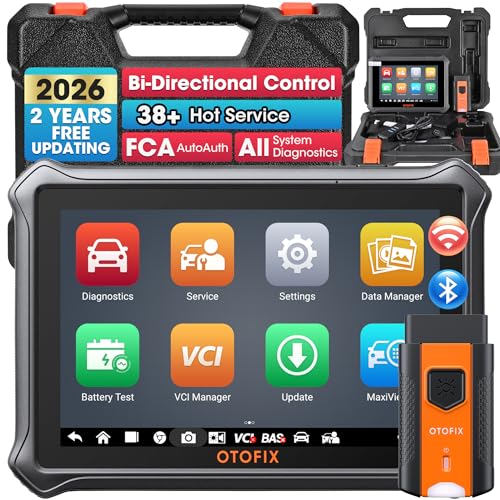
- 🎉[OTOFIX D1 Lite, Perfect Cost-effective Diagnostic Tool]: OTOFIX D1 Lite, a newest bidirectional scan tool from OTOFIX company, is a great choice for DIYers and repair shops. 👉This obd2 scanner diagnostic tool packs all practical functions: OE level all systems diagnoses, Bi-Directional Control, 38+ reset services fixing 99% of common problems, support DoIP & CANDF protocols and FCA
 AutoAuth, high-end hardware configuration. Worldwide vehicles and 🔥2 Years Free Updating🔥 covered.
 - 🎉[Bi-Directional Scan Tool, Active Test]: OTOFIX D1 Lite bluetooth obd2 scanner can also command ECUs and monitor the operation of the actuators to track down the problems of certain parts, like windows, sunroof, wipers, fuel pumps, etc., saving repair time & trouble. This makes OTOFIX D1 Lite the most cost-effective bidirectional scan tool.
- 🎉[2026 Newest, 38+ Hot Reset Functions]: Equipped with 38+ reset functions in one, the OTOFIX D1 lite automotive scanner diagnostic tool allows you to troubleshoot 99% of common vehicle problems. You can use this car diagnostic scanner holding enough functions to easily repair common vehicle models in your repair shops. Including Oil Reset, Injector Coding, Throttle, DPF Reset, SCR Reset, Gear Learning, Clutch Learning, Suspension, etc. Note* Reset functions vary by model.
- 🎉[OE Level Full Systems Diagnostics]: Unlike the 2-system and 4-system diagnostic tools, the OTOFIX auto scan tool can complete comprehensive system diagnostics within 5 minutes. It accesses and scans all available onboard systems like for Engine /AT /ABS /EPB /BMS /TPMS /SRS /SAS /Audio System /BCM /Air Conditioning / etc., to read & clear codes, view live data, and check ECU information. Note: Active test is not involved.
- 🎉[Powerful Hardware Configuration]: Designed with a fashion appearance & a 7” touchscreen and a weight of 463g, this OTOFIX D1 Lite OBD2 diagnostic scanner scan tool is convenient for everywhere and easy to use & store. Android9.0 OS and 2+64GB memory enhance multi-task smoothness and diagnostic operation, no more wasting too much time. 5800mAh battery allows hours-lasting use. WiFi & VCI1 also bring faster communication for your diagnostics.

- 🏆【2026 TOP OBD2 Scanner Diagnostic Tool】OTOFIX D1 Lite wireless obd2 scanner has upgraded hardware configuration and car coverage. The newly upgraded D1 Lite with 🔥OS Android 9.0🔥1.5Ghz 4 core high efficiency processor🔥2GB RAM+64GB ROM large storage🔥5800mAh large battery, more stable and longer lasting diagnostics🔥 38+ Reset🔥action tests🔥full system diagnostic🔥Supports MV105 endoscope🔥21+ Language Supports🔥100000+ vehicle coverage to meet all your daily maintenance needs.
- 👍【Bi-Directional Control / Active Test】D1 Lite obd2 scanner has bidirectional control(worth $300+), which is the most beloved feature among mechanic. If your headlights or car windows are broken, going to a repair shop will cost a lot of money. You can use D1 Lite to send execution commands to the ECU module and identify the repair status. Such as ABS, car windows, doors, valves, wipers, headlights, etc., effectively shorten diagnostic time and reduce diagnostic costs.
- 🔥【All Systems Diagnostics, In-depth Checking】This advanced OBD2 Scanner D1 Lite can perform OE-level diagnosis of all systems including engine, transmission, airbag, ABS, ESP, TPMS, gateway, steering, radio, and air conditioning for more than 100 brands. This diagnostic scanner supports essential functions, such as reading ECU version info, reading and clearing fault codes, and reading data streams.With just a simple click, it provides you with accurate and in-depth diagnostics.
- 🏆【38+ Reset Hot Functions】For repair workshops, holding an OTOFIX D1 Lite Auto scanner is a strong advantage over others. Its 38+ maintenance functions provide various solutions for all module repairs, including Oil Reset, TPMS Reset, Injector Coding, Suspension, Throttle Matching, etc., which will usher your repair business to a new pinnacle. Continuously updating will never make the functionality & compatibility out-of-date.
- 🏆【150+ Models, 10000+ Car Coverage & 16 Languages】D1 Lite is a comprehensive car diagnostic scan tool, help you to troubleshoot car issues fast for 95% US, European, Asian auto makes. ✅ With frequent updates and optimizations allow D1 Lite to cover more vehicles to meet your needs. ✅ Multilingual menu allows auto mechanics around the world to use it without language barriers. 🚩Note: Kindly send us the S/N of the device to authorize new language updates before changing the menu language.
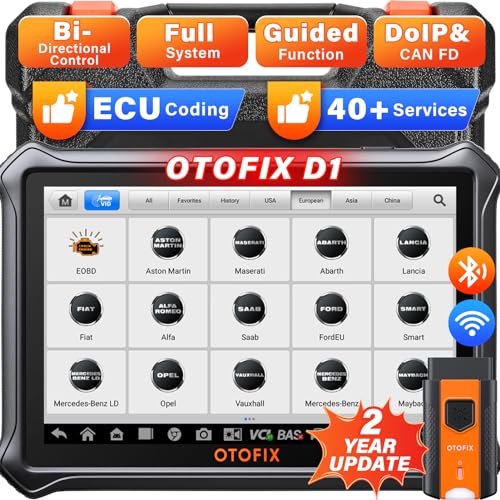
- 2026 Newest Wireless Bluetooth Scan Tool D1: OTOFIX D1 Diagnostic scanner is upgraded version with Enhanced Hardwares & Newest Functions, FASTER and SMARTER! ✅Alternative Bluetooth 5.0 +USB connect✅2G+64GB✅Android 9.0 OS✅5G & 2.4 GHz Dual WiFi✅5800mAh battery👍VAG Guided Function👍ECU Online Coding👍CANFD&DOIP👍40+ Services👍Bi-Directional Control👍Full Systems Diagnose👍2 Years Free Update👍150+ Vehicle Coverage🎁Contact to get gift: otofixaftersales-amz@ outlook.com
- ECU Coding to Unlock the Hidden Features: OTOFIX D1 obd2 scanner diagnostic tool newly adds ECU Coding which can Online Coding(ONLY for VW/Au.di/Sk0da), Variant Coding/Offline Programming, Flash Hidden Functions, Reset Adaptive Data, Match Replaced Components, Customize OE-Settings. Such as: halogen fog lamps retrofitted with xenon fog lamps, different capacity battery retrofit, disbale auto start-stop, sunroof initialization, injector calibration, etc. PS: Coding functions vary by model&year.
- Full Bidirectional Control for Active Car Tests: The D1 OTOFIX scanner also offers bi-directional control, allowing you to perform powerful active tests on car subsystems. This means that you can check the working status and functionality of open & close solenoids, energize injectors, turn cooling fan on & off, and more, all from the device itself.🚩The D1 bi-directional obd2 scanner can quickly help you to check if a system or component goes well,Improving 200% Efficiency.**Note that Active Tests available depend on the make/model/year of your car.
- 40+ Popular Maintenance Functions: OTOFIX D1 obd scanner for car performs 40+ hot services, including Oil Reset, EPB, TPMS, BMS, E.GR, G.PF, D.PF, SAS Calibration, ABS Bleeding, Injector Coding, Gearbox Match, Suspension, Crankshaft Relearn, Power Balance, etc., still growing. Great choice for DIYers, technician, repair shop. 🚩Get MORE special functions from "Car Brand>System>Service". Check compatibility before purchase via 📧 otofixaftersales-amz@ outlook.com.
- OE-Level All Systems Diagnostic + One-Click AutoVIN & AutoSCAN: OTOFIX D1 scanner automotriz gives you the ability to troubleshoot entire car systems including engion system,transmission system,body system,chassis,etc. 🚩One of the standout features of the D1 obd2 scanner diagnostic tool is the one-click AutoVIN & AutoScan function. This feature allows you to quickly and easily scan all diagnosable ECUs with just one click, and identify any problems hidden in your vehicle's systems.
Last update on 2026-06-23 / Affiliate links / Images from Amazon Product Advertising API
This product presentation was made with AAWP plugin.