
NHTSA ID Number: 10133570
Manufacturer Communication Number: 0118-17
TSB/Document Date: 2018-04-16
Summary
0118-17 Symptom Diagnostics - Oil Leaks
If the PDF is very large, it may not load in the preview below.
Some older TSBs had multiple PDFs — visit the NHTSA Website to view all PDFs.
If the TSB PDF does not show, download or view it on the NHTSA Website.
Click on the (+) Plus Sign
Then Click on Associated Document(s)

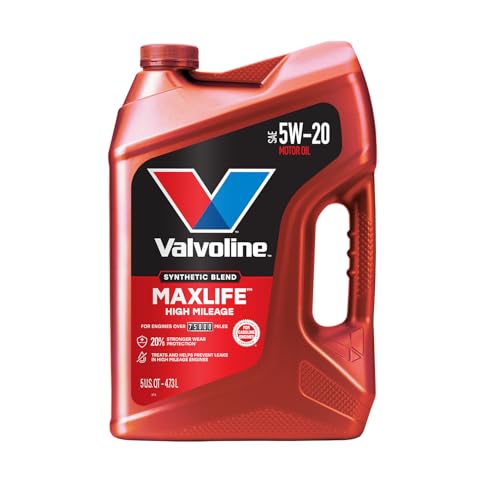
- MaxLife Technology prevents engine breakdown with 40% better...
- Includes seal conditioners to reduce oil consumption and oil...
- Added detergents reduce sludge, corrosion, rust and deposits...
- Advanced friction-fighting additives help maximize...
- Meets or exceeds all requirements of ILSAC GF-6A, API SP...
This product presentation was made with AAWP plugin.
Search NHTSA Database for Recalls
Search NHTSA Database for Vehicle Investigations
View Latest Vehicle Investigations
Search NHTSA Database for Vehicle Complaints
View Latest Vehicle Complaints
TSB/Document ID: 0118-17
Replacement Service Bulletin Number:
MFR Communication Date: 2017-01-18
MFR Internal Campaign ID/Software Version:
Communication Type: Service Bulletin/Repair Instructions
NHTSA Components: ENGINE
MFR Component System:
MFR Component Subsystem:
Previous TSB | Next TSB |
01 18-17
1
01 18-17
SUBJECT
DATE
Symptom Diagnostics - Oil Leaks
January 2017
Additions, Revisions, or Updates
Publication Number / Title
Platform
Section Title
DDC-SVC-MAN-0191
GHG17 DD
Platform HD
Engine Oil Leaks
DDC-SVC-MAN-0084
EPA07/10/
GHG14 DD
Platform
These are new sections.
Engine Oil Leaks
All information subject to change without notice.
01 18-17
Change
Copyright © 2017 DETROIT DIESEL CORPORATION
3
2 Engine Oil Leaks
2
Engine Oil Leaks
NOTE: Detroit™ and the Department of Transportation (DOT) define an external fluid leak as a condition where
fluids are pooling or leaking onto the ground.
Figure 1. Example of an Oil Leak - Very Wet with Evidence That Fluid Leaks onto the Ground
4
All information subject to change without notice.
Copyright © 2017 DETROIT DIESEL CORPORATION
01 18-17
01 18-17
Figure 2. Example of a Seep - Residue Accumulation on the Surface But Remains on that Surface and
Does Not Drip onto the Ground
NOTE: Block porosity is an immediate issue and does not happen over time. If there was a block porosity concern
present, the porosity issue would be evident when the engine is new.
Check as follows:
1. Shut off the engine, apply the parking brake, chock the wheels, and perform any other applicable safety steps.
2. Was an oil change recently performed on this vehicle?
a. Yes; check to make sure that the oil filter and drain plug were properly installed and clean any oil presence
spilled from the previous service interval.
b. No; Go to step 3.
3. Is oil pooling or leaking onto the ground?
a. Yes; Go to step 4.
b. No; no leaks are present, release the vehicle. Refer to 12WO-2. (http://www.ddcsn.com/cps/rde/xchg/ddcsn/hs/
5525.htm)
4. Check vehicle repair history. Are there any recent repairs that could have resulted in oil spills on the engine that would
appear as an oil leak?
a. Yes; examine the oil spill area of the engine to make sure it is not being perceived as an oil leak.
b. No; Go to step 5.
NOTE: Isolating the exact location can be difficult due to fan blast and road grime that can cause the leaking oil to
migrate. Oil leaks tend to move in a downward and rearward direction. Look for the highest point of any oil trace.
5. Inspect the entire vehicle for signs of leaks; note any leaks that could be confused for an engine oil leak. Was the
source of the leak identified as being caused by the engine?
a. Yes; Go to step 6.
b. No; identify the non-engine component causing the leak and refer to the component OEM literature for
additional information on troubleshooting/repair of the oil leak.
All information subject to change without notice.
01 18-17
Copyright © 2017 DETROIT DIESEL CORPORATION
5
2 Engine Oil Leaks
6. Visually inspect the rocker cover gasket, starting at the left front of the engine and continuing down the left side
toward the rear of the engine. Is there an external oil leak coming from the rocker cover gasket?
a. Yes; replace the rocker cover gasket. Refer to section "Removal of the Rocker Cover".
b. No; Go to step 7.
7. Visually inspect the Camshaft Position (CMP) sensor for sign of external oil leaks. Is there an external oil leak coming
from the CMP sensor?
a. Yes; replace the O-ring on the CMP sensor. Refer to section "Removal of the Camshaft Position Sensor".
b. No; Go to step 8.
8. Visually inspect the camshaft housing seal, starting at the front left and continuing down the left side to the rear. Pay
special attention to the rear corner, as leaks are hard to see in this area. Are there any external oil leaks coming from
the cam frame housing seal?
a. Yes; replace the cam housing seal. Refer to section "Removal of the Camshaft Housing Assembly".
b. No; Go to step 9.
9. Visually inspect the cylinder head gasket (1), starting at the left front of the engine and continuing down the left side
to the rear of the engine. Keep in mind that the oil supply ports are at the front and the rear of the block. Are there any
external oil leaks coming from the cylinder head gasket?
a. Yes; remove the cylinder head and inspect the head gasket oil supply and return seals for damage.
Refer to section "Removal of the DD13 Cylinder Head Assembly"
Refer to section "Removal of the DD15 and DD16 Cylinder Head Assembly"
Repair as necessary.
b. No; Go to step 10.
1. Cylinder Head Gasket
2. Rocker Cover Gasket
3. Camshaft Housing Cup Plugs (behind
crossover pipe)
4. Camshaft Housing Seal
5.
6.
7.
8.
Oil Gallery Cup Plugs
Front Cover Seal (behind damper)
Crankshaft Seal (behind damper)
Oil Pan Gasket
Figure 3. Front of Engine (steps 10 - 13)
10. Is oil leaking from the front of the engine?
a. Yes; Go to step 11.
6
All information subject to change without notice.
Copyright © 2017 DETROIT DIESEL CORPORATION
01 18-17
01 18-17
11.
12.
13.
14.
b. No; Go to step 14.
Visually inspect the camshaft housing cup plugs (behind the crossover pipe) (3). Are there any external leaks present?
a. Yes; repair as necessary.
b. No; Go to step 12.
Visually inspect the oil gallery cup plugs (5) in the cylinder block. Are there any external leaks present?
a. Yes, repair as necessary.
b. No; Go to step 13.
Looking behind the damper, inspect for a leaking front cover seal (6) or a leaking crankshaft seal (7). Is either seal
leaking?
a. Yes; repair as necessary.
b. No; Go to step 39.
Is oil leaking from the right side of the engine?
1.
2.
3.
4.
Cylinder Head Gasket
Rocker Cover Gasket
Turbo Oil Supply and Return
Crankcase Breather and Tube
5.
6.
7.
8.
Oil Pan Gasket
Right Oil Drain Plug
Cylinder Block Cover Plate (if equipped)
Camshaft Housing Seal
Figure 4. Right Side (steps 14 - 20)
a. Yes; Go to step 15.
b. No; Go to step 21.
15. Inspect the right side oil drain plug (6). Is there an oil leak present at the oil drain plug?
a. Yes; repair as necessary.
b. No; Go to step 16.
16. Inspect the crankcase breather (4). Check for leaks at the inlet and outlet tubes, fittings, mounting surface to the
cylinder block, and the housing-to-cap seal. Are there any external oil leaks present?
a. Yes; repair as necessary, Go to step 18.
b. No; Go to step 17.
All information subject to change without notice.
01 18-17
Copyright © 2017 DETROIT DIESEL CORPORATION
7
2 Engine Oil Leaks
NOTE: An internally leaking crankcase breather will leak at a rate of at least three drips of oil every five minutes. If
a leak is found at a slower rate than three drips every five minutes the source of the drip is not internal to the
crankcase breather.
17. Wipe the crankcase breather clean. Place a blank card under the crankcase breather assembly to visualize any leaks.
An internal leaking crankcase breather will leak at a rate of at least three drips of oil every five minutes. Are there any
oil leaks present of more than three drips of oil in a five-minute time span?
a. Yes; Go to step 18.
b. No; Go to step 19.
18. Measure the crankcase pressure. Refer to section "Crankcase Pressure Test". Does the engine have high crankcase
pressure?
a. Yes; repair as necessary.
b. No; replace the crankcase breather. Refer to section "Removal of the Crankcase Breather Assembly".
19. Is oil leaking at the boost pipe?
a. Yes; inspect for loose clamps, seeping, worn or damaged boost pipe and for a dirty air filter. Then Go to step
20.
b. No; Go to step 20.
20. Inspect the turbocharger assembly and related parts.
Refer to section "Inspection of the DD13 and DD15 Turbocharger"
Refer to section "Inspection of the DD16 Turbocharger"
Check for leaks at the inlet and outlet pipes, oil supply and drain lines, speed sensor, speed sensor O-ring, sealing
surface between the turbocharger assembly and the engine block . Are there any external oil leaks present?
a. Yes; repair as necessary.
b. No; Go to step 39.
21. Is oil leaking from the left side of the engine?
8
All information subject to change without notice.
Copyright © 2017 DETROIT DIESEL CORPORATION
01 18-17
01 18-17
1.
2.
3.
4.
5.
6.
7.
22.
23.
24.
25.
Injector Harness Grommets
Camshaft Housing Seal
Rocker Cover Gasket
High Pressure Transfer Line Seals
Cam Position Sensor O-ring
Cylinder Head Gasket
High Pressure Pump Mounting Seal
8. Oil Gallery Cup Plug between High Pressure
Pump and Air Compressor
9. Air Compressor Mounting Seal
10. Power Steering Pump Mounting Gasket
11. Left Oil Pan Plug
12. Oil Pan Gasket
13. Oil Thermostat Cover Plate Seal
14. Oil Coolant Module (see 13TS-10)
Figure 5. Left Side (steps 21 - 33)
a. Yes; Go to step 22.
b. No; Go to step 34.
Inspect the left side oil pan plug (11). Is there an oil leak present at the oil pan plug?
a. Yes; repair as necessary.
b. No; Go to step 23.
Visually inspect the oil pressure and oil temperature sensors for signs of external oil leaks. Leaks can be present at the
sensors or O-rings. Is there an external oil leak coming from either sensor?
a. Yes; repair as necessary.
b. No; Go to step 24.
Visually inspect the injector harness grommets (1). Are there any external leaks present?
a. Yes; replace the injector harness grommets.
b. No; Go to step 25.
Visually inspect the high pressure fuel injector line seals for each cylinder. Are any of the high pressure fuel injector
line seals leaking?
a. Yes; replace the high pressure fuel line injector line seal(s) that are leaking.
b. No; Go to step 26.
NOTE: When inspecting the oil coolant module, consider that oil might be spilled around the filler neck and oil
filter cap area during service intervals. These spills can sometimes lead to misdiagnosis.
All information subject to change without notice.
01 18-17
Copyright © 2017 DETROIT DIESEL CORPORATION
9
2 Engine Oil Leaks
26. Inspect the oil coolant module. Check for leaks at the oil fill neck, oil filter cap, oil thermostat cover, plugs, and
around the sealing surface between the oil coolant module and the engine block. Are there any external oil leaks
present?
a. Yes; repair as necessary.
b. No; Go to step 27.
27. Inspect the oil dipstick tube. Are there any external oil leaks present?
a. Yes; repair as necessary.
b. No; Go to step 28.
28. Check for leaks at the High Pressure Fuel Pump (HPFP) (7). Are there any external oil leaks at the HPFP weep hole or
where the HPFP mates to the engine block?
a. Yes; Go to step 29.
b. No; Go to step 30.
29. Remove the HPFP and inspect its camshaft seal. Is damage present?
a. Yes; install a new HPFP and mounting O-ring.
b. No; install a new mounting O-ring and reinstall the HPFP.
30. Inspect the cylinder block oil gallery cup plug, located two inches under the high pressure fuel pump (8). Is there an
external oil leak at the cup plug?
a. Yes; replace the cup plug. Refer to section "Replacement of the Oil Gallery Cup below the High Pressure Fuel
Pump".
b. No; Go to step 31.
31. Inspect the air compressor assembly; check for oil leaks at the compressor's cup plug. Are there any external oil leaks
present?
a. Yes; replace the air compressor.
b. No; Go to step 32.
32. Inspect the air compressor flange where it mates to the engine block. Is there an external oil leak present?
a. Yes; remove the air compressor, clean the area, replace the O-ring, and reinstall the air compressor.
b. No; Go to step 33.
33. Inspect the seal between the rear of the air compressor and the power steering pump. Is there an external oil leak
present?
a. Yes; remove the power steering pump, replace the seal, and reinstall the power steering pump.
b. No; Go to step 39.
34. Visually inspect the camshaft housing cup plugs (1). Is there an external oil leak present?
10
All information subject to change without notice.
Copyright © 2017 DETROIT DIESEL CORPORATION
01 18-17
01 18-17
1.
2.
3.
4.
5.
35.
36.
37.
38.
Camshaft Housing Cup Plugs
Rocker Cover Gasket
Camshaft Housing Seal
Access Plate for #5 Idler
Rear Crank Seal (behind flywheel)
6.
7.
8.
9.
Flywheel Housing Gasket
Oil Pan Gasket
Access Plate for #3 Idler
Cylinder Head Gasket
Figure 6. Back of Engine (steps 34 to 38)
a. Yes; repair as necessary.
b. No; Go to step 35.
Visually inspect the camshaft housing seal (3). Is there an external oil leak present?
a. Yes; replace the cam housing seal. Refer to section "Removal of the Camshaft Housing Assembly".
b. No; Go to step 36.
Visually inspect the access plate for #5 idler (4). Is there an external oil leak present?
a. Yes; repair as necessary.
b. No; Go to step 37.
Visually inspect the access plate for #3 idler (8). Is there an external oil leak present?
a. Yes; repair as necessary.
b. No; Go to step 38.
Visually inspect the flywheel housing for leaks (6). Is there a leak on the lower 6 inches of the flywheel housing?
a. Yes; Go to step 39.
b. No; the oil leak is generated by either the flywheel housing gasket or the rear crankshaft seal. Inspect and repair
as necessary.
NOTE: For oil pan gasket warranty submissions, you may choose to use the image below to mark the location of
the leak on the oil pan gasket. When replacing an oil pan gasket, Refer to section "Installation of the Oil Pan".
39. Inspect the oil pan starting at the front of the engine working towards the rear of the engine. Is there an external oil
leak present?
All information subject to change without notice.
01 18-17
Copyright © 2017 DETROIT DIESEL CORPORATION
11
2 Engine Oil Leaks
a. Yes; repair as necessary.
b. No; Refer to section "Engine Oil Leaks - Oil Developer Method".
12
All information subject to change without notice.
Copyright © 2017 DETROIT DIESEL CORPORATION
01 18-17
01 18-17
3
Engine Oil Leaks
NOTE: Detroit™ and the Department of Transportation (DOT) define an external fluid leak as a condition where
fluids are pooling or leaking onto the ground.
Figure 7. Example of an Oil Leak - Very Wet with Evidence that Fluid Leaks onto the Ground
All information subject to change without notice.

- [2026 Top-Tier Hardware and Software Upgrade]: Topdon ArtiDiag900 Lite scanner has enhanced hardware and latest features, including Android 11.0, 5x faster CPU, 10000mAh battery for 12 hours of continuous operation, stable wireless diagnosis with Bluetooth 5.0, 8-inch touchscreen. Added bi-directional control, wireless diagnosis, battery testing (optional), and DTC repair guide
- [TOPDON Bidirectional Scan Tool]: This bidirectional obd2 scanner sends commands to the vehicle's ECU for active testing, enabling users to accurately and quickly locate faulty components such as injectors, coolant pumps, windows, wipers, headlights, mirrors, etc. The bidirectional control scanner is the ideal choice for workshops/automotive repair shops as it significantly reduces mechanic's diagnostic time.
- [Wireless Bluetooth Diagnostic Experience]: The AD900 Lite scan tool comes with a Bluetooth 5.0 VCI, supporting a wireless diagnostic range of up to 33 feet (10 meters), allowing you to diagnose without being confined to cables or tight spaces. Stable and fast wireless diagnosis provides a comfortable repair environment. It also offers VCI cables to increase connectivity options.
- [DTC Repair Guide Function]: Easily diagnose issues with your vehicle and receive guidance on repairs with the topdon scan tool's fault code definitions for all systems,maximize your diagnostic capabilities. This function is compatible with Chrysler
 /Dodge/Jeep/Fiat 2010-2014 and expanding with continual updates,the AritDiag 900 Lite car diagnostic scanner is the must-have tool for any technician or DIY enthusiast.
 - [OE-Level Full System Diagnostics]:AritDiag900 Lite full system diagnostic scanner can scan ALL available modules(Engine, Transmission, Airbag, ABS, ESP, TPMS, Gateway, Steering, Radio, Air conditioning, ect.) to✔read ECU info, ✔read/clear codes, ✔view live data stream, ✔retrieves freeze-frame, ✔perform active tests, and more. With just a simple click, it provides you with accurate and in-depth diagnostics.
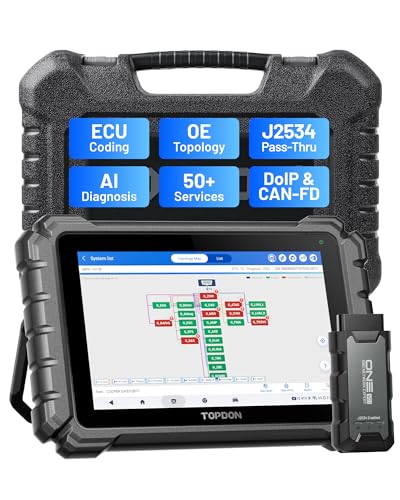
- Dual WiFi & 10.1" Touchscreen: Provides a stable, high-speed wireless link 3x faster than bluetooth, and a responsive, professional interface. Topdon ONE obd2 scanner diagnostic tool ensures smooth, non-lagging diagnostic scan, boosting mechanic efficiency
- J2534 Pass-Thru Support: The included ONE VCI supports the J2534 standard, allowing it to function as a pass-thru device when paired with OEM diagnostic software.Through TOPDON’s RLink platform, technicians can perform dealer-level coding, expanding in-house capabilities without investing in multiple factory automotive scan tools
- OE Topology Mapping: Visualize the vehicle’s ECU network exactly as it’s built.Zoom, pan, and highlight specific modules to pinpoint component issues with precision.Topology mapping displays real-time communication between modules
- Topfix AI Assistant: Covers 5 million plus fault codes and delivers instant causes, symptoms, and repair guidance with professional wiring diagrams for each code.Slashes diagnostic time, boosts first-time fix accuracy, and increases shop revenue
- 50 Plus Service Functions: Covers high-demand services like ADAS calibration, DPF regen, TPMS reset, ABS bleed, and throttle adaptation.Expands your service menu, allows you to charge premium rates, and turns away zero jobs due to lack of tooling. Vehicle-specific functionality may vary.

- Bi-Directional Control, Quickly Locate Problems: Turn your phone into a professional diagnostic tool. You can send commands from your phone to the ECU to test injectors, cooling fans, headlights, A/C clutch, windows, wipers, and more. See which one doesn't respond. Helps you quickly locate the problem and save time. No need to tear things apart, avoid blind disassembly.
- Full System Diagnostics, No Fault Hides: Unlike basic diagnostic tools that only cover 4 systems, TopScan can scan all systems. Read and clear trouble codes, view live data streams, and generate a complete vehicle health report – all issues are clear at a glance. Covers 10,000+ vehicle models and is compatible with 99.99% of vehicles.
- Flexible Subscription, Choose Advanced Features as Needed: TopScan Lite provides free-for-life access to core diagnostics, including full system scan, code reading, performance tests, and repair information. After purchase, advanced features (bi-directional control, service operations, live data, code clearing, and AI functions) are free-for-the-first-year. After the first year, if you want to use advanced features, you need to subscribe on a monthly, quarterly, or yearly basis. As new models and reset functions are updated, the tool will also be continuously upgraded.
- AI Assistant - TopFix: Think of TopFix as your personal AI mechanic. It leverages a repair database and OEM data to deliver clear, step-by-step repair solutions. Features include AI Q&A, one-click translation, and a full repair log, making your diagnostic process simpler and more efficient.
- 8+ Hot Resets, Keep Your Car in Top Shape: One-tap resets for oil, throttle, EPB, steering angle, DPF, ABS, BMS, and airbag. It enables car owners to easily perform essential maintenance, ensuring the vehicle stays in optimal condition and extends its service life.
This product presentation was made with AAWP plugin.
Last update on 2026-05-12 / Affiliate links / Images from Amazon Product Advertising API