
NHTSA ID Number: 10130218
Manufacturer Communication Number: SSP 950173
TSB/Document Date: 2018-03-13
Summary
Audi Academy Self-paced Study Program - The OBZ 7-speed Dual Clutch S tronic Transmission in the 2017 Audi R8
3
Output shaft 2
643_048
2nd gear
R
4
1
5
K2 K1
2
6
3
7
643_049
32
3rd gear
R
4
1
5
K2 K1
2
6
7
3
643_050
4th gear
R
4
1
5
K2 K1
2
6
3
7
643_051
33
5th gear
Pinion shaft
Gearbox unit 1
Gearbox unit 2
Input shaft 1
Input shaft 2
R
1
4
Output shaft 1
5
K2 K1
PTO shaft for front final drive
2
7
6
3
Output shaft 2
643_052
6th gear
R
1
4
5
K2 K1
2
6
3
7
643_053
34
7th gear
R
4
1
5
K2 K1
2
7
6
3
643_054
Reverse gear
R
4
1
5
K2 K1
2
6
3
7
643_055
35
Parking lock – mechanical function
Because there is never any drive gear engaged when the
engine is not running (both clutches K1 and K2 are not
engaged), the OBZ transmission requires a parking lock.
The parking lock consists of a parking lock gear and a locking
pawl that is actuated by a spring loaded, tapered sliding
sleeve.
Unique to the OBZ transmission, is that the parking lock gear
is not located on the gearbox output shaft, as is normally the
case, but instead is integrated in sliding collar R/4. See page
29.
Engaging the parking lock – P-ON
The parking lock is engaged by the force of the parking lock
spring. The parking lock spring forces the parking lock piston
together with arrester element and tapered sliding sleeve
between the bracing plate and the locking pawl. As a result,
the locking pawl is pressed against the parking lock gear. The
claw engages in the teeth of the parking lock gear and locks it
in position.
Parking lock piston
Locking element with shoulder and holder for sensor magnet
Parking lock spring
Striker block
Spring-loaded tapered
sliding sleeve
Pawl
Pivot mounted in gearbox
housing
Resetting spring
Parking Lock Solenoid
N486
Parking Lock Solenoid Valve
N573 – Parking lock engagement valve
643_078
Hydraulic pressure acts on
parking lock piston
Disengaging the parking lock – P-OFF
The parking lock is disengaged by the
hydraulic force of the parking lock piston.
The parking lock piston pulls the tapered
sliding sleeve back against the force of the
parking lock spring. The return spring
forces the locking pawl out of engagement
with the gear teeth and holds it in that
position.
643_079
36
1st step
Engaging the parking lock if pawl and gear do not mesh
1. If the claw of the locking pawl clashes with a tooth of the
parking lock gear, the tapered sliding sleeve is still forced between
the bracing plate and the locking pawl by the preloaded spring
force. The tapered sleeve is spring-loaded and presses the locking
pawl against the tooth of the parking lock gear.
Tapered sliding
sleeve – springloaded
2nd step
Claw and tooth
clashing
643_080
2. As soon as the vehicle rolls a little and the parking lock
gear rotates slightly, the locking pawl snaps into engagement
with the parking lock gear because the tapered sleeve is
preloaded by the force of the spring. The parking lock is
engaged.
643_081
Holding the parking lock in position P-OFF with Parking Lock Solenoid N486
A - Keeping parking lock disengaged
If the parking lock needs to remain disengaged after the
engine is switched off, the parking lock piston has to be held
in the P-OFF position by the Parking Lock Solenoid N486.
In that position, the 3 ratchet springs of N486 engage with
the locking tip of the arrester element and so lock the parking
lock piston in the P-OFF position.
To hold the lock in position P-OFF, N486 remains energized
after the engine is switched off. That means that the armature of N486 remains pulled in against the force of the spring
(Figure A).
More information on activating the transmission setting
P-OFF can be found on page 12.
Ratchet spring
A
Arrester element with
parking lock piston
B
Snap hook
Piston spring
Locking element
B - Engaging the parking lock
N4
86
If N486 is de-energized, the armature of N486 moves out (to
the right) under the force of the armature spring. As a result,
the ratchet springs are forced apart and release the arrester
element of the parking lock piston. The parking lock piston is
thus unlocked and the parking lock spring forces the parking
lock piston into the P-ON position.
643_082
37
Parking lock – electro-hydraulic function
Normal position – Parking lock ON – Engine OFF
The following circuit diagram shows the system in pressurized and depressurized condition.
The spring in the parking lock piston ensures that the parking
lock is engaged.
A hydraulic circuit with spring-loaded self-holding valve (SHV)
and an additional holding solenoid (N486) for the P-OFF
position make sure that the parking lock cannot be unintentionally engaged when the vehicle is moving.
Parking lock gear
WhenParking Lock Solenoid Valve 2 N574 and Parking Lock
Solenoid N486 are de-energized, the parking lock always
remains engaged. In that circuit setting, the pressure line of
the parking lock piston has an open connection to the sump
via the self-holding valve (SHV) and is not pressurized.
The basic principle is:
When it has no oil pressure and power supply, the parking
lock is always engaged (parking lock PN).
Solenoid valve N574 is only briefly operated. The self-holding
valve retains whichever switching condition is initiated.
Parking lock piston
Parking lock module
Auxiliary hydraulic module
Key:
N486 Parking Lock Solenoid
– PHM – Parking lock holding solenoid
N573 Parking Lock Solenoid Valve
– PEV – Parking lock engagement valve
N574 Parking Lock Solenoid Valve 2
– PAV – Parking lock disengagement valve
SHV Self-holding valve
A1
A2
A3
SHV piston face A1
SHV piston face A2
SHV piston face A3
Primary pressure
supply
643_083
38
Parking lock ON – engine running
Even if the primary pressure is present when the engine is
running, the self-holding valve remains in its normal position
and keeps connection between the parking lock piston
pressure line and the sump open and, therefore, depressurized. When P-ON is active, N573 remains energized until the
engine is switched off.
That means the connection between the parking lock piston
and the sump is open. This prevents unintentional pressure
build up that would result from the disengagement of the
parking lock.
The following relationships apply to the piston faces:
1. Face A2 is smaller than face A1.
2. Faces A2 and A3 combined are larger than face A1.
A larger face (A) = Greater force
In the situation illustrated in Figure 643_084 – primary
pressure applied to A2 and A1 – the SHV remains in the lefthand position because the force acting on piston face A1 is
greater than that on A2.
The self-holding valve, SHV
The SHV has a spring-loaded valve with 3 different-sized
piston faces – faces A1, A2 and A3. Depending on the switching position of the solenoid valves N573 and N574, either the
primary pressure (equal pressure) or no pressure is acting on
those faces. Since the same pressure acts on all the piston
faces, different forces result and enable the valve to be
moved to the desired setting.
Parking lock module
Auxiliary hydraulic module
Primary pressure
supply
643_084
39
Disengaging the parking lock and holding the P-OFF setting
To disengage the parking lock, primary pressure is applied to
the packing lock piston. The hydraulic force is many times
greater than the force of the parking lock spring, so the
parking lock piston is forced back together with the tapered
sleeve. The return spring of the locking pawl lifts the pawl out
of engagement with the parking lock gear and so releases the
parking lock. See Figure 643_079 on page 36.
Parking lock module
Electro-hydraulic function
Step 1
Auxiliary hydraulic
module
Parking Lock Solenoid Valve N573 has to be de-energized. By
operating Parking Lock Solenoid Valve 2 N574 the control line
for piston A1 is connected to the sump and de-pressurized.
Initially, pressure is only applied to piston face A2, causing the
self-holding valve, SHV, to switch over to the right. At that point,
the primary pressure is connected through to the parking lock
piston via N573 and the parking lock is disengaged.
At the same time, the primary pressure is directed to piston
A3 via a control line. The primary pressure is then acting on
both piston faces A2 and A3. At the same time as the valves
N573 (OFF) and N574 (ON) are switched over, Parking Lock
Solenoid N486 is also energized.
Primary pressure
supply
643_085
Parking lock gear
Parking lock piston
Parking lock spring
Step 2
As soon as the position P-OFF is definitely detected (signal
from G747 plus short delay), N574 is de-energized. N574 is
then back in its normal position and applies primary pressure
to piston face A1. The switching condition of the SHV remains
unchanged, however, because the forces acting on A2 and A3
are greater than the force on A1 (self-holding function).
Primary pressure is acting on the parking lock piston and
holds the parking lock in the position P-OFF.
Parking lock module
Auxiliary hydraulic
module
The energized Parking Lock Solenoid N486 acts as an additional safeguard against unwanted engagement of the
parking lock while the vehicle is being driven.
If, for example, the ATF supply were to fail (for example,
because of the engine stopping) while the vehicle is moving,
the parking lock would be engaged. In such a scenario,
Parking Lock Solenoid N486 prevents the parking lock engaging and so protects the parking lock (and the transmission)
from damage. Refer to Figure 643_089.
Primary pressure supply
40
643_086
Holding the position P-OFF in transmission setting N.
To prevent the parking lock being engaged when the engine
is switched off, transmission setting N must be selected
while the engine is running. If the engine is switched off with
the transmission in N, N486 remains energized. The Parking
Lock Solenoid N486 then keeps the parking lock piston in the
P-OFF position.
More information on the subject can be found on page 12
and page 37.
Key:
N486 Parking Lock Solenoid
– PHM – Parking lock holding solenoid
N573 Parking Lock Solenoid Valve
– PEV – Parking lock engagement valve
N574 Parking Lock Solenoid Valve 2
– PAV – Parking lock disengagement valve
SHV Self-holding valve
A1
A2
A3
SHV piston face A1
SHV piston face A2
SHV piston face A3
643_089
Engaging the parking lock – parking lock ON
643_087
Parking lock spring
643_088
643_084
Step 1
Step 2
Step 3
To engage the parking lock, N486 must
first be switched off.
At the same time, N573 is energized.
As primary pressure is acting on piston
face A3, the self-holding valve, SHV,
switches over to the left into its normal
position.
That connects the pressure line for the
parking lock piston and the control line
for piston A3 to the sump, thereby
de-pressurizing them. The parking lock
is engaged by the force of the parking
lock spring.
The entire pressure line for the parking
lock piston is then connected through
to the sump and thus de-pressurized.
N573 is not switched off until the
engine is switched off. Refer to page
38.
41
In normal operation, the parking lock is electro-hydraulically
actuated. To enable electro-hydraulic disengagement of the
parking lock, the engine must be running to generate sufficient ATF pressure. And to hold the parking lock in the OFF
position, there must also be sufficient ATF pressure or an
adequate power supply to Parking Lock Solenoid N486.
The emergency release mechanism serves to disengage the
parking lock and hold it in the P-OFF position if the electrohydraulic function fails or if it is necessary to hold the P-OFF
position for an extended period.
The emergency release mechanism of the parking lock must
be actuated in the following situations:
›› In general, when recovering or maneuvering the vehicle.
›› If the parking lock cannot be released electro-hydraulically
due to a malfunction.
›› If the vehicle cannot be maneuvered or moved due to
insufficient onboard voltage.
›› If the engine is not running and it is necessary to maneuver or move the vehicle, for example, in the workshop.
›› For function testing after carrying out assembly work on
components of the emergency release mechanism. See
Note.
After removing and installing the transmission or carrying out assembly work on components of the emergency release
mechanism, a function test must be performed as described in the workshop manual.
42
43
Parking lock emergency release
The parking lock is emergency-released from inside the
vehicle by means of a cable pull. The special socket tool and
the screwdriver are included in the vehicle tool kit.
Operating the parking lock emergency release (position P-OFF)
Follow the instructions on the page opposite.
Warning! Before actuating the emergency release device of the
parking lock, the vehicle must be secured to prevent it from rolling
away.
Indications on the instrument cluster
When the parking lock emergency release device is actuated,
the yellow gearbox warning lamp and the gear drive position
indicator N light up in the instrument cluster. In addition,
information on the instrument cluster indicates that the
- Advanced VCI Box, Industry-leading J2534 Pass-Thru...
- High-Speed OEM-Level Diagnostics & Programming: Unlock true...
- Coverage for 17 Car Brands & Ultra Reliability: Works...
- User-Friendly RLink Platform & Expert Support: TOPDON’s...
- 6.6 ft USB-C Cable & Portable Storage Case: The RLink J...
Last update on 2026-06-23 / Affiliate links / Images from Amazon Product Advertising API
If the PDF is very large, it may not load in the preview below.
Some older TSBs had multiple PDFs — visit the NHTSA Website to view all PDFs.
If the TSB PDF does not show, download or view it on the NHTSA Website.
Click on the (+) Plus Sign
Then Click on Associated Document(s)
Search NHTSA Database for Recalls
Search NHTSA Database for Vehicle Investigations
View Latest Vehicle Investigations
Search NHTSA Database for Vehicle Complaints
View Latest Vehicle Complaints
TSB/Document ID: SSP 950173
Replacement Service Bulletin Number:
MFR Communication Date: 2016-11-18
MFR Internal Campaign ID/Software Version:
Communication Type: Service Bulletin/Repair Instructions
NHTSA Components: POWER TRAIN
MFR Component System:
MFR Component Subsystem:
Previous TSB | Next TSB |
- [Notice] When you receive a used device, it may be a customer return resold by Amazon without inspection. You can exchange it for a new one through Amazon. As this situation is unavoidable, we sincerely apologize. For any issues, contacting us via Amazon's "Messages" is the best way. THINKSCAN 689BT Bidirectional Scan Tool Can Be Used Immediately After It is Turned On, Without Complicated Registration Process, Which is More Convenient & Quick.
- Full Bi-Directional Control & 3000+ Active Tests: Take control and test components like actuators, fuel injectors, relays, and cooling fans in real time. You’ll quickly see if the problem is in the part itself or the control module — saving you hours of guesswork and frustrating trial-and-error.
- Advanced ECU Coding Capabilities: Handle module matching and hidden feature activation with confidence. When you replace an ECU or want to customize settings, this obd2 scanner diagnostic bi directional tool gives you the professional-level capabilities you need without the dealership price tag.
- 34+ Useful Reset and Maintenance Functions: Complete everyday service tasks smoothly with a wide range of helpful reset and maintenance functions. Whether you’re keeping up with regular upkeep or tackling a specific job, this scanner makes maintenance simpler and less stressful for both DIYers and pros.
- Comprehensive Full System Diagnostics: Diagnose every major system — Engine, Transmission, ABS, SRS, TPMS, and more — all in one place. Finally stop wondering if you’re missing something important; get the full picture and clear codes with ease.
Last update on 2026-07-02 / Affiliate links / Images from Amazon Product Advertising API
- Top Reasons to Choose the D7S OBD2 Scanner: XTOOL D7S car scan tool, an upgrade of XTOOL D7, offers comprehensive features for automotive technicians, workshops, and DIY enthusiasts 1. Upgraded Hardware: 2+64GB memory, rear camera, intuitive interface, foldable bracket 2. Complete Diagnostics: FCA
 Autoauth, OE-level all system scan, 39+ maintenance services, 4K+ bidirectional, CANFD/DoIP protocol 3. Advanced Capabilities: ECU c0ding, PMI functions 4. Wide Compatibility: Support 10,000+ models, covering 99% vehicle brands 5. Multi-language: Available in 22+ languages, No IP Restrictions 6. 3-Year Updates: Save 300 bucks on software updates for the latest features and optimizations
 - 2026 Upgraded D7S Car Scanner Features: The newly 2026 D7S V2.0 scanner for car brings exciting features for advanced vehicle diagnostics and enhanced user experience 1. FCA AutoAuth: Now supports FCA SGW module for Chrysler, for Jeep, for Dodge (2018+), for Fiat (2017+), enabling faster vehicle communication without gateway restrictions 2. PMI (Offline ECU Pr0gramming): Allows for Ford, for Lincoln, and for Mazda ECU pr0gramming for new modules 3. Optimized Diagnostic Report 2.0: Personalized reports with logos and customer info for auto shops. Note: Compatibility varies by cars, please check before order
- 39+ Services/Resets/Adaptations/Relearns/Calibrations: XTOOL D7S full system car scanner diagnostic tool tackles 99% of common car issues through its 36+ special functions, including Oil Reset, EPB, SAS, BMS, Throttle Reset, Injector C0ding, ABS Bleed, TPMS Reset, Power Balance, etc and also covers specific-vehicle functions like Crank Sensor Relearn, ABS Initialization, Cylinder Power Balance, Fuel Trim Reset, Idle Relearn etc. This car diagnostic scanner enhances efficiency, making repairs and maintenance hassle-free. Tip: DO NOT for All vehicles, please check compatibility first
- Cost-effective ECU C0ding Scan Tool for Specific Brands: Enhance your vehicle's performance with XTOOL D7S! This obd2 scanner all systems bidirectional offers advanced capabilities at an affordable price, supports online for BMW, for Benz and offline for BENZ, for MIT, along with PMI functions for Ford, for Mazda, and for Lincoln. Ideal for technicians and DIY enthusiasts, this automotive scanner diagnostic tool optimizes vehicle performance and enhances the driving experience. Note: Not for all cars and modules, please send car VIN to check the compatibility before purchase
- OE All System Diagnostic & 8 Pids Graphing: XTOOL D7S is a comprehensive all system bi directional obd2 scanner that delivers dealer-level diagnostics, completely controlling over your vehicle’s performance and health. This automotive scan tool can read and clear DTCs, view live data and ECU information, retrieve freeze frames, and perform active tests and full obd2 functions. This bi-directional scan tool can can identify your vehicle's make, model, and year information with just one click and show up to 8 PIDs live data with options for CSV viewing, playback, and recording for in-depth analysis. It is easy-to-use for both professionals and beginners, helping pinpoint issues efficiently
Last update on 2026-06-30 / Affiliate links / Images from Amazon Product Advertising API
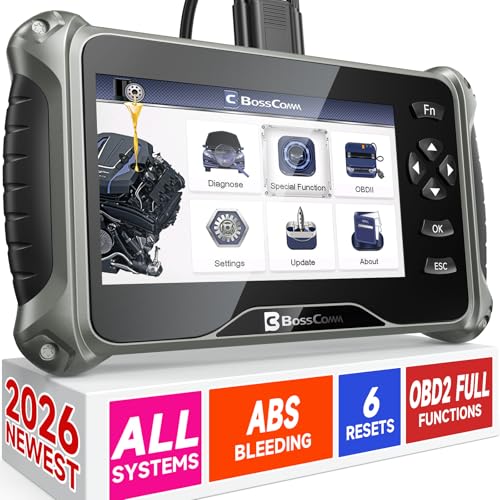
- 【✅Compared to BOSSCOMM IF742, IF745 Offers Full-System Diagnostics】The BOSSCOMM IF745 car diagnostic scanner is an upgraded model of IF742. In addition to supporting all OBD2 Code Reader functions and 6 reset options (ABS/EPB/SAS/BMS/Oil/Throttle), it expands diagnostics from 4 systems (Check Engine/ABS/SRS/Transmission) to vehicle All systems, including Steering, Suspension, and Body Electronics. This provides deeper, more comprehensive diagnostic capabilities.
- 【✨10 OBD2 Functions】The BOSSCOMM IF745 scan tool’s DTC Lookup instantly translates fault codes into user-friendly explanations, its I/M Readiness feature streamlines emissions testing with a single tap, and Freeze Frame lets you pinpoint the exact moment of a fault for in-depth root-cause diagnosis. Combined with a live data dashboard and advanced diagnostics (O2S, OBMon, EVAP), it delivers comprehensive insights for confident troubleshooting.
- 【✨Deep Diagnostics for All Vehicle System Modules】Beyond code reading/clearing and ECU information retrieval, our all-in-one data stream feature lets you inspect all current fault codes and their locations across the vehicle’s systems. This vehicle code reader helps you turn off dashboard warning lights and perform a comprehensive self-check of your car at home—no more back-and-forth trips to the repair shop or hefty inspection fees.
- 【✨6 Essential Resets: ABS Bleeding, Oil, EPB, SAS, Throttle, BMS】The BOSSCOMM IF745 obd2 scanner diagnostic tool swiftly purges air from brake lines to restore braking sensitivity, fine-tunes maintenance cycles to eliminate false alerts, resolves parking brake issues with one-click control, recalibrates steering sensors for stability, optimizes engine idling/acceleration for smoother performance, and deeply resets battery systems to extend lifespan and range via precise parameter adjustments.❗NOTE: Does NOT support bidirectional control, coding, or programming.
- 【✨10,000+ Car Models, AutoVIN, 13 Languages】The BOSSCOMM IF745 vehicle scanner diagnostic tool covers 73+ global car brands and offers support in 13 languages, making it perfect for DIYers, auto mechanics, or as a thoughtful gift. With a single-click AutoVIN feature, it instantly retrieves vehicle serial numbers, streamlining diagnostics for users globally. This adaptable tool balances user-friendliness with precision, catering to both personal and professional requirements.✅Unsure about compatibility? Compatibility will vary on vehicles' model and year, pls reach us via 📧 [email protected] 📧 before purchase.
Last update on 2026-07-02 / Affiliate links / Images from Amazon Product Advertising API
This product presentation was made with AAWP plugin.