
NHTSA ID Number: 10126252
Manufacturer Communication Number: NTB00-033f
TSB/Document Date: 2017-12-22
Summary
BRAKE NOISE/JUDDER/PEDAL FEEL DIAGNOSIS AND REPAIR This bulletin has been amended to include vehicles built up to the publication date. Also, tips for using the ProCut? brake lathe were added on page 8, and a Brake Noise Diagnostic Worksheet was added on page 10. Please discard previous versions of this bulletin.
Classification:
Reference:
BR00-004f
Date:
NTB00-033f
November 28, 2017
BRAKE NOISE/JUDDER/PEDAL FEEL DIAGNOSIS AND REPAIR
This bulletin has been amended to include vehicles built up to the publication date. Also, tips for
using the ProCut™ brake lathe were added on page 8, and a Brake Noise Diagnostic Worksheet
was added on page 10. Please discard previous versions of this bulletin.
APPLIED VEHICLES: All Nissan
SERVICE INFORMATION
This bulletin is to assist you in responding to customer questions about brake operation,
and provides diagnostic and repair information for each item listed, if any should occur.
Most brake incidents fall into the following categories:
a. Brake Noise: A squeak, squeal, clunk, or groan that occurs when the brakes are
applied or released.
b. Brake Judder: A vibration that can be felt in the vehicle, steering wheel or brake
pedal when the brakes are applied.
c. Pedal Feel: The effort needed to operate the brakes is too high or too low.
SERVICE PROCEDURE
1. Verify the condition by interviewing the customer and road testing the vehicle with the
customer.
Refer to the Brake Noise Diagnostic Worksheet on page 10 of this bulletin.
2. Determine the specific brake incident based on the description in the Service
Information above.
3. Follow the appropriate repair procedure(s), listed on the following pages, for your
specific incident.
Nissan Bulletins are intended for use by qualified technicians, not 'do-it-yourselfers'. Qualified technicians are
properly trained individuals who have the equipment, tools, safety instruction, and know-how to do a job
properly and safely. NOTE: If you believe that a described condition may apply to a particular vehicle, DO
NOT assume that it does. See your Nissan dealer to determine if this applies to your vehicle.
1/12
BRAKE NOISE
Brakes can make a range of noises when applied or released. Some noises are normal
and no repair action should be taken.
Use the following descriptions to identify the specific type of brake noise and the
appropriate repair:
Squeak noise when the brakes are cold:
Usually occurs during the first few stops in the morning.
This is a normal condition. No service action is necessary.
Squeak noise with the brakes at normal operating temperatures:
Refer to technical bulletins specific to the model of vehicle regarding this incident.
If there are no bulletins for the car you are working on, install Original Equipment
(OE) type pads using the information listed under Brake Service on page 6 of this
bulletin and the appropriate Electronic Service Manual (ESM) procedures.
Notes about brake pads and brake noise:
Original Equipment (OE) brake pads are installed on all current Nissan vehicles at the
factory.
The OE pads use a Non-asbestos Organic (NAO) compound. The NAO material
provides state of the art resistance to squeal noise.
These pads are available as service parts and must be used if replacing brake pads
under the terms of the Nissan new car warranty.
Value Advantage brake pads are also available as a high quality service replacement
part at a very attractive price.
These pads use a NAO compound similar to the material used in Nissan OE pads.
Value Advantage brake pads offer excellent braking performance but do not offer the
same level of noise resistance as the OE-NAO pads.
Service customers have varying sensitivity to brake noise and the individual
customer must decide which product best suits his or her requirements, balancing
price and noise resistance.
Make sure the Service Advisor adequately explains the differences between Value
Advantage brake pads and Nissan OE-NAO brake pads to the customer when
discussing brake service.
2/12
NTB00-033f
Loud continuous squeak/squeal noise:
Occurs with or without braking.
This is a normal brake function. It occurs when the brake pad wear indicators
contact the rotor.
It indicates the brake pads are worn out and need to be replaced. Install new brake
pads using the information listed under Brake Service on page 6 of this bulletin and
the appropriate ESM procedures.
Groan noise when slightly releasing the brakes after coming to a stop:
This is sometimes called “creep groan”.
It is a normal condition. No repair or service is necessary.
Groan noise during stopping:
Usually caused by glazing of the rotor’s surface as a result of heavy or frequent
braking.
Refer to technical bulletins specific to the model of vehicle regarding this incident.
Replace the brake pads, then resurface the rotors and finish them with sand paper.
Refer to Brake Service on page 6 for additional detail.
Single clunk noise from front suspension when applying the brakes:
The noise is a result of the brake pads shifting in the direction of rotor rotation when
the brakes are applied.
Can be duplicated by lightly touching the brake pedal.
If the brake pedal is pushed hard, the noise is less likely to occur.
Make sure the brake pads and pad hardware (shims, springs, clips, etc.) are
installed correctly.
Refer to ASIST for vehicle specific brake service information.
Refer to Brake Service on page 6 for additional detail.
Multiple clunk noise and/or pedal pulsation that occurs only one time after the
engine is started:
This is a normal ABS Self Check noise. No service action is necessary.
The vehicle’s ABS system performs a self check. On some models this self check
occurs with the first application of the brakes after the engine is started. On other
models the self check occurs the first time the vehicle reaches 5 mph after the
engine is started.
3/12
NTB00-033f
Rear Brake Squeal:
Usually due to an accumulation of brake dust and dirt between the pads/shoes and
rotors or drums.
Clean all dust and dirt from the brake pads/shoes, backing plates and related
components.
WARNING: Brake dust may be hazardous if inhaled. Refer to the ESM for brake
dust precautions and use approved brake cleaning equipment.
Refer to ASIST (Service Bulletins and ESM) for correct installation and lubrication of
brake pads/shoes, caliper parts, and hardware.
CAUTION: Do not get grease on the brake pad/shoe friction surface.
BRAKE JUDDER
Brake Judder is caused by rotor thickness variation and/or rotor run out.
Rotor Thickness Variation: When the
inner and outer surface of the rotor are
not flat and not parallel, the brake pads
will travel in and out as they follow the
low and high spots on the rotor
(see Figure 1).
Figure 1
Rotor Run Out: If the brake rotor is not
true to the hub center, the brake pads
contact one point on each side of the
rotor with each wheel rotation, even if
the brakes are not applied. Over time,
this point contact will cause the rotor to
wear more in these areas and cause
rotor thickness variation (see Figure 2).
Figure 2
This motion of the brake pads is transferred through the caliper pistons and is felt in
the brake pedal as a pulsation. In severe cases it can also cause a back and forth
oscillation in the steering wheel.
4/12
NTB00-033f
Vehicle Storage:
If the vehicle is not operated for periods of time, the area of the brake rotors not
covered by the brake pads will rust.
The friction characteristics between the rusted and un-rusted areas of the rotor
braking surface will be different.
This difference may cause brake judder at low and/or high mileage, even after the
rust wears off.
Lug Nut Over-torque:
Another contributor of brake judder is lug nut over-torque. This can occur if the lug
nuts are over tightened, especially with an air impact wrench.
Brake Judder Repair:
Brake judder incidents must be corrected by turning the rotors with a ProCut™ PFM
series On-Car Brake Lathe.
Refer to page 8 for tips on using this lathe.
If the rotors are replaced, make sure to index them to the axle hub to ensure
minimum runout (see Rotor Indexing on page 7).
PEDAL FEEL
Some customers may say that the brake pedal feels too high or low when applying
the brakes.
This may indicate the brake system needs service or it may be the result of the
customer comparing the feel of the brakes in a new car with the feel of the brakes in
a previous car.
Road test the vehicle with the customer. Compare brake operation to a “known
good” vehicle and determine if brake service is necessary. If so, refer to the
following service items:
a. Inspect the brake calipers and make sure they are correctly installed and sliding
freely.
b. Inspect the front and rear brakes and make sure the brake pads and/or shoes
are properly installed.
c. Bleed all air from the brake system.
d. Make sure the brake pedal stroke and free play are adjusted correctly. Refer to
the appropriate section of the ESM which covers brakes.
NOTE: Use Essential Tool J-46532 (Brake Pedal Height Tool) for brake pedal
height check and adjustment. This tool is available from TECH-MATE at 1-800662-2001.
5/12
NTB00-033f
BRAKE SERVICE
To ensure a high quality brake service be sure to:
1. Finish rotors properly.
This is one of the most important aspects of preventing and eliminating brake noise.
Use the ProCut™ PFM series on-car brake lathe. It has been chosen as the
approved tool for rotor resurfacing (refer to page 8 for additional information).
2. Correctly install pads and shims.
IMPORTANT: Correct installation and lubrication of brake pads and all caliper parts
and hardware is essential for proper brake operation and will help dampen noisecausing movement and vibrations.
Refer to ASIST (Service Bulletins and ESM) for correct installation and lubrication of
brake pads, caliper parts, and hardware.
CAUTION: Do Not get grease on the brake pad friction surface.
3. Perform the following post-installation checks.
Confirm that brake pads fit snugly in the calipers. Replace worn components as
necessary.
Test drive after repairs and burnish the new brakes. This will influence brake
performance, including noise.
a. Drive the vehicle on a straight smooth road at about 30 mph (50 kph).
b. Use medium brake pedal/foot effort to bring the vehicle to a complete stop from
about 30 mph (50 kph). Adjust your pedal/foot pressure so that the vehicle
stopping time is 3-5 seconds.
c. Cool the brake system by driving at about 30 mph (50 kph) for approximately one
minute without stopping.
d. Repeat steps a, b, and c ten times to complete the burnishing process.
4. Follow-up to ensure customer satisfaction, safety, and proper brake performance.
Confirm the procedures described in steps 1 - 4 above have been strictly followed.
6/12
NTB00-033f
ROTOR INDEXING
When installing a new rotor, a rotor that has been surfaced off the car, or a rotor that has
been removed for any reason, use the following indexing procedure to ensure the minimum
amount of rotor runout.
1. Make sure the rotor is fully contacting the hub. Clean the rotor-to-hub surface if it is
rusty.
NOTE: For cleaning the hub surface, specifically around the wheel studs, it is
recommended to use the Wheel Hub Resurfacing Kit #J-42450-B, which can be ordered

- Mixes well with conventional fluids
- Low-moisture formula provides excellent vapor lock...
- Ideal for hydraulic and disc brakes


- Provides an extra margin of safety in extreme braking...
- Mix of polyglycol ethers ensures hot brake-system operation...
- Excellent for ABS, disc and drum brake systems
- Delivers braking power when needed by avoiding a spongy...
- Both wet and dry boiling points exceed the minimum...
Last update on 2026-06-23 / Affiliate links / Images from Amazon Product Advertising API
If the PDF is very large, it may not load in the preview below.
Some older TSBs had multiple PDFs — visit the NHTSA Website to view all PDFs.
If the TSB PDF does not show, download or view it on the NHTSA Website.
Click on the (+) Plus Sign
Then Click on Associated Document(s)
Search NHTSA Database for Recalls
Search NHTSA Database for Vehicle Investigations
View Latest Vehicle Investigations
Search NHTSA Database for Vehicle Complaints
View Latest Vehicle Complaints
TSB/Document ID: NTB00-033f
Replacement Service Bulletin Number:
MFR Communication Date: 2017-11-28
MFR Internal Campaign ID/Software Version:
Communication Type: Service Bulletin/Repair Instructions
NHTSA Components: SERVICE BRAKES
MFR Component System:
MFR Component Subsystem:
Previous TSB | Next TSB |
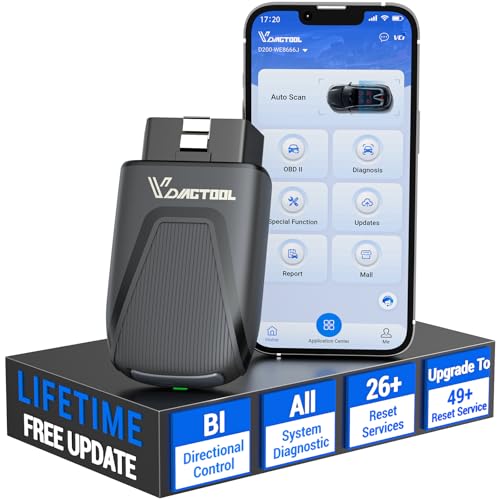
- 【OE-Level Full System Diagnostics-Lifetime F*REE Software Updates】The VDIAGTOOL D200 OBD2 Scanner for cars is a all system bidirectional scan tool that enjoy lifetime f*ree software updates, delivers complete system coverage. reading/clearing codes across engine, transmission, ABS, SAS, EPB, TPMS plus full access to body, chassis, powertrain and all control modules. This D200 Bidirectional car scanner works with most 1996+ OBD2 gasoline and hybrid
 cars and light trucks. It does NOT support pure electric and heavy-duty trucks. PLEASE CHECK COMPATIBILITY BEFORE ORDERING or Contact us with VIN to confirm compatibility.
 - 【Supports OBD2 Full Functions-ZERO Subscription Fees】D200 Bidirectional OBD2 Scanner is a upgarde of universal car code reader. It supports OBD2 full functions to help you turn off the annoying instrument fault indicator, such as read/clear codes, O2 sensor test, I/M readiness, on-board monitor test, datastream, freeze frame, E-VAP system test, and retrieve vehicle information. This professional obd2 scanner diagnostic tool can full access to diagnostics, reset tools and maintenance features with a single payment. NOTE: The fault code can only be cleared after the vehicle's malfunction has been repaired; please ensure the vehicle issue is fixed before clearing the code.
- 【D200 Hidden 2 Advantages: 1. $169 Expandable 49+ Advanced Resets. 2. $199 Get J2534 P*a*s*s-Thru Programming】Your core car diagnostics and 26 reset remain lifetime f*ree for everyday maintenance. When you need deeper repair capability, upgrade with 3-year access for $169 in Store on VDIAGTOOL App, gaining 49+ advanced resets. D200 configured with J2534 hardware, upgrade only when you need without replacing the entire device. You also can Lifetime Unlock for $199 in Store one-time, perform module programming, software re~flashing and ECU data updates directly. Supports 17+ major brands, including for BMW, for Audi, for GM, for Ford and more. Note:D200 does‘t provide any OE software.
- 【Full Bidirectional Control / Active Tests】The D200 car scanner diagnostic tool is a true bidirectional scan tool that lets you send commands directly to the vehicle’s ECU for active tests. Quickly test fuel pumps, relays, solenoids, injectors, cooling fans, windows, sunroofs and more to verify operation instantly. Get dealership-level diagnostic control at a fraction of the cost (ofter $100-200$ per diagnostic visit), reduce guessworkand confirm repairs faster, avoid unnecessary parts replacement, towing fees and wait times.
- 【26 F*ree Essential Reset & Relearn Functions – Everyday Maintenance Made Easy】Handle common maintenance and repair jobs without visiting the shop. The D200 code readers & scan tools includes 26 f*ree high-demand reset functions, including Oil Reset, EPB Service, SAS Calibration, ABS Brake Bleeding, Throttle Relearn, Injector Coding, Headlight Adjustment, Tire Size Reset and more. Perfect for home car owners, mechanics and DIYers – just plug and diagnose anytime, anywhere! Note: Service functions vary by vehicle model—please confirm compatibility.
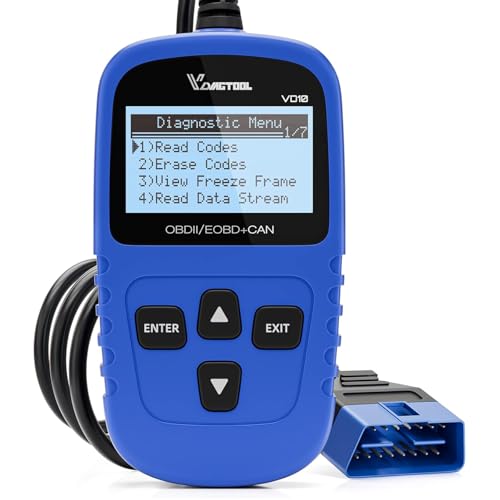
- 【A MUST-HAVE TOOL FOR DIYERS】 - VDIAGTOOL VD10 car code reader is an incredibly useful obd scanner for each car owner or hobbyist, even for those with little to no experience when it comes to vehicle mechanics! Similar to a fixd car diagnostic tool, using this car diagnostic scanner is extremely easy. All you have to do is attach it to your car OBDII port and you can diagnose car problems in seconds! Read Codes (DTCs); Clear Codes; Live Data; View Freeze Frame; I/M Readiness; Vehicle Information.
- 【KEEP ENGINE IN GOOD STATUS】 - VDIAGTOOL check engine code reader brings a fast access to scan, read the car fault code, show its definition on the screen instantly, troubleshooting to find the root causes of problems, erase the engine fault code and turn off the MIL (Malfunction Indicator Light). Similar to a fixd car diagnostic tool, this car code reader helps ensure your engine stays in top condition.
- 【READ/CLEAR CODES & DTC LOOKUP】- No search online & saving your time, this vehicle car code reader retrieves generic (P0, P2, P3, and U0), manufacturer specific (P1, P3, and U1) codes, pending codes and displays DTC definitions based on the built-in database(more than 3000 codes) on the TFT screen, find out the root causes and clear the codes after fixed.
- 【LIVE DATA & RETRIEVE FREEZE FRAME】 - This diagnostic scan tool for accurate diagnosis enables you to retrieve data from vehicle sensors, such as Engine RPM, Intake air temperature, Short/Long term fuel, Misfire data and etc. The freeze frame is stored in the PCM together with the diagnostic trouble code (DTC) related to the fault. Comparable to a fixd car diagnostic tool, the VD10 car code reader car scanner can be a valuable & practical diagnostic aid and also greatly help when diagnosing intermittent problems.
- 【I/M READINESS for THE S-nn-0-g CHECK】- OBDII vehicle may not pass the annual inspection unless the required monitors since reset are complete. So you should at least read the readiness monitors and make sure they are ready. This car obd2 scanner diagnostic tool is equipped with I/M readiness function to check the operations of the e-m-issi0n system on OBD2 compliant vehicles, run I/M monitor readiness test, checking if the pass vehicle s-m-0-g inspection.
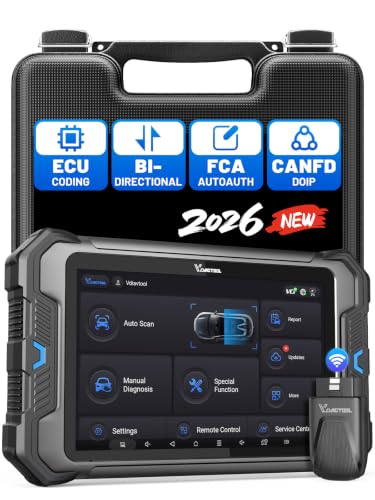
- 【Professional Diagnostics】 The VD80 BT Lite bidirectional obd2 scanner is a professional OBD2 scanner diagnostic tool, delivering vehicle diagnostics right in your own garage. It supports 4,000+ active diagnostic tests, 28+ maintenance service functions, ECU coding, PMI calibration, brake service reset, and OEM-grade full-system vehicle scanning—perfect for DIYers and pros looking for powerful automotive tools. The available function tests vary by model—please to confirm compatibility.
- 【ADVANCED ECU CODE, CUSTOMIZE OE-SETTINGS】As a complete car code reader and reset tool, the VD80 BT Lite bidirectional obd2 scanner supports ECU coding for VW, for Audi, for BMW, for Benz, for Mitsubishi and more. PMI function for Ford/for Lincoln/for Mazda, supports copy data into new module. Step-by-step Guided Diagnostics makes complex jobs easier—making this one of the most reliable code readers & scan tools on the market.
- 【100000+ Vehicles Compatibility – CAN FD/DOIP】 VD80 BT Lite Auto Scanner Compatible with 100,000+ vehicles worldwide, this bidirectiona car scanner works with all OBD2-compliant vehicles manufactured after 1996, covering more than 100 brands worldwide. It also supports CAN FD, DOIP and FCA Secure Gateway protocols, boost 2X faster data transfer, covers 99% of U.S., EU and Asian cars. With 22 languages and 2 years of f*ree updates—future-proofing your car reader diagnostic for all cars.
- 【28+ Maintenance Services & Calibration Functions】VD80 BT Lite scanner for car Supports 28 maintenance services, including resetting oil and service lights after routine maintenance, registering new batteries for proper system operation, and clear clogged filters and restore performance. Additionally, it calibrates TPMS sensors after tire rotations, resets brake systems after pad replacements, relearns steering angle sensors after alignments, and more. These functions help your vehicle quickly and accurately return to peak performance—without the costly dealer visits.
- 【True Bidirectional Control – Diagnose with Confidence】Standing out with full-system coverage and extensive active test capabilities, the VD80 BT Lite bidirectional scan tool retrieves data from electronic control units and performs a wide range of active tests. You can real-time control over modules like fuel pumps, windows, A/C clutches, and relays. Perform 100+ advanced functions including throttle adaptation, injector coding, VIN write, idle relearn, and ABS bleed—helping you fix it right the first time with this all-in-one car diagnostic scanner.
Last update on 2026-06-23 / Affiliate links / Images from Amazon Product Advertising API
This product presentation was made with AAWP plugin.