
NHTSA ID Number: 10121244
Manufacturer Communication Number: V211501 2026771
TSB/Document Date: 2017-10-31
Summary
Technical Bulletin: Discussion on engine issues lacking performance. The document covers diagnosis of the engine and the codes that are meant to describe the issues. How to service the issue is discussed, and where to find warranty information to pay for the service
Technical Bulletin
Model(s)
Year(s)
Jetta, Jetta
Wagon
2009
Jetta Sedan,
Golf, Golf
Wagon, Jetta
SportWagen
2010
Jetta Sedan,
Golf, Golf
Wagon, Jetta
SportWagen
2011-2014
Eng. Code(s)
Trans. Code(s)
VIN Range From
VIN Range To
All
All
All
All
All
All
All
All
All
2.0L TDI
(CBEA)
2.0L TDI
(CJAA)
2.0L TDI
(CJAA)
Condition
21 15 01 January 15, 2015 2026771 Supersedes T. B. V211403 dated April 24, 2014 to update labor operations in
warranty tables.
Engine Lacks Performance, Engine Warning Light ON, DTCs P2563, P2564, P0299 or P20D8 Stored in ECM
Fault Memory
Engine does not have any power and the engine warning light may be ON. One of the following DTC entries is
stored in the engine control module.
DTC
Description
09570, P2562
Turbocharger Boost Control Position Sensor "A"
Circuit
09571, P2563
Position Sensor for Boost Pressure Controller has
an Implausible Signal
09572, P2564
Signal is too Low of the Position Sensor for Boost
Pressure Controller
09573, P2565
Turbocharger Boost Control Position Sensor "A"
Circuit High
09574, P2566
Turbocharger Boost Control Position Sensor Circuit
Intermittent
00665, P0299
Boost Pressure Control, Values are Below Control
Limit
Page 1 of 17
© 2015 Volkswagen Group of America, Inc.
All rights reserved. Information contained in this document is based on the latest information available at the time of printing and is subject to the copyright and other
intellectual property rights of Volkswagen Group of America, Inc., its affiliated companies and its licensors. All rights are reserved to make changes at any time without notice.
No part of this document may be reproduced, stored in a retrieval system, or transmitted in any form or by any means, electronic, mechanical, photocopying, recording, or
otherwise, nor may these materials be modified or reposted to other sites, without the prior expressed written permission of the publisher.
Technical Bulletin
08408, P20D8
Exhaust Monitoring, Following Injection Regulation
Limit Exceeded
00175, P00AF
Turbocharger/Supercharger Boost Control "A"
Module Performance
Technical Background
1. Vacuum hose kinked, twisted or leaks.
2. Stud with clamp nut on turbo charger broken/missing, or rotated turbocharger housing. As a result the turbine
adjustment travel is outside the tolerance.
3. Vacuum diaphragm on turbo charger leaks.
4. Plastic boost pipe from intake side of turbo to intercooler cracked/leaking.
5. Boost hose connection to intercooler leaking.
6. Check ECM Software level.
Production Solution
Optimized assembly process to avoid twisted vacuum line.
Increase compressor housing washer thickness.
Change of material for min. flow adjustment screw.
Improved vacuum diaphragm with charge pressure actuator position sensor -G581-.
Page 2 of 17
© 2015 Volkswagen Group of America, Inc.
All rights reserved. Information contained in this document is based on the latest information available at the time of printing and is subject to the copyright and other
intellectual property rights of Volkswagen Group of America, Inc., its affiliated companies and its licensors. All rights are reserved to make changes at any time without notice.
No part of this document may be reproduced, stored in a retrieval system, or transmitted in any form or by any means, electronic, mechanical, photocopying, recording, or
otherwise, nor may these materials be modified or reposted to other sites, without the prior expressed written permission of the publisher.
Technical Bulletin
Service
Step 1
• Check the vacuum system for any leaks according to the workshop manual, repair group 21 exhaust/turbo
charging, G-charger (section 'Checking Vacuum System').
Tip:
When checking, observe the following points in particular (Figures 1, 2, and 3):
Hose not inserted into the vacuum container.
Figure 1
Vacuum hose at the solenoid valve, or in the pipe system, is
kinked.
• Re-position hoses to avoid pinching. It is not necessary to
replace the hoses.
Figure 2
Page 3 of 17
© 2015 Volkswagen Group of America, Inc.
All rights reserved. Information contained in this document is based on the latest information available at the time of printing and is subject to the copyright and other
intellectual property rights of Volkswagen Group of America, Inc., its affiliated companies and its licensors. All rights are reserved to make changes at any time without notice.
No part of this document may be reproduced, stored in a retrieval system, or transmitted in any form or by any means, electronic, mechanical, photocopying, recording, or
otherwise, nor may these materials be modified or reposted to other sites, without the prior expressed written permission of the publisher.
Technical Bulletin
Vacuum hose at the solenoid valve, or in the pipe system, is
twisted.
• Re-position hoses to avoid pinching. It is not necessary to
replace the hoses.
Figure 3
Step 2
Turbocharger inspection may require the use of a inspection mirror
• Inspect the turbocharger stud with clamp nut (min. flow
adjustment screw) ( Figure 4).
Figure 4
Page 4 of 17
© 2015 Volkswagen Group of America, Inc.
All rights reserved. Information contained in this document is based on the latest information available at the time of printing and is subject to the copyright and other
intellectual property rights of Volkswagen Group of America, Inc., its affiliated companies and its licensors. All rights are reserved to make changes at any time without notice.
No part of this document may be reproduced, stored in a retrieval system, or transmitted in any form or by any means, electronic, mechanical, photocopying, recording, or
otherwise, nor may these materials be modified or reposted to other sites, without the prior expressed written permission of the publisher.
Technical Bulletin
• Inspect the turbo charger to see whether the stud with clamp
nut is broken (Figure 5).
Figure 5
• Inspect the turbo charger to see whether the stud with clamp
nut is missing (Figure 6).
• If the stud or clamp nut are missing, replace turbocharger.
Figure 6
Page 5 of 17
© 2015 Volkswagen Group of America, Inc.
All rights reserved. Information contained in this document is based on the latest information available at the time of printing and is subject to the copyright and other
intellectual property rights of Volkswagen Group of America, Inc., its affiliated companies and its licensors. All rights are reserved to make changes at any time without notice.
No part of this document may be reproduced, stored in a retrieval system, or transmitted in any form or by any means, electronic, mechanical, photocopying, recording, or
otherwise, nor may these materials be modified or reposted to other sites, without the prior expressed written permission of the publisher.
Technical Bulletin
• Carefully inspect the turbocharger housing around the entire
housing assembly for an alignment mark (Figure 7). If the
alignment mark is misaligned, this indicates that the housing
has rotated.
• If misaligned, replace turbocharger.
Tip:
Not all turbocharger houses have alignment marks present.
Figure 7
• Carefully inspect the turbocharger housing around the retaining
bolts for witness marks (Figure 8), indicating that the housing
has rotated.
• If witness marks are present from washers, replace
turbocharger.
Figure 8
Step 3
• Disconnect the vacuum hose on the turbo charger vacuum diaphragm.
• Connect a hand vacuum pump to the vacuum diaphragm and create a vacuum of about 600 mbar.
• Observe whether the adjusted vacuum is retained.
If the vacuum drops or cannot be achived:
• Install vacuum diaphragm with charge pressure actuator position sensor -G581- part number 03L198716A
according to the repair manual, Group 21 turbo charger, G charger > Removal and installation > Vacuum
Diaphragm with Charge Pressure Actuator Position Sensor G581.
Page 6 of 17
© 2015 Volkswagen Group of America, Inc.
All rights reserved. Information contained in this document is based on the latest information available at the time of printing and is subject to the copyright and other
intellectual property rights of Volkswagen Group of America, Inc., its affiliated companies and its licensors. All rights are reserved to make changes at any time without notice.
No part of this document may be reproduced, stored in a retrieval system, or transmitted in any form or by any means, electronic, mechanical, photocopying, recording, or
otherwise, nor may these materials be modified or reposted to other sites, without the prior expressed written permission of the publisher.
Technical Bulletin
If vacuum holds:
• And all other vacuum system diagnosis is OK, but fault codes P2563, and/or P2564 are stored in ECM fault
memory, replace the vacuum diaphragm with charge pressure actuator position sensor -G581- part number
03L198716A according to the repair manual, Group 21 turbo charger, G charger > Removal and installation >
Vacuum Diaphragm with Charge Pressure Actuator Position Sensor G581.
If vacuum holds:
And all other vacuum system diagnosis is OK, but fault codes P0299, is stored in ECM fault memory, continue with
diagnosis.
Tip:
For the installation of the vacuum diaphragm with charge pressure actuator position sensor -G581- use the special
tools T10422A socket and T10461 spanner.
Note:
DO NOT replace the complete turbo charger if the vacuum diaphragm with Charge Pressure Actuator Position
Sensor -G581- has failed.
Step 4
• Inspect the plastic boost pipe that runs from the intake side of the turbocharger to the intercooler for cracks or
leaks (Figures 9 and 10).
Tip:
These cracks can be difficult to see. It may be necessary to pressure test the charge air system according to the
repair manual under Engine > Engine Mechanical, Fuel Injection and Glow Plug > 21 turbo charger, G charger
=>Diagnosis and Testing => Charge Air System, Checking for Leaks.
Figure 9
Figure 10
Page 7 of 17
© 2015 Volkswagen Group of America, Inc.
All rights reserved. Information contained in this document is based on the latest information available at the time of printing and is subject to the copyright and other
intellectual property rights of Volkswagen Group of America, Inc., its affiliated companies and its licensors. All rights are reserved to make changes at any time without notice.
No part of this document may be reproduced, stored in a retrieval system, or transmitted in any form or by any means, electronic, mechanical, photocopying, recording, or
otherwise, nor may these materials be modified or reposted to other sites, without the prior expressed written permission of the publisher.
Technical Bulletin
Step 5
• Inspect the boost pressure hose connections to the intercooler
for leaks.
• Ensure that the seals are in the proper position and not
damaged (Figure 11).
•
Damaged or missing seals should be replaced. The seals are
available separately, it is not necessary to replace the entire
hose.
Tip:
Figure 11
Pay close attention to this area if DTC P20D8 is recorded in
ECM faults.
Step 6
• Ensure that any other Bulletins or Updates for ECM software have been performed. The software programming
should be charged to the appropriate bulletin.
Page 8 of 17
© 2015 Volkswagen Group of America, Inc.
All rights reserved. Information contained in this document is based on the latest information available at the time of printing and is subject to the copyright and other
intellectual property rights of Volkswagen Group of America, Inc., its affiliated companies and its licensors. All rights are reserved to make changes at any time without notice.
No part of this document may be reproduced, stored in a retrieval system, or transmitted in any form or by any means, electronic, mechanical, photocopying, recording, or
otherwise, nor may these materials be modified or reposted to other sites, without the prior expressed written permission of the publisher.
Technical Bulletin
Warranty
Note:
Multiple warranty tables may be claimed.
To determine if this procedure is covered under Warranty, always refer to the Warranty Policies and
1)
Procedures Manual
Model(s)
Year(s)
Jetta, Jetta
Wagon
2009
Jetta Sedan,
Golf, Golf
Wagon, Jetta
SportWagen
2010
Jetta Sedan,
Golf, Golf
Wagon, Jetta
SportWagen
2011-2014
Eng. Code(s)
Trans. Code(s)
VIN Range From
VIN Range To
All
All
All
All
All
All
All
All
All
2.0L TDI
(CBEA)
2.0L TDI
(CJAA)
2.0L TDI
(CJAA)
SAGA Coding
Claim Type:
Use applicable Claim Type
1)
Damage
Service Number:
HST
Damage Location
(Depends on Service No.)
--
Use applicable when
indicated in ElsaWeb
(L/R)
Code
2165
0010
Golf, Passat
WWO
Jetta, Jetta Sportwagen
3ME
2)
Parts Manufacturer
2)
3)
Labor Operation :
Remove and Install Engine Cover
10831900 = 20 TU
Page 9 of 17
© 2015 Volkswagen Group of America, Inc.
All rights reserved. Information contained in this document is based on the latest information available at the time of printing and is subject to the copyright and other
intellectual property rights of Volkswagen Group of America, Inc., its affiliated companies and its licensors. All rights are reserved to make changes at any time without notice.
No part of this document may be reproduced, stored in a retrieval system, or transmitted in any form or by any means, electronic, mechanical, photocopying, recording, or
otherwise, nor may these materials be modified or reposted to other sites, without the prior expressed written permission of the publisher.
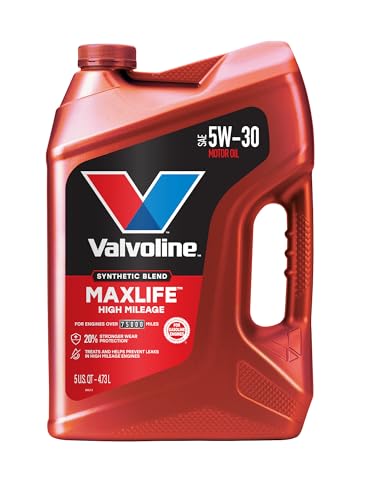
- Formulated for engines with 75,000 miles or more, Valvoline...
- Delivers 20% better wear protection and 15% better sludge...
- Extra detergents safeguard against friction, corrosion and...
- Advanced friction-fighting additives help maximize...
- Provides performance benefits for high mileage, new and...

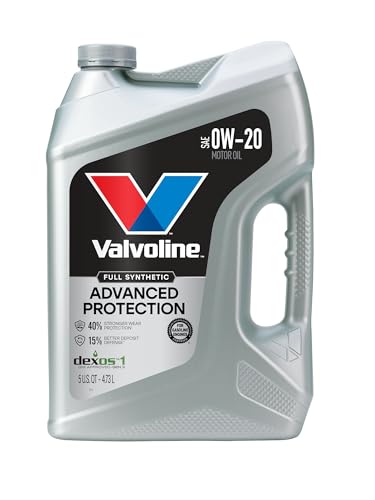
- Advanced protection against the four main causes of engine...
- Delivers 40% stronger wear protection than industry...
- Provides 15% better deposit defense vs. industry standards...
- Up to 2.5X better heat protection vs. industry standards to...
- Engineered for excellent low-temperature flow, reducing...
This product presentation was made with AAWP plugin.
If the PDF is very large, it may not load in the preview below.
Some older TSBs had multiple PDFs — visit the NHTSA Website to view all PDFs.
If the TSB PDF does not show, download or view it on the NHTSA Website.
Click on the (+) Plus Sign
Then Click on Associated Document(s)
Search NHTSA Database for Recalls
Search NHTSA Database for Vehicle Investigations
View Latest Vehicle Investigations
Search NHTSA Database for Vehicle Complaints
View Latest Vehicle Complaints
TSB/Document ID: V211501 2026771
Replacement Service Bulletin Number:
MFR Communication Date: 2015-01-15
MFR Internal Campaign ID/Software Version:
Communication Type: Service Bulletin/Repair Instructions
NHTSA Components: ENGINE
MFR Component System:
MFR Component Subsystem:
Previous TSB | Next TSB |
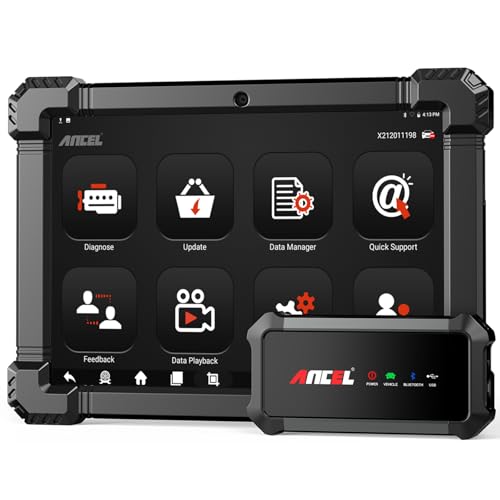
- 🔥🔥🔥2026 New Functions Making X7HD the Top Dog - Big Surprise!!! ANCEL X7HD truck scanner 10 major functional advantages .✅>Full HDOBD/OBD2 Function ✅>ALL System Diagnostic ✅>42+ Reset Function ✅>Active Test / Bi-Directional Control✅>ECU Coding✅>Graphing Live Data✅>Wide Compatibility ✅>2 Yrs Free Update✅>Remote Operation✅>Bluetooth 5.0 & Wifi In addition, 8 major hardware advantages: ✅>6000 mAh✅>10.1 inch Tablet✅>2G RAM
 ✅>32G ROM (Expandable to 128GB)✅>Data Record & Replay & Print✅>Android 10.0✅>Bluetooth 5.0 & Wifi✅>14 Languages
 - 🚛OEM DPF Forced Regen & Cylinder Cutout Test & more - ANCEL X7HD diesel scanner diagnostic tool not only supports DPF regeneration, DPF reset, DPF related information reset, DPR state reset, DPD forced regeneration etc, which helps you better solve the exhaust aftertreatment system problems, but also supports activate motor to do exhaust air in ABS Automatically. Moreover, it features TPMS activation, cylinder cut-off and learning functions
- 🚛Advanced ECU Coding & Programming - ANCEL X7HD 10.1inch truck scanner diagnostic tool is equipped with advanced ECU coding, supports Level calibration, Idle speed learning and Adjustment, Camshaft timing control learning, Control unit adaptations, Injector Codes, Read/Write VIN, Road speed limit optional vehicle speed set, etc... PLEASE NOTE that ECU codes are not compatible with all vehicles, please send us your VIN# to check vehicle compatibility
- 🚛42+ Reset Functions & Bidirectional Control - 2026 newest top heavy duty truck scan tool, comes with 42+ special services (ECU, Speed Limit and Idle Reset, Oil Reset, Injector Coding, EPB, ABS, SRS, Suspension, Throttle, etc. and always keep growing), which meet all your various needs for service and maintenance
- 🚛10 Inch All Systems Diesel Scanner & Full HDOBD/OBD2 Modes - ANCEL X7HD diesel truck scan tool supports all systems scan, such as Engine, Brake, Retarder, TECU Transmission, Tachograph, ABS, SRS, TPMS, EPB, SAS, ESP, and other vehicle systems, comes with 10 obd2 service modes: read/erase error codes, Data Stream, I/M Readiness, Vehicle Information, Actuations, DTC Lookup, EVAP, view freeze frame, etc
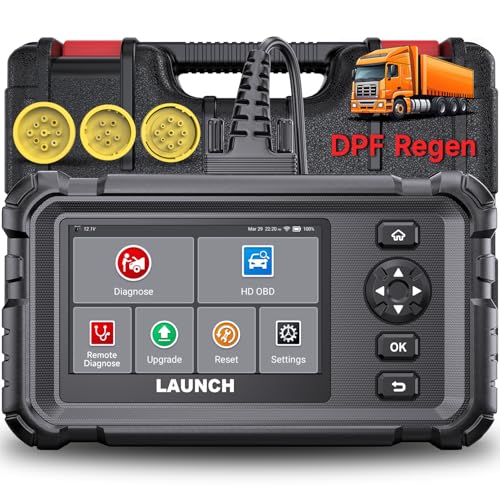
- Dealer-Level Diagnostics, Faster & Easier: The heavy duty truck scanner delivers full-system diagnostics for engine, ABS, transmission, and more, plus 7+ reset functions like DPF Regen and Speed Limit Adjust. Powered by a 1.3G CPU, 2GB RAM, 16GB storage, Android 8.1, and a 3000mAh battery, it runs smoothly for fast scanning, live data, reports, Auto VIN, Wi-Fi updates, and easy handheld use. It captures screenshots, replays live data, and generates reports to support your repair decisions.
- One Tool for 50+ Truck Brands: The diesel scanner supports J1939, J1708, J1587, and OBD2/CAN protocols, delivering broad coverage for major diesel trucks and commercial vehicles including Cummins, Cat, Detroit, Paccar, Volvo, Freightliner, Kenworth, Peterbilt, International, Mack, Isuzu, Hino, Scania, Mercedes-Benz, and more. Also supports Allison, Aisin, Eaton, WABCO, and Bendix, helping you diagnose more vehicles, reduce equipment costs, and handle more jobs with one professional scan tool.
- Diesel Truck DPF Regen & Reset Features: Experiencing loss of power, sluggish acceleration, or poor hill-climbing performance? These symptoms are often caused by a clogged or overloaded DPF. The truck diagnostic scanner offers OEM-level forced DPF regeneration, DPF reset, and DPD/DPR functions. This device extends DPF lifespan and efficiently diagnoses exhaust aftertreatment issues. It can significantly reduce diagnostic time and save you up to $3,000 or more in costly dealership fees.
- 7+ Resets - Perform Essential Procedures: The truck scanner features 7+ essential resets including DPF Regen clears carbon buildup; Oil Reset clears service light; Injector Coding matches new injectors; DEF Test checks urea injection; Speed Limit Adjust saves fuel; Cylinder Cutout pinpoints misfires; Clutch Relearn restores smooth engagement. Reset after maintenance or part replacement for proper truck operation. Vehicle compatibility varies. Email [email protected] to confirm before buying.
- Full System Diagnostic for Truck: The truck scanner diagnostic tool covers all systems like engine, ABS, transmission, SAS, SRS, TPMS and more. It reads fault codes and shows real-time data. Additionally, it includes full HD OBD and OBD2 modes: read/clear codes, live data stream, I/M readiness, freeze frame, DTC lookup, and more. When warning lights appear or performance issues arise, quickly identify which system is affected and gain the real-time data needed for accurate diagnosis.
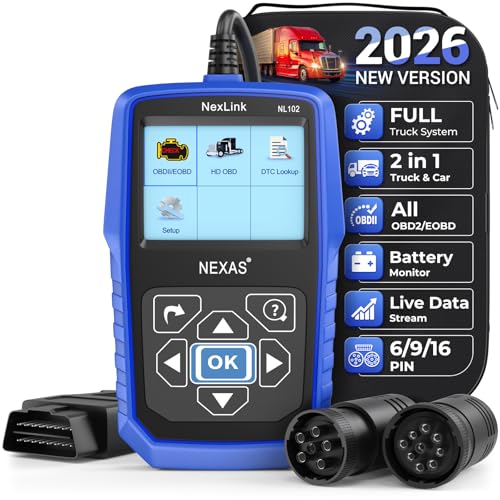
- Diagnose Heavy-Duty Truck Problems Fast — Read and clear fault codes and diagnose warning light issues on many Class 4–8 diesel trucks including Freightliner, Peterbilt, Kenworth, Volvo, Mack and Cummins-powered vehicles
- Help Reduce Downtime & Repair Costs — It offers full system diagnostics for major trucks meeting standard protocols, along with complete OBD2 functionality. Quickly check engine faults, view live truck data and identify issues before expensive repair shop visits or unnecessary repairs
- No complicated setup required — Simple menus and built-in DTC explanations make this truck code reader easy to use for owner-operators, mobile mechanics and small fleet maintenance
- Live Data & Built-in DTC Lookup — View real-time engine data and built-in truck fault code definitions directly on the scanner to help understand vehicle problems faster without searching through manuals
- Free Lifetime Updates & Technical Support — Includes free software updates plus responsive technical support for setup, compatibility and everyday truck diagnostics
This product presentation was made with AAWP plugin.
Last update on 2026-06-05 / Affiliate links / Images from Amazon Product Advertising API