
NHTSA ID Number: 10114840
Manufacturer Communication Number: PIT5434A
TSB/Document Date: 2017-08-15
Summary
This Preliminary Information communication provides information to the technician only to provide additional tips when diagnosing a front heated seat concern and is not meant to be a diagnostic flow chart or replace Service Information. Always, perform and refer to Service Information for the latest diagnostic information and procedures. Trucks equipped with heated and cooled seats Regular Production Option Code (KB6), may comment on any of the following front heated seat concerns. Condition 1, a front heated seat (back and/or cushion) is inoperative. Technician should diagnosis each affected seat heater individually. Technician should test all four circuits Power, Ground, Control (from Body Control Module) and Heating Element Supply Power. The Power, Ground, Control (from Body Control Module) can easily be checked by starting the engine and turn on the cooled seat. When the cooled seats are turned on the blower in each seat back and cushion will turn on at that point technician will be able to hear the blower moving. The heating element supply power circuit can be test by disconnecting the affected heating element and connect a voltmeter across the heating element supply power and ground circuit. Then start the engine and turn on the heated seat, the blower will supply system voltage on the element supply power circuit for 1 to 2 seconds. With the heated seat element disconnected, use an ohmmeter to measure the resistance of the heating element. If all of the above steps check ok or the heating element resistance is close to the approximate spec, reconnect all disconnected connectors. Connect a voltmeter across the affected heated seat element connectors supply power and ground circuits back probing the connector. Then check the resistance of the heating element. The resistance should be close to the same resistance as when testing with the connector unplugged. Now check the voltage with the engine running and the heated sets on high. Condition 2, the front heate
If the PDF is very large, it may not load in the preview below.
Some older TSBs had multiple PDFs — visit the NHTSA Website to view all PDFs.
If the TSB PDF does not show, download or view it on the NHTSA Website.
Click on the (+) Plus Sign
Then Click on Associated Document(s)



- MaxLife Technology prevents engine breakdown with 40% better...
- Includes seal conditioners to reduce oil consumption and oil...
- Added detergents reduce sludge, corrosion, rust and deposits...
- Advanced friction-fighting additives help maximize...
- Meets or exceeds all requirements of ILSAC GF-6A, API SP...
This product presentation was made with AAWP plugin.
Search NHTSA Database for Recalls
Search NHTSA Database for Vehicle Investigations
View Latest Vehicle Investigations
Search NHTSA Database for Vehicle Complaints
View Latest Vehicle Complaints
TSB/Document ID: PIT5434A
Replacement Service Bulletin Number:
MFR Communication Date: 2016-11-18
MFR Internal Campaign ID/Software Version:
Communication Type: Service Bulletin/Repair Instructions
NHTSA Components: ELECTRICAL SYSTEM
MFR Component System:
MFR Component Subsystem:
Previous TSB | Next TSB |
Bulletin No.: PIT5434A
Date: Nov-2016
Subject:
Diagnostic Tips - Front Heated Seats (RPO KB6)
Models:
2015-2017 Cadillac Escalade Models
2014 Chevrolet Silverado 1500
2015 Chevrolet Silverado
2015-2016 Chevrolet Suburban, Tahoe
2014 GMC Sierra 1500
2015 GMC Sierra
2015-2016 GMC Yukon Models
With Heated and Cool seats (RPO KB6)
This PI was superseded to update the Model Years. Please discard PIT5434.
The following diagnosis might be helpful if the vehicle exhibits the symptom(s) described in this PI.
Condition/Concern
Note: This document is only to provide additional tips when diagnosing a front heated seat concern and is not meant to be a diagnostic flow chart or replace
SI. Always, perform and refer to SI for the latest diagnostic information and procedures.
Some customers, with trucks equipped with heated and cooled seats (RPO KB6), may comment on any of the following front heated seat concerns:
Condition 1: A front heated seat (driver, passenger, back and/or cushion) is inoperative
Condition 2: The front heated seats do not operate when the truck is remote started and/or when first started in the morning during a cold start
Condition 3: The front heated seats do not heat up like their previous vehicle
Recommendation/Instructions
1.
Condition 1: A front heated seat (back and/or cushion) is inoperative
1.1 In general, the front heated seats can be viewed as four independent seat heaters that include a Heating Element and Blower. Diagnosis each
affected seat heater individually. Example, if the owner's complaint is the driver's heated seat (back and cushion) are inoperative, diagnosis the driver's
seat back separate from the driver's seat cushion.
1.2 Each blower has 4 circuits: Power, Ground, Control (from BCM) and Heating Element Supply Power.
1.3 Three of the four blower circuits (blower Power, Ground and Control (from BCM) circuits) can easily be checked by starting the engine and turn on
the cooled seat. When the cooled seats are turned on the blower in each seat back and cushion will turn on. Listen carefully when the cooled seats are
turned on for the blowers to turn on. This is the quickest and easiest way to verify if each of the blowers have good power (circuits 5140 or 6140),
ground (circuits 1150 or 1250) and control (from BCM) circuits (circuits 5906 or 5908). These circuits are the same circuits needed to operate the
heated seat. If any of the blowers do not turn on, these circuits will need to be tested at the blower.
1.4 The fourth blower circuit, heating element supply power, (circuits 2432, 2077, 2481, or 2479) can be tested to determine if the blower is supplying
power to the heating element. Disconnect the affected heating element and connect a voltmeter across the heating element supply power and ground
circuit. These are male terminals and the connector will either need to be back probed or use test probe J35616-65B. Start the engine and turn on the
heated seat, the blower will supply B+ on the element supply power circuit for 1-2 seconds. Because the heating element is disconnected the blower
senses a fault, which is why the power is only present for 1-2 seconds.
1
Tip: Depending on the voltmeter's update rate, it may not be able to detect/display the 1-2 seconds B+ turn on from the blower. The meter may need to be set
to a min/max setting for it to detect/display the B+ supply from the blower. In most cases, a test light maybe used in place of a voltmeter and it should briefly
illuminate after pressing the heated seat switch, test light dependent.
1.5 With the heated seat element disconnected, use an ohmmeter to measure the resistance of the heating element. The heating element resistance
should be approximately 5 - 7.5 ohms. Do NOT condemn the heating element just because the resistance is not within the approximate resistance
spec. Some common sense should be used if the resistance is close to the spec, performing step 1.6 will help determine if the heating element should
be condemned. The resistance spec listed is approximate because of a couple different reasons: 1. The heating element resistance can change with
temperature. 2. The heating element is not a single resistive wire design like used on previous GM vehicles. It is more like a rear window defroster
grid. Just like a rear window defroster grid, if only one grid line is damage, only that part of the grid will not heat, but the rest of the grid will operate. The
only difference is the seat blower monitors the amperage and can detect high and/or low current issues and turn off the heated seat element if out of
range.
Tip: When measuring the resistance of the heating element, the connector terminals are very small terminal and can be damage. When checking the
resistance, the connector should either be back probed or use test probe J35616-64B.
1.6 If all of the above steps check ok or the heating element resistance is close to the approximate spec, reconnect all disconnected connectors.
Connect a voltmeter across the affected heated seat element connectors supply power and ground circuits (back probing the connector). To make
sure you have a correct connection back probing, switch the meter to ohms and check the resistance of the heating element. The resistance should be
close to the same resistance as seen in step 1.5. Switch the meter back to voltage and start the engine. While monitoring the voltmeter, turn the heated
seats on high. The blower, duty cycles the heating element supply power on and off from 0 volts to Battery voltage. If the voltmeter is measuring slightly
lower than battery voltage, this indicates the heated seat is ON and operating (no fault present please review steps 2 and 3 for additional help). If you
only measure a quick 1-2 seconds B+ turn on from the blower (like in step 1.4) then the blower has detected a fault with the heating element or
circuits/terminals. In most cases, the main concern is with the heating element itself.
Tip: A new heating element can easily be plugged in, without installing it into the seat, and then be felt to make sure it is heating up.Do this before completely
installing the heating element into the seat.
Additional test: If the voltmeter can measure duty cycle, an additional test can be performed to indicate the blower is cycling the heating element on
correctly. With the voltmeter still connected in the same manner as step 1.6 switch the meter to measure duty cycle. This test will only work if the meter
was measuring voltage when the heated seats were turned on. With the heated seats on High, the duty cycle should measure 90% duty cycle (90% on
and 10% off), which is why when measuring voltage the voltmeter measured slightly lower than battery voltage (90% on time). If the heated seat is
switched to Med it would measure 40% duty cycle (40% on and 60% off) and low is 10% duty cycle (10% on and 90% off).If you are getting these
values the heated seats is working correctly at this time.
Note: When checking the duty cycle be sure to understand if the meter being used is measuring on time or off time. Also, make sure the meter leads
are connected in the correct polarity.
2.
Condition 2: The front heated seats do not operate when the truck is remote started and/or when first started in the morning during a cold start.
2.1 If the concern is only during a remote start event please review these tips:
- The heated seats will only turn on if the ambient temperature is below 50 deg F (10 degs C).
- The heated seat feature needs to also be turned on in the Radio's "Settings" menu before they will operate during a remote start. See the latest
version of PIT5240 for additional information.
- During a remote start, the heated seat indicators will remain off, even when the seats are active, this is normal.
- When the ignition is turned on from a remote start, the heated seats will turn off. The customer must reactivate the heated seats if they desire the seat
heater to be active, this is normal.
- When a heated seat is unoccupied, like during a remote start, the heat transfer between the heating element and the seat surface is significantly less
compared to when the seat is occupied. This is normal and if an unoccupied seat is felt during a remote start it may not feel as if the heated seats are
operating. When the seat is occupied, the seat surface is compressed closer to the heating element providing greater transfer. A quick test is to have
the customer/dealer sit in the seat and perform a cold remote start, like first thing in the morning. Allow the vehicle to run for several minutes and feel if
the seat is operating
- If a remote start is performed within 2 hrs. of shutting the engine off, the heated seats may not turn on, depending on how long the engine was running
on the previous ignition cycle. This is due to the outside temperature sensor being inaccurate because of the heat generated by the engine radiator. If
testing for an inoperative heated seat during an RVS event, allow the vehicle to sit outside in ambient temperatures below 50 deg F (10 degs C) with the
ignition off for more than 2 hours.
2.2 In general, if there is a valid complaint that the "Heated Seats do not operate during the first cold start or first cold remote start" it could be caused
by the heated seat element resistance being too low and out of specification when cold. The heated seat element can be warmed up, changing its
2
resistance, by either the person sitting in the seat or because of the interior warming up, this change can bring the resistance into spec and the heated
seat could become operational. The best way to test for this is to perform the following testing. The testing should be performed during the first cold
start in the morning at the same outside temperature the customer states the issue happens. Allow the vehicle to sit outside overnight, and the day
before have the heated seat element connectors accessible so testing can be done first thing without delay. Do NOT sit in the seat you are testing.
Before turning the ignition on or starting the truck perform the resistance test at each affected heating element as outlined in step 1.5, and document on
RO. Next, perform the test outlined in step 1.6. When measuring the voltage and duty cycles if they indicate the heated seat is on, either the condition
has not been duplicated or review the information in step 3. If only the quick 1-2 second B+ turn on power is measured, then the blower detected a fault
with the heating element or circuits. In some cases, you may measure a very low voltage and duty cycle approximately 5% (5% on and 95% off). This
could be cause by the blower detecting a slight fault, but still trying to turn on the heating element. Regardless, the blower motor is detecting a fault with
the heating element or circuits and it needs to be repaired. In either case, the most common issue is with the heating element itself and it will need to be
replaced.
Tip: A new heating element can easily be plugged in, without installing it into the seat, and then be felt to make sure it is heating up.Do this before completely
installing the heating element into the seat.
3.
Condition 3: The front heated seats do not heat up like our previous vehicle.
3.1 Some owners may comment the heated seats do not get as hot as their previous vehicle or they may claim they are inoperative. If the above testing
has been performed and it has been proven the heated seats are operating, please review the following tip:
3.2 This heated seat system utilizes a self-regulating heating element system, which is different from the non-regulated heating element systems with
seat temperature sensors previously used on GM vehicles. In the self-regulating type of system, temperature feedback to a control module (blower) is
not required for temperature regulation. The heating element material itself regulates the surface temperature based on the effective voltage/duty cycle
applied to the heating element. This new way of regulating the heating elements could be why some owner's notice a difference between their previous
vehicle.
Please follow this diagnostic or repair process thoroughly and complete each step. If the condition exhibited is resolved without completing every step, the
remaining steps do not need to be performed.
GM bulletins are intended for use by professional technicians, NOT a "do-it-yourselfer". They are written to inform these technicians of conditions that may
occur on some vehicles, or to provide information that could assist in the proper service of a vehicle. Properly trained technicians have the equipment, tools,
safety instructions, and know-how to do a job properly and safely. If a condition is described, DO NOT assume that the bulletin applies to your vehicle, or that
your vehicle will have that condition. See your GM dealer for information on whether your vehicle may benefit from the information.
WE SUPPORT VOLUNTARY TECHNICIAN CERTIFICATION
3
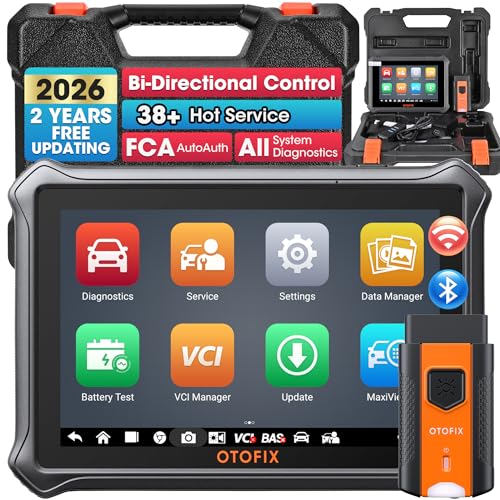
- 🎉[OTOFIX D1 Lite, Perfect Cost-effective Diagnostic Tool]: OTOFIX D1 Lite, a newest bidirectional scan tool from OTOFIX company, is a great choice for DIYers and repair shops. 👉This obd2 scanner diagnostic tool packs all practical functions: OE level all systems diagnoses, Bi-Directional Control, 38+ reset services fixing 99% of common problems, support DoIP & CANDF protocols and FCA
 AutoAuth, high-end hardware configuration. Worldwide vehicles and 🔥2 Years Free Updating🔥 covered.
 - 🎉[Bi-Directional Scan Tool, Active Test]: OTOFIX D1 Lite bluetooth obd2 scanner can also command ECUs and monitor the operation of the actuators to track down the problems of certain parts, like windows, sunroof, wipers, fuel pumps, etc., saving repair time & trouble. This makes OTOFIX D1 Lite the most cost-effective bidirectional scan tool.
- 🎉[2026 Newest, 38+ Hot Reset Functions]: Equipped with 38+ reset functions in one, the OTOFIX D1 lite automotive scanner diagnostic tool allows you to troubleshoot 99% of common vehicle problems. You can use this car diagnostic scanner holding enough functions to easily repair common vehicle models in your repair shops. Including Oil Reset, Injector Coding, Throttle, DPF Reset, SCR Reset, Gear Learning, Clutch Learning, Suspension, etc. Note* Reset functions vary by model.
- 🎉[OE Level Full Systems Diagnostics]: Unlike the 2-system and 4-system diagnostic tools, the OTOFIX auto scan tool can complete comprehensive system diagnostics within 5 minutes. It accesses and scans all available onboard systems like for Engine /AT /ABS /EPB /BMS /TPMS /SRS /SAS /Audio System /BCM /Air Conditioning / etc., to read & clear codes, view live data, and check ECU information. Note: Active test is not involved.
- 🎉[Powerful Hardware Configuration]: Designed with a fashion appearance & a 7” touchscreen and a weight of 463g, this OTOFIX D1 Lite OBD2 diagnostic scanner scan tool is convenient for everywhere and easy to use & store. Android9.0 OS and 2+64GB memory enhance multi-task smoothness and diagnostic operation, no more wasting too much time. 5800mAh battery allows hours-lasting use. WiFi & VCI1 also bring faster communication for your diagnostics.
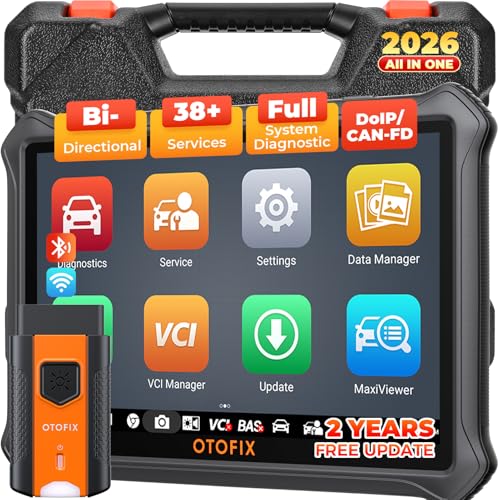
- 🏆【2026 TOP OBD2 Scanner Diagnostic Tool】OTOFIX D1 Lite wireless obd2 scanner has upgraded hardware configuration and car coverage. The newly upgraded D1 Lite with 🔥OS Android 9.0🔥1.5Ghz 4 core high efficiency processor🔥2GB RAM+64GB ROM large storage🔥5800mAh large battery, more stable and longer lasting diagnostics🔥 38+ Reset🔥action tests🔥full system diagnostic🔥Supports MV105 endoscope🔥21+ Language Supports🔥100000+ vehicle coverage to meet all your daily maintenance needs.
- 👍【Bi-Directional Control / Active Test】D1 Lite obd2 scanner has bidirectional control(worth $300+), which is the most beloved feature among mechanic. If your headlights or car windows are broken, going to a repair shop will cost a lot of money. You can use D1 Lite to send execution commands to the ECU module and identify the repair status. Such as ABS, car windows, doors, valves, wipers, headlights, etc., effectively shorten diagnostic time and reduce diagnostic costs.
- 🔥【All Systems Diagnostics, In-depth Checking】This advanced OBD2 Scanner D1 Lite can perform OE-level diagnosis of all systems including engine, transmission, airbag, ABS, ESP, TPMS, gateway, steering, radio, and air conditioning for more than 100 brands. This diagnostic scanner supports essential functions, such as reading ECU version info, reading and clearing fault codes, and reading data streams.With just a simple click, it provides you with accurate and in-depth diagnostics.
- 🏆【38+ Reset Hot Functions】For repair workshops, holding an OTOFIX D1 Lite Auto scanner is a strong advantage over others. Its 38+ maintenance functions provide various solutions for all module repairs, including Oil Reset, TPMS Reset, Injector Coding, Suspension, Throttle Matching, etc., which will usher your repair business to a new pinnacle. Continuously updating will never make the functionality & compatibility out-of-date.
- 🏆【150+ Models, 10000+ Car Coverage & 16 Languages】D1 Lite is a comprehensive car diagnostic scan tool, help you to troubleshoot car issues fast for 95% US, European, Asian auto makes. ✅ With frequent updates and optimizations allow D1 Lite to cover more vehicles to meet your needs. ✅ Multilingual menu allows auto mechanics around the world to use it without language barriers. 🚩Note: Kindly send us the S/N of the device to authorize new language updates before changing the menu language.
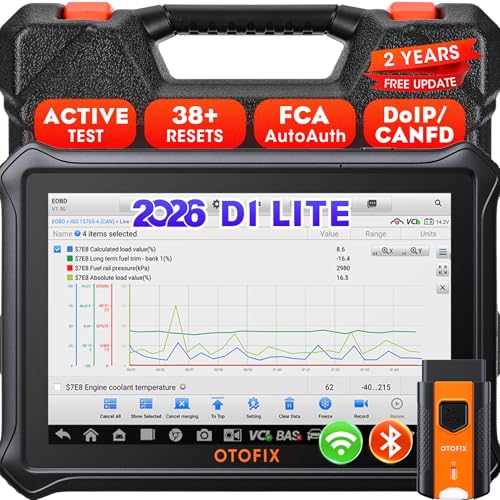
- 【2026 OTOFIX D1 Lite Gives the Best Value for Money】OTOFIX D1 Lite bidirectional scan tool is more FASTER and SMARTER with 2026 Enhanced Hardwares & New Functions! 👍Alternative Bluetooth +USB connect 👍2G+64GB 👍4x ARM Cortex-A35 (1.5GHz) Processor (5X Faster CPU) 👍Android 9.0 OS 👍5G GHz WiFi 👍CANFD&DOIP 👍 FCA AutoAuth 👍38+ Services 👍3K+ Bi-Directional Control 👍Full Systems Diagnose 👍2 Years Update 👍150+ Vehicle Coverage.
- 👍【Active Tests】 OTOFIX D1 Lite is a bi-directional scan tool that can send commands to, and also receive information from vehicle control modules. This way, you can quickly locate and repair faulty auto parts. For Example: send direct commands to ask the vehicle to turn on/off the radiator fan, lights, sound horn, fuel pump, modulate throttle, open/close windows, operate mirrors and more. *Note that only available tests will be displayed in the menu.
- 👍【38+ Service Functions】 OTOFIX D1 Lite scan tool offers 38+ of the hottest service functions that are commonly used for car repairs. That include Oil reset/SAS/EPB/BMS/Throttle/ABS bleeding, and 2065-new SUS/ADBLUE/NOX/Headlamp resets (and more) to help restore your car status after repairs are done. Compared to other diagnostic scanners for cars, the OTOFIX D1 Lite scanner is much more fully-featured. *Note that specific functions available depend on the make/model/year of your car.
- 👍【All System Diagnostics + Cloud Report Management】 This 2026 car scanner OTOFIX D1 Lite provides troubleshooting and data for all ECUs: read/clear DTCs, view graphic live data/VIN, and locate system faults for safe driving. With Cloud Report Management, you can save detailed reports to cloud servers and easily shared them with others via QR codes/emails/text messages. Others can access these reports from any device (smartphones/tablets/PCs …) anytime, and you can better manage repair work.
- 👍【99% Car Coverage】 This one-station car scanner diagnostic for all cars works on 150+ major car brands across the world. 1) It supports CAN-FD/DoIP protocols: compatible with GMCAVALIER/TRAX/Encore/Envision/GL8(LSY)/CT4/CT5 after 2019; Volvo after 2018; Land Rover/Jaguar after 2017; and BM.W F/G all chassis. 2) For models equipped with security modules (such as Renault & 2018+ FCA SGW), its built-in AutoAuth allows you to easily break diagnostic barriers after registration.
This product presentation was made with AAWP plugin.
Last update on 2026-05-12 / Affiliate links / Images from Amazon Product Advertising API