
NHTSA ID Number: 10089762
Manufacturer Communication Number: 99924-1515-01
TSB/Document Date: 2017-01-27
Summary
SERVICE MANUAL
If the PDF is very large, it may not load in the preview below.
Some older TSBs had multiple PDFs — visit the NHTSA Website to view all PDFs.
If the TSB PDF does not show, download or view it on the NHTSA Website.
Click on the (+) Plus Sign
Then Click on Associated Document(s)
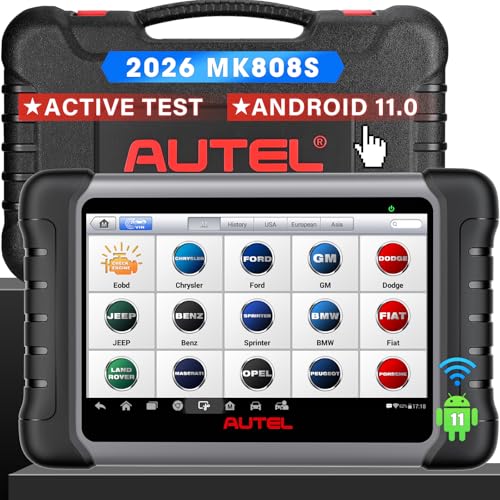
- 💝【Questions? We’re Here Anytime】MK808S is a...
- 🔥🔥🔥【2026 NEWLY RELEASED BI-DIRECTIONAL...
- 【28+ MOST POPULAR RESET SERVICE FOR 150 MAKES】Autel...
- 【ALL SYSTEM DIAGNOSTICS, FACTORY-LEVEL SCANNER】The...
- 【AUT0 SCAN & AUT0V1N, 10X FASTER】How much have you spent...

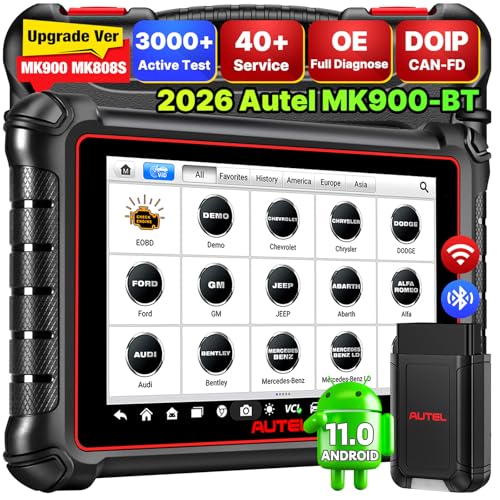
- 💯【Conta.ct us for Support Directly】If you met any...
- 🔥🔥🔥【2026 AUTEL FLAGSHIP MK900BT MK900-BT, NEW...
- 🚗【3000+ ACTIVE TESTS (50➡3000+), SAME AS MS...
- 🚗【40+ HOT SERVICES FOR 150 MAKES (28+➡40+)】Full...
- 🚗【OE ALL SYSTEM DIAGNOSE, AUTO SCAN 2.0: SCAN LICENSE...
This product presentation was made with AAWP plugin.
Search NHTSA Database for Recalls
Search NHTSA Database for Vehicle Investigations
View Latest Vehicle Investigations
Search NHTSA Database for Vehicle Complaints
View Latest Vehicle Complaints
TSB/Document ID: 99924-1515-01
Replacement Service Bulletin Number:
MFR Communication Date: 2016-12-05
MFR Internal Campaign ID/Software Version:
Communication Type: Service Bulletin/Repair Instructions
NHTSA Components: EQUIPMENT:OTHER:OWNERS/SERVICE/OTHER MANUAL
MFR Component System:
MFR Component Subsystem:
Previous TSB | Next TSB |
DFI System
DFI System Wiring Diagram
FUEL SYSTEM (DFI) 3-15
DFI System
Part Names
1. ECU
2. Rear Wheel Rotation Sensor
3. Joint Connector B
4. Kawasaki Diagnostic System Connector
5. Fuel Pump
6. Frame Ground (1)
7. Frame Ground (5)
8. Frame Ground (2)
9. Engine Ground
10. Battery
11. Main Fuse 30 A
12. Relay Box
13. Fuel Pump Relay
14. ECU Main Relay
15. Radiator Fan Relay
16. Fuse Box (3)
17. Ignition Fuse 10 A
18. Fuse Box (2)
19. Fan Fuse 15 A
20. Fuse Box (1)
21. ECU Fuse 15 A
22. Yellow Engine Warning Indicator Light (LED)
23. Meter Unit
24. Ignition Switch
25. Engine Stop Switch
26. Starter Button
27. Fan Motor
28. Spark Plugs
29. Stick Coils
30. Frame Ground (6)
31. Air Switching Valve
32. Subthrottle Valve Actuator
33. Subthrottle Sensor
34. Main Throttle Sensor
35. Intake Air Pressure Sensor
36. Vehicle-down Sensor
37. Fuel Injector #1
38. Fuel Injector #2
39. Water Temperature Sensor
40. Intake Air Temperature Sensor
41. Purge Vale (CAL Model)
42. Gear Position Sensor
43. Crankshaft Sensor
44. Oxygen Sensor
3-16 FUEL SYSTEM (DFI)
DFI System
DFI System Wiring Diagram (ABS Equipped Models)
FUEL SYSTEM (DFI) 3-17
DFI System
Part Names
1. ECU
2. Rear Wheel Rotation Sensor
3. Joint Connector B
4. Kawasaki Diagnostic System Connector
5. Fuel Pump
6. Frame Ground (1)
7. Frame Ground (5)
8. Frame Ground (2)
9. Engine Ground
10. Battery
11. Main Fuse 30 A
12. ABS Hydraulic Unit
13. Relay Box
14. Fuel Pump Relay
15. ECU Main Relay
16. Radiator Fan Relay
17. Fuse Box (3)
18. Ignition Fuse 10 A
19. Fuse Box (2)
20. Fan Fuse 15 A
21. Fuse Box (1)
22. ECU Fuse 15 A
23. Meter Unit
24. Yellow Engine Warning Indicator Light (LED)
25. Ignition Switch
26. Engine Stop Switch
27. Starter Button
28. Fan Motor
29. Spark Plugs
30. Stick Coils
31. Frame Ground (6)
32. Air Switching Valve
33. Subthrottle Valve Actuator
34. Subthrottle Sensor
35. Main Throttle Sensor
36. Intake Air Pressure Sensor
37. Vehicle-down Sensor
38. Fuel Injector #1
39. Fuel Injector #2
40. Water Temperature Sensor
41. Intake Air Temperature Sensor
42. Purge Vale (CAL, CN, SEA-B1, SEA-B3, TH and WVTA (FULL))
43. Gear Position Sensor
44. Crankshaft Sensor
45. Oxygen Sensor
○Color Codes:
BK: Black
BL: Blue
BR: Brown
CH: Chocolate
DG: Dark Green
G: Green
GY: Gray
LB: Light Blue
LG: Light Green
O: Orange
P: Pink
PU: Purple
R: Red
V: Violet
W: White
Y: Yellow
3-18 FUEL SYSTEM (DFI)
DFI System
Terminal Numbers of ECU Connectors
Terminal Names
1. Subthrottle Valve Actuator: BK/O
2. Subthrottle Valve Actuator: G/Y
3. Unused
4. Green Neutral Indicator Light (LED): LG
5. Oxygen Sensor: BL/Y
6. Unused
7. Main Throttle Sensor: Y/R
8. Intake Air Pressure Sensor: Y/BL
9. Unused
10. Power Supply to Sensors: BL
11. Vehicle-down Sensor: Y/G
12. Gear Position Sensor: LG/R
13. Crankshaft Sensor (+): R/BK
14. Power Supply to Rear Wheel Rotation Sensor (EN650C): W/G
15. Rear Wheel Rotation Sensor Signal (from
ABS Hydraulic Unit, EN650D/E): G/R
16. Power Supply to ECU (from ECU Main Relay): BR/W
17. External Communication Line (*KDS): P/BL
18. Subthrottle Valve Actuator: P
19. Subthrottle Valve Actuator: W/BL
20. Unused
21. Unused
22. Water Temperature Sensor: O
23. Unused
24. Subthrottle Sensor: BR
25. Oxygen Sensor: G
26. Intake Air Temperature Sensor: R
27. Unused
28. Ground for Sensors: GY/R
29. Oxygen Sensor Heater: P/BK
30. Crankshaft Sensor (–): Y/BK
31. Rear Wheel Rotation Sensor Signal: P
32. Rear Wheel Rotation Sensor (EN650C):
BK/O
33. Purge Valve (CAL, CN, SEA-B1, SEA-B3,
TH and WVTA (FULL)): R/Y
34. Ground for Control System: BK
35. Power Supply to ECU (from Battery): W/BK
36. Engine Stop Switch: R
37. Starter Lockout Switch: R/G
38. Starter Button: BK/R
39. Fuel Pump Relay: BR/Y
40. Air Switching Valve: R/BL
41. Fuel Injector #2: BL/Y
42. Fuel Injector #1: BL/R
43. Stick Coil #1: BK
44. Side Stand Switch: G/BK
45. Radiator Fan Relay: P/BL
46. External Communication Line (*KDS):
LG/BK
47. Meter Unit (Tachometer): LB
48. Meter Communication Line: BL/O
49. Unused
50. Ground for Oxygen Sensor Heater: BK/Y
51. Ground for Ignition System: BK/Y
52. Stick Coil #2: BK/O
*: KDS (Kawasaki Diagnostic System)
FUEL SYSTEM (DFI) 3-19
DFI Parts Location
Battery [A]
Kawasaki Diagnostic System Connector [B]
Purge Valve [C] (CAL, CN, SEA-B1, SEA-B3, TH and
WVTA (FULL) Models)
Gear Position Sensor [A]
Oxygen Sensor [A]
Water Temperature Sensor [A]
Subthrottle Sensor [A]
Main Throttle Sensor [B]
Subthrottle Valve Actuator [C]
3-20 FUEL SYSTEM (DFI)
DFI Parts Location
Vehicle-down Sensor [A]
Relay Box [B]
ECU [C]
Intake Air Temperature Sensor [D]
Intake Air Pressure Sensor [E]
Yellow Engine Warning Indicator Light (LED) [A]
Ignition Switch [B]
Fuel Injectors #1, #2 [A]
Air Switching Valve [A]
Stick Coils #1, #2 [B]
Fuse Box (1) [A]
Fuse Box (2) [B]
Fuse Box (3) [C]
FUEL SYSTEM (DFI) 3-21
DFI Parts Location
Fuel Pump [A]
Crankshaft Sensor [A]
Rear Wheel Rotation Sensor [A]
3-22 FUEL SYSTEM (DFI)
Specifications
Item
Digital Fuel Injection System
Idle Speed
Throttle Body Assy:
Throttle Valve
Bore
Throttle Body Vacuum
Bypass Screws (Turn Out)
ECU:
Make
Type
Fuel Pressure (High Pressure Line)
Fuel Pump:
Type
Discharge
Fuel Injectors:
Type
Nozzle Type
Resistance
Main Throttle Sensor:
Input Voltage
Output Voltage
Resistance
Intake Air Pressure Sensor:
Input Voltage
Output Voltage
Intake Air Temperature Sensor:
Output Voltage
Resistance
Water Temperature Sensor:
Output Voltage
Gear Position Sensor:
Input Voltage
Output Voltage
Vehicle-down Sensor:
Input Voltage
Output Voltage
Standard
1 300 ±50 r/min (rpm)
Dual throttle valve
38 mm (1.5 in.)
37.9 ±1.3 kPa (284 ±10 mmHg) at idle speed
0 2 1/2 (for reference)
DENSO
Digital memory type, with built in IC igniter, sealed
with resin
294 kPa (3.0 kgf/cm², 43 psi) with engine idling
In-tank pump (in fuel tank)
50 mL (1.7 US oz.) or more for 3 seconds
EAT287
Fine atomizing type with 12 holes
About 11.7 12.3 Ω @20°C (68°F)
DC 4.75 5.25 V
DC 0.99 1.05 V at idle throttle opening
DC 4.11 4.50 V at full throttle opening (for reference)
4 6 kΩ
DC 4.75 5.25 V
DC 3.80 4.20 V at standard atmospheric pressure
(101.32 kPa, 76 cmHg)
About DC 2.25 2.50 V @20°C (68°F)
5.4 6.6 kΩ @0°C (32°F)
0.29 0.39 kΩ @80°C (176°F)
About DC 2.80 2.97 V @20°C (68°F)
DC 4.75 5.25 V
In the text
DC 4.75 5.25 V
With sensor tilted 60 70° or more right or left: DC
0.65 1.35 V
With sensor arrow mark pointed up: DC 3.55 4.45 V
FUEL SYSTEM (DFI) 3-23
Specifications
Item
Subthrottle Sensor:
Input Voltage
Output Voltage
Resistance
Subthrottle Valve Actuator:
Input Voltage
Resistance
Oxygen Sensor:
Output Voltage (Rich)
Output Voltage (Lean)
Heater Resistance
Purge Valve (Equipped Models):
Resistance
Throttle Grip and Cables
Throttle Grip Free Play
Air Cleaner
Air Cleaner Element
Standard
DC 4.75 5.25 V
DC 0.46 0.95 V at subthrottle valve full close
position (for reference)
DC 4.05 4.15 V at subthrottle valve full open
position
4 6 kΩ
About DC 8.5 10.5 V and then 0 V or About DC
8.5 10.5 V
About 5.2 7.8 Ω
DC 0.5 V or more
DC 0.2 V or less
5.49 6.91 Ω @20°C (68°F)
30 34 Ω @20°C (68°F)
2 3 mm (0.08 0.12 in.)
Viscous paper element
3-24 FUEL SYSTEM (DFI)
Special Tools and Sealant
Oil Pressure Gauge, 5 kgf/cm²:
57001-125
Throttle Sensor Setting Adapter:
57001-1538
Fork Oil Level Gauge:
57001-1290
Fuel Pressure Gauge Adapter:
57001-1593
Vacuum Gauge:
57001-1369
Fuel Hose:
57001-1607
Peak Voltage Adapter:
57001-1415
Oxygen Sensor Measuring Adapter:
57001-1682
Needle Adapter Set:
57001-1457
Measuring Adapter:
57001-1700
FUEL SYSTEM (DFI) 3-25
Special Tools and Sealant
Liquid Gasket, TB1211:
56019-120
3-26 FUEL SYSTEM (DFI)
DFI Servicing Precautions
DFI Servicing Precautions
There are a number of important precautions that should
be followed servicing the DFI system.
○This DFI system is designed to be used with a 12 V sealed
battery as its power source. Do not use any other battery
except for a 12 V sealed battery as a power source.
○Do not reverse the battery cable connections. This will
damage the ECU.
○To prevent damage to the DFI parts, do not disconnect the
battery cables or any other electrical connections when
the ignition switch is on, or while the engine is running.
○Take care not to short the leads that are directly connected to the battery positive (+) terminal to the chassis
ground.
○When charging, remove the battery from the motorcycle.
This is to prevent ECU damage by excessive voltage.
○Whenever the DFI electrical connections are to be disconnected, first turn off the ignition switch, and disconnect
the battery (–) terminal. Do not pull the lead, only the connector. Conversely, make sure that all the DFI electrical
connections are firmly reconnected before starting the engine.
○Connect these connectors until they click [A].
○Do not turn the ignition switch on while any of the DFI
electrical connectors are disconnected. The ECU memorizes service codes.
○Do not spray water on the electrical parts, DFI parts, connectors, leads and wiring.
○If a transceiver is installed on the motorcycle, make sure
that the operation of the DFI system is not influenced by
electric wave radiated from the antenna. Check operation
of the system with the engine at idle. Locate the antenna
as far as possible away from the ECU.
○When any fuel hose is disconnected, do not turn on the
ignition switch. Otherwise, the fuel pump will operate and
fuel will spout from the fuel hose.
○Do not operate the fuel pump if the pump is completely
dry. This is to prevent pump seizure.
○Before removing the fuel system parts, blow the outer surfaces of these parts clean with compressed air.
○When any fuel hose is disconnected, fuel may spout out
by residual pressure in the fuel line. Cover the hose joint
with a piece of clean cloth to prevent fuel spillage.
○When installing the fuel hoses, avoid sharp bending, kinking, flattening or twisting, and run the fuel hoses with a
minimum of bending so that the fuel flow will not be obstructed.
○Run the hoses according to Cable, Wire, and Hose Routing section in the Appendix chapter.
○To prevent corrosion and deposits in the fuel system, do
not add to fuel any fuel antifreeze chemicals.
FUEL SYSTEM (DFI) 3-27
DFI Servicing Precautions
○If the motorcycle is not properly handled, the high pressure inside the fuel line can cause fuel to leak or the hose
to burst. Remove the fuel tank (see Fuel Tank Removal)
and check the fuel hose [A].
Replace the fuel hose if any fraying, cracks or bulges are
noticed.
○To maintain the correct fuel/air mixture (F/A), there must
be no intake air leaks in the DFI system. Be sure to install
the oil filler plug [A] after filling the engine oil.
3-28 FUEL SYSTEM (DFI)
Troubleshooting the DFI System
Outline
When a problem occurs with DFI system, the yellow engine warning indicator light (LED) [A] stays on after starting
the engine to alert the rider.
With the engine stopped and turned in the self-diagnosis
mode, the service code [A] is displayed on the LCD (Liquid
Crystal Display) by the number of two digits.
If the problem is with the following parts, the ECU can
not recognize these problem. Therefore, the yellow engine
warning indicator light (LED) does not go on, and service
code is not displayed.
Fuel Pump
Fuel Pump Relay
ECU Main Relay
When the service code [A] is displayed, for first ask the
rider about the conditions [B] of trouble, and then start to
determine the cause [C] of problem.
As a pre-diagnosis inspection, check the ECU for ground
and power supply, the fuel line for no fuel leaks, and for
correct pressure. The pre-diagnosis items are not indicated
by the yellow engine warning indicator light (LED).
Don’t rely solely on the DFI self-diagnosis function, use
common sense.
FUEL SYSTEM (DFI) 3-29
Troubleshooting the DFI System
Even when the DFI system is operating normally, the yellow engine warning indicator light (LED) goes on may be
displayed under strong electrical interference. Additional
measures are not required. Turn the ignition switch off to
stop the indicator light.
If the yellow engine warning indicator light (LED) of the
motorcycle brought in for repair still goes on, check the service code.
When the repair has been done, the yellow engine warning indicator light (LED) goes off after the service code erasing procedure (see Service Code Erasing) is done.
When the motorcycle is down, the vehicle-down sensor
operates and the ECU shuts off the fuel pump relay, fuel
injectors and ignition system. The ignition switch is left on.
If the starter button is pushed, the electric starter turns but
the engine does not start. To start the engine again, raise
the motorcycle, turn the ignition switch off, and then on.
Much of the DFI system troubleshooting work consists
of confirming continuity of the wiring. The DFI parts are
assembled and adjusted with precision, and it is impossible
to disassemble or repair them.
checking the DFI parts, use a digital meter which
• When
can be read two decimal place voltage or resistance.
○The DFI part connectors [A] have seals [B], including the
ECU. When measuring the input or output voltage with the
connector joined, use the needle adapter set [C]. Insert
the needle adapter inside the seal until the needle adapter
reaches the terminal.
Special Tool - Needle Adapter Set: 57001-1457
NOTICE
Insert the needle adapter straight along the terminal
in the connector to prevent short-circuit between
terminals.
sure that measuring points are correct in the con• Make
nector, noting the position of the lock [D] and the lead
•
•
color before measurement. Do not reverse connections
of a digital meter.
Be careful not to short-circuit the leads of the DFI or electrical system parts by contact between adapters.
Turn the ignition switch on and measure the voltage with
the connector joined.
NOTICE
Incorrect, reverse connection or short circuit by
needle adapters could damage the DFI or electrical
system parts.
3-30 FUEL SYSTEM (DFI)
Troubleshooting the DFI System
○After measurement, remove the needle adapters and apply silicone sealant to the seals [A] of the connector [B]
for waterproofing.
Sealant - Liquid Gasket, TB1211: 56019-120
check battery condition before replacing the DFI
• Always
parts. A fully charged battery is a must for conducting
•
•
•
accurate tests of the DFI system.
Trouble may involve one or in some cases all items.
Never replace a defective part without determining what
CAUSED the problem. If the problem was caused by
some other item or items, they too must be repaired or
replaced, or the new replacement part will soon fail again.
Measure the coil winding resistance when the DFI part is
cold (at room temperature).
Make sure all connectors in the circuit are clean and tight,
and examine leads for signs of burning, fraying, short,
etc. Deteriorated leads and bad connections can cause
reappearance of problems and unstable operation of the
DFI system.
If any wiring is deteriorated, replace the wiring.
each connector [A] apart and inspect it for corrosion,
• Pull
dirt, and damage.
If the connector is corroded or dirty, clean it carefully. If it
is damaged, replace it. Connect the connectors securely.
Check the wiring for continuity.
○Use the wiring diagram to find the ends of the lead which
is suspected of being a problem.
○Connect a tester between the ends of the leads.
If the tester does not read about 0 Ω, the lead is defective.
Replace the lead or the main harness.
•
○If both ends of a harness [A] are far apart, ground [B] the
one end [C], using a jumper lead [D] and check the continuity between the end [E] and the ground [F]. This enables to check a long harness for continuity. If the harness
is open, repair or replace the harness.
FUEL SYSTEM (DFI) 3-31
Troubleshooting the DFI System
○When checking a harness [A] for short circuit, open one
end [B] and check the continuity between the other end
[C] and ground [D]. If there is continuity, the harness has
a short circuit to ground, and it must be repaired or replaced.
down suspicious locations by repeating the con• Narrow
tinuity tests from the ECU connectors.
If no abnormality is found in the wiring or connectors, the
DFI parts are the next likely suspects. Check the part,
starting with input and output voltages. However, there is
no way to check the ECU itself.
If an abnormality is found, replace the affected DFI part.
If no abnormality is found in the wiring, connectors, and
DFI parts, replace the ECU.
3-32 FUEL SYSTEM (DFI)
Troubleshooting the DFI System

- [2026 Top-Tier Hardware and Software Upgrade]: Topdon ArtiDiag900 Lite scanner has enhanced hardware and latest features, including Android 11.0, 5x faster CPU, 10000mAh battery for 12 hours of continuous operation, stable wireless diagnosis with Bluetooth 5.0, 8-inch touchscreen. Added bi-directional control, wireless diagnosis, battery testing (optional), and DTC repair guide
- [TOPDON Bidirectional Scan Tool]: This bidirectional obd2 scanner sends commands to the vehicle's ECU for active testing, enabling users to accurately and quickly locate faulty components such as injectors, coolant pumps, windows, wipers, headlights, mirrors, etc. The bidirectional control scanner is the ideal choice for workshops/automotive repair shops as it significantly reduces mechanic's diagnostic time.
- [Wireless Bluetooth Diagnostic Experience]: The AD900 Lite scan tool comes with a Bluetooth 5.0 VCI, supporting a wireless diagnostic range of up to 33 feet (10 meters), allowing you to diagnose without being confined to cables or tight spaces. Stable and fast wireless diagnosis provides a comfortable repair environment. It also offers VCI cables to increase connectivity options.
- [DTC Repair Guide Function]: Easily diagnose issues with your vehicle and receive guidance on repairs with the topdon scan tool's fault code definitions for all systems,maximize your diagnostic capabilities. This function is compatible with Chrysler
 /Dodge/Jeep/Fiat 2010-2014 and expanding with continual updates,the AritDiag 900 Lite car diagnostic scanner is the must-have tool for any technician or DIY enthusiast.
 - [OE-Level Full System Diagnostics]:AritDiag900 Lite full system diagnostic scanner can scan ALL available modules(Engine, Transmission, Airbag, ABS, ESP, TPMS, Gateway, Steering, Radio, Air conditioning, ect.) to✔read ECU info, ✔read/clear codes, ✔view live data stream, ✔retrieves freeze-frame, ✔perform active tests, and more. With just a simple click, it provides you with accurate and in-depth diagnostics.
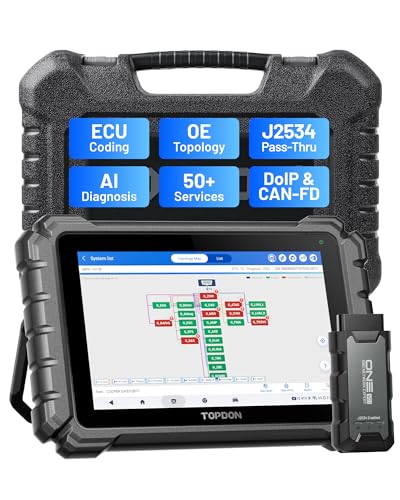
- Dual WiFi & 10.1" Touchscreen: Provides a stable, high-speed wireless link 3x faster than bluetooth, and a responsive, professional interface. Topdon ONE obd2 scanner diagnostic tool ensures smooth, non-lagging diagnostic scan, boosting mechanic efficiency
- J2534 Pass-Thru Support: The included ONE VCI supports the J2534 standard, allowing it to function as a pass-thru device when paired with OEM diagnostic software.Through TOPDON’s RLink platform, technicians can perform dealer-level coding, expanding in-house capabilities without investing in multiple factory automotive scan tools
- OE Topology Mapping: Visualize the vehicle’s ECU network exactly as it’s built.Zoom, pan, and highlight specific modules to pinpoint component issues with precision.Topology mapping displays real-time communication between modules
- Topfix AI Assistant: Covers 5 million plus fault codes and delivers instant causes, symptoms, and repair guidance with professional wiring diagrams for each code.Slashes diagnostic time, boosts first-time fix accuracy, and increases shop revenue
- 50 Plus Service Functions: Covers high-demand services like ADAS calibration, DPF regen, TPMS reset, ABS bleed, and throttle adaptation.Expands your service menu, allows you to charge premium rates, and turns away zero jobs due to lack of tooling. Vehicle-specific functionality may vary.

- Bi-Directional Control, Quickly Locate Problems: Turn your phone into a professional diagnostic tool. You can send commands from your phone to the ECU to test injectors, cooling fans, headlights, A/C clutch, windows, wipers, and more. See which one doesn't respond. Helps you quickly locate the problem and save time. No need to tear things apart, avoid blind disassembly.
- Full System Diagnostics, No Fault Hides: Unlike basic diagnostic tools that only cover 4 systems, TopScan can scan all systems. Read and clear trouble codes, view live data streams, and generate a complete vehicle health report – all issues are clear at a glance. Covers 10,000+ vehicle models and is compatible with 99.99% of vehicles.
- Flexible Subscription, Choose Advanced Features as Needed: TopScan Lite provides free-for-life access to core diagnostics, including full system scan, code reading, performance tests, and repair information. After purchase, advanced features (bi-directional control, service operations, live data, code clearing, and AI functions) are free-for-the-first-year. After the first year, if you want to use advanced features, you need to subscribe on a monthly, quarterly, or yearly basis. As new models and reset functions are updated, the tool will also be continuously upgraded.
- AI Assistant - TopFix: Think of TopFix as your personal AI mechanic. It leverages a repair database and OEM data to deliver clear, step-by-step repair solutions. Features include AI Q&A, one-click translation, and a full repair log, making your diagnostic process simpler and more efficient.
- 8+ Hot Resets, Keep Your Car in Top Shape: One-tap resets for oil, throttle, EPB, steering angle, DPF, ABS, BMS, and airbag. It enables car owners to easily perform essential maintenance, ensuring the vehicle stays in optimal condition and extends its service life.
This product presentation was made with AAWP plugin.
Last update on 2026-05-11 / Affiliate links / Images from Amazon Product Advertising API