
NHTSA ID Number: 10068626
Manufacturer Communication Number: 02-157-14R
TSB/Document Date: 2016-06-02
Summary
SUMMARY TO BE PROVIDED ON A FUTURE DATE.
ATTENTION:
CLAIMS PERSONNEL q
IMPORTANT - All
Service Personnel
Should Read and
Initial in the boxes
provided, right.
SERVICE MANAGER
© 2014 Subaru of America, Inc. All rights reserved.
GENERAL MANAGER q
PARTS MANAGER
q
q
SERVICE BULLETIN
APPLICABILITY: 2013MY Legacy and Outback Models with
NUMBER: 02-157-14R
2.5L FB Engines
DATE: 08/28/14
2011-14MY Forester Models with 2.5L FB Engines
REVISED: 09/29/14
2012-13MY Impreza and 2013MY XV Crosstrek Models
with 2.0L FB Engine
SUBJECT: Surface Treatment Change To Oil Control
Piston Rings
INTRODUCTION
This bulletin announces information regarding a major change to the repair procedures previously
outlined in Service Bulletins 02-143-13R, 02-144-13R and 02-145-13R. These bulletins provided
a repair procedure for the replacement of the piston rings to address verified concerns of unusual
engine oil consumption. Vehicles confirmed as having this condition which are within the supplied
VIN ranges will no longer be repaired with piston ring replacement. The revised repair procedure
to address verified unusual oil consumption concerns on these specific vehicles will consist of
replacing the engine short block assembly.
It is critical to understand the nature of the concern as reported by the customer and to confirm the
actual condition prior to attempting repairs. Some oil consumption can and should be expected
as a by-product of engine operation even where no concern exists. Failure to recognize this and
correctly diagnose the condition presented can result in unnecessary repairs. For example: a vehicle
which is presented with a report of a low engine oil level (as read on engine dipstick/ gauge or
indicated by illumination of the low engine oil level warning lamp), which is at or near the time /
mileage of the next service interval (based upon the date / mileage of the most recent oil change),
is not representative of unusual oil consumption. The information supplied in this bulletin is
only applicable to vehicles within the specific production ranges of this publication exhibiting the
condition(s) previously described.
IMPORTANT: Read and understand this bulletin COMPLETELY before starting an oil
consumption test or initiating any repairs.
Concerns related to a possible oil consumption condition are generally initiated when the customer
believes the engine oil level on the dipstick has dropped since the last time it was checked or when
the low oil lamp illuminates. These types of complaints by themselves do not directly indicate
a concern with the vehicle exists. It is important to understand all the factors involved in order
to make a sound decision regarding whether or not a repair is required or if an oil consumption
test should even be started. When speaking with customers about a reported or suspected oil
consumption concern, always keep the following in mind:
Continued...
CAUTION: VEHICLE SERVICING PERFORMED BY UNTRAINED PERSONS COULD
RESULT IN SERIOUS INJURY TO THOSE PERSONS OR TO OTHERS.
Subaru Service Bulletins are intended for use by professional technicians ONLY. They
are written to inform those technicians of conditions that may occur in some vehicles,
or to provide information that could assist in the proper servicing of the vehicle. Properly
trained technicians have the equipment, tools, safety instructions, and know-how to
do the job correctly and safely. If a condition is described, DO NOT assume that this
Service Bulletin applies to your vehicle, or that your vehicle will have that condition.
Bulletin Number: 02-157-14; Revised: 09/29/14
SUBARU OF AMERICA, INC. IS
ISO 14001 COMPLIANT
ISO 14001 is the international standard for
excellence in Environmental Management
Systems. Please recycle or dispose of
automotive products in a manner that is friendly
to our environment and in accordance with all
local, state and federal laws and regulations.
Page 1
Some engine oil will always be consumed as part of normal engine operation. How much and
when it is consumed varies according to manufacturing tolerances, wear, and vehicle usage patterns.
With the extended service intervals commonly used for today’s engines combined with one or more
of the conditions listed below, typical engine oil consumption may require adding engine oil in
between scheduled maintenance intervals:
•
When the engine is new and within the break-in period (during the first 1000 miles of
operation)
•
When the engine oil being used is of lower quality (other than “Energy or Resource
Conserving” API Classification SM or SN or ILSAC, look for the starburst design with
GF-4 or GF-5)
•
When the incorrect oil viscosity is used (viscosity other than 0W-20 in
the case of these specific vehicles)
•
When engine braking is employed (use of the transmission’s gear ranges
to decelerate while using the engine to apply resistance)
•
When the engine is operated at high engine speeds (continually or under
frequent, hard acceleration)
•
When the engine is operated under heavy loads (frequent carrying of
heavy cargo, passengers or trailer towing)
•
When the engine idles for long periods of time (may be related to frequent
use of a remote engine start system)
•
When the vehicle is operated in stop and go and/or heavy traffic situations
•
When the vehicle is used under severe temperature conditions (cold or hot)
•
When the vehicle accelerates and decelerates frequently
Under these or similar operating conditions, the oil level should be checked more frequently. The
engine oil and filter may also need to be changed more often. As per the Owner’s Manual, engine
oil consumption under these conditions may be as high as 1 quart per 1200 miles.
As related information, the low oil level warning light (on models so equipped) is designed to
illuminate when the engine oil level in the sump drops below approximately 4 quarts with the engine
not running (engine is 1.1 quarts low on oil) and 2.4 quarts when the engine is running. While this
may seem very low, keep in mind that oil remains suspended in the engine while running and will
not fully drain back until the engine has been shut off for at least 5 minutes. In some rare cases, this
light may illuminate with more oil present when the engine is running due to specific road or driving
conditions such as repeated hard acceleration/ deceleration, tight turning, driving on undulating
roads. In these cases, the light will generally reset on its own once the actual level is determined
to be above the illumination threshold. However, this may take some time as certain driving
parameters must be met for the system to self-correct. As long as the oil level has been checked and
adjusted (if necessary), the immediate concern has been addressed. If the lamp does not extinguish
on its own after some time and the oil level remains full, an inspection of the circuit and components
should be performed. See Section 3 of the Owner’s Manual for more information on the oil level
warning system. See Service Procedure to reduce false illumination of low oil level warning
lamp (on models so equipped) later in this bulletin for instructions on how to address customer
concerns where the low engine oil level warning lamp illuminates when the engine oil level is either
full or nearly full.
Continued...
Bulletin Number: 02-157-14; Revised: 09/29/14
Page 2
COUNTERMEASURE IN PRODUCTION
The updated piston rings were incorporated into production as per the table below.
MODEL
STARTING VIN
2013MY Legacy and Outback
2013MY Impreza 2.0L and XV Crosstrek
2011-2013MY Forester
2014MY Forester
DATE
Legacy - D3048058
Outback - D3321342
Impreza - D*025244
XV Crosstrek - D*855330
n/a
E*521302
5/8/2013
2/20/2013
n/a
10/30/2013
PART INFORMATION
The chart below provides a required part list for the short block replacement procedure. This list is
provided as a reference only and may not be totally complete depending on the needs of your specific
repair. Always verify with your Parts Department that all needed parts with the most up-to-date part
numbers are ordered.
PART NUMBER
10103AC400
10103AC410
10103AC390
10103AC420
10103AC460
11821AA660
44011AC030
44616AA200
14035AA580
14852AA040
14738AA150
806912190
806924120
806915100
806916080
10966AA040
13270AA240
13272AA170
13270AA27A*
13272AA21A*
806915170
11044AA790
10944AA080
11044AA780*
10944AA070*
DESCRIPTION
QTY. /REPAIR
APPLICABILITY
Short Block Assy.
1
2014MY Forester
2013MY Legacy & Outback
2013MY XV Crosstrek 2.0L
2012-2013MY Impreza 2.0L
2011-2013MY Forester
PCV Adaptor
Exhaust Gasket
Center Pipe Gasket
Intake Gasket
1
2
1
2
1
1
3
1
1
1
4
1
1
1
1
4
1
1
1
1
EGR Pipe Gasket
O-Ring, Chain Cover
O-Ring, Tensioner
Seal, Spark Plug Tube
Rocker Gasket*
O-Ring, Cam Carrier
Head Gasket*
Up to 1/2012
2/2012 and Later
Impreza, Forester and
XV Crosstrek
*Legacy & Outback
Legacy, Outback and Forester
*Impreza and XV Crosstrek
w/ 2.0L
Continued...
Bulletin Number: 02-157-14; Revised: 09/29/14
Page 3
PART NUMBER
DESCRIPTION
QTY. /REPAIR
11122AA350
Sealing-Oil Pan
2
806949060
O-Ring, Pick-Up Tube
1
806932030
3
21236AA050
Thermostat Gasket
1
806939060
O-Ring, Crank Extension
1
806750080
1
16608KA000
Injector O-Rings
16698AA110
APPLICABILITY
4
4
15208AA15A
1
803916010
Gasket, Drain Plug
1
806933010
2
MISCELLANEOUS MATERIALS (WARRANTY PART NUMBERS)
PART
DESCRIPTION
QUANTITY
SOA635065
SOA635041
SOA635045
ThreeBond 1280B / 1217G
Super Coolant, (qt.)
Engine Oil (qt.) 0W-20
1
8
6
SERVICE PROCEDURE / INFORMATION
Before starting any repairs, the first step is to always confirm the customer’s complaint. It is
critical to get as much information from the customer as possible to help you make the most accurate
diagnosis.
•
Review all the available service and repair history along with any other records the customer
can provide to establish whether or not the vehicle has been properly maintained.
•
Perform a thorough visual inspection to make sure there are no external oil leaks that could
be contributing to the condition.
•
It is also very important to not overlook the engine’s PCV system and to confirm it is
operating properly. Check the air filter assembly and throttle body / intake manifold for any
excessive oil residue which could be an indicator of a sticking or failed PCV valve.
NOTES:
•
An oil consumption test will need to be completed to determine the proper course of action.
There is a specific procedure and Oil Consumption Test form which must be completed. See
Subarunet \ Service \ Forms for the latest test form. Always print the latest form anytime a
new test is started.
•
Where applicable, available reprogramming to reduce the possibility of false low engine oil
level warning lamp illumination must be installed. See Service Procedure to reduce false
illumination of low oil level warning lamp (on models so equipped) later in this bulletin
for further instructions. This must be completed at either the start or end of the consumption
testing regardless of the final outcome.
Continued...
Bulletin Number: 02-157-14; Revised: 09/29/14
Page 4
IMPORTANT: At the start of the Oil Consumption Test Form, specific information regarding what
prompted (reason for) the testing must be collected. Once this questionnaire section of the form is
completed, it must be faxed to 856-488-3199. Upon completion of the actual consumption test, the
remainder of the form must be completed and faxed AGAIN to 856-488-3199. This information is
being collected for quality assurance purposes only. You will not receive any response from these
submissions. This is NOT an authorization process. Proceed with any necessary testing or repairs as
indicated by the information provided in this service bulletin, the Oil Consumption Test form results,
Subaru’s Claims Policies and Procedures, and your evaluation of the actual condition presented based
upon your review of all three areas. Keep in mind, these repairs should only be completed when
unusual oil consumption has been confirmed.
Before initiating the consumption test, all basic checks must be completed. These include (but are not
limited to): confirming the actual oil level, noting if any oil has been added prior to this visit and how
much, checking for any external leaks, confirming PCV operation, and verifying that a consumption
test has not already been started or completed previously. Always use the latest Oil Consumption
Test form form found on Subarunet in the Service Forms area. Follow the instructions outlined on the
form.
NOTE: The oil and filter change is only necessary if no prior consumption test has been completed
or is already in process. There is no need for duplicate or repeat testing. One-time documented results
are all that is required to move forward with these repairs. Always close the repair order on the day
the oil change has been completed and submit the claim for the oil consumption test using the coding
provided at the end of this bulletin. Indicate “Oil Consumption Test” in the comments field / box
when entering your claim. DO NOT hold the repair order open until the vehicle returns. Have the
customer drive the vehicle then return for inspection when any of the following have occurred:
•
At least 1200 miles have elapsed
•
When the low engine oil level warning lamp illuminates (when equipped)
•
When the oil level reaches the lower hole in the dipstick/ gauge (as determined by the
customer).
The customer should be advised to not add oil unless there will be a significant delay before they can
return for inspection once a low oil condition occurs. A one-time check of the oil consumption by the
retailer is all that is needed to establish if the condition outlined in this bulletin applies.
SPECIFIC SERVICE PROCEDURES
The following information is provided to underscore service procedures specific to the repairs
outlined in this bulletin. They are not meant to represent the entire repair process from start
to finish. The procedures provided here are specific to certain steps in the overall process.
In some cases, they will differ greatly from the Service Manual instructions and should be
followed in place of the Service Manual for these specific areas only. For the balance of the
repair procedure, refer to the Service Manual. It is highly recommended to review all of the
Service Manual procedures for short block replacement then review these specific procedures to
become familiar with the differences.
Continued...
Bulletin Number: 02-157-14; Revised: 09/29/14
Page 5
•
When draining the engine oil, do not remove the engine oil filter. Leave the existing oil filter
in place through engine disassembly, reassembly, installation and initial startup after engine
reassembly.
•
When removing the engine, there is no need to remove the transmission case cover (CVT
only) or to disconnect / disturb any of the transmission harness connectors. While raising
the transmission with the service jack placed under the front differential as shown in the
illustration below, only raise it enough to access and remove the engine mounting
hardware. Raising it too high can push the transmission up into the bulkhead / transmission
tunnel and possibly cause damage.
•
When removing the CVT fluid cooler (if equipped), leave it attached to its mounting bracket
and remove as an assembly (3 bolts) from the transmission. Disconnect just the engine
coolant hoses from it and do not disturb the 2 short CVT fluid lines. Hook one of the cooler’s
mounting bracket “ears” behind the bulkhead harness as shown in the photo below to keep
the cooler assembly out of your way. Use a shop cloth between the “ear” and the bulkhead
harness to prevent any chafing.
Continued...
Bulletin Number: 02-157-14; Revised: 09/29/14
Page 6
•
To make separating the transmission (CVT) from the engine easier, there is a pry relief
shown below in the machined mounting surface of the transmission case near the engine
number. Use caution when applying any prying pressure and avoid twisting the tool to
prevent case damage.
•
Once the engine is removed, if you are using a generic engine stand (preferable since engine
rotation is necessary), use the four mounting holes on the engine block shown below to
mount it. NOTE: Do not use the mounting studs in the upper oil pan.
Continued...
Bulletin Number: 02-157-14; Revised: 09/29/14
Page 7
•
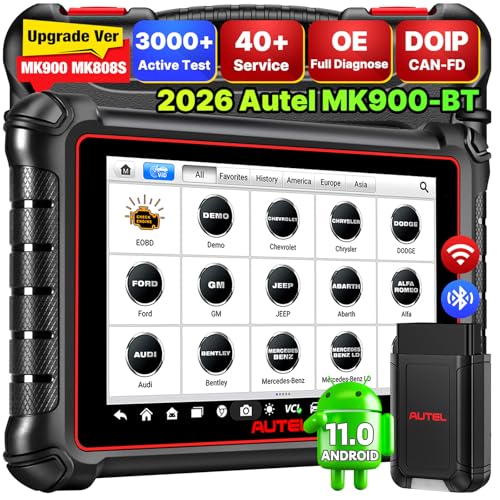
- 💯【Conta.ct us for Support Directly】If you met any...
- 🔥🔥🔥【2026 AUTEL FLAGSHIP MK900BT MK900-BT, NEW...
- 🚗【3000+ ACTIVE TESTS (50➡3000+), SAME AS MS...
- 🚗【40+ HOT SERVICES FOR 150 MAKES (28+➡40+)】Full...
- 🚗【OE ALL SYSTEM DIAGNOSE, AUTO SCAN 2.0: SCAN LICENSE...

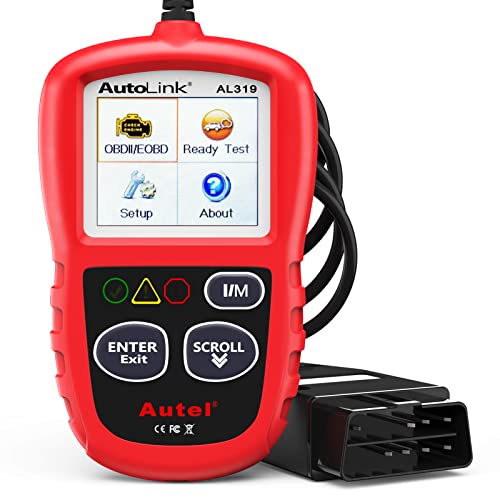
- 【TURN OFF CEL】 This AL319 car scanner diagnostic tool...
- 【EXTENSIVE APPLICATION】 Autel AL319 Compatible with...
- 【FOR END USER & DIYERS】 This error code reader AL319 is...
- 【USER-FRIENDLY DESIGN】 This OBD2 scanner and check...
- 【HIGH-QUALITY SERVICES】 12 months war.ranty from the...
This product presentation was made with AAWP plugin.
If the PDF is very large, it may not load in the preview below.
Some older TSBs had multiple PDFs — visit the NHTSA Website to view all PDFs.
If the TSB PDF does not show, download or view it on the NHTSA Website.
Click on the (+) Plus Sign
Then Click on Associated Document(s)
Search NHTSA Database for Recalls
Search NHTSA Database for Vehicle Investigations
View Latest Vehicle Investigations
Search NHTSA Database for Vehicle Complaints
View Latest Vehicle Complaints
TSB/Document ID: 02-157-14R
Replacement Service Bulletin Number:
MFR Communication Date: 2014-09-29
MFR Internal Campaign ID/Software Version:
Communication Type: Service Bulletin/Repair Instructions
NHTSA Components: ENGINE
MFR Component System:
MFR Component Subsystem:
Previous TSB | Next TSB |
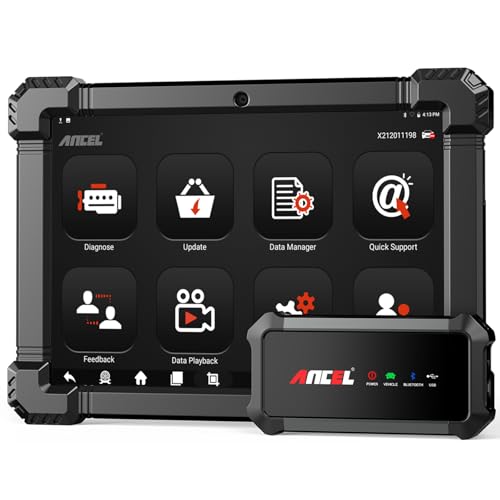
- 🔥🔥🔥2026 New Functions Making X7HD the Top Dog - Big Surprise!!! ANCEL X7HD truck scanner 10 major functional advantages .✅>Full HDOBD/OBD2 Function ✅>ALL System Diagnostic ✅>42+ Reset Function ✅>Active Test / Bi-Directional Control✅>ECU Coding✅>Graphing Live Data✅>Wide Compatibility ✅>2 Yrs Free Update✅>Remote Operation✅>Bluetooth 5.0 & Wifi In addition, 8 major hardware advantages: ✅>6000 mAh✅>10.1 inch Tablet✅>2G RAM
 ✅>32G ROM (Expandable to 128GB)✅>Data Record & Replay & Print✅>Android 10.0✅>Bluetooth 5.0 & Wifi✅>14 Languages
 - 🚛OEM DPF Forced Regen & Cylinder Cutout Test & more - ANCEL X7HD diesel scanner diagnostic tool not only supports DPF regeneration, DPF reset, DPF related information reset, DPR state reset, DPD forced regeneration etc, which helps you better solve the exhaust aftertreatment system problems, but also supports activate motor to do exhaust air in ABS Automatically. Moreover, it features TPMS activation, cylinder cut-off and learning functions
- 🚛Advanced ECU Coding & Programming - ANCEL X7HD 10.1inch truck scanner diagnostic tool is equipped with advanced ECU coding, supports Level calibration, Idle speed learning and Adjustment, Camshaft timing control learning, Control unit adaptations, Injector Codes, Read/Write VIN, Road speed limit optional vehicle speed set, etc... PLEASE NOTE that ECU codes are not compatible with all vehicles, please send us your VIN# to check vehicle compatibility
- 🚛42+ Reset Functions & Bidirectional Control - 2026 newest top heavy duty truck scan tool, comes with 42+ special services (ECU, Speed Limit and Idle Reset, Oil Reset, Injector Coding, EPB, ABS, SRS, Suspension, Throttle, etc. and always keep growing), which meet all your various needs for service and maintenance
- 🚛10 Inch All Systems Diesel Scanner & Full HDOBD/OBD2 Modes - ANCEL X7HD diesel truck scan tool supports all systems scan, such as Engine, Brake, Retarder, TECU Transmission, Tachograph, ABS, SRS, TPMS, EPB, SAS, ESP, and other vehicle systems, comes with 10 obd2 service modes: read/erase error codes, Data Stream, I/M Readiness, Vehicle Information, Actuations, DTC Lookup, EVAP, view freeze frame, etc
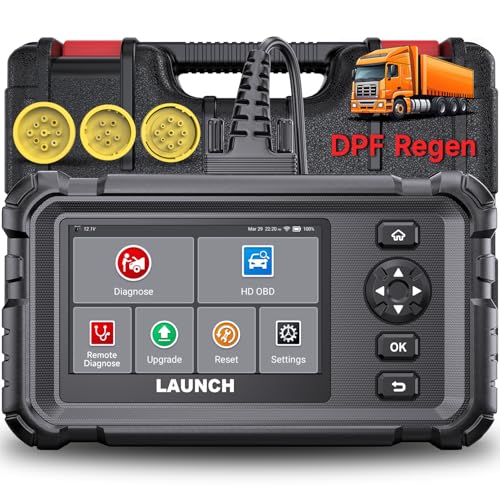
- Dealer-Level Diagnostics, Faster & Easier: The heavy duty truck scanner delivers full-system diagnostics for engine, ABS, transmission, and more, plus 7+ reset functions like DPF Regen and Speed Limit Adjust. Powered by a 1.3G CPU, 2GB RAM, 16GB storage, Android 8.1, and a 3000mAh battery, it runs smoothly for fast scanning, live data, reports, Auto VIN, Wi-Fi updates, and easy handheld use. It captures screenshots, replays live data, and generates reports to support your repair decisions.
- One Tool for 50+ Truck Brands: The diesel scanner supports J1939, J1708, J1587, and OBD2/CAN protocols, delivering broad coverage for major diesel trucks and commercial vehicles including Cummins, Cat, Detroit, Paccar, Volvo, Freightliner, Kenworth, Peterbilt, International, Mack, Isuzu, Hino, Scania, Mercedes-Benz, and more. Also supports Allison, Aisin, Eaton, WABCO, and Bendix, helping you diagnose more vehicles, reduce equipment costs, and handle more jobs with one professional scan tool.
- Diesel Truck DPF Regen & Reset Features: Experiencing loss of power, sluggish acceleration, or poor hill-climbing performance? These symptoms are often caused by a clogged or overloaded DPF. The truck diagnostic scanner offers OEM-level forced DPF regeneration, DPF reset, and DPD/DPR functions. This device extends DPF lifespan and efficiently diagnoses exhaust aftertreatment issues. It can significantly reduce diagnostic time and save you up to $3,000 or more in costly dealership fees.
- 7+ Resets - Perform Essential Procedures: The truck scanner features 7+ essential resets including DPF Regen clears carbon buildup; Oil Reset clears service light; Injector Coding matches new injectors; DEF Test checks urea injection; Speed Limit Adjust saves fuel; Cylinder Cutout pinpoints misfires; Clutch Relearn restores smooth engagement. Reset after maintenance or part replacement for proper truck operation. Vehicle compatibility varies. Email [email protected] to confirm before buying.
- Full System Diagnostic for Truck: The truck scanner diagnostic tool covers all systems like engine, ABS, transmission, SAS, SRS, TPMS and more. It reads fault codes and shows real-time data. Additionally, it includes full HD OBD and OBD2 modes: read/clear codes, live data stream, I/M readiness, freeze frame, DTC lookup, and more. When warning lights appear or performance issues arise, quickly identify which system is affected and gain the real-time data needed for accurate diagnosis.
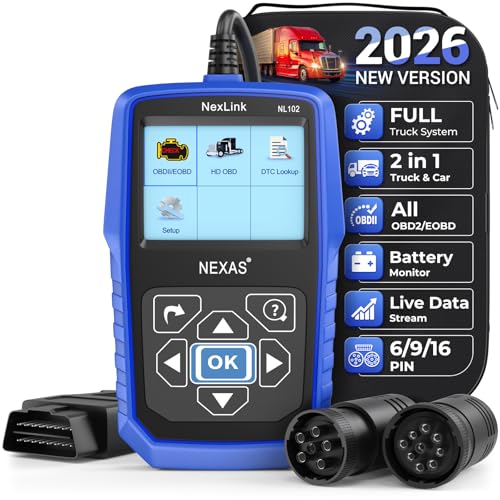
- Diagnose Heavy-Duty Truck Problems Fast — Read and clear fault codes and diagnose warning light issues on many Class 4–8 diesel trucks including Freightliner, Peterbilt, Kenworth, Volvo, Mack and Cummins-powered vehicles
- Help Reduce Downtime & Repair Costs — It offers full system diagnostics for major trucks meeting standard protocols, along with complete OBD2 functionality. Quickly check engine faults, view live truck data and identify issues before expensive repair shop visits or unnecessary repairs
- No complicated setup required — Simple menus and built-in DTC explanations make this truck code reader easy to use for owner-operators, mobile mechanics and small fleet maintenance
- Live Data & Built-in DTC Lookup — View real-time engine data and built-in truck fault code definitions directly on the scanner to help understand vehicle problems faster without searching through manuals
- Free Lifetime Updates & Technical Support — Includes free software updates plus responsive technical support for setup, compatibility and everyday truck diagnostics
This product presentation was made with AAWP plugin.
Last update on 2026-06-05 / Affiliate links / Images from Amazon Product Advertising API