
NHTSA ID Number: 10044660
Manufacturer Communication Number: ITS-4921
TSB/Document Date: 2012-07-18
Summary
NEW FLYER : INFORMATION BEING PROVIDED ON THE REPAIR OF WELD CRACKS ON GUSSET PLATES LOCATED ON ENGINE MOUNT STREET SIDE. *PE
SB-10044660-3220
Page 1 of 27
THIS DOCUMENT AND THE CONTENTS DISCUSSED HEREIN ARE THE CONFIDENTIAL AND
PROPRIETARY INFORMATION OF NEW FLYER INDUSTRIES CANADA ULC AND NEW FLYER
OF AMERICA INC. AND ARE DISCLOSED BY NEW FLYER IN CONFIDENCE. THIS DOCUMENT
AND THE CONTENTS HEREIN ARE NOT TO BE DISCLOSED BY THE INTENDED RECIPIENT
WITHOUT THE PRIOR WRITTEN AUTHORIZATION OF NEW FLYER. ANY UNAUTHORIZED
DISCLOSURE, REPRODUCTION OR OTHER DISTRIBUTION OF THIS DOCUMENT OR
INFORMATION IS STRICTLY PROHIBITED AND MAY RESULT IN ACTION BEING TAKEN
AGAINST THE PARTY MAKING THE UNAUTHORIZED DISCLOSURE. THIS DOCUMENT AND
ALL COPIES HEREOF MUST BE RETURNED TO NEW FLYER UPON REQUEST.
INSTRUCTION TO SERVICE
SECTION:
400
MODEL:
TYPE:
30FT
35FT
40FT
60FT
HIGH FLOOR
DSL
LNG
ELEC
LOW FLOOR
ITS:
4921
WRITTEN BY:
Jeff Kosheluk
Structure
OBJECTIVE/SUBJECT:
Repair cracked weld on street side engine mount (if required). On coaches with the engine
mount completely cracked, replace motor mount. Weld on gusset plates (x2) to the street side
engine mount. This will be completed in 4 parts (Part B will only be done as required).
PROCEDURE:
1. Turn the main battery disconnect switch to the “OFF” position.
2. Raise coach in accordance with the New Flyer Service Manual.
3. Disconnect battery cables when welding. Also disconnect ECU’s for engine,
transmission, electronic destination signs, ABS and VCM as applicable.
PART A:
REMOVE ANY COMPONENTS AS REQUIRED TO GAIN ACCESS TO THE STREET SIDE MOTOR
MOUNT.
4. Open the rear engine access door.
5. To remove the radiator, remove the CAC silicone hoses from the radiator. Note: Have some
type of drain pan around for any fluid that will leak out of the hoses. For steps 5 - 7, refer to
Figure 1.
Page 2 of 27
ITS:
4921
6. Loosen off the hardware and disconnect the strut from the top of the radiator. Disconnect the
lines from the surge tank.
7. Loosen all hardware on the bottom of the radiator mounting plate. Have a removable stand of
some type to lower the radiator on top to allow for removal. Slowly disconnect and remove
from coach.
FIGURE 1: SHOWN INSTALLATION OF THE RADIATOR.
Page 3 of 27
ITS:
FIGURE 1A: SHOWN SIDE VIEW OF RADIATOR.
FIGURE 1B: SHOWN MOUNTING HARDWARE OF SECTION A & B.
4921
Page 4 of 27
ITS:
4921
FIGURE 1C: SHOWN MOUNTING HARDWARE AT SECTION C (FORWARD LOWER MOUNTING).
FIGURE 1D: SHOWING MOUNTING HARDWARE ON STRUT AT TOP OF RADIATOR.
Page 5 of 27
ITS:
4921
8. With the engine access door in the up position, loosen off the hardware on the auxiliary
exhaust tube at the 3 clamps. Refer to Figure 2.
FIGURE 2: LOOSEN RETAINING HARDWARE ON THE AUXILIARY EXHAUST TUBE AS SHOWN.
9. With the hardware loose on the auxiliary exhaust pipe, disconnect the exhaust and pull off the
pipe. Set aside to re-install later. Refer to Figure 3.
FIGURE 3: REMOVE EXHAUST TUBE AS SHOWN.
Page 6 of 27
ITS:
4921
10. Remove the u-bolt clamp near the street side forward engine mount (only). Leave the other
clamp connected further down the main rail. Set aside to re-install later. Refer to Figure 4.
FIGURE 4: SHOWN VIEW OF THE U-BOLT REMOVED.
11. Wrap the exhaust tube near the motor mount with welding blanket. Refer to Figure 5.
FIGURE 5: SHOWN EXHAUST WRAPPED TO PREVENT DAMAGE WHEN WELDING.
12. Remove the mounting hardware on the hydraulic oil cooler installed near the near motor
Page 7 of 27
ITS:
4921
mount. Typical 4 places. New hardware will be used to re-install later. Carefully set aside with
lines still connected. Push cooler to the street side to allow for welder to have access. Refer
to Figure 6.
FIGURE 6: SHOWN VIEW OF THE HYDRAULIC OIL COOLER SET ASIDE TO
GAIN ACCESS TO THE STREET SIDE MOTOR MOUNT.
13. Remove the complete burner head with the exhaust hose from the pro heat unit. Set aside to
re-install later. Position the hose off to the side to allow for access and prevent any damage
to the hose. Refer to Figure 7. For steps 13 & 14, “only remove the burner head if
required.”
Page 8 of 27
ITS:
4921
FIGURE 7: SHOWN VIEW OF THE EXHAUST DISCONNECTED FROM THE PRO HEAT. SET ASIDE
HOSE TO PREVENT DAMAGE FROM WELDING.
14. With the exhaust disconnected, you know have access to the side of the engine mount. Refer
to Figure 8.
Page 9 of 27
ITS:
4921
FIGURE 8: WITH EXHAUST REMOVED, ACCESS IS GAINED TO ALLOW WELDING TO THE MOTOR MOUNT.
15. Before any grinding or welding can begin, all electrical/airlines or other components must be
covered up with welding blankets to prevent any damage.
PART B: REPLACE MOTOR MOUNT IF COMPLETELY SEPARATED FROM THE MAIN RAIL
“ONLY COMPLETE IF REQUIRED”
NOTE: If the crack propagates more than a 1/3 of the way across the face of the
mount, then the mount will need to be replaced. Refer to Figure 9.
Page 10 of 27
ITS:
4921
FIGURE 9: SHOWN VIEW OF STREET SIDE MOTOR MOUNT COMPLETELY CRACKED.
WARNING:
Before welding anywhere on vehicle, disconnect the following items:
Disconnect battery cable before welding.
Engine ECM – disconnect the vehicle interface harness
connector.
Transmission ECU – disconnect the vehicle interface harness
connector.
Vansco Multiplexing Modules (VMM) – disconnect all VMM1210,
VMM2820 and Pocket Gateway (PGM) modules.
Destination Sign – disconnect the vehicle interface harness
connector.
HVAC Controller (if equipped) – disconnect vehicle interface
harness connector.
Page 11 of 27
ITS:
4921
Auxiliary Heater (if equipped) – disconnect main connector.
NOTE: Inspect to see if the street side motor mount is cracked. If crack is more than a
1/3 of the way or completely separated, proceed to replace the motor mount
(as per Part B). If the mount is cracked and less then 1/3 of the way, proceed to
Part C (V-groove and weld).
16. If the motor mount needs to be replaced, support the engine and transmission assembly
using a transmission jack, jack stands or a component lift with component adapter or
fabricated lift fixture.
17. Remove the center bolt from the engine mount. New hardware will be used. Set aside rubber
motor mount to re-use later.
18. Slightly lift the engine and transmission assembly just enough to separate the rubber mounts
from the support by ¼” – ½”. If jack stands were used to support the engine/transmission,
slightly lower the lift to free the engine mount.
19. Cover up the section of the engine at the area were the grinding and welding will be taken
place. Use a welding blanket.
20. Cut off the original motor mount from the main rail. Grind off the weld and remains from
cutting the support on the rear chassis rail. Clean the weld zone to bare metal.
NOTE: In grinding weld remnants, make sure not to over-grind the frame, not to dent it
and not to create any undercuts in metal component.
21. Place new support – LH (NF PN: 354201) to its original position on the chassis rail. Refer to
Figure 10 & 11.
Page 12 of 27
ITS:
4921
FIGURE 10: SHOWN DIMENSIONS TO INSTALL NEW MOTOR MOUNT ON THE STREET SIDE.
FIGURE 11: SHOWN LOCATION TO MOUNT MOTOR MOUNT.
Page 13 of 27
ITS:
FIGURE 11A: SHOWN WELD DETAILS TO WELD ON MOTOR MOUNT.
FIGURE 11B: SHOWN BACK VIEW OF MOTOR MOUNT.
4921
Page 14 of 27
ITS:
4921
22. Install center bolt from the top of rubber engine mount through the support mount holes.
23. Slightly lower the engine/transmission so that the rubber mount sits on the support. Make
sure the support is perpendicular to the chassis. Verify mount position per dimensions
showing on Figure 10 & 11. Make adjustments as required.
WARNING:
as required:
•
•
The following safety equipment should be at the work station and used
Safety shields should be utilized and used as required when working at each
workstation. Safety shields must be provided at each workstation.
Fire Extinguishers should be placed at each workstation. Each member trained to
operate the fire extinguisher and know the location of each fire extinguisher at each
workstation.
24. Using a wire wheel or similar tool, remove all primer and Sika sealant from the required weld
areas. Extend past the weld location 1.5 inches to ensure adequate welds are obtained.
25. Locally clean repair area’s with vacuum to remove dust and debris. Wipe the weld areas
clean with a flashing solvent.
26. Weld the LH engine mount to the rear chassis following procedure outlined in Appendix A.
Make 0.25” fillet weld all around outside of the support and everywhere possible inside the
support.
27. After welding of the cracks has been completed, grind off sharp edges. Check for any weld
defects such as undercut and porosity.
NOTE:
Visual Inspection of all tubes in the area must be done to confirm no further
cracking has occurred after welding procedure is complete.
28. Once area is cooled, re-apply zinc primer to the affected welded area and any other
applicable area’s where the zinc primer came off on including on the main rail. Tape off an
area on the top surface of the motor mount that the engine isolator mount will be installed.
Zinc primer everything else that is bare metal. See Appendix B.
29. After zinc primer is dry, apply light coats of corashield to the motor mount. See Appendix B.
30. Re-install the rubber motor mount in place (set aside in step 14). Install new bolt – ¾-10 UNC
x 5.50 (NF PN: 10B12088) with flat washer – ¾ (NF PN: 20W12000) from the top of the top
of the rubber mount. On the bottom, install flat washer – ¾ (NF PN: 20W12000) and nut –
Page 15 of 27
ITS:
4921
hex lock ¾ UNC (NF PN: 40N12000). With the hardware on loose, completely lower the
engine and remove transmission jack or jack stands. Once in place, torque engine mount
bolts to 250 FT-LBS dry. Refer to Figure 12.
FIGURE 12: SHOWN VIEW OF THE RUBBER MOTOR MOUNT WITH APPLICABLE MOUNTING HARDWARE.
TORQUE TO 250 FT-LBS DRY.
PART C: COACHES ONLY SHOWING CRACKS THAT REQUIRE WELD REPAIR (V-GROOVE AND WELD)
31. For coaches only exhibiting cracks on the street side motor mount (less than 1/3 across the
face of the motor mount) will need to be v-grooved and weld repaired. If crack found at the
engine motor bracket, drill stop (1/4” hole)/v-groove and weld repair the crack. Refer to weld
crack repair as per Appendix C.
32. After welding of the cracks has been completed, grind off sharp edges. Check for any weld
defects such as undercut and porosity.
Page 16 of 27
ITS:
NOTE:
4921
Visual Inspection of all tubes in the area must be done to confirm no further
cracking has occurred after welding procedure is complete.
PART D:
WELD ON GUSSET BRACKETS ON THE FORWARD/REAR SIDE OF THE STREET SIDE MOTOR
MOUNT.
33. Position plate – eng. Mount support (NF PN: 468779) in place against the fore side of the
engine mount bracket. Mark off location where plate is to be installed and mark off location.
Refer to Figure 13.
FIGURE 13: SHOWN AREA TO BE CLEANED OFF TO BARE METAL TO ALLOW FOR
PROPER WELD PENETRATION TO SURFACE.
Page 17 of 27
ITS:
4921
34. Using a wire wheel or similar tool, remove all primer and Sika sealant from the required weld
areas. Extend past the weld location 1.5 inches to ensure adequate welds are obtained.
35. Secure the plate (NF PN: 468779) in place and tack weld in place. Follow welding instructions
as per Figure 14. Refer to Appendix A for weld information. For steps 31 - 35, Refer to
Figure 14.
36. Using a wire wheel or similar tool, remove all primer and Sika sealant from the required weld
areas. Extend past the weld location 1.5 inches to ensure adequate welds are obtained. This
will be for the aft side of the motor mount.
37. Secure the bracket (NF PN: 468778) in place and tack weld in place on the aft side. Follow
welding instructions as per Figure 14. Refer to Appendix A for weld information.
38. After welding of the cracks has been completed, grind off sharp edges. Check for any weld
defects such as undercut and porosity.
NOTE:
Visual Inspection of all tubes in the area must be done to confirm no further
cracking has occurred after welding procedure is complete.
FIGURE 14: SHOWN VIEW OF THE PLATE/BRACKET TO BE WELDED TO THE ENGINE MOTOR MOUNT
(STREET SIDE).
Page 18 of 27
ITS:
4921
FIGURE 14A: SHOWN VIEW OF THE PLATE/BRACKET WELDED TO THE STREET SIDE MOTOR MOUNT.
FIGURE 14B: SHOWN THE FORWARD VIEW TO WELD ON PLATE.
Page 19 of 27
ITS:
Section AC-AC
FIGURE 14C: SHOWN THE AFT SIDE VIEW TO WELD ON BRACKET.
FIGURE 14D: SHOWN FORWARD SIDE OF MOTOR MOUNT.
4921
Page 20 of 27
ITS:
4921
FIGURE 14E: SHOWN AFT SIDE OF MOTOR MOUNT.
NOTE: Remove all welding blankets from work area that was covered up due to
welding.
39. Once area is cooled off, re-apply zinc primer to the affected weld area and plate/bracket. This
also includes any other area were the original primer was removed. Refer to Appendix B.
40. After zinc primer is dry, apply light coats of corashield to the motor mount. See Appendix B.
41. Re-install the auxillary heater exhaust tube. Tighten clamp back in place.
42. Re-position the radiator assembly back in place. Install forward CAC tube into silicone hose
Page 21 of 27
ITS:
4921
while positioning radiator. Install lower mounting hardware & tighten. For 7/16” bolts (Torque
to 76 FT/LBS dry) and 3/8” bolts (Torque to 48 FT/LBS dry). After torque complete, mark
with yellow paint pen. For steps 42 – 45, refer to Figure 1.
43. Install top radiator strut and tighten bolts.
44. Connect surge tank overflow tubes.
45. Connect CAC tubes to charge air cooler ensuring clamps are installed correctly and are tight
to the required torque for a breeze clamp. Ensure coolant lines clamps to radiator are tight
and positioned correctly.
46. Re-position hydraulic oil cooler back into position. Use new hardware to mount in place.
Install bolt – Hex 3/8 UNC x 1.25 (NF PN: 10B06020) & flat washer (NF PN: 10W06000) from
top side and install flat washer (NF PN: 10W06000) & nut – 3/8-16 lock (NF PN: 40N06000).
Tighten all hardware. Typical at 4 places. Torque hardware to 48 FT/LBS dry.
47. Re-install exhaust brackets and tube, connect and tighten all hardware in place.
48. Certified Welder is to complete the sign off sheet for the welding certification sheet for the
structural repairs with a KCM representative present. Once completed the sheet will be given
to a KCM representative. See Appendix D.
49. If necessary, lower coach in accordance with the New Flyer Service Manual.
50. Connect battery cables. Also connect ECU’s for engine, transmission, electronic
destination signs, ABS and VCM as applicable.
51. Remove all tools and debris from work area to return coach to service condition.
52. Turn the main battery disconnect switch to the “ON” position.
Page 22 of 27
ITS:
4921
Appendix A
Welding Procedure
I.
Remove old weld by grinding as required. Oxy-acetylene torches must not be used.
II. Area enclosed by welded zone plus 2” either side to be cleaned to base metal by wire brush, removing all grease, oil, rust
and scale from surfaces to be joined.
III. Disconnect battery cables when welding. Also disconnect ECUs for engine, transmission, electronic destination signs,
ABS, articulated joint (black box and pressure sensors) and VCM.
IV. All welds to be made with E7018, low hydrogen welding rods. Gas metal arc welding (semi-automatic) may be used where
practicable, provided AWS A5.18 standard E70S-3 or
E70S-6 wire is used, with argon-carbon dioxide shielding gases.
Welder shall meet qualifications for “all position” welding as per AWS D1.1 or CSA W59 standard qualification for metal arc

- 6X better wear protection on critical engine parts than...
- 1.3X better sludge protection than industry standards*
- 3X Stronger against viscosity breakdown than leading full...
- Protection for 10,000 miles between oil changes
- Meets or exceeds the following specifications: API SP/SN...

- Formulated for engines with 75,000 miles or more, Valvoline...
- Delivers 20% better wear protection and 15% better sludge...
- Extra detergents safeguard against friction, corrosion and...
- Advanced friction-fighting additives help maximize...
- Provides performance benefits for high mileage, new and...
Last update on 2026-06-23 / Affiliate links / Images from Amazon Product Advertising API
If the PDF is very large, it may not load in the preview below.
Some older TSBs had multiple PDFs — visit the NHTSA Website to view all PDFs.
If the TSB PDF does not show, download or view it on the NHTSA Website.
Click on the (+) Plus Sign
Then Click on Associated Document(s)
Search NHTSA Database for Recalls
Search NHTSA Database for Vehicle Investigations
View Latest Vehicle Investigations
Search NHTSA Database for Vehicle Complaints
View Latest Vehicle Complaints
TSB/Document ID: ITS-4921
Replacement Service Bulletin Number:
MFR Communication Date: 2012-07-18
MFR Internal Campaign ID/Software Version:
Communication Type: Service Bulletin/Repair Instructions
NHTSA Components: ENGINE
MFR Component System:
MFR Component Subsystem:
Previous TSB | Next TSB |

- 🎉[OTOFIX D1 Lite, Perfect Cost-effective Diagnostic Tool]: OTOFIX D1 Lite, a newest bidirectional scan tool from OTOFIX company, is a great choice for DIYers and repair shops. 👉This obd2 scanner diagnostic tool packs all practical functions: OE level all systems diagnoses, Bi-Directional Control, 38+ reset services fixing 99% of common problems, support DoIP & CANDF protocols and FCA
 AutoAuth, high-end hardware configuration. Worldwide vehicles and 🔥2 Years Free Updating🔥 covered.
 - 🎉[Bi-Directional Scan Tool, Active Test]: OTOFIX D1 Lite bluetooth obd2 scanner can also command ECUs and monitor the operation of the actuators to track down the problems of certain parts, like windows, sunroof, wipers, fuel pumps, etc., saving repair time & trouble. This makes OTOFIX D1 Lite the most cost-effective bidirectional scan tool.
- 🎉[2026 Newest, 38+ Hot Reset Functions]: Equipped with 38+ reset functions in one, the OTOFIX D1 lite automotive scanner diagnostic tool allows you to troubleshoot 99% of common vehicle problems. You can use this car diagnostic scanner holding enough functions to easily repair common vehicle models in your repair shops. Including Oil Reset, Injector Coding, Throttle, DPF Reset, SCR Reset, Gear Learning, Clutch Learning, Suspension, etc. Note* Reset functions vary by model.
- 🎉[OE Level Full Systems Diagnostics]: Unlike the 2-system and 4-system diagnostic tools, the OTOFIX auto scan tool can complete comprehensive system diagnostics within 5 minutes. It accesses and scans all available onboard systems like for Engine /AT /ABS /EPB /BMS /TPMS /SRS /SAS /Audio System /BCM /Air Conditioning / etc., to read & clear codes, view live data, and check ECU information. Note: Active test is not involved.
- 🎉[Powerful Hardware Configuration]: Designed with a fashion appearance & a 7” touchscreen and a weight of 463g, this OTOFIX D1 Lite OBD2 diagnostic scanner scan tool is convenient for everywhere and easy to use & store. Android9.0 OS and 2+64GB memory enhance multi-task smoothness and diagnostic operation, no more wasting too much time. 5800mAh battery allows hours-lasting use. WiFi & VCI1 also bring faster communication for your diagnostics.

- 🏆【2026 TOP OBD2 Scanner Diagnostic Tool】OTOFIX D1 Lite wireless obd2 scanner has upgraded hardware configuration and car coverage. The newly upgraded D1 Lite with 🔥OS Android 9.0🔥1.5Ghz 4 core high efficiency processor🔥2GB RAM+64GB ROM large storage🔥5800mAh large battery, more stable and longer lasting diagnostics🔥 38+ Reset🔥action tests🔥full system diagnostic🔥Supports MV105 endoscope🔥21+ Language Supports🔥100000+ vehicle coverage to meet all your daily maintenance needs.
- 👍【Bi-Directional Control / Active Test】D1 Lite obd2 scanner has bidirectional control(worth $300+), which is the most beloved feature among mechanic. If your headlights or car windows are broken, going to a repair shop will cost a lot of money. You can use D1 Lite to send execution commands to the ECU module and identify the repair status. Such as ABS, car windows, doors, valves, wipers, headlights, etc., effectively shorten diagnostic time and reduce diagnostic costs.
- 🔥【All Systems Diagnostics, In-depth Checking】This advanced OBD2 Scanner D1 Lite can perform OE-level diagnosis of all systems including engine, transmission, airbag, ABS, ESP, TPMS, gateway, steering, radio, and air conditioning for more than 100 brands. This diagnostic scanner supports essential functions, such as reading ECU version info, reading and clearing fault codes, and reading data streams.With just a simple click, it provides you with accurate and in-depth diagnostics.
- 🏆【38+ Reset Hot Functions】For repair workshops, holding an OTOFIX D1 Lite Auto scanner is a strong advantage over others. Its 38+ maintenance functions provide various solutions for all module repairs, including Oil Reset, TPMS Reset, Injector Coding, Suspension, Throttle Matching, etc., which will usher your repair business to a new pinnacle. Continuously updating will never make the functionality & compatibility out-of-date.
- 🏆【150+ Models, 10000+ Car Coverage & 16 Languages】D1 Lite is a comprehensive car diagnostic scan tool, help you to troubleshoot car issues fast for 95% US, European, Asian auto makes. ✅ With frequent updates and optimizations allow D1 Lite to cover more vehicles to meet your needs. ✅ Multilingual menu allows auto mechanics around the world to use it without language barriers. 🚩Note: Kindly send us the S/N of the device to authorize new language updates before changing the menu language.
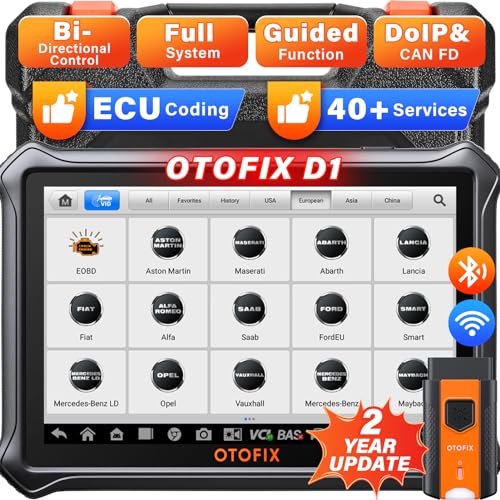
- 2026 Newest Wireless Bluetooth Scan Tool D1: OTOFIX D1 Diagnostic scanner is upgraded version with Enhanced Hardwares & Newest Functions, FASTER and SMARTER! ✅Alternative Bluetooth 5.0 +USB connect✅2G+64GB✅Android 9.0 OS✅5G & 2.4 GHz Dual WiFi✅5800mAh battery👍VAG Guided Function👍ECU Online Coding👍CANFD&DOIP👍40+ Services👍Bi-Directional Control👍Full Systems Diagnose👍2 Years Free Update👍150+ Vehicle Coverage🎁Contact to get gift: otofixaftersales-amz@ outlook.com
- ECU Coding to Unlock the Hidden Features: OTOFIX D1 obd2 scanner diagnostic tool newly adds ECU Coding which can Online Coding(ONLY for VW/Au.di/Sk0da), Variant Coding/Offline Programming, Flash Hidden Functions, Reset Adaptive Data, Match Replaced Components, Customize OE-Settings. Such as: halogen fog lamps retrofitted with xenon fog lamps, different capacity battery retrofit, disbale auto start-stop, sunroof initialization, injector calibration, etc. PS: Coding functions vary by model&year.
- Full Bidirectional Control for Active Car Tests: The D1 OTOFIX scanner also offers bi-directional control, allowing you to perform powerful active tests on car subsystems. This means that you can check the working status and functionality of open & close solenoids, energize injectors, turn cooling fan on & off, and more, all from the device itself.🚩The D1 bi-directional obd2 scanner can quickly help you to check if a system or component goes well,Improving 200% Efficiency.**Note that Active Tests available depend on the make/model/year of your car.
- 40+ Popular Maintenance Functions: OTOFIX D1 obd scanner for car performs 40+ hot services, including Oil Reset, EPB, TPMS, BMS, E.GR, G.PF, D.PF, SAS Calibration, ABS Bleeding, Injector Coding, Gearbox Match, Suspension, Crankshaft Relearn, Power Balance, etc., still growing. Great choice for DIYers, technician, repair shop. 🚩Get MORE special functions from "Car Brand>System>Service". Check compatibility before purchase via 📧 otofixaftersales-amz@ outlook.com.
- OE-Level All Systems Diagnostic + One-Click AutoVIN & AutoSCAN: OTOFIX D1 scanner automotriz gives you the ability to troubleshoot entire car systems including engion system,transmission system,body system,chassis,etc. 🚩One of the standout features of the D1 obd2 scanner diagnostic tool is the one-click AutoVIN & AutoScan function. This feature allows you to quickly and easily scan all diagnosable ECUs with just one click, and identify any problems hidden in your vehicle's systems.
Last update on 2026-06-23 / Affiliate links / Images from Amazon Product Advertising API
This product presentation was made with AAWP plugin.